Home » Consumer News » Recent Articles:

Tax Time: AT&T and Verizon May Pay A Lower Tax Rate Than You Do

Phillip Dampier April 7, 2010 AT&T, Audio, Consumer News, Public Policy & Gov't, Verizon, Video Comments Off on Tax Time: AT&T and Verizon May Pay A Lower Tax Rate Than You Do

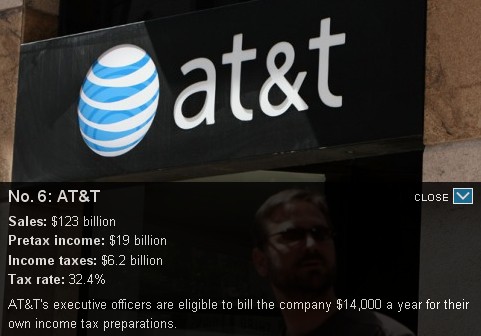
AT&T had to pay considerably more in taxes last year than Verizon did

One of the most common talking points among pro-business tax cutting advocates is the claim that companies in the United States face the highest corporate tax rate in the world.  But that assumes corporations actually pay taxes at that rate, which few do.  In fact, this week Forbes discovered that many of the country’s biggest, most profitable corporations enjoy a far lower tax rate than you do–that is, if they pay taxes at all.

While the biggest tax savings were grabbed by the bailed-out banks, the nation’s two largest telecommunications companies — AT&T and Verizon didn’t do too badly for themselves.

Of the two, AT&T had the higher tax bill, paying an effective tax rate of 32.4 percent.  But AT&T is still prone to  avoid paying corporate taxes wherever it can.  In Connecticut, AT&T’s maneuvers are fueling a campaign for state tax reform to close the loopholes.

This morning, the Hartford Courant slammed AT&T:

AT&T Corp. has emerged as the poster child for these shenanigans.

A state Department of Public Utility Control audit found AT&T to be engaging in a tax-avoidance scheme sometimes called the Las Vegas Loophole. Over a period of 2.5 years, AT&T shifted about $145 million in Connecticut earnings to a subsidiary in Nevada, ostensibly paying licensing fees for the right to use the company’s own name and logo. Nevada has no corporate income tax, so the shifted earnings went untaxed and Connecticut lost out. If it sounds fishy, that’s because it is. AT&T is not alone. Many large corporations use sham transactions designed to move profits generated in Connecticut to a different state where they won’t be taxed.

AT&T’s executives benefit from creative tax accounting themselves, earning a stipend of up to $14,000 a year to hire high-priced accountants that specialize in finding ways to reduce their own personal tax bite.  But no matter — AT&T covers the taxes CEO Randall Stephenson has to pay on some of his benefits anyway.

While the rest of the country plods through a jobless recovery, Stephenson decided the time was right to get a base salary increase and resume taking a bonus — a big one, too.  His effective compensation package rose by a third in 2009.

Among Stephenson’s compensation and perks:

  • $1.45 million in base salary, up two percent over 2008;
  • $12.1 million in options and performance-based stock incentives;
  • $216,000 in rebates to cover his club membership dues;
  • $200,000 to cover his life insurance premiums;
  • $140,576 to cover any taxes he is forced to pay on his benefits package.
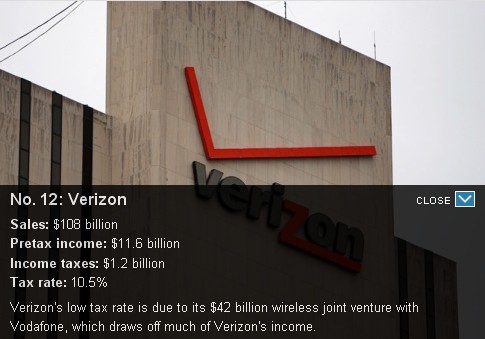
Verizon gets to use partner Vodafone's British address to help reduce exposure to U.S. corporate taxes. It reports much of its income through its British partner, which helps reduce its American tax liability.

Meanwhile, over at the nation’s 12th largest company, Verizon has managed to cut its tax rate to just 10.5 percents.  That’s because on paper, Verizon’s British partner Vodafone gets much of the income, while the U.S. side gets lots of expenses.  That dramatically reduces the corporate taxes incurred by the company in the United States.  That tax rate is even lower than Steve Forbes’ much-promoted 15 percent flat tax.

Verizon’s compensation to Uncle Sam calls out the myth of America’s corporate tax rate.  With creative accounting work, companies can slash their tax obligations.

That gives Verizon more money to spread around to top executives at the company, all while Verizon lays off thousands of workers and leaves retirees wondering how long the company will stand behind its pension and health coverage benefits.

Some shareholders are rankled by news CEO Ivan Seidenberg is on track to receive an $11 million stock grant if the company makes it as low as 25th among 34 similar Dow Jones-ranked companies, and a doubling to $22 million, if the company ranks among the top four.  That’s hardly a high hurdle to achieve an $11 million bonus.

That kind of compensation raises the ire of former employees of Verizon, who launched the Association of BellTel Retirees to protect the pension and health care benefits of retirees.

“Large payouts for below-median performance does not adequately align pay with performance,” said Bill Jones, the retiree group’s president, a former managing director at NYNEX, now a part of Verizon.

The group is well known for its high profile pressure on Verizon to stop providing a largess of benefits for top management for merely doing their jobs.

This year, the Association will demand a vote on a resolution to better tie stock awards to stock performance and limit executive compensation.  It also wants to stop expensive windfall golden parachute packages, such as Seidenberg’s $33.1 million dollar bon voyage, which he receives if he’s fired or retires.

While a handful of Verizon executives fight to preserve their generous compensation packages, Verizon retirees are fighting to get their doctor bills paid.  Jones’ group is strongly advocating new legislation to stop companies from walking away from their agreements with retired employees.

Bill Jones appeared on WOCA-AM Ocala, Florida in February to discuss the threat retirees face when companies walk away from their pension and health care plans for former employees. (28 minutes)
You must remain on this page to hear the clip, or you can download the clip and listen later.

<

p style=”text-align: center;”>

H.R. 1322, the Emergency Retiree Health Benefits Protection Act, was introduced into the 111th Congress by Rep. John Tierney and would:

  • Prohibit group health plans from making post-retirement reductions in retiree benefits;
  • Require plans to adopt provisions barring post-retirement cuts in retiree health benefits;
  • Require employers to restore benefits reduced after retirement;
  • Provide an exemption for employers who are unable to restore benefits because they would experience substantial business hardship to be determined by the Secretary of Labor; and,
  • Create a loan guarantee program to assist employers in restoring retiree health benefits.

[flv width=”560″ height=”336″]http://www.phillipdampier.com/video/The Association of BellTel Retirees Inc.mp4[/flv]

Bill Jones discusses his organization’s battles to protect pensions and health care benefits for Verizon retirees.  (5 minutes)

https://www.forbes.com/forbes/welcome/?toURL=https://www.forbes.com/2010/04/01/ge-exxon-walmart-business-washington-corporate-taxes.html&refURL=http://stopthecap.com&referrer=http://stopthecap.com

Time Warner Cable Upgrading Navigator Program Guide in Northeast

Phillip Dampier April 6, 2010 Audio, Consumer News, Video 31 Comments

Time Warner Cable may be robocalling you any day now with news that your set top box is getting what the cable company is calling an upgrade.

Time Warner Cable is making this robocall to customers with set top boxes announcing an upcoming upgrade. (1 minute)
You must remain on this page to hear the clip, or you can download the clip and listen later.

Calls are being made to customers with set top boxes in Buffalo and Rochester notifying them an upgrade to the new Mystro platform begins as early as April 13th, depending on the box being used.  Syracuse and southern tier residents can expect their upgrade to commence in May.  The company maintains a website that will let you find the exact schedule for the Mystro upgrade in your area.

Time Warner Cable’s Navigator software displays the electronic program guide, helps you program and control your DVR, and also includes the setup menu for the box.

The upgrade will result in a dramatic change in the look and feel of the box’s on-screen graphics, change how you navigate through the program guide, and provide more options for hooking up today’s HDTV sets. If you have a DVR box from Time Warner Cable, the upgrade sets the stage for an upcoming feature that will let you remotely program your DVR while away from home.

Not everyone is thrilled with the upgrade, however.  In fact, a Google search for “Time Warner Navigator upgrade” reveals a large selection of websites and forums filled with complaints.  Regularly reported problems include:

  • Sluggish performance, especially on older set top boxes;
  • Poor responsiveness on fast forward/rewind functions for DVRs, making it difficult to land precisely where you want to be;
  • The loss of “virtual HD” channels which some boxes passed through to even standard analog-only TV’s (albeit not in HD of course);
  • DVR bugs that made recording reliability inconsistent;
  • A DVR menu that makes it difficult to record only new episodes of series that repeat regularly on the channel lineup;
  • Box crashes, lost program guide data, and issues with the box retaining settings, especially for more complex HDTV setups;

Time Warner Cable began testing Mystro at least two years ago in selected markets, and the company believes it has worked out a number of the bugs noted above along the way. Time Warner plans to systematically upgrade their customers to the new platform nationwide now that testing has been completed.


This customer was so bemused with the Time Warner Navigator upgrade, he made a video illustrating the absurd journey he took to find a science-fiction movie to watch.

[flv width=”480″ height=”380″]http://www.phillipdampier.com/video/Navigator Demo.flv[/flv]

Time Warner Cable’s own promotional videos show off the new Time Warner Cable Navigator system in a better light. (5 minutes)

Online Sales Taxes Are In Your Future, And New York Pioneers An Even Broader One By Suggesting Online Services Taxable

Phillip Dampier April 5, 2010 Consumer News, Public Policy & Gov't, Video 1 Comment

America's most creative taxing authority, charged with collecting the innovative taxes the state government dreams up

No state can be more innovative in finding new ways to tax, fee, and surcharge residents than New York.  Once it becomes taxable in the Empire State, it’s only a matter of time before it becomes taxable in other states as well.  Now consumers face the prospect of paying new sales taxes on broadband and other services they purchase online, even in cases where federal laws would seem to exclude such possibilities.

New York residents have endured the so-called “Amazon tax” since June 1, 2008 when the state government demanded large, out of state Internet retailers collect and remit sales taxes for online purchases should they result from online advertising.  Although largely ignored by smaller online retailers, large high profile Internet retailers with so-called “affiliate programs” that pay independent websites for referring potential customers faced the choice of cutting ties with their “affiliates” in New York or imposing sales tax on New York customers.

Websites ranging from Overstock.com, Buy.com, Amazon.com, Newegg, and others were all targeted by the New York State Department of Taxation and Finance.  Overstock and Newegg eventually threw their New York affiliates under the bus to preserve an “unofficial” tax-free shopping experience for New Yorkers.  Buy.com and Amazon both complied with the state, although the latter filed suit challenging the constitutionality of out-of-state sales tax collection.

What made the New York sales tax law different from all the rest is that it delivered an end run around settled federal interstate commerce law.  A Supreme Court decision found it legal for states to demand sales tax payments from businesses that operate within their state, but no such provision was made for businesses who don’t locate an office or store in a particular state.  Buying a new hard drive from an online retailer inside your state?  You’ll be charged sales tax.  Order it from outside of the state, and the company typically won’t try to collect sales tax.

New York wants online businesses to get a new attitude.  It wants sales tax money for orders placed by New Yorkers no matter where your business is located.

As the Great Recession wreaks havoc on state budgets, state lawmakers who don’t want to cut popular spending programs are instead sniffing for new ways to raise revenues.  Some are declaring ‘I Love New York’ for blazing the trail to fatter sales tax coffers.

Colorado's legislature ignited a firestorm of controversy after passing an online sales tax bill into law

One recent example is Colorado, where state lawmakers borrowed liberally from New York’s tax law and passed their own — requiring large online retailers to start collecting sales taxes or provide a summary of residents’ web purchases in the state (so the Colorado taxing authority can pressure residents to declare those purchases and pay sales tax themselves.)  The penalty for not doing so is a fine of several dollars per non-compliant transaction.  Amazon.com, among others, yanked their affiliate program in the state, and some online retailers have declared they won’t comply.  A few proclaimed they would throw away any fine notifications, suggesting the state has no authority to impose such fines for interstate commerce, which is regulated on the federal level.

Rhode Island passed its own sales tax law, and collected almost nothing from it, in part because online retailers outside of Rhode Island almost universally ignored it.  Now the law faces repeal.

Other states like North Carolina and California have endured their own controversies over such legislation.  In North Carolina, Amazon.com threw their affiliates under the bus.  California Gov. Arnold Schwarzenegger vetoed a sales tax proposal last year.  There are bills to impose sales taxes on all online purchases in Iowa, New Mexico, Vermont and Virginia.

Meanwhile, New York’s taxing authority has some new ideas on how to expand the scope of sales taxation to include a whole new range of online activities.

The E-Commerce Times reports the New York State Department of Taxation and Finance has declared doing practically anything online that involves the transfer of money in return for a service could be subject to New York sales tax:

This new position results in the imposition of sales tax on purchases of services provided over the Internet that would not be subject to sales tax if provided in person by a human being. For example, the purchase of an educational course is not taxable if provided by a live speaker, but the same course may now be considered taxable by the Department if the course is given online.

The Department has painted with a broad brush to conclude in a number of advisory opinions that, among other things, the following services or forms of entertainment are really sales of software when provided over the Internet:

  1. e-learning courses;
  2. information technology courses;
  3. mail-tracking services performed for airlines;
  4. loan origination and processing services;
  5. automobile insurance policy services;
  6. payroll processing services; and
  7. video games played on computers located at a business’ facility.

Rhode Island's efforts to collect sales tax on out of state purchases was a flop

The logic used to justify taxation of online services illustrates the time and talent state workers are willing to extend to help fill New York’s dire budget pothole:

The Department is asserting that a purchaser of an online service is controlling the software on the provider’s server by clicking various icons on his or her own computer screen, and thus the purchaser has control over the software; hence the software has effectively been “transferred” to the purchaser. Accordingly, the Department is taking the position that the purchase of an online service is really the purchase of a license to use software, even though the software is being used by the service provider on its own server.

Critics of the taxing authority accuse it of exceeding its legislative mandate.  In fact, the New York State legislature previously considered — and rejected — legislation that would have imposed sales tax on digital downloads like music and movies.  The legislature has been resistant to taxing online activities in hopes of retaining high tech businesses in the state, who might consider locating out of state if it meant avoiding imposing sales tax on consumers.

Of course, online buyers are technically subject to paying sales taxes for every taxable purchase, made in or out of state.  But since most states ask taxpayers to voluntarily report such purchases, the compliance rate is notoriously low.

In New York, the taxing authority has a reputation best summed up as “we don’t play — padlock and seize first, ask questions later.”  Aggressive enforcement against non-compliant retailers is likely, and E-Commerce Times suggests online retailers need to pay attention:

The sales tax is a transfer tax, and sellers collect the tax from purchasers and remit the tax to the Department. However, when a seller fails to collect and remit any tax due, the seller itself becomes liable for the tax, interest and possibly penalties. The Department has not been content simply to apply its new position going forward, but rather has been seeking to apply its position retroactively on audit as well.

There have been instances of the Department auditing online service providers and assessing sales tax as far back as 2005, even though the Department’s first clear administrative guidance with respect to its new position dates from November 2008 (and even though the Department issued administrative guidance in February 2006, that seems to conflict with its present position).

The Times predicts this will all come to a head when the taxing authority sues an online retailer or state resident for non-payment of taxes.  Then it’s up to the courts to decide… when they get around to it.  Remember the lawsuit Amazon.com filed against New York in 2008?  The New York Supreme Court threw out the suit in January 2009, but an appeal was filed with the next court up the chain — the appellate court — July 13th.  It’s still pending.

[flv width=”640″ height=”380″]http://www.phillipdampier.com/video/Online Sales Taxes 4-5-10.flv[/flv]

Here are three reports about the ongoing online sales tax controversy underway in three states (9 minutes):

  1. KMGH-TV in Denver reports on a local family running a campaign to repeal the so-called “Amazon tax” in Colorado which resulted in the end of the company’s affiliate program for Colorado residents.
  2. WCAX-TV in Burlington, Vermont discusses a proposed Vermont law that would extend sales tax to online purchases.  Local merchants support the proposed law as a way to restore pricing fairness between online and brick and mortar retailers.
  3. WTVR-TV in Richmond, Virginia covers that state’s proposed online sales tax bill.  George Peyton from the Retail Merchant’s Association reminds viewers whether or not an online retailer charges them sales tax, they still owe the state the tax — declared on your income tax return.

Windstream Prepares for Investigation Into Major Nebraska Service Outage

Phillip Dampier April 5, 2010 Consumer News, Public Policy & Gov't, Video, Windstream Comments Off on Windstream Prepares for Investigation Into Major Nebraska Service Outage

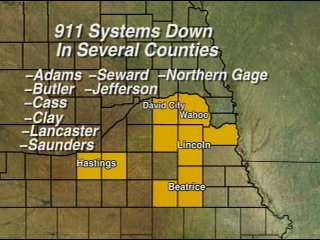
More than 36,000 Nebraska phone customers were left with blocked landline service, unable to reach 911 emergency services or many area business and government agencies after a switch failure resulted in “all circuits are busy” messages for hours on end.

Windstream’s service outage was unprecedented in Nebraska telephone history, lasting over 15 hours and impacting customers in at least 12 southeastern Nebraska counties.  Government agencies were forced to open emergency operations centers, police and fire officials asked people with emergencies to walk or drive to the nearest police station or firehouse, and some customers were left thinking the whole incident was a hacker April Fools Day attack on the telephone system.

The Nebraska Public Service Commission plans to hold hearings to investigate Windstream’s failure to maintain their network in good working order.  The Commission wants to know how the failure happened, why it took 15 hours to restore service, and what plans the company has to make sure it doesn’t happen again.

The Journal Star reported on what they’ve learned thus far about the outage:

Problems were worst in downtown Lincoln, including state and local government offices and the University of Nebraska-Lincoln. But they ultimately stretched to at least a dozen Southeast Nebraska counties.

Brad Hedrick, Windstream’s Nebraska vice president and general manager, said a number of operations and engineering technicians were doing a “root-cause analysis” Friday to try to find out what went wrong.

The outage came about 7 hours after Windstream updated the switch. But because the failure occurred so long after the update, Hedrick said, it’s unclear whether it played any role.

“We’re digging into all potential scenarios to make sure we didn’t overlook anything,” he said.

Windstream is not aware of a similar problem ever occurring before in its nationwide network, although Hedrick said he has heard of other companies having similar problems elsewhere.

Local emergency management officials said they had never experienced a service failure of similar magnitude.

“We’ve had, over the years, some minor outages, mostly geographical,” said Julie Righter, communications manager of Lancaster County’s 911 Center. “Nothing this widespread. This was multiple counties.

“It wasn’t just 911. It was every kind of phone.”

Righter said the 911 center was alerted to the problem by an alarm company employee.

“They called us and asked if we were able to call out, at which point our staff started making some test calls back and forth and we did discover we had problems.”

[flv width=”640″ height=”500″]http://www.phillipdampier.com/video/KOLN Windstream Outage Update 4-2-10.flv[/flv]

A complete wrap-up of the Windstream outage in Nebraska comes courtesy of KOLN-TV in Lincoln.  (16 minutes)

Included are interviews with three key players in the saga:

  1. Commissioner Tim Schram – Public Service Commission
  2. Brad Hedrick – Windstream Communications
  3. Julie Righter – (Emergency) Communications Center


Windstream Suffers Major Landline Failure in Nebraska; Several Counties Lose Phone, 911 Service

Phillip Dampier April 1, 2010 Consumer News, Video, Windstream 1 Comment

Windstream Communications customers in eastern Nebraska have spent much of today without access to emergency 911 services, and many were without their own landlines as well.  A switch failure in downtown Lincoln caused the outage impacting several counties starting at 7:45 Thursday morning.

Emergency services personnel were forced to rely on cell phones and amateur radio operators to process calls for emergency service, and several law enforcement personnel were staged in outage areas to assist with any calls for help.

Emergency dispatch centers were silent for much of today.  Those attempting to call 911 received a busy signal.

“You know there’s people out there that are going to need help at some point, there always is, and they’re unable to get that help,” Cass County dispatcher Deb Thiessen told KETV in Omaha.

“It’s very rare there’s an outage of this type,” said Cass County Chief Deputy Brad Lahm.

[flv]http://www.phillipdampier.com/video/KOLN-ABC Nebraska Windstream Suffers Major Outage 4-1-10.flv[/flv]

KOLN-TV and NTV report on today’s major Windstream outage.  (5 minutes)

[flv width=”640″ height=”380″]http://www.phillipdampier.com/video/KETV Omaha Windstream Failure No April Fools Joke 4-1-10.flv[/flv]

KETV-TV in Omaha also covered the outage in their viewing area. (2 minutes)

Search This Site:

Contributions:

Recent Comments:

Your Account:

Stop the Cap!