Home » Consumer News » Recent Articles:

New Yorkers: If the Cable Guy Arrives Late, You’ll Receive a Free Month of Cable Service

Phillip Dampier September 23, 2010 Cablevision (see Altice USA), Consumer News, Public Policy & Gov't, Video Comments Off on New Yorkers: If the Cable Guy Arrives Late, You’ll Receive a Free Month of Cable Service

Big Apple Day

New York City officials are sick and tired of taking complaints about missed cable appointments and other service problems on its 311 city help line.  Nearly 1,200 calls about cable have been made so far this year alone, with fed up New Yorkers annoyed they took a day off work to wait for a cable technician that never arrived, or one who never solved the problem they were called to fix.

Now city officials are forcing the area’s two incumbent cable operators — Time Warner Cable and Cablevision, to pay for their mistakes.

As part of franchise renewal negotiations, both cable companies have agreed to credit subscribers the full amount of that month’s cable bill if the cable guy arrives late, or not at all.

The penalty decreases to $25 after 2012, when Verizon FiOS service is expected to blanket most of the city.

But consumer reforms extend beyond financial penalties for missed appointments.

Customers will soon be able to request notification by e-mail, phone or text message when a technician is heading to their home.  And calls to either cable company should be answered by a real person no more than 30 seconds after dialing.

Many of these reforms are already a part of the franchise agreement New York City’s Office of Information Technology & Telecommunications worked out with Verizon, allowing the phone company to provide cable television in the city.

Time Warner Cable spokesman Alex Dudley didn’t miss the opportunity to turn the challenging new requirements into an opportunity.  He told area reporters Time Warner welcomes the new customer service standards and appreciates the opportunity to compete for customers in the metropolitan New York area.

As Robert Porto, 38, a Time Warner Cable customer in Boerum Hill, Brooklyn, told the New York Times, the new contract will be “the ultimate revenge for the little guy.”

Importantly, none of these consumer-focused reforms would have been possible had New York adopted the kind of “reform” companies like AT&T and Verizon have advocated in other states — statewide video franchising.

Brodsky

New York’s legislature has rejected previous attempts to eliminate local cable and video franchise agreements, citing the loss of control by local municipalities to deal with provider issues that would sail over the heads of a statewide committee in Albany.  New York has been generally hostile to Big Telecom’s deregulation agenda.  One state assemblyman, Richard Brodsky (D-Westchester), even introduced a bill requiring phone companies like Verizon to split the proceeds of asset sales with ratepayers.

Other provisions of the franchise agreements include:

  • The right to terminate franchise agreements with Time Warner Cable and Cablevision Systems if broadband-delivered video significantly erodes cable TV revenue over the next 10 years;
  • Time Warner Cable and Cablevision are required to invest about $10 million to install Wi-Fi access in 32 public parks in all five boroughs, to be operated and maintained by the companies until 2020;
  • At least five new Public, Educational and Government (PEG) community access channels will be added, up from the four that currently exist, by 2012.  At least one must be in HD.  The operators also agree to pay a combined total of more than $9 million, payable in annual installments, plus an additional $2 million of “in-kind” services to pay for equipment and operation expenses;
  • More than $20 million to help finance the upgrade of CityNet, the city government-dedicated network;
  • Time Warner Cable will establish four community broadband access centers per year (40 total), in collaboration with nonprofits, over life of franchise;
  • Time Warner Cable will install 20 miles of fiber per year in underserved commercial/industrial areas over franchise term; and will build-out Brooklyn Navy Yard. Cablevision already serves the commercial blocks in its service areas. Companies will commit to expend $1.8 million per year to bring fiber to commercial buildings of city’s choice.

[flv width=”640″ height=”380″]http://www.phillipdampier.com/video/WABC New York New Yorkers could get money if cable guy stands them up 9-15-10.mp4[/flv]

WABC-TV covers the introduction of pro-consumer cable service reforms for metropolitan New York residents.  (2 minutes)
Cablevision Sticks It to Long Island: No Box? No TV for You!

Big Apple Day

Residents on Long Island are learning what Cablevision subscribers in Bronx, Brooklyn, and Connecticut have known for a few years now — if you want to watch Cablevision’s TV lineup, be prepared to shell out almost $7 a month for every television in your home.

It’s part of Cablevision’s march to an all-digital, encrypted cable lineup.  If you want cable TV, you’ll need to lease one of Cablevision’s digital set top boxes or CableCARD devices.

Cablevision says it will provide customers with free boxes for their televisions for the first year, available in limited quantities at Optimum stores or shipped free to your door by UPS.  But after 12 months, customers with several TV’s will find steep increases to their monthly bills, just to cover boxes many don’t want in the first place.

“It’s just more gouging from Cablevision,” writes our reader Stephanie who lives in Lindenhurst, N.Y.  “We used to watch television box-free at the kitchen table or on the computer with our Slingbox, but now our home will need three more boxes when we already pay them $14 for the two we already have.”

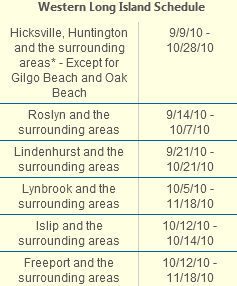
Cablevision's Conversion Schedule for Western Long Island

For customers like Stephanie, that adds up to nearly $35 a month just in equipment fees.

“Our bill is already $170 a month and next year it will probably run over $200 with the boxes we don’t want and whatever their next rate increase turns out to be,” she writes.

Cablevision claims they are not doing anything their competition isn’t.

“In fact, every other TV service provider in the New York metropolitan area already requires digital boxes for each TV,” a Cablevision spokesman stressed.

Those upset with the change are considering making some changes themselves — some by switching to a promotional package from satellite TV or Verizon’s FiOS.

“I am well aware they both want you to use boxes on those services as well, but for a year or two, we could probably knock $30 or more a month off our current cable bill with a promotional deal,” Stephanie says.

What about after the deal expires?

“We’ll just switch back to Cablevision on one of their promotional deals,” she says.  “For this family, it’s about the ‘total amount due’ at the bottom of the bill.”

Cablevision’s ongoing transition to digital caused panic when it blanked out broadcast basic cable service for more than 500 residents of a Coney Island complex housing numerous senior citizens, almost all watching local television signals delivered in analog.  When Cablevision made the digital switch in August, every local channel suddenly disappeared.  The NY Post explained what happened next:

Despite the best efforts of property managers to inform the elderly residents of the Luna Park Houses and the Warbasse Houses about the change, some of them just didn’t get the message.

“It was hell trying to explain this to the elderly people,” said Rochelle Captan, the manager of the Warbasse houses.

“Everyone in the Luna Houses — we think we’re the chosen ones, we don’t have to convert to digital,” said Fikret Deljanin, the property manager of the Luna Park Houses. “I don’t understand the ignorance — we’re just an ignorant population, I guess.”

Both Deljanin and Captan said they had called in favors with Cablevision to keep the analog service going as long as possible — and that now they were having to call in another favor to get some free conversion boxes delivered to calm disgruntled elderly residents.

But Joe M. said many elderly residents — including his mother — are feeling betrayed and confused.

“My mother wants her channels 3, 10 and 12, that’s it. Now the seniors are told they have to get a converter box — I don’t mind that — but my mother is 87! She doesn’t know anything about this!”

And now, it’s simply a matter of picking up the pieces and trying to move on … over to the couch to watch this afternoon’s episode of “Murder She Wrote.”

Cablevision also announced this week it had upgraded its set top boxes to support several new applications and services on the way.  Multichannel News covered the story:

Cablevision Systems has now deployed Zodiac Interactive’s interactive TV platform — including support for the industry’s EBIF specification — across the MSO’s entire New York-area footprint serving 2.9 million digital cable subscribers.

The operator is using Zodiac’s PowerUp framework software, running on Cisco Systems’ native set-top box environment, to run several interactive applications and services. These include iO TV Shortcuts, search, an enhanced program guide, video-on-demand navigation and dedicated ITV channels.

The companies also are working together on Cablevision’s remote-storage DVR — which the operator has been planning to launch this year — and the MSO is using Zodiac’s PowerUp Advanced Messaging Solution (AMS) software to integrate Web and mobile applications with set-top boxes.

Some other families are considering a different change.

“Maybe we just should stop watching TV in the kitchen,” Dominick Galletta of East Northport, N.Y., told WNBC-TV.

[flv width=”597″ height=”356″]http://www.phillipdampier.com/video/WNBC New York No Cable Box No TV for You on Long Island 9-16-10.flv[/flv]

WNBC-TV covers frustrated Cablevision customers on Long Island now forced to obtain digital cable boxes for every television in their home.  (2 minutes)

Blockbuster Files for Bankruptcy; Wipes Out Shareholders But Keeps Stores, Rent-by-Mail Service Open

Phillip Dampier September 23, 2010 Consumer News, Online Video 4 Comments

Blockbuster, Inc. announced this morning it was filing for Chapter 11 bankruptcy protection under a plan that cuts nearly $1 billion in debt and delivers a financial rescue package to help reorganize its operations.

The company, based in Dallas, faced insurmountable challenges from online video, piracy, pay-per-view, Netflix, and most recently Redbox — video kiosks strategically placed in supermarkets and drug stores.

But despite the bankruptcy filing, which wipes out the company’s shareholders, Blockbuster said it would keep its 3,400 company-operated and franchise stores, its DVD by-mail business, and online operations open for business.  Those holding Blockbuster coupons and gift cards need not worry — the company will continue to honor both.  Some unprofitable store locations may be closed later.

Netflix and Redbox are among the biggest contributors to Blockbuster’s financial demise.  Netflix’s 15 million customers dwarf Blockbuster’s 2.6 million customer rent-by-mail operation.  Redbox has more than a 13,000 store kiosk advantage over Blockbuster.

Shareholders blamed Blockbuster CEO Jim Keyes for the company’s financial position.

“Jim Keyes is the main reason Blockbuster is in this position today due to his denial of being in a business model that did not work anymore,” said Niko Celentano. “If Jim Keyes would have seen the changes that were evolving in this industry in the past few years, Blockbuster would not have been in the courts today filing Chapter 11 bankruptcy.”

Time Warner Cable Backs Down on $12,000 Installation Fee, Now Wants “Only” $4,000

Phillip Dampier September 22, 2010 Consumer News, Rural Broadband 4 Comments

Back in July, Stop the Cap! shared the story of Mark Williams, an eager new customer for Time Warner Cable in Lee, Massachusetts.  The only thing getting in the way of Williams’ desire to shower the cable company with money for its triple-play Internet, cable, and phone service was the $12,000 fee the cable company sought to install it.

That sparked a major incident with Lee’s Board of Selectmen, who called the installation fee “ridiculous.”  It warned the cable company they were prepared to vote Tuesday night to sanction the company, taking money from the $10,000 Time Warner posted with the town as part of its local license agreement, if it didn’t relent.

At issue was Time Warner’s reasoning for the high installation fee, invoking a “long driveway clause” Malcolm Chisholm Jr., of Lee’s Cable Advisory Committee argued was an incorrect interpretation of the town’s license agreement.  Chisholm told The Berkshire Eagle the contract entitles all homes to cable service if electric and telephone service already are available.

Before the board voted, Williams reported the cable company verbally agreed to reduce the installation fee to $4,000.

“They’ve given me a price, but it’s still not cheap,” Williams said. “I’m looking to find an independent contractor who will do the job cheaper.”

Williams acknowledged the cost would be even lower, but he wants the cable buried between his home and the nearest utility pole, which is 500 to 600 feet away. He has his electricity service underground to his home on Fernside Road, near the Tyringham town line.

Time Warner’s typical installation fee of $35 covers up to 200 feet — above ground — with the rest of any necessary cost borne by the subscriber. Williams said he didn’t seek a cost estimate from Time Warner for an above-ground installation.

[…]In a similar case three years ago, Time Warner agreed to drop its claim that a homeowner on Antelope Drive in Lee pay $1,102 for cable installation. The company’s decision followed the town also threatening the company with financial penalties. However, Time Warner officials said the reversal was based on the individual case, rather than agreeing to the town’s interpretation of the contract regarding installation.

Cablevision Chief Warns of Consumer Revolt, Tells Operators to Exercise “Restraint” in Cable Rates

Phillip Dampier September 22, 2010 Cablevision (see Altice USA), Consumer News, Video 1 Comment

Dolan

Cablevision Systems CEO James Dolan warned cable executives the combination of rate increases and the poor economy could spark a consumer revolt, driving a legislative agenda that could force a-la-carte pricing on cable companies.

“At some point you reach a point where the consumer rebels,” Dolan said. “You’re likely to see that in a reaction in Washington on the government side because it will become a politically easy issue for politicians to jump on and a-la-carte [pricing] is an obvious answer. But the impact of a-la-carte on the programming industry would be devastating. It behooves all the participants to exercise restraint.”

Dolan pointed to high unemployment and a deterioration in earnings among those still employed combined with continuing rate increases as a potentially dangerous combination.  Dolan was especially concerned about payments for local broadcasters and major broadcast networks which have sparked high-profile carriage battles.  Earlier this year, Cablevision briefly dropped programming from ABC and Scripps Networks’ HGTV and Food Network.

Dolan was speaking at the Bank of America Merrill Lynch Media, Communications & Entertainment conference in Newport Beach, Calif.

His comments come at the same time Cablevision is preparing for yet another carriage battle, this time with News Corporation.

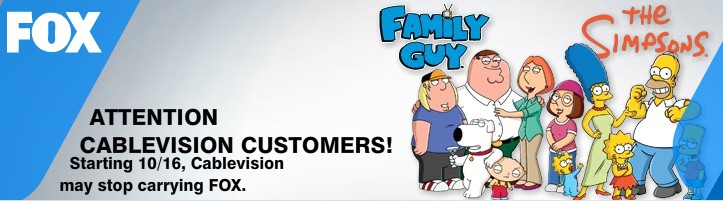
On October 15th, Cablevision’s contract to carry FOX’s television stations in New York (WWNY 5 and WWOR 9) and Philadelphia (WTXF 29) will expire. Unless Cablevision renews its agreement with FOX, Cablevision may no longer carry the three over-the-air stations. Also impacted are several FOX Networks’ cable channels: FOX Sports en Español, Nat Geo WILD and FOX Business Network.

News Corporation’s website, KeepFoxOn, turned its attention to the dispute, urging viewers to contact Cablevision.  Viewers are being warned of the potential loss of the channels through advertising messages that began last weekend.

The issue of a-la-carte pricing, which allows cable customers to pick and choose individual channels, has been the nightmare scenario for cable systems and programmers, who fear it would force most niche channels out of business and dramatically cut earnings for cable systems.  The industry also warns it would force every cable subscriber to rent set top boxes to manage channel lineups for every television in the home.

But as programming costs continue to exceed the rate of inflation, relentless rate increases and restrictive contracts that keep most networks out of specialty programming tiers makes cable television a service many Americans are contemplating doing without.

[flv width=”640″ height=”380″]http://www.phillipdampier.com/video/Keep Fox On.flv[/flv]

FOX has begun informing Cablevision viewers they could lose access to their local FOX stations and several FOX-owned cable networks.  (30 seconds)

Search This Site:

Contributions:

Recent Comments:

Your Account:

Stop the Cap!