Home » Consumer News » Recent Articles:

Here We Go Again: Sinclair Threatens Time Warner Cable Subs With Loss of 33 Stations in 21 Cities

Sinclair Broadcasting is threatening to pull 33 television stations in 21 cities from Time Warner Cable customers on January 1st if the cable company doesn’t agree to demands to pay around 20-25 cents per month per subscriber for each of the stations, primarily Fox and MyNetworkTV affiliates.

It’s just the latest in a series of retransmission rights battles underway between broadcasters and cable companies over cable carriage agreements.

Sinclair is a major group owner of television stations, and the impact on viewers in places like western New York, Dayton, Ohio, Greensboro, N.C., San Antonio, Tex., and Pittsburgh, Pa., won’t be missed because these markets have multiple Sinclair-owned or programmed stations involved in the dispute.

As always, the dispute is about money.  This week, viewers of affected stations, including our readers Lance and Andrew, started being annoyed with repeated warnings scrolled at the bottom of screens about the potential loss of their “favorite stations.”  In the case of WUHF, viewers might have thought a serious weather warning was being issued as text crawled against a distinctive red background.

So far, the dispute has not infected Sinclair’s local newscasts, which have often been used as a sounding board for the company’s past retransmission consent fights.  But then, many Sinclair stations have abandoned producing local news themselves over the past few years as a cost-savings measure.  However, many of the stations involved have put the dispute high on their home pages, as a too-cute-by-half link: “Learn About Time Warner Cable’s Plans to Drop Carriage Of This Station.”  Sinclair leaves no doubt about who they blame for the debacle.

Stations Impacted

  • AL  Birmingham — WTTO (CW)
  • AL  Birmingham — WABM (MyNetworkTV)
  • FL  Pensacola — WEAR (ABC)
  • FL  Tallahassee — WTWC (NBC)
  • FL  Tampa — WTTA (MyNetworkTV)
  • KY  Lexington — WDKY (Fox)
  • ME  Portland — WGME (CBS)
  • MO  Girardeau — KBSI (Fox)
  • NC  Greensboro — WXLV (ABC)
  • NC  Greensboro — WMYV (MyNetworkTV)
  • NC  Raleigh — WLFL (CW)
  • NC  Raleigh — WRDC (MyNetworkTV)
  • NY  Buffalo — WUTV (Fox)
  • NY  Buffalo — WNYO (MyNetworkTV)
  • NY  Rochester — WUHF (Fox)
  • NY  Syracuse — WSYT (Fox)
  • NY  Syracuse — WNYS (MyNetworkTV)
  • OH  Cincinnati — WSTR (MyNetworkTV)
  • OH  Columbus — WSYX (ABC)
  • OH  Columbus — WTTE (Fox)
  • OH  Dayton — WKEF (ABC)
  • OH  Dayton — WRGT (Fox)
  • SC  Charleston — WTAT (Fox)
  • SC  Charleston — WMMP (MyNetworkTV)
  • PA  Pittsburgh — WPGH (Fox)
  • PA  Pittsburgh — WPMY (MyNetworkTV)
  • TX  San Antonio  —  KABB (Fox)
  • TX  San Antonio — KMYS (MyNetworkTV)
  • VA  Norfolk — WTVZ (MyNetworkTV)
  • WI  Milwaukee — WVTV (CW)
  • WI  Milwaukee — WCGV (MyNetworkTV)
  • WV  Charleston — WCHS (ABC)
  • WV  Charleston — WVAH (Fox)

Sinclair’s website warns viewers negotiations with Time Warner Cable are not promising:

Sinclair (or in some cases the licensees of the television stations not owned by Sinclair) and Time Warner are in the process of negotiating a renewal of the current agreement between Sinclair and Time Warner Cable which is scheduled to expire on December 31, 2010. Without a renewal, Time Warner Cable will no longer have the right to carry the broadcast of the television stations covered by this expiring agreement. Unfortunately, based on the status of the negotiations Sinclair does not believe we are going to be able to reach agreement on an extension of the deal. As a result, Time Warner would no longer be carrying the stations covered by the agreement with Sinclair beginning on January 1, 2011. Although some might try and characterize this as a dispute, in the end it represents nothing more than the failure of two companies to reach a business agreement, something that happens in the business world thousands of times a day.

Taking a cue from News Corp., Sinclair claims Time Warner Cable is stalling, hoping the Obama Administration will intervene and prohibit signal blackouts while negotiations are still underway.  Despite the claim the cable company is the one with the plan to drop stations, Sinclair informs viewers it is giving them early warning to help them make arrangements with alternative providers like Verizon FiOS, AT&T U-verse, or satellite companies to “avoid interruptions” in programming.

Time Warner Cable recognized the seriousness of the Sinclair dispute and has given it top billing on their Roll Over or Get Tough website.  So far, the cable company has rolled over in every dispute, eventually caving to programmer demands.  But the cable company would claim it has at least reduced the rates being demanded, or won concessions that allow subscribers to catch shows on-demand as part of its TV Everywhere project.

Because the cable industry has so far been dealt the weaker hand in these disputes, they are spending an increasing amount on lobbying the issue in Washington, right down to creating a front group that claims to represent viewers.  The s0-called “American Television Alliance,” has a mission statement that, on the surface, doesn’t wade too deep into actual solutions:

The ATVA’s mission is a simple one – to give consumers a voice and ask lawmakers to protect consumers by reforming outdated rules that do not reflect today’s marketplace.  We are united in our determination to achieve our goal: ensure the best viewing experience at an affordable price, without fear of television signals being cut off or public threats of blackouts intended to scare and confuse viewers.

The overwhelming majority of the interests represented by the ATVA are giant cable and phone companies (and two groups willing to play along when sharing common interests: Public Knowledge and the New America Foundation.)

The group filed comments petitioning the Federal Communications Commission to modify retransmission consent policy to give cable and phone companies additional tools to battle with intransigent broadcasters.  The most important, and one we agree with, is an end to the ban on importing distant network signals from nearby cities to replace those from local stations who simply dump “take it or leave it” offers on operators who then raise rates to cover ever-inflating programming costs.

As it stands now, cable systems cannot grab network stations from other cities to at least restore network programming, because FCC rules prohibit it, even if the nearby station doesn’t mind.  While that might not help Time Warner viewers in cities like Rochester, where the nearby Fox affiliates in both Buffalo and Syracuse are also owned by Sinclair, the cable operator’s extended reach made possible serving all three major upstate cities might still deliver relief by grabbing further distant Fox stations like WYDC in Corning, WFXV in Utica, or WFXP in Erie, Pa and distributing them across all three affected cities.

Unfortunately, the Fox TV network has also made it clear stations could risk their affiliation deals with the network if they were to grant retransmission consent to providers that effectively undercut other Fox affiliates.

The ATVA also wants providers to retain the right to continue carrying disputed signals so long as good faith negotiations are ongoing, and has also suggested binding arbitration as another alternative reform.  Broadcasters have rejected both.

Some of the ATVA’s proposals are worthy of merit to benefit consumer interests, but consumer groups might do better creating their own group to fight this issue, if only to keep broadcasters from dismissing the group as heavily stacked with cable and phone companies with a biased, vested interest in the outcome.

Just reviewing the FCC petition left a bad taste when they quoted everyone’s favorite “dollar-a-holler” group — the League of United Latin American Citizens, which continues to amaze with its omnipresent Zelig-performance in just about every telecommunications policy debate involving LULAC’s benefactors.

More than a few politicians are likely to accept broadcaster arguments, which would ultimately weaken the effectiveness of any reform effort.

Murdoch’s News Corp. Blames Obama’s FCC and Dems for Blacking Out World Series for Cablevision Subs

Phillip Dampier November 10, 2010 Cablevision (see Altice USA), Consumer News, HissyFitWatch, Public Policy & Gov't, Video Comments Off on Murdoch’s News Corp. Blames Obama’s FCC and Dems for Blacking Out World Series for Cablevision Subs

Chase Carey (courtesy: Forbes)

Chase Carey, President, Chief Operating Officer of Rupert Murdoch’s News Corp., has blamed the federal government and politicians for giving aid and comfort to Cablevision, the cable system serving most of suburban New York City, forcing Fox to cut off the World Series for millions of subscribers in the recent contract dispute between the two providers.

Carey told Bloomberg News that the standoff with Cablevision would have been resolved much more quickly if lawmakers hadn’t threatened to weigh in, leading the cable provider to hold out in hopes of getting better terms.

“This process would have been resolved more easily, more quickly,” Carey said. “I would actually contend we wouldn’t have gone off the air at all.”

Carey said Fox needs the feeds that it collects from cable companies because even with advertising revenue, the broadcast network loses a “few hundred million dollars” every year. Carey said he came to Washington to explain to lawmakers why Fox needed two streams of revenue and explain why public declarations of support for Cablevision from more than 50 lawmakers only helped to prolong the standoff.

“We’re not running a nonprofit,” Carey said.

Was John Kerry responsible...

If Fox is unprofitable, you wouldn’t know it from Carey’s compensation package.  The COO will earn $8.1 million this year, plus a $15 million bonus and additional compensation totaling more than 26 million dollars.

Carey is upset with Democrats for inserting themselves in private corporate matters, despite the fact the resulting dispute left millions of cable subscribers without the networks they were paying for (and forced to fight for refunds from Cablevision.)

“You’re going to bastardize every negotiation because you’re going to have this specter of arbitration,” he said.

At least 50 members of Congress, many from the northeastern United States where cable blackouts have been the most prevalent, support binding arbitration for such disputes, and criticized Fox for demanding increasing amounts of money for formerly free television signals.  Cablevision contends it was forced to pay an “unfair amount” to get the signals back on cable.

Carey especially targeted Democratic senator John Kerry from Massachusetts, who was among the most vocal opponents of cable systems and programmers putting viewers in the middle of disputes.

...or Rupert Murdoch?

Kerry intends to introduce legislation during the lame duck session of Congress to force both parties to keep programming on while negotiations are underway, especially because consumers have already paid, often in advance, for such programming.  Analysts say Republicans in the Senate will likely filibuster any such measure.  Most Republicans are inclined to share Carey’s view and let the companies duel it out amongst themselves, according to Andrew D. Lipman, a Washington-based partner with the law firm Bingham McCutchen.

Carey himself has been on both sides of the issue.  His former job was chief executive of DirecTV, the largest U.S. satellite-television provider.  Carey at the time thought the television networks and local stations were responsible for their own failing business models and were late to the table demanding payments for cable carriage.  When the Great Recession caused advertising revenue to plummet, both networks and local stations decided the concept of free, ad-supported television was no longer a viable business model.  Now stations want dual revenue streams — ad revenue and payments from the majority of Americans who watch those stations on cable, satellite, or telco-TV.

More importantly, Carey wants the government to butt out, even when consumer dollars are at stake.

[flv width=”640″ height=”500″]http://www.phillipdampier.com/video/Bloomberg Man Who Blacked Out World Series Blames Politicians 11-9-10.flv[/flv]

Bloomberg News reflects on the dispute between News Corp.’s Chase Carey and Cablevision.  (3 minutes)

Time Warner Cable Gets Innovative to Stem the Flow of Departing Cable TV Customers

Phillip Dampier November 9, 2010 Competition, Consumer News, Online Video, Video 6 Comments

Although the cable trade press reports it is business as usual at most of the nation’s largest cable companies, news that several companies are losing more cable-TV subscribers than they are adding is creating concern in boardrooms and on Wall Street.  Although the power of the perennial “rate increase” has kept revenues up, cable operators like Time Warner Cable are beginning to realize they can’t just keep raising rates expecting customers to sit still for it.

For more than 30 years, cable operators have assumed (correctly) that raising rates far in excess of inflation will bring about a lot of grumbling from upset subscribers, but few will actually resort to cutting the cord and going back to free TV (or books).  But as many cable households now routinely pay “triple-play” bills well in excess of $200 a month, that is finally starting to change:

  • For many households, the switch to digital TV and an increasing number of sub-channels has proved adequate to meet the needs of many viewers, so long as they receive a decent picture and at least a handful of digital sub-channels;
  • Online access to at least some cable programming, movies, and television shows on-demand has solved the problem of having too few viewing options.  If nothing of interest is running on local channels, a quick visit to Netflix or Hulu can satisfy most viewers;
  • Many increasingly prefer spending their free time online instead of parked in front of the television;
  • The realities of the current economy and tightened middle class budgets make many cable packages simply unaffordable, even if customers wanted them.

Time Warner Cable has recognized the growing strain on their video side of the business and has initiated some strong marketing efforts to hold onto customers who are one rate increase away from canceling.

This fall, the cable company unveiled its $33 per service promotion, charging that price for each component of their triple-play package for a year.  While Time Warner has more aggressively priced individual services in the past for new customers, this one is unique because it is open to existing customers as well.  Customers speaking to Time Warner’s retention agents are being offered this package in an effort to keep customers hooked up to the company’s video, broadband, and phone services.  Currently, many markets also include a free year of Showtime or at least six months of DVR service, and a year of Road Runner Turbo.  In highly competitive markets, informal promotions can bring even lower prices or extra add-ons.

A few weeks ago, the cable company unveiled online video streaming of ESPN Networks for existing cable subscribers, and an online remote DVR-programming application that lets subscribers set up recordings while away from home.

Now the company is further bolstering its video packages:

  1. As part of its long term agreement with Disney, ABC and ESPN, this week Time Warner Cable added over 300 hours of new On Demand programming content from ABC, Disney and ESPN. In addition, the company will launch Primetime HD On Demand tomorrow, which will also be available to Digital Cable customers at no additional cost.  The new channel Primetime HD On Demand will carry primetime programming from ABC, NBC and CBS in High Definition. Subscribers will have over 100 hours of the networks’ popular primetime programs including NBC’s 30 Rock and The Office; ABC’s Grey’s Anatomy and Desperate Housewives; and CBS’ Medium and CSI.
  2. Time Warner Cable Look Back will bolster the existing “Start Over” feature by archiving up to three days of programming on more than two dozen different networks and cable channels.  Now, if you missed a favorite show that aired the evening before, you can watch it on demand.  As with “Start Over,” Time Warner has disabled fast-forwarding, so no zipping through commercials is allowed.  But the service comes free of charge, and includes an impressive lineup of participating networks including ABC, NBC, Fox Cable Networks, Discovery Networks, and Scripps’ Food Network, Cooking Channel, HGTV, and DIY.
  3. HBO Max and Go Max, part of TV Everywhere, will reach more than 50 million Time Warner Cable customers by the end of the month.  These services deliver online on-demand access to movies, series, and specials airing on HBO and Cinemax and will be available to customers paying for the premium channels at no additional charge.  More than 70 million customers will have access by the second quarter of 2011.
  4. Time Warner Cable CEO Glenn Britt told investors on a conference call held last week that the cable company is aggressively pursuing renewal agreements with programmers that allow the cable company to begin offering smaller, budget priced packages of cable-TV programming.  While it won’t be the a-la-carte option many consumers crave, cable programming packages could begin to resemble what home satellite dish customers used to receive — a core package of two dozen channels with theme or network-based add-on “programming packs” for additional fees.  For example, customers looking for reality or educational programming might buy a “Home and Garden” package consisting of Food TV, HGTV, The Weather Channel, Discovery and The Learning Channel.  Movie fans might get a package of Encore, AMC, Turner Classic Movies, Fox Movies and MGM.  “We have negotiated some additional flexibility beyond what we had a few years ago that will allow us to begin to offer some smaller packages at lower prices. Probably not all the way where we’d like to be. But we’re moving in the right direction,” Britt told investors.

The cable company’s friendly former owner — Time Warner, Inc.,  has also helped man the barricades against cable’s competitors.  For Netflix and Redbox customers: longer waiting times for access to the latest Time Warner movies are likely.  The current delay of 28 days could be extended, according to CEO Jeff Bewkes.

“So far the 28-day window has clearly been a success versus no delay,” Bewkes told investors. “The question of whether we ought to go longer is very much under scrutiny. It may well be a good idea.”

Even local movie theaters face some potential competition, as Time Warner considers introducing a premium pay-per-view option that would allow cable customers to watch movies currently in theaters at home.  But they’ll pay a heavy price to watch — reportedly between $30-50 per title, and the cable operator will insert anti-recording technology into the signal to prevent digital recordings.

Will these new services ultimately stop the bleeding from departing cable customers?  For most it’s a matter of dollars and sense.

[flv width=”640″ height=”500″]http://www.phillipdampier.com/video/Cutting Cable’s Cord 11-9-10.flv[/flv]

The media has gotten aggressive about talking to viewers about how they can get rid of their cable-TV subscription and save plenty.  (10 minutes)

Thomas Clancy Jr., 35, in Long Beach, N.Y., canceled the family’s Cablevision subscription this spring. He said he has been happy with Netflix and other Internet video services since then, even though there isn’t a lot of live sports to be had online.

“The amount of sports that I watched certainly didn’t justify a hundred-dollar-a-month expense for all this stuff. I mean, that’s twelve hundred dollars a year,” Clancy told the Associated Press. “Twelve hundred dollars is … near a vacation.”

Customers like Clancy are comfortable with technology and well-versed on how to hook up Internet video and integrate it with the family’s TV sets.  For customers like him, online video will increasingly be an attractive alternative to high cable TV bills.

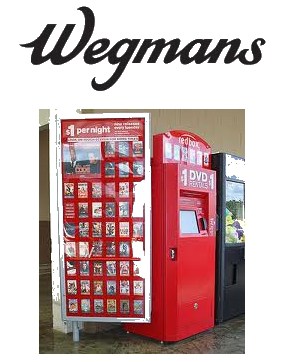
For some western New Yorkers, Wegmans' Redbox kiosk is their new "cable company."

For homes with less tech-savvy subscribers who have watched their wages fall over the past decade even as cable rates keep increasing, economic realities driven home by the Great Recession are making the decision for them.

“The price of cable TV has risen to the point where it’s simply not affordable to lots of lower-income homes. And right now there are an awful lot of lower-income homes,” Craig Moffett, a Wall Street analyst who favors the cable industry said. “The evidence suggests that what we’re seeing is a poverty problem rather than a technology phenomenon.”

For these customers, including many in the middle class, each time cable companies like Time Warner increase cable rates, they drop a service or two.

“First it was Showtime, the Movie Channel, and Starz!,” writes Stop the Cap! reader Joanne in Penfield, N.Y., a suburb of Rochester. “Then when they raised the rates again on the premium channels, we dropped them all — bye bye HBO and Cinemax.”

“When Time Warner sends us their rate increase notice right after Christmas as they’ve done for years, we’re dropping digital cable and returning our cable boxes,” she writes.  “If they keep it up, we’ll drop cable altogether — something we might have done earlier if we had some competition around here.”

“I don’t care how much they claim it’s a ‘great value,'” Joanne says. “My husband got laid off from his job at Xerox in 2009 and was just let go from his new job at Carestream.  I already work myself and we have three kids, and our health insurance premiums are skyrocketing at the end of the year.  We haven’t had a real raise in five years, so that made the decision for us.”

Joanne now rents movies from Redbox just inside the local Wegmans grocery store and has a $9 monthly subscription with Netflix, mostly for online streaming.

“It’s more than made up for the $40+ a month we used to spend on premium channels with Time Warner,” she said.

[flv width=”640″ height=”500″]http://www.phillipdampier.com/video/WISN Milwaukee Time Warner Cable Offers Start Over For WISN 12 ABC Programs 11-9-10.flv[/flv]

WISN-TV in Milwaukee introduces viewers to Time Warner Cable’s newest on-demand features.  (1 minute)

Cable One Shuts Off Customers Using Unsecured Wireless Routers That Are Easy to Hack

Phillip Dampier November 9, 2010 Cable One, Consumer News, Issues, Video, Wireless Broadband 8 Comments

Dora Gonzales may have to explore other options for Internet service, thanks to Cable One.

Dora Gonzales sat down in front of her computer this week to check her e-mail, surf the web and play a little Tetris.

Instead of e-mail, the Albuquerque resident found a message telling her to call Cable One’s Internet security department, because her service was canceled.

“You downloaded a movie illegally and we’re shutting your service off,” came the explanation from Cable One, her local cable company.

Gonzales proclaimed her innocence, noting she doesn’t have the first clue how to download movies online.

After several minutes of conversation, Cable One figured out what was probably happening.  Gonzales not surprisingly didn’t secure the wireless network Cable One provided her with its cable modem broadband service.  Someone, possibly a neighbor, hopped on board her connection for some downloading mischief.  As a result, the illegal download was traced back not to the perpetrator, but to Gonzales — who takes the fall because it was her account.

Cable One manager told KOB-TV that Gonzales was ultimately responsible, even though the situation is not unique.

“What will happen is because they’re using your modem, it’s going to come back to you,” said Cable One manager David Gonzalez. “So the movie company or whoever is going to be trying to press charges will be looking at you because it came from your computer.”

Cable One wants to reduce the risk customers might face using the company’s wireless equipment, so effective immediately, it is requiring customers use passwords to access their wireless networks.

While a noble idea, Stop the Cap! reader Jon notes his Cable One gear only offers him the option of WEP security, a wireless security protocol that was broken back in 2005.

“Any neighbor savvy enough to run peer-to-peer traffic over the neighbor’s Wi-Fi is probably well-equipped to hack their way through WEP-based security in mere minutes,” he writes.  “Even worse, it becomes a lot harder for victims to claim innocence when they were running in a ‘secure mode’ that is anything but.”

A quick check with Cable One shows the cable company is equipping at least some of its customers with more security-conscious modems.  The company now advises customers to use WPA-PSK security, which its newer equipment supports.  Existing customers using older WEP-only modems should consider switching them out with Cable One for newer equipment.

Frontier Communications is another provider equipping some of its DSL customers with WEP-only modems.  We had one at Stop the Cap! headquarters when we tested their DSL service last year.

Consumers using wireless routers are advised to use the latest versions of WPA security, which offer better protection.  Be sure to use a password that is easy for you to remember but hard for others to guess.  Using a combination of letters and numbers and avoiding words or phrases is strongly recommended.

[flv width=”480″ height=”290″]http://www.phillipdampier.com/video/KOB Albuquerque Providers Crack Down of Wireless Pirating 11-8-10.flv[/flv]

KOB-TV in Albuquerque reports Cable One is shutting off broadband service for customers not using wireless security.  (2 minutes)

Another Weekend Spat: AT&T U-verse vs. Food Network: “It’s Not About the Money,” Scripps Claims

Phillip Dampier November 8, 2010 AT&T, Consumer News, Editorial & Site News, HissyFitWatch, Online Video, Video Comments Off on Another Weekend Spat: AT&T U-verse vs. Food Network: “It’s Not About the Money,” Scripps Claims

AT&T's "Fair Deal" website claims the company is fighting for lower programming costs.

Programmers trying to play hardball over fees paid by cable, satellite, and phone company providers occasionally get the ball thrown back at them, which is precisely what happened Friday when Scripps-Howard found their popular networks thrown off of AT&T’s U-verse, even though the companies had agreed on financial terms.

At issue — AT&T wants to distribute programming it pays for over new mediums, ranging from video on demand, online viewing, and even wireless watching through smartphone applications.  If programmers want more money, AT&T argues, they’d better also be willing to deal on how that programming gets watched.

When Scripps’ officials demurred Friday morning, AT&T simply pulled the plug on Food TV, HGTV, the Cooking Channel, as well as lesser-watched Great American Country and DIY Networks.

Scripps’ officials hurried out a statement:

“Let me start by saying this impasse is not about money,” said John Lansing, president of Scripps Networks. “We reached an agreement in principle with AT&T U-verse on the distribution fees we would receive for these networks well in advance of last month’s contract deadline.”

“AT&T U-verse demanded unreasonably broad video rights for emerging media where business models have not even been established,” Lansing said. “Accepting their demands would have restrained our ability to deliver our content to our viewers in new and innovative ways.”

Food Network President Brooke Johnson threw a HissyFit, claiming AT&T yanked the channels while the two sides were still at the negotiating table.

As Friday wore on, both sides defended their respective positions.  Scripps’ saw AT&T’s actions as nothing short of a Pearl Harbor sneak attack.  AT&T claimed Scripps was pulling a flim-flam — trying to stick the phone company with an inferior deal that restricted how they can use the basic cable networks, all at prices higher than their cable competitors were paying.

But when Lansing claimed the dispute was not about money, reality was also yanked from the lineup.  When a cable company or programmer tells you it is not about the money, it is all about the money.

Scripps reactivated their "Keepmynetworks.com" website to fight another programming fee battle

Johnson told the Chicago Tribune AT&T was trying to negotiate for broad usage rights of their programming for services that don’t even exist yet.

“They are asking for broad, unlimited distribution on non-linear platforms that go well beyond emerging media technologies. It’s anticipatory and it’s without a business model,” Johnson said.

Such agreements could end up haunting Scripps if a new money-making distribution scheme evolves that AT&T can use -and- get to keep all of the profits.

Cable companies might also be unhappy if AT&T won concessions they themselves don’t have.

Re-purposing video content into on-demand or portable viewing could evolve into a multi-million dollar business, especially if consumers begin deserting cable TV packages that include dozens of unwatched channels.  Cable cord-cutters could end up watching Food TV shows online, and who benefits financially from that is ultimately the issue here.

A weekend without the networks on U-verse was apparently enough for both sides, who pounded out an agreement announced yesterday evening, restoring the networks.

It was all-smiles for both sides:

Brian Shay, senior vice president of AT&T U-verse, said, “It was important to us on behalf of our customers to come to a positive resolution as quickly as possible. We appreciate everyone’s willingness to make that happen, working diligently over the weekend, so the situation wasn’t prolonged, and we thank our customers for their support and patience while we reached a fair deal.”

From Scripps:

“AT&T U-verse customers, we have been overwhelmed by your loyalty and support of HGTV and our other networks – DIY, Food Network, Cooking Channel and GAC. Your voice has been heard and we are very close to getting our networks back on AT&T U-verse.  We hope to have more good news for you soon.”

Terms of the new agreement were not disclosed, but you can be certain it includes a higher price tag for the bouquet of Scripps’ networks that will eventually appear on future AT&T U-verse bills.  But at least the cable networks avoided the fate of the Hallmark Channel, kicked off U-verse Sept. 1st and is still off as of today.

[flv width=”512″ height=”308″]http://www.phillipdampier.com/video/WDAF Kansas City Cable Customers Lose Channels 11-8-10.flv[/flv]

WDAF-TV in Kansas City covers the weekend loss of Food TV and other cable networks on AT&T U-verse over another programming fee dispute.  (2 minutes)

Search This Site:

Contributions:

Recent Comments:

Your Account:

Stop the Cap!