Home » Consumer News » Recent Articles:

Escaping Canada’s Expensive Broadband With Wi-Fi Across the Niagara River

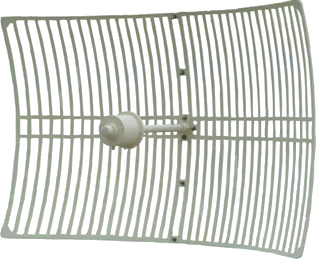
High gain Wi-Fi antennas like this one allowed one Ontario couple to leave Canada's cable companies behind and sign up for Time Warner service in the United States.

Last week, Stop the Cap! compared prices from two Internet Service Providers — Rogers Communications on the western side of the Niagara River — in Ontario, and Time Warner Cable on the eastern side in Niagara Falls, N.Y.

The price disparity is no secret to one Canadian family who read our piece and let us know they import their broadband service, thanks to long distance Wi-Fi, from the United States.

The couple, Neil and Michelle (we’ve been asked not their reveal their real names) and their three boys have lived along the Niagara River, which divides the United States and Canada, for over a decade.  Jim has been fascinated with low power, long distance communications since his days in amateur radio.

“I’ve always been trying to see what stations I can pick up, especially low power ones,” Neil tells us.

That curiosity came with Neil to his interest in broadband wireless communications.  Living along the river, Neil was fascinated to see Wi-Fi signals make their way across the river from the United States’ side.

“Thanks to a clear shot across the river, and a lot of businesses located adjacent to the Robert Moses Parkway, it’s easy to pickup Wi-Fi signals from businesses on the American side,” says Neil.

Neil discovered many networks wide open for public use and began to consider the implications of “importing” his broadband service from the United States to escape Rogers’ high prices.

“For Canadians, the idea of escaping the country’s communications providers is not that unusual,” Neil says.  “Some already have ‘gray market’ satellite dish accounts with America’s DISH or DirecTV, and some even use American prepaid cell phones, which are much cheaper than our own services and get good local reception across Niagara Falls down to Fort Erie.”

“So I began wondering what would happen if we could install a decent Wi-Fi system high enough on the house to get a good signal from a partner on the other side of the river,” Neil pondered.  “We started by putting a test signal up and driving through some Niagara Falls neighborhoods on the American side and found some good prospects.”

A long-shot advertisement on a well-known “for-sale/trade” website paid off, when an American family responded, intrigued by the experiment.

“The fact we were willing to pay their cable bill as compensation didn’t hurt either,” Neil suggests.  “The chances appeared very good for success, because we can see some of their trees from our roof.”
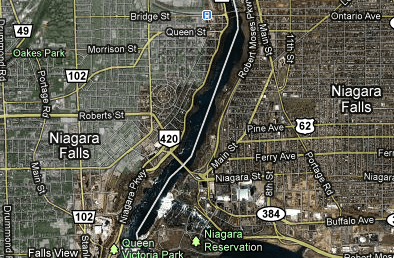
Niagara Falls, Ontario (left) and Niagara Falls, N.Y. (right), divided by the Niagara River.

Neil guessed right because today, with the help of two raised directional, roof-mounted high-gain Wi-Fi antennas that can literally “see” one another, the Ontario family enjoys its cable-TV and broadband service from Time Warner Cable.

“The signal is rock solid and the only time we get some speed problems is if someone in one of the bed and breakfast places nearby ends up on our channel,” Neil says.  “We can even watch television with the help of a Slingbox we installed on the American side which works perfectly fine on a Wireless N connection.”

Since the rise of Canada’s exchange rate against America’s declining dollar, the savings are dramatic. A comparable cable-TV plan with Rogers runs $80 a month for standard service, equipment fees, and HD service charges.  Add another $50 for broadband service with the modem rental fee and Neil would pay Rogers $130 a month before taxes for the two services.

“And we would be limited to just 60GB of usage per month before the $2/GB overlimit fee started making the bill even higher,” Neil says.

Time Warner Cable currently charges Neil’s adopted family $87 a month for television and broadband on a promotion.

Today, Neil’s conscience (and savings) led him to decide “borrowing” another family’s account wasn’t fair, so now he pays for -two- accounts with Time Warner, one for the New York family, the other belonging to him.

“Time Warner thinks of us as apartment renters and bills a post office box,” Neil says.  “The other family doesn’t care about cable-TV anymore so we’re just paying for their broadband account.”

The neighbors are certainly amused.

“When they come over, they call us ‘the American Embassy in Niagara Falls’ because of all the ads for Time Warner they see across the cable channels we get and because American cable systems ignore virtually all Canadian TV networks.”

Why go through all this?

“Now that we’re paying for two accounts, it’s a matter of principle,” Neil says. “I will not do business with a company that slaps usage limits on broadband, and now I don’t have to.”

In fact, now that the family’s sons are getting close to teen years, their Internet use is growing.

“We almost don’t care about the cable-TV anymore ourselves — we’re watching shows online, on-demand in this household,” Neil says.  “For my kids, they are growing up with the concept of television being always on-demand and it works around their schedule, not the other way around.”

Besides, Americans have access to Hulu, and Canada does not.

“Hulu is very important, and Netflix was even before it was sold in Canada,” Neil says.  “Now we can watch what we want, as much as we want, and pay a fair price for unlimited broadband.”

Neil can’t complain about Time Warner Cable, except for the fact it provides him with a U.S. IP address, which locks him out of a lot of Canadian online video-on-demand services from the CBC and other networks’ websites.

“They do a much better job than Rogers ever did with consistent broadband speeds and fewer outages, and we can live without replays of 18 to Life and Little Mosque on the Prairie,” Neil says. “I’m just glad you folks at Stop the Cap! convinced Time Warner to abandon the kind of pricing that is ruining the hell out of Canada’s broadband.”


Verizon Reserves the Right to Throttle Your iPhone Connection and “Optimize” Your Browsing

Verizon Wireless isn’t entirely rolling out the welcome mat for new iPhone customers.  PreventCAPS, one of our regular readers, dropped us a note indicating Verizon quietly added something new to the terms and conditions for new customers as of Feb. 3rd, which just so happens to coincide with the date the company started taking orders for the Apple iPhone — it reserves the right to throttle your speeds and “optimize” your browsing experience with caching and network management techniques that could reduce the quality of online videos and other bandwidth-intensive graphics.

Important Information about Verizon Wireless Data Plans and Features

As part of our continuing efforts to provide the best experience to our more than 94 million customers, Verizon Wireless is introducing two new network management practices.

We are implementing optimization and transcoding technologies in our network to transmit data files in a more efficient manner to allow available network capacity to benefit the greatest number of users. These techniques include caching less data, using less capacity, and sizing the video more appropriately for the device. The optimization process is agnostic to the content itself and to the website that provides it. While we invest much effort to avoid changing text, image, and video files in the compression process and while any change to the file is likely to be indiscernible, the optimization process may minimally impact the appearance of the file as displayed on your device. For a further, more detailed explanation of these techniques, please visit www.verizonwireless.com/vzwoptimization

If you subscribe to a Data Plan or Feature on February 3, 2011 or after, the following applies:

Verizon Wireless strives to provide customers the best experience when using our network, a shared resource among tens of millions of customers. To help achieve this, if you use an extraordinary amount of data and fall within the top 5% of Verizon Wireless data users we may reduce your data throughput speeds periodically for the remainder of your then current and immediately following billing cycle to ensure high quality network performance for other users at locations and times of peak demand. Our proactive management of the Verizon Wireless network is designed to ensure that the remaining 95% of data customers aren’t negatively affected by the inordinate data consumption of just a few users.

These kinds of “network management” techniques, which include speed throttles, reduced quality graphics, and caching (which can result in stale web pages being served to your mobile device), are all made possible by the Federal Communications Commission’s failure to implement Net Neutrality protections for wireless providers.  While Verizon stresses it will treat all content to the same network management techniques equally, the “improved” broadband experience Verizon claims to offer is more likely to improve the company’s bottom line from reduced spending on network upgrades.

Like most providers, Verizon isn’t willing to be specific about what amount of usage is likely to trigger the throttle, why it needs to be maintained for the remainder of the billing cycle even when network congestion is not a problem, and what speed customers will be stuck with for the rest of the month.

Broadband Reports reached out to Verizon for specifics and discovered the provider has not actually implemented these measures… yet:

“The notice yesterday simply reserves the right for new customers or renewing their contracts,” Verizon spokesman Jeffrey Nelson tells Broadband Reports. “We’re reserving the right to actively manage the network in specific ways should that need exist – and only for customers who are under contract that includes that provision,” he says. “Because this is down the road – if at all – it’s too early to tell what those triggers might be, or what throughput limitations would look like.”

Verizon may be concerned about the potential impact millions of data-craving iPhone customers will bring to its network in the coming weeks.  Existing customers with Android devices or Blackberry handsets are safe for now — the provision only impacts customers who sign new contracts as of last Thursday.

Verizon says it will retain its unlimited data option (with the right to throttle service) for a “limited time only.”

AT&T Announces New Wi-Fi, Tethering, and Trade-In Plans for Data Customers

Gertraude Hofstätter-Weiß February 3, 2011 AT&T, Competition, Consumer News, Data Caps, Wireless Broadband Comments Off on AT&T Announces New Wi-Fi, Tethering, and Trade-In Plans for Data Customers

Select smartphone customers will soon be able to connect multiple devices from their smartphone – via Wi-Fi – with AT&T’s new Mobile Hotspot application. Starting Feb. 13, customers bundling the Hotspot application with the AT&T Data Pro plan will get up to 4GB of data for $45 per month.

Customers on AT&T’s $20 tethering plan, which permits access to AT&T’s wireless network on a laptop or other device through your phone, will get an additional 2GB of use at no charge to match the Mobile Hotspot offer.

AT&T Mobile Hotspot details include:

  • Connectivity for multiple wireless devices to AT&T’s mobile broadband network
  • 2 GB of data usage for $20 a month, bundled with AT&T’s Data Pro plan ($25/2GB)
  • The combined AT&T Data Pro plus AT&T Mobile Hotspot will provide 4GB for $45 per month
  • 4GB applies to collective use among all devices
  • Customers will receive a text message from AT&T once the additional 2GB has been auto-added to their plan
  • An overlimit fee of $10 per gigabyte applies

AT&T also announced a new trade-in program:

Beginning Feb. 13, AT&T/FlipSwap’s trade-in service will launch in all AT&T stores, allowing AT&T customers to turn in old wireless phones and receive an AT&T gift card reflective of the device’s trade-in value and condition, as determined by FlipSwap. Customers can use the card in AT&T stores towards the purchase of new phones, equipment, or services.  All phones – regardless of manufacturer or date purchased – will be considered for trade-in.

AT&T also offers customers the option to donate old devices – or proceeds from their trade-in – to members of the military through the Cell Phones for Soldiers program.  Donation boxes are set up across AT&T retail locations.

Kyle, an AT&T customer and Stop the Cap! reader noticed the changes, and wasn’t very impressed.

“They matched Verizon’s pricing, nothing more — nothing less,” Kyle writes.  “What would be useful is free tethering tied to our existing data plan; there is no justification for charging extra just for the right to use your existing data plan on another device.”

iPhone 4 Pre-Orders for Existing Verizon Customers Begin As AT&T Retention Goes All Out

The date has arrived.  Existing Verizon Wireless customers are now invited to “pre-order” The Precious.

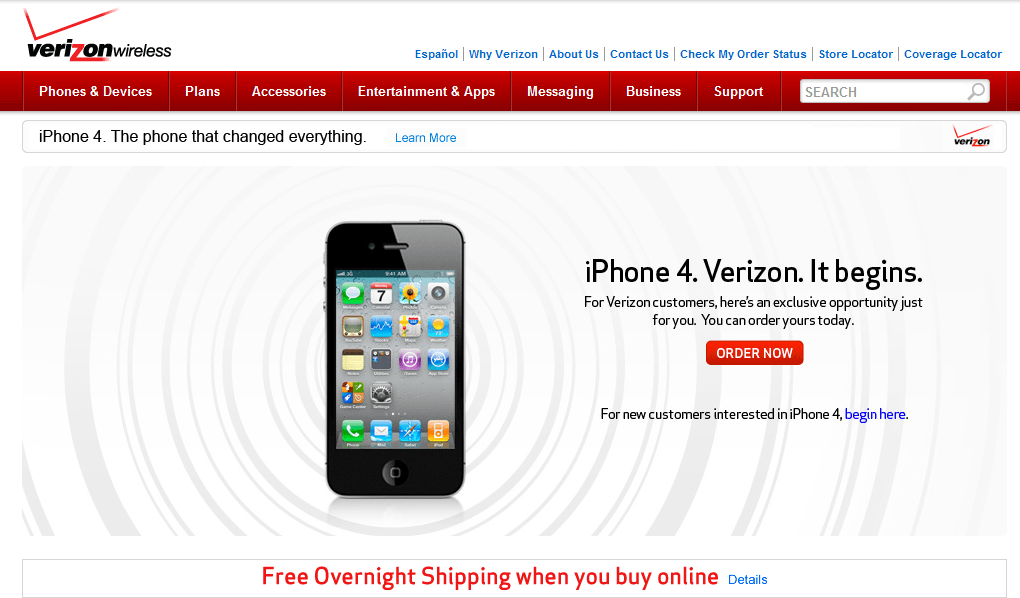
Strangely, Verizon’s website gave more prominence to the phone before they could actually accept orders for it:

Verizon Website 2/2/2011

Verizon Website 2/3/2011

Verizon wants you to think of its Apple iPhone as a fine wine, offering “exclusive” access to “our reserved quantity, while they last.”

When they’re gone, they’re… will be more on the way.  The Keebler Elves at Apple will certainly make more, plenty more, to sustain pent up demand for the phone on Verizon’s network.

AT&T is doing all it can to keep customers from switching.  In addition to earlier efforts to lock customers into those two-year contracts with early termination fees, lots of AT&T customers are also getting e-mail from the company reminding them AT&T is the only network that lets you talk and surf the web at the same time (with your iPhone).  They ignore T-Mobile, which also accepts unlocked iPhones and works the same way.  AT&T and T-Mobile utilize GSM technology while Verizon (and Sprint… and Cricket… and MetroPCS) use CDMA.  The latter technology, at least in its current implementation, allows users do one or the other, not both.

That probably won’t keep too many disenchanted AT&T customers from leaving, but some other factors might:

  1. Apple will release the iPhone 5 in less than six months, if things run according to schedule.  The new phone might work on Verizon’s new LTE network, something iPhone 4 does not.  Is there a hurry to upgrade now when something better is around the corner?
  2. AT&T Retention Agents are giving away the store to customers warning of their intention to depart.  Restoration of unlimited data plans, free upgraded phones to qualified customers, free accessories, and even credit for a month of service have all been offered, even as the company publicly announces it is pulling back from some of those giveaways and specials.
  3. As potentially millions of AT&T customers leave, those remaining may find improved performance from the lighter load on AT&T’s network.  Plus, the impact of the iPhone on Verizon’s 3G network remains unknown.  AT&T customers could parade themselves into new headaches on Verizon’s network.

Verizon will allow new iPhone customers access to its “unlimited data” add-on plan “for a limited time.”  Verizon plans to join AT&T in officially ending the unlimited option sometime this year, but exact pricing and plan details remain unavailable.

Customers can begin booking their departure from AT&T Feb. 9, when Verizon begins taking orders from new customers and those intending to drop their current carrier.

AT&T Accused of Rigging iPhone Data Usage Meter to Overcharge Consumers

Phillip Dampier February 2, 2011 AT&T, Consumer News, Data Caps, Wireless Broadband 4 Comments

A snake in the grass?

You used 50 kilobytes of data visiting a web page on your iPhone, but AT&T claims the site actually consumed six times that — 300 kilobytes, for which the carrier overcharged you for access.

A major point of contention for consumers facing Internet Overcharging schemes is that the same company with a vested interest in maximizing revenue from such schemes also administers the meter that measures how much you used.  There is no oversight or independent verification.

In a lawsuit filed this week, AT&T Mobility faces accusations it is systematically overcharging iPad and iPhone users for data services many never used.

Patrick Hendricks claims AT&T’s Internet Overcharging “was discovered by an independent consulting firm retained by plaintiff’s counsel, which conducted a two-month study of AT&T’s billing practices for data usage, and found that AT&T systematically overstate web server traffic by 7 percent to 14 percent, and in some instances by over 300 percent.”

The lawsuit compares the company’s billing system to a gas pump that charges for a full gallon when it only dispenses nine-tenths into your tank.

Hendricks’ suit also claims the same independent testing firm confirmed AT&T charges for data usage even when phones and iPads were disabled for data sessions, push notifications, location services, and other data features.  After 10 days, the firm found AT&T had billed 35 data transactions totaling 2,292 kilobytes of usage, akin to being billed for gas when you never even pulled into the station.

The complaint admits the individual overcharges are relatively small for most consumers, but collectively they earn massive profits for AT&T.

“AT&T has 92.8 million customers. In the fourth quarter of 2010, AT&T reported its wireless data revenues increased $1.1 billion, or 27.4 percent, from the year-earlier quarter, to $4.9 billion,” the suit claims. “A significant portion of those data revenues were inflated by AT&T’s rigged billing system for data transactions.”

The lawsuit is seeking class action status and refunds of alleged overcharging for impacted customers.

The firm handling the case, Bursor & Fisher, has tangled with cell phone providers before, winning cases against Verizon, Sprint and T-Mobile.  The firm is also exploring a lawsuit against Sprint on behalf of Evo owners who paid a $10 surcharge on top of an “unlimited” data plan.

Search This Site:

Contributions:

Recent Comments:

Your Account:

Stop the Cap!