Home » Consumer News » Recent Articles:

Can Google TV Replace Your Cable Service?

Gertraude Hofstätter-Weiß February 21, 2011 Competition, Consumer News, Online Video, Video 1 Comment

[flv width=”480″ height=”380″]http://www.phillipdampier.com/video/WCPO Cincinnati Can Google TV Replace Cable 2-18-11.flv[/flv]

Can Google TV replace your monthly cable bill?  WCPO-TV in Cincinnati explores whether the time is right for getting rid of cable television.  (3 minutes)

Frontier’s Press Releases Ignore Serious Service Problems Which Can Last for Weeks

Slaterville Springs is a hamlet in the town of Caroline, N.Y.

Frontier Communications issues press releases promoting the expansion of low speed DSL service into new areas, but for many existing customers, extended service outages ruin their broadband experience.

Just ask Stop the Cap! reader Paul from Slaterville Springs, just outside of Ithaca, N.Y.  Much of his hamlet was without Frontier’s DSL service for more than two weeks, leaving dozens of families with poor-to-non-existent access to broadband for the better part of January.

It Was Supposed to Be Restored in Two Days — But Three Weeks Was More Like It

“It was supposed to be restored in two days, but after repeated calls, they told me it was a “common cause” failure impacting a large number of subscribers,” Paul told us. “Later, we were told Frontier was waiting for parts to fix some equipment at the central office.”

Paul heard the same excuse a week later, as he and other local residents remained cut off from the Internet.

Paul has been underwhelmed by the attention Frontier has given to the town of Caroline, which includes Slaterville Springs.  He has complained to the town supervisor and the New York Public Service Commission.  Frontier has already offered him a refund for the extended interruption in service, but Paul would really like a stable Internet connection that performs well with today’s bandwidth-intensive Internet.

“Before the outage, I got about two-thirds of the promised 3Mbps speed from Frontier, which means any interactive applications can be difficult, and YouTube videos require lengthy buffering before one can watch,” Paul says.  “I think being able to watch YouTube without painful slowdowns should be a key metric for today’s broadband.”

At the end of January, Paul reached out to Ann Burr, Frontier’s regional president of operations.  She called up Claudia Maroney,  the general manager of Frontier’s Central New York division.

“I was told right away that I’d get a service credit for two months and that the problem would be dealt with quickly,” Paul said. “The technician in the central office contacted us and said the solution was to further reduce my speed, because he thought we were too far away from the central office to sustain even the slow speed we had before.”

That turned out not to solve the problem either.

Finally, Frontier brought Paul a new DSL modem which, in concert with repairs in the central office, finally resolved his problems.

Frontier claims it will also increase capacity in his area, which apparently also suffers from evening congestion.

Poor Internet service is not just limited to Caroline.  The entire Southern Tier region between Corning and Binghamton is hard-pressed to access high-speed service.

Eleven towns in Tompkins and Cayuga County have jointly applied for a federal grant to create the infrastructure needed to make high speed wireless or fiber optic-to-the-home service available throughout the area.

The Case of Proctor Creek and Coffield Ridge, W.V.
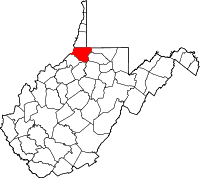
Wetzel County, W.V.

One of the most challenging areas to provide DSL service is in the Panhandle section of West Virginia.  Hilly terrain and large distances between neighbors assure a challenging broadband environment.  Cable television is out of the question in many areas, and Verizon’s legacy network was in decrepit condition before selling operations to Frontier and fleeing the state.

So it was with great excitement Frontier announced incremental progress in expanding DSL service to two small sections of Wetzel County.  Proctor Creek, close to the West Virginia-Ohio state line, and the relentlessly hilly Coffield Ridge area was finally getting DSL from Frontier — three years after Verizon promised to make the service available.

Wetzel County EMS President Jim Colvin and Del. Dave Pethtel joined Frontier’s Bill Moon at the Grandview EMS Squad station on Jan. 4, to learn more about Frontier’s expansion plans, as the Wetzel Chronicle reported.

Moon informed customers that DSL was now available in both areas and it’s only the beginning of Frontier’s plans to deliver expanded broadband service across West Virginia.  He said Frontier aims to “do things right the first time,” taking more time to establish service in efforts to prevent customers from dealing with the inconveniences of repeat visits from technicians.

“We want to bring the feel of a local company with the advantages of a big company,” Moon said. He went on to say that being a manager specifically for one region meant day-to-day decisions could be made at the local and personal level. “A lot of the red tape is gone,” he told the Chronicle. “We can make things happen directly and get things resolved quickly.”

“There is nothing quick or personal about Frontier Communications,” Shirley tells Stop the Cap! from her home in Proctor.  Her sister signed up for Frontier’s broadband service Jan. 15, and it has worked for exactly three days.  “She has never dealt with a more disorganized company.”

Shirley says nobody from Frontier ever marketed DSL to her sister’s family.

“I read the story in the Chronicle and called her right away, because they have been waiting for broadband for at least 10 years,” Shirley says.  “Calling Frontier was the first mistake — the company couldn’t bring up her account for 15 minutes.”

Shirley says her sister finally succeeded in ordering the service after her line was “qualified.”  She specifically told Frontier “no thanks” to a heavily pushed big package of services from the company, and she did not want to get into a term contract.  But Frontier signed her to one anyway.

“Installation turned out to take almost two weeks because the installer never showed up and she actually got her first bill with DSL charges on it before they installed the service,” Shirley says.  “She called me right away — they signed her up for a calling plan she didn’t want, a hard drive backup service she never ordered, and a one year contract she won’t accept.”

Frontier took all of the extra services off her bill without a fight, even as she still waited for the installer to show up.

“It worked for three days — three days,” Shirley reports.  “Ever since the last heavy rain, the modem lights just blink and Frontier tells her it must be a line problem, but she’s still waiting for someone to come fix it.”

Frontier is charging Shirley, and her neighbors, nearly $40 a month for 1.5Mbps DSL service.  It was supposed to be 3Mbps, but Moon admitted to residents the farther a customer is from a hub, the slower the connection will be.

Common Congestion Symptoms?  Frontier Promises Relief

National Radio Astronomy Observatory in Green Bank

Meanwhile, residents in Pocahontas and Webster counties in eastern West Virginia have DSL service, but intolerable congestion has made it practically unusable since last Thanksgiving.

Nate in Marlinton has had DSL service since Verizon ran it, and believes Frontier has successfully run DSL straight into the ground in the state.

“Frontier actually managed to achieve slower speeds than my neighbor’s satellite Internet service, which is simply amazing,” Nate tells Stop the Cap! “He had Frontier DSL as well, but he went back to the satellite because it was actually better in the evenings.”

Nate’s in a good position to know he has a good quality line to Frontier’s central office — he can see the building from his house.

“When Verizon ran DSL, I actually got better speeds than they promised because you can count the line length between me and the central office in yards, not tens of thousands of feet,” Nate says.  “Now the problem is with Frontier’s own pipeline to the rest of the Internet, which has become hopelessly congested.”

Nate criticizes Frontier for claiming their network has loads of fiber optics for their broadband service.

“Not for ordinary West Virginians they sure don’t,” Nate says.

The Pocahontas Times covered Frontier’s molasses-slow broadband speeds, getting promises that better broadband was on the way late last week.

“But you have to read further down in the story to find the company is spending its time, attention, and money on a fiber network connecting the National Radio Astronomy Observatory in Green Bank with West Virginia University in Morgantown,” Nate complains. “Although that fiber travels down the same phone poles and streets our phone lines do, that sure doesn’t mean we’ll be able to access it.”

Reed Nelson, Frontier’s Director of Engineering for West Virginia, vaguely offered the $5.9 million, 66-mile fiber project will indirectly benefit consumers through fiber loops installed along the way.  He was joined by an apologetic Dana Waldo, Frontier’s senior vice president for West Virginia.

“We know we’ve had some bumps in the road,” Waldo said at the outset of the meeting.

“This is very much like being on the Interstate highway at rush-hour,” he said. “It gets congested. What we’re trying to do is look for paths where we can reduce that congestion. That’s the short-term fix.”

Nate remains unimpressed.

“This is a residential broadband improvement project through osmosis — somehow Frontier’s congested network problems in the area will be resolved by an institutional network we cannot access,” Nate says. “The fact the company turned up at the Observatory to make these announcements before an audience of NRAO technical and executive staff, Pocahontas County Commissioners and representatives of the local schools and libraries, tells you all you need to know — this is an institutional, not residential network.”

Pocahontas County's Cranberry Glades: Go for Nature's Mountain Playground, but don't stay for Frontier's broadband.

Our regular reader DJ, also in the affected area, says speeds have been downright terrible since Thanksgiving, and despite Frontier’s “new capacity” coming online last week, his service is as slow as ever.

“I’m getting anywhere between 0.5Mbps – 2Mbps if I’m lucky,” he shares.

For most customers in eastern West Virginia, Frontier’s ironically-named High Speed Max service delivers a whopping 1Mbps broadband experience.

“Customers have been paying for value not received,” Pocahontas County Commissioner Martin Saffer told Nelson.

Constituents in both counties regularly complain to elected officials about the dreadful broadband service Frontier delivers.

“This company got more than one hundred million in broadband stimulus funding and it sure isn’t helping people in eastern West Virginia,” Nate says.

Another part of Frontier’s problems is an overcongested access point in Bluefield, where Frontier exchanges traffic with the Internet’s national backbone.  Sending the majority of the state’s traffic through one data center has proved untenable, so the company plans additional access points in Charles Town, Charleston, and Clarksburg.

Frontier promises speed boosts are forthcoming, bringing 5Mbps service in the days ahead, according to the Times.

John Mutscheller, Frontier’s Technical Supervisor in Marlinton, told the Times local crews are working to increase capacity whenever they go out to service equipment in Pocahontas County.

“When we put in a new site or we augment an existing site, if they’re at one meg–we have some at three–we’re jumping them up to 5 megs,” he said. “That’s the company policy.”

An installation at Thornwood will be the first 5 Mbps site to come online in Pocahontas County, Mutscheller said. Eventually, all sites in the county will be upgraded to that level, he said.

But as the newspaper points out, not everyone will get those speeds. Generally, with the copper lines that connect customers to Frontier’s equipment, connection speeds drop off as the distance from the equipment increases. Nelson said advances in modems, like those Frontier provides customers for connecting to its network, could fix that in coming years.

Frontier continues to navigate political minefields in the state with the help of employees hired from county governments. Reta Griffith, a former county commissioner today is Frontier’s General Manager for the territory that includes Pocahontas County.

Reporters pressed Griffith on the question of refunds for beleaguered customers experiencing very un-broadband speeds from Frontier:

“We will take those concerns into consideration,” Griffith responded.

Frontier’s service agreements with customers state that speeds received are not guaranteed, but rather will be ‘up to’ the specified speed, she added.

Frontier’s own marketing materials have added to the billing headaches of the company and its customers.

“‘High Speed Max’ doesn’t mean the same thing every place,” Griffith explained.

The National Broadband Map is Here, and It Has Some Flaws

The National Telecommunications and Information Administration unveiled America’s broadband map early this morning, showing broadband availability, speeds, and coverage areas across all 50 states.

“A state-of-the-art communications infrastructure is essential to America’s competitiveness in the global digital economy,” said Acting Commerce Deputy Secretary Rebecca Blank. “But as Congress recognized, we need better data on America’s broadband Internet capabilities in order to improve them. The National Broadband Map, along with today’s broadband Internet usage study, will inform efforts to enhance broadband Internet access and adoption — spurring greater innovation, economic opportunities, and advancements in health care, education, and public safety.”

The map, searchable by street address or zip code, delivers data largely volunteered by service providers themselves.  Some of the data, particularly for broadband speeds, represent best-case scenarios, not actual results.  Regardless, looking at the nation as a whole, there are some dramatic gaps in coverage.  Large areas west of the Mississippi are without broadband, which can be understandable in the sparsely populated region.  To the east, the biggest problem by far as in the Appalachians, especially in West Virginia, western Virginia, and the western Carolinas.  West Virginia in particular stands out as the state with the least amount of coverage in the east, perhaps only rivaled by Maine.  In the southern U.S., Alabama, Mississippi, Louisiana, and northern Florida are problem areas.  East Texas outside of major cities is as well.  In rural areas, the coverage map fills in the most when rural wireless mobile providers are introduced, but their broadband plans are hardly suitable as a replacement for wired, unlimited access service.

“The National Broadband Map shows there are still too many people and community institutions lacking the level of broadband service needed to fully participate in the Internet economy. We are pleased to see the increase in broadband adoption last year, particularly in light of the difficult economic environment, but a digital divide remains,” said Assistant Secretary for Communications and Information and NTIA Administrator Lawrence E. Strickling. “Through NTIA’s Broadband Technology Opportunities Program, digital literacy activities, and other initiatives, including the tools we are releasing today, the Obama Administration is working to address these challenges.”

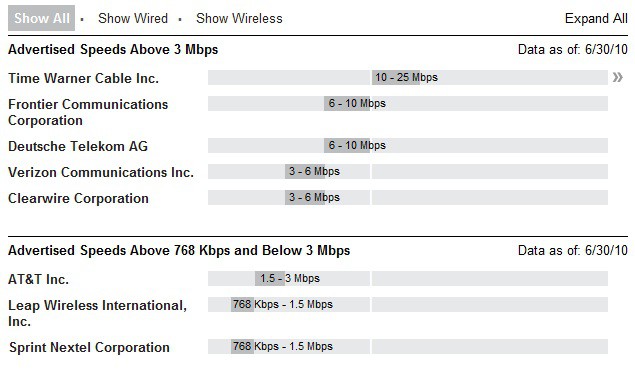
Reviewing the map for Stop the Cap!‘s headquarters — Rochester, N.Y., shows a correct list of providers, but the data about their products is more fantasy than reality:

  • Time Warner Cable does not deliver 25/1.5Mbps service to residential customers in Rochester at this time, but its PowerBoost temporary speed gimmick might, for around 30 seconds.  Currently, Time Warner Cable maxes out at 15/1Mbps in the Rochester area;
  • Frontier’s claim of 10Mbps is a theoretical maximum.  Most DSL customers don’t come close.  In our area (Brighton, N.Y.) Frontier couldn’t deliver more than 3.1Mbps.
  • Wireless carrier data is simply wrong.  Sprint-Nextel is beaten down to a maximum 1.5Mbps, despite the arrival of its 4G network, which can manage better than that.  Verizon’s 3-6Mbps service is in their dreams, considering this data came from last June — before the introduction of LTE service in Rochester.  Clearwire is also guilty of boasting speeds they will never deliver on their increasingly throttled network.

The NTIA touts their map will be verifiable using “crowdsourcing,” but we found visitors are only able to confirm if a provider serves an area, but not how well and at what speeds.

Price data is also missing.  Strickling blames that on fast-changing industry practices.  We blame it on the fact providers refused to disclose that information, along with more specific details about their broadband networks.  Large providers claimed releasing proprietary, confidential business information could harm them competitively.

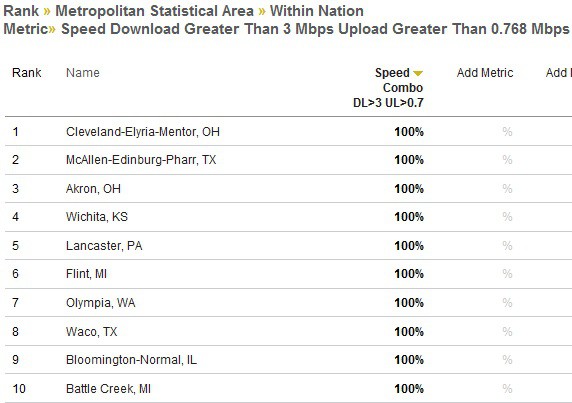
Another glaring example of questionable accuracy is the compelled-to-report top and bottom 10 cities in the country for service.  According to the NTIA, America’s number one city for broadband availability at speeds greater than 3Mbps is… Cleveland, Ohio.

Cleveland?

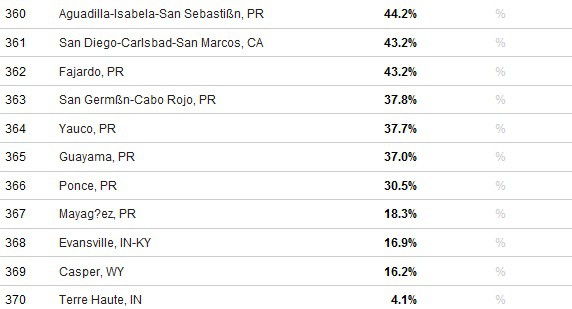
The worst?  Terre Haute, Indiana.

Really?

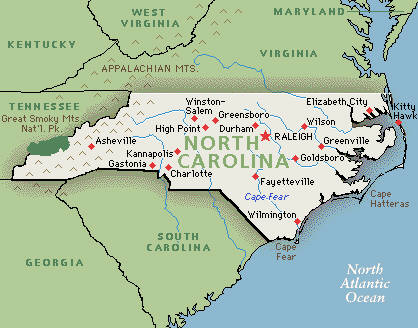
Another Year, Another Anti-Community Broadband Bill in North Carolina

Here we go again.

You always know when a new year has arrived when another North Carolina legislator files a Big Telecom industry-written bill attacking community-owned broadband.

This year, the laughably-named “Act to Protect Jobs and Investment by Regulating Local Government Competition With Private Business” comes courtesy of Rep. Marilyn Avila (R-Wake County), a former manager of the conservative think tank John Locke Foundation.

H.129 is remarkable for its legislative micro-management, coming from someone who claims to oppose big government meddling.

Among its requirements:

  • Demands a public accounting for every community broadband network;
  • Limitations on service to strict city boundaries;
  • Prohibits contractual agreements with apartment and condo building owners that mandate municipal service for individual residents;
  • Bans advertising and “promotion” of community-owned broadband networks on Public, Education, and Government access channels;
  • Shall not price any component of its service below cost;
  • Requires payment of a special tax equal to the amount of local property taxes and/or fees normally exempted for local government enterprises;
  • Requires permission through an extended hearing process to win permission before delivering service to any area deemed “unserved”;
  • Demands a laundry list of pre-conditions before obtaining permission to shop for financing.

Avila

Avila doesn’t mind putting government all over the backs of community-owned networks if they happen to compete with her friends at AT&T, Time Warner, and CenturyLink.

Let’s review this exceptionally provider-friendly piece of protectionist legislation.

First, Avila’s demand for an open accounting of community broadband projects provides a treasure trove of business intelligence for any competitor.  They can demand to open the books and gain critical subscriber information — what residents pay for service, who gets the service, and how much it costs to provide.  That’s pure gold for targeted marketing campaigns to win back customers with special offers municipal providers are banned from offering.

We’re calling a foul ball because Avila’s “fair and level playing field” doesn’t have room for fair play.  Private providers get to keep the secrets community-owned network are forced to reveal.  That, by design, puts municipalities at a competitive disadvantage and could help drive them out of business.  Remember, these networks are financed by privately obtained bonds, not taxpayer dollars.  Shouldn’t any such provider have the right to keep its business strategies secret?

Second, if banning mandatory service for renters and condo owners is such a great idea, why does Avila only limit it to community-owned networks?  The record is clear — private providers are increasingly signing agreements with property owners mandating cable television fees for residents.  Apparently Avila’s concept of fairness doesn’t include the actual companies found guilty of raising the rent.

Third, Avila bends over backwards for her cable and phone friends by tying the hands of municipal providers who want their networks to be commercially successful.  Time Warner has no problem injecting endless promotions for its own services not just on a handful of channels, but on virtually every channel on the lineup, often during nearly every commercial break.  Can municipal networks ban advertising from AT&T and Time Warner?  Of course not.  And the definition of “promotion” specified in Avila’s ad ban is vague.  If a town government meeting talks up the success of a community-owned network, has Avila’s law been broken?  Apparently censorship by government mandate is a-OK as long as it doesn’t target her Big Telecom friends.

Avila’s ban on setting pricing below cost is another giveaway to Time Warner and AT&T, who routinely deliver retention and new customer promotions that could be temporarily priced below cost to secure or maintain a customer relationship for a limited period of time.  Of course, Avila doesn’t require either company to open their books to find out exactly what it costs companies to provide these special pricing packages.  No municipal provider seeks to price service at a rate that puts the project out of business.  Time Warner Cable has been accused of delivering below-cost retention pricing to departing customers in Wilson, where GreenLight has been poaching the cable company’s customers for more than a year.  Avila’s hand-tying provision allows some companies in the marketplace to keep pricing flexibility while the municipal provider is forced to price service according to a state-dictated formula.  John Locke would be turning over in his grave if he heard about this planned economy-pricing.

Rep. Avila can certainly no longer claim to be for low taxes, because her bill would effectively raise them for community-owned networks.  Again, since these projects are almost always funded from private bond markets, not public tax dollars, slapping complicated tax formulas on municipal providers while continuing to permit special tax break deals for private companies (such as “payment in lieu of taxes” or special tax breaks/grants for Time Warner in return for job creation) shouldn’t work for most small government conservatives.  Shouldn’t they support lower taxes for everyone?  Instead, Avila seeks to hamper community network business models by punitively sticking them with taxes she would otherwise oppose for commercial providers.

Avila’s support for smaller, less regulatory-minded government must also be called into question with this bill’s ridiculously complicated regulations for serving unserved areas of the state (which also grants a special window to private providers to protest, which they will certainly do in just about any area of the state even partially suitable for a future project).  Her bill even demands 60-day delays, custom-tailored to allow industry lobbyists to gin up opposition and demagogue projects.  Since a commission will be involved in the decision making process and has to take into account opposition from private providers, all of the benefits of Avila’s legislation flow to the cable and phone industry, none to community-owned networks or individual consumers that will ultimately benefit from better service at lower prices.

Avila's idea of a level-playing field.

Avila destroys her own “level playing field” argument in language within her own bill:

“The city or joint agency making the application to the Commission shall bear the burden of persuasion.”

In other words, Avila offers a “level playing field” with an 11-foot electrified barbed wire fence surrounding it.  Unfortunately, municipalities won’t be the only ones shocked by Avila’s cable and phone company protectionism.

Ordinary consumers in communities like Wilson, exempted from the relentless annual rate hikes from Time Warner because of the presence of a municipal competitor won’t get to keep the savings if Avila has anything to say about it.  She wants you to pay full price for your cable service, and pay higher prices year after year.

Her claim that the legislation will somehow “protect jobs and investment” is specious at best.  Time Warner has not exited Wilson or Salisbury — two cities with a community-owned competitor.  In fact, Time Warner is on record welcoming competition.  In reality, these companies simply don’t welcome new choices from those providers that will actually deliver savings and better service to customers.

This anti consumer legislation brought to you by Time Warner Cable...

The cable industry’s flagellation against projects like GreenLight and Fibrant flips between calling them financial boondoggles not worth bothering about to unfair competition that will harm private investment.  AT&T’s protests, in particular, ring the most hollow.  This is the same company that wants deregulation to make it easier for new players like themselves to enter the marketplace.  Their U-verse service enjoys the benefits of statewide video franchising, which removes accountability to local governments.  Yet this same company lobbies for increased bureaucracy and regulation for some of their potential competitors.  Avila is only too happy to oblige.

As with every other piece of legislation we’ve seen on this subject from North Carolina, it’s yet another custom-written favor to big cable and phone companies and an attack on consumer interests across the state.  Generous campaign contributions from the telecom industry pay off only too well when state legislators allow these companies to write the bills designed to protect their turf.

For Time Warner Cable, the costs associated with sending selected legislators and their families to a recent delicious BBQ event in sunny San Diego to attend a sham “conference” sponsored by a corporate front group shows there are plenty of favors to be had all around, just as long as you support the company’s legislative agenda.

...and AT&T

Fighting this year’s anti-consumer legislation will be tougher than ever.  For the first time in 112 years, the corporate friendly North Carolina Republican party won control of the General Assembly.  For many members, the free market can do no wrong and anything government touches is bad news.  Many will reflexively support Avila’s legislation.  But any underserved county in the state knows the truth about today’s broadband in rural North Carolina — if local communities can’t step up and deliver the service, nobody will.  For these representatives, Democrat or Republican, concern should run high that Avila’s bill assures these areas of years of high prices, poor or no service, and status quo protection designed to keep the market exactly as it is today.  Considering how poorly North Carolina stands in national broadband rankings, standing still should never be an option.

HissyFitWatch: Billionaire Owner of FilmOn Declares War on CBS-Viacom – “CBS You Suck”

Phillip Dampier February 17, 2011 Competition, Consumer News, HissyFitWatch, Online Video, Public Policy & Gov't, Video Comments Off on HissyFitWatch: Billionaire Owner of FilmOn Declares War on CBS-Viacom – “CBS You Suck”

British billionaire Alki David thinks Viacom, owner of CBS, is “an irresponsible hypocrite.”

After being dragged into court in New York and finding himself with an injunction, the founder of FilmOn is looking for revenge.

Claiming Viacom-owned CNET “has ruined the lives of hundreds of thousands of people in the creative community and created copyright infringement damages into the trillions of dollars,” David is considering a lawsuit against the company, which David accuses of dealing in piracy:

Has your song, movie, software or literary work been copied and distributed illegally through the file-sharing software called LimeWire? If so, and if you are interested in joining a lawsuit against CNET for its widespread distribution of LimeWire with the malicious intent to infringe on copyright, then please read on.

We are putting together a committed coalition of artists and rights owners whose movies, music, software and literary works have been pirated by LimeWire users. A U.S. District Court has already shut down LimeWire, but others who participated in its wrongdoing like CNET have not yet been made accountable.

On December 21, 2010, Leslie Moonves issued a statement to the Hollywood Reporter regarding Alki David’s “incendiary video” which was posted on YouTube and which detailed CNET/CBS Interactive’s participation in widespread, “malicious copyright infringement”. Mr. Moonves was quoted as saying that was that “He (Alki David) is hardly an expert on intellectual property rights. CNET respects such rights.”

Mr. David has just released a second video in response. The video is even more fact filled and includes a discussion by a leading copyright attorney, Michael Zeller of Quinn Emanuel.

As demonstrated in the new video and supported by Court documents, CNET.com — also known as download.com — was responsible for distributing 95.5% of all LimeWire downloads. In May 2010, U.S. District Judge Kimba Wood granted a summary judgment in favor of the music industry’s claims that LimeWire’s software maker and its founder Mark Gorton committed copyright infringement, engaged in unfair competition, and induced copyright infringement.

Mr. David said: “We are very pleased to announce that a large coalition of copyright owners, including myself, who have been harmed by CNET’s distribution of LimeWire file sharing software are working with Mr. Zeller’s firm in preparation for a lawsuit.” Mr. David added: “Mike Mozart of YouTube fame originally introduced me to CNET/Limewire connection. Since absorbing all of the evidence, it has now become an impassioned commitment to stop the injustice that still goes on today as a result of CNET’s actions.”

David’s new website, Viaconned, is the home base for his campaign against CBS.  His video, rambling at times, claims that CNET’s website recommended software that can be used to strip copyright protection mechanisms from songs, and also distributed the very file sharing software Viacom railed against for copyright infringement.

FilmOn recently had to yank most of its American network stations from the lineup of its online virtual cable system, and the service is now relegated to showing pornography, documentaries, older movies, and international channels of limited interest to most American viewers.

[flv width=”640″ height=”380″]http://www.phillipdampier.com/video/David Alki Attacks Viacom 12-2010.flv[/flv]

Alki David outlines his case against Viacom, with a little help from his friends.  (10 minutes)

Search This Site:

Contributions:

Recent Comments:

Your Account:

Stop the Cap!