Home » Consumer News » Recent Articles:

Frontier Adds New $1.50 Surcharge to Broadband Bills; Customers Told It Will Improve Service

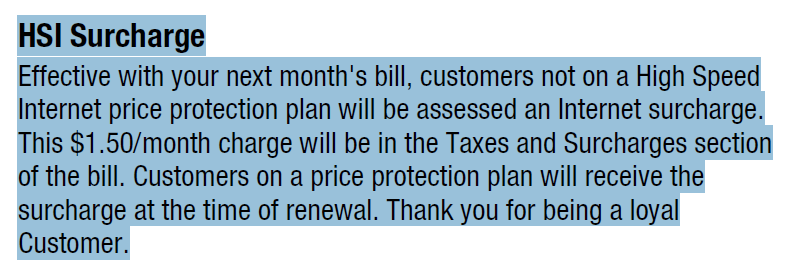
Frontier Communications is adding a new $1.50 monthly surcharge for broadband customers not currently enrolled in a “price protection agreement.”  Labeled the HSI Surcharge, the new fee started showing up on customer bills this month, with only a vague explanation buried inside the bill:

Courtesy: Manmaniac

Frontier's Fast One.

Customers attempting to get an explanation of what this charge was all about got a myriad of answers from Frontier customer service representatives:

  • It’s a broadband tax;
  • It’s a surcharge to help pay for network improvements;
  • It’s a charge for customers who refuse to take a price protection plan;
  • It’s a rate increase.

Stop the Cap! called Frontier this afternoon and was told it was designed to collect additional revenue to fund network expansion and was, effectively a rate increase.  Even customers on 1-3 year price protection agreements will eventually pay the “surcharge” as their agreements expire.  It is not a government-mandated charge or tax.

Effectively, this rate increase allows the company to advertise their Internet service at a deceptively low price, until customers discover Frontier’s modem rental fees and surcharges.  In 2009, during Stop the Cap!‘s flirtation with Frontier DSL, we found the “out the door” price for their 3.1Mbps service was actually higher than that charged by Time Warner Cable’s 10Mbps Road Runner service.

AT&T Leaves Hundreds of Burbank Customers Without Landlines for Nearly A Week

Phillip Dampier August 23, 2011 AT&T, Consumer News 1 Comment

Accidents can be forgiven, but when AT&T’s repair crews take nearly a week to fix them, they are rarely forgotten.

More than 350 residents of Burbank, Calif., learned that first hand when they lost their AT&T landlines for six days, after an unrelated construction crew accidentally cut a telephone cable.

For more than a few impacted residents, AT&T took their sweet time fixing the problem, costing area businesses thousands of dollars and leaving hundreds of customers mystified.

The accidental cable cut on Front Street Aug. 13 left consumers reaching for their cellphones and local businesses trying to convince their own customers they had not gone out of business.

The Glendale News-Press shared the misery:

Brian Schneider of Schneider & Associates Claim Services said he has been without phone service since Monday morning.

“It’s really destroying my business, I feel very helpless,” Schneider said. “I feel like I’m living in a Third World country with no telephone.”

He estimated a loss of $6,000 to $7,000 a day because customers cannot reach him.

“Customers are sending emails asking if we’re still in business,” Schneider said. “I have 25 employees who are going to be adversely affected by this.”

Compounding matters is the fact that he just rolled out a marketing campaign to attract new customers.

“It’s not easy to get new clients in this environment, and then they call and the phone just rings and we don’t pick it up — bye-bye new client.”

AT&T claims they had to dig down at least 12 feet to reach and repair the affected cable, and told the newspaper it would take up to a week to restore service, and it did.  But many customers were infuriated they were kept in the dark on the company’s progress, and others had trouble convincing AT&T to forward affected calls to unaffected cellphones and other working numbers.

AT&T said reimbursements for lost service, finally restored six days after the cable cut, were not automatic.  Customers seeking a refund have to call the company’s customer service line and request one.

Time Warner Cable: Fix My Fence

Phillip Dampier August 23, 2011 Consumer News, Video Comments Off on Time Warner Cable: Fix My Fence

Corpus Christi resident Sonny Tristan wants Time Warner Cable to fix the fence he claims they damaged more than a year ago when the company installed cable service at his Texas home.

Tristan says the cable company dug a trench to install the underground cable wire, but didn’t complete the job, leaving his backyard fence unstable and threatening to fall down.

Even a cable company technician agreed it was Time Warner’s responsibility to fix the problem, but for weeks all he got was talk and no action.

Like so many cable and telephone company problems Stop the Cap! covers for consumers, public exposure by local or online media is what usually draws enough attention to get a supervisor involved to fix the problem.  This time, Tristan went to KZTV’s Troubleshooters to try and cut through the red tape.

After the station called Time Warner, repair crews quickly arrived with word they were going to fix the fence without further delay, at no charge.

[flv]http://www.phillipdampier.com/video/KZTV Corpus Christi Troubleshooters Cable Company Damages Fence 8-17-11.flv[/flv]

Too often, media attention is the only effective way to cut through red tape that keeps cable and phone companies from fixing problems for customers.  KZTV in Corpus Christi reports it took their Troubleshooters team to get Time Warner out to fix a resident’s fence damaged by their installers.  (2 minutes)

President Obama Brings Improved Cell Service to Martha’s Vineyard… Temporarily

Phillip Dampier August 23, 2011 Consumer News, Verizon, Wireless Broadband 1 Comment
Courtesy: Norman Einstein

Martha's Vineyard

President Barack Obama’s arrival on Martha’s Vineyard brings a gift any local resident can enjoy: improved cell phone reception on the island, located off the coast of Massachusetts.

The president’s advance team and entourage rely on Verizon Wireless cell phone service, so when the president travels to a vacation spot, Verizon Wireless usually follows with one or two temporary cell towers to guarantee adequate coverage.  This summer is no different, and customers that used to have to walk outside and face the mainland for adequate reception are suddenly enjoying four bars, thanks to two traveling cell towers strategically placed on the island at Chilmark and West Tisbury.

Martha’s Vineyard is notorious for lousy cell phone reception, and the island’s small population has not justified investment for improved service.  Even when carriers explore the idea, local residents usually object to the proposed cell towers, dismissed as unsightly.

But for much of August, the island’s cell phones have been ringing as Verizon customers accustomed to simply going without service while on the island are suddenly getting rock solid service.  That puts a temporary end to the usual practice of trading knowledge of “known reception spots” — specific floors in buildings, certain sidewalks with an especially clear view to the coastline, or where unknown forces converge to deliver enough signal to make a quick call or send a text message.

The cacophony of ringtones has received a mixed reception from the locals, some of whom are unimpressed with wealthy vacationers, bankers, and politicians who call Martha’s Vineyard home for two weeks during the summer.

Rachel Fox, an entertainment lawyer from Manhattan whose family has a home on the island told the New York Times, “A lot of the people who vote here, who live here year-round, couldn’t care less if the people who invade them in the summer get to talk to their Hollywood producers in the middle of the Chilmark [general] store.”
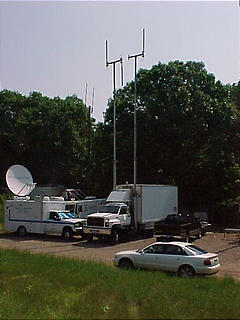
Cell Tower on Wheels

When the president leaves, Verizon’s two cell-on-wheels-trucks leave as well, leading some 15,000 locals to ponder who is paying Verizon to haul the two towers on and off of the island and the expense to run them.  The newspaper wondered the same and didn’t get a clear answer.

Laura Williams, a spokeswoman for the White House Communications Agency, said its job was to ensure “that the president has the best communications possible wherever he travels” so that he can “remain informed and connected.” But Ms. Williams would not answer specific questions about the enhanced service, including how much it costs and who pays for it, citing security concerns.

One thing is certain, the two or three week cell phone nirvana the island enjoys in the summer only benefits Verizon Wireless customers.  Those with AT&T, T-Mobile, and Sprint find themselves with no bars in virtually all places on the island.

That suits Linda Alley, whose home in West Tisbury is located right next door to one of Verizon’s temporary towers, just fine.

“I’m not attached to my cell phone like a lot of people are,” she told the Times. “I couldn’t care less.”


Sen. Chuck Schumer Proposes Security Lockout for Stolen Smartphones

Sen. Schumer

Senator Chuck Schumer (D-New York) has proposed cell phone carriers permanently disable stolen cellphones, unless and until they are reactivated by the original owner.

Currently, only Verizon Wireless shuts down stolen phones, preventing their easy reactivation.  Other carriers only disable internal SIM cards, which are easily replaced by any thief in minutes, and for a fee AT&T and T-Mobile will reactivate any phone.  Sprint only disables access to stored contact lists and contents of memory cards that often accompanying modern smartphones.  But anyone can reactivate a stolen Sprint or Nextel phone just by claiming to have acquired it legitimately from the former owner and replacing the removable SIM card.

The result of easy reactivation is a thriving black market for stolen phones, particularly in New York.

“Forty-one percent of all property crimes in New York City in the first half of this year were related to cellphones,” Schumer said, noting phones often sell for hundreds of dollars and are back in operation sometimes hours after being stolen.

SIM Card

Schumer says if carriers permanently disabled stolen phones until the rightful owners declare them retrieved, phones would become worthless to would-be thieves.

The senator notes that European carriers use each phone’s unique identification code to monitor the status of the phone.  Once reported stolen, overseas carriers will not reactivate a disabled phone without a signed statement from the original owner authorizing the transfer of ownership.

Schumer notes cell phone theft is rising dramatically in New York as more people start carrying increasingly sophisticated smartphones.

In 2009, 10,650 phones were stolen in the city.  In 2010 — 10,746.  So far this year, more than 11,320 phones have been taken by thieves.

[flv width=”640″ height=”500″]http://www.phillipdampier.com/video/WNYW New York Deactivate Cellphones 8-21-11.flv[/flv]

WNYW-TV in New York has raw video of Sen. Schumer’s press conference on cell phone theft.  (10 minutes)

Search This Site:

Contributions:

Recent Comments:

Your Account:

Stop the Cap!