Home » Consumer News » Recent Articles:

Verizon Ends White Pages Distribution in California

Phillip Dampier September 29, 2011 Consumer News, Verizon Comments Off on Verizon Ends White Pages Distribution in California

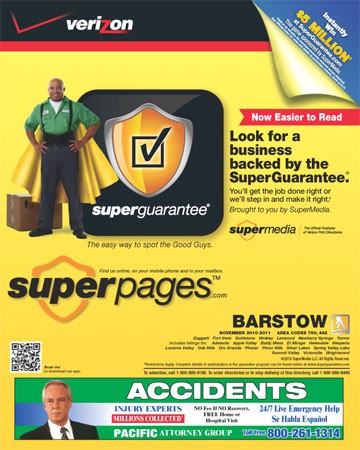
The Barstow Verizon Superpages

Verizon Communications today announced it was ending more than 100 years of residential telephone directory distribution, instead directing callers to online listings services or a CD-ROM, available free for California customers.  The White Pages will still be available upon request in print form, but the company expects many Californians will skip the request, keeping an estimated 1,900 tons of paper per year out of the California waste stream.

But if Verizon’s intent was to avoid excessive paper use, the effort comes up short.  The company will still automatically distribute the much larger, and much more lucrative Yellow Pages on every customer doorstep whether they ask for it or not.

Verizon asked the state Public Utility Commission to stop automatic distribution of the White Pages last October.  The PUC granted the request on June 9.  The last automatically delivered edition of residential listings will be the 2011-2012 Barstow Regional and High Desert Verizon Superpages in November.

Despite the discontinuation of the automatic delivery, customers will be able to order free residential print and CD-ROM versions of white pages directories by calling 1-800-888-8448 as each local yellow pages directory begins delivery.  In addition, all white pages listings are accessible at www.verizon.com/whitepages.

Telephone customers across the country, regardless of provider, can opt-out of all telephone directory delivery by visiting a website sponsored by the Association of Directory Publishers.

Clearwire Nearly Doubles “Lifetime” Rates for Some of Their Earliest Customers in Pacific Northwest

Phillip Dampier September 28, 2011 Consumer News, Data Caps, Wireless Broadband 1 Comment

Some of Clearwire’s very first, and most loyal customers in the Pacific Northwest are receiving an unwelcome message of thanks for their years of service with the company: a massive rate increase.

The company is nearly doubling rates for customers who were promised special “lifetime” discounts for agreeing to remain with the wireless 4G broadband service, which has been experiencing financial problems recently.

D.B. in Seattle has been a Clearwire customer for years, even before the company upgraded to WiMax speeds.  In 2009, Clearwire sent him an offer he couldn’t refuse: stay with Clear and pay just $22 a month (plus $5 modem rental fee) for life.

“Of course I accepted immediately,” D.B. writes. “Then Clear [sent me a letter recently] telling me my monthly fee was going up to approximately $47 a month with the modem fee.”

D.B. has been calling and e-mailing Clearwire asking what happened to the $22-for-life promotion he has in writing from the company, but “nobody knows anything.”

Clearwire says they have improved their service recently in Seattle, but D.B. isn’t impressed.

“I’m here to tell the world that is not true,” he says. “Plus the times I’ve had this thing freeze up has greatly increased, and usually I have to unplug the modem for five minutes [to get service back].”

Mireille in Seattle managed to get an even lower “lifetime” rate from Clearwire two years ago.

“They offered me a monthly rate of $19.95 for as long as I maintained uninterrupted Clearwire service. That means forever and ever until I cancel.,” she says.  “Last week they sent me an email letting me know that they were raising my rate to $35.95 a month (that includes a $10 a month ‘long time customer discount’) and since I was such a good customer I was being offered that rate for the life of my uninterrupted Clearwire service. Sound familiar?”

Mireille calls it something else: breach of contract.

“I spoke to three different people and no one had anything to say besides that they were sorry but they were not able offer me that rate anymore.”

Customers in the Portland, Ore. area are getting similar e-mails, and The Oregonian took note:

Clearwire Corp., a wireless Internet provider that operates as Clear, is raising prices for 30,000 customers who signed up for the service soon after its 2009 launch.

The Kirkland, Wash.-based company didn’t provide details of the rate hikes, but e-mails to customers show that monthly rates for some home Internet plans will rise from $35 to $45 beginning in October.

Clearwire said the rate hike affects both home and mobile customers who subscribed when the service was first available, at a time when rates were lower or promotional prices were available.

Clearwire still offers a home Internet plan for $35 a month, but it limits download speeds to 1.5 megabits per second — one-eighth the speed of Comcast’s standard plan. Clear’s standard plan, which now costs $45, promises downloads between 3 and 6 megabits per second.

AT&T Adds New Jobs in St. Louis to Handle U-verse Service Calls

Phillip Dampier September 27, 2011 AT&T, Consumer News, Video Comments Off on AT&T Adds New Jobs in St. Louis to Handle U-verse Service Calls

Suburban St. Louis is getting some new jobs and a $20 million data center upgrade courtesy of AT&T, which has announced it has nearly completed hiring 64 additional U-verse technicians and will renovate and upgrade a data center in Bridgeton, Mo. to handle Internet traffic.

AT&T U-verse has captured nearly 100,000 customers in the greater St. Louis area, which is the primary reason the company needed additional technicians.

But St. Louis resident Charles McNed isn’t positive these jobs are as good as AT&T might lead people to believe.

“AT&T is probably adding jobs through a contractor,” McNed says. “Last year I worked for an AT&T contractor and the training was horrendous and the pay was awful.”

The Bridgeton data center, in a building currently leased by AT&T, will be upgraded once the company completes the outright purchase of the property.  AT&T expects to spend approximately $20 million on infrastructure upgrades.

The company held a ribbon cutting ceremony this morning to break ground on the building renovations, and to celebrate the forthcoming use of compressed natural gas-powered service vehicles.

Bridgeton, an economically challenged suburb northwest of St. Louis, is welcoming the new jobs and hopes workers will choose to live and spend their money in the community of 15,000.  Bridgeton has been losing population since at least 1980.

[flv width=”512″ height=”308″]http://www.phillipdampier.com/video/KTVI St Louis ATT Announcing More Jobs In St Louis 9-27-11.mp4[/flv]

KTVI in St. Louis reports on AT&T’s expansion in northwestern St. Louis County, Mo.  (2 minutes)

Internet Overcharged: Verizon Reseller Sells California Man Wireless Data Plan That No Longer Exists

Phillip Dampier September 26, 2011 Competition, Consumer News, Data Caps, Editorial & Site News, Verizon, Video, Wireless Broadband Comments Off on Internet Overcharged: Verizon Reseller Sells California Man Wireless Data Plan That No Longer Exists

Company-owned store or third party reseller?

Customers who see the logo of their favorite wireless phone company on a storefront might do better to look a little closer to determine if they are doing business with a company-owned store, or a third-party reseller.  A Bakersfield, Calif., man quickly learned the difference when he bought a mobile broadband service plan from Go Wireless that Verizon says no longer exists.

Allan Fox found out the hard way when his first bill arrived with a steep overlimit fee attached, and without the broadband plan he signed up for.

Fox purchased the discontinued plan from Go Wireless, a third party reseller of Verizon Wireless services.  Fox thought he was purchasing a 3GB plan for $35, with a two-year service contract.  Verizon thought otherwise, and so began weeks of a runaround between Fox, Go Wireless, and Verizon.

It turned out that Verizon no longer offered the plan Fox bought from what he thought was Verizon Wireless itself.  Go Wireless is one of several independent third party companies that resell Verizon Wireless service, often with their own terms and conditions that include early termination fees owed not just to Verizon, but also to Go Wireless.

Go Wireless’ retail stores prominently feature Verizon Wireless’ logo, with their own logo appearing in reduced size, next to a message indicating they were a “premium retailer.”  That presumably sounds better than “third party reseller.”

After several attempts to straighten out the mess, Fox wanted to cancel his contract and just move on.  But then he discovered Go Wireless would charge him a $175 early cancellation fee, even though Fox’s predicament was their fault.  That’s when Fox called a local television newscast for help.

Wirefly is a major online reseller of Verizon Wireless

KBAK-TV news waded into the middle of the dispute that had gone on for nearly six weeks.  Verizon Wireless told the station it was willing to cancel Fox’s service penalty-free, but since Fox purchased the phone from a third-party reseller, and not from a company-owned store, Go Wireless would have to credit their own cancel fee.  Go Wireless, experiencing some turnover in local management, finally agreed to waive the fee, but only after the TV station got involved.

Customers must be careful when purchasing phones or signing contracts with third party sellers — both online and in traditional stores.  Most company-owned stores display their respective carrier logos and nothing else.  Words that usually provide a clue you are dealing with a reseller include: “authorized retailer,” “authorized dealer,” “Service provided by: (name of third party company),” “authorized agent,” and a dead giveaway is a signed contract with anyone other than the cell phone company you are using for service.

Third party resellers make their money on generous commissions earned when a customer signs a new contract or renews an existing one.  That commission can be forfeit if a customer returns the phone or cancels service early, which is why third party dealers protect themselves with their own contracts that include early termination or cancellation penalties owed to them, not the wireless provider.  Some customers can find themselves exposed to $500 or more in total cancellation penalty fees owed between the wireless phone company and the reseller.

So why do people purchase phones from these resellers?  Convenience and savings.

In smaller communities, company-owned stores may be few in number (or non-existent), and in-person help can be a godsend for customers who need to figure out their phone or obtain a warranty replacement.  Online, resellers like Amazon.com, Newegg, Wirefly, and others often charge substantially less than wireless carriers charge themselves for phones.  That savings can often be more than $100.  But these resellers are not for those who are unsure about the phone they want (or the provider).  Returning a phone or canceling service means dealing with two parties — the carrier and the reseller, to end service.  The cost of doing so can be very steep, so always read the terms and conditions before buying.

[flv]http://www.phillipdampier.com/video/KBAK Bakersfield Man has Internet billing trouble 9-26-11.mp4[/flv]

KBAK-TV’s Investigation Bakersfield unit helped a local man untangle a major billing mess that began when he was sold a mobile broadband plan that no longer existed.  (3 minutes)

Close Sezmi: Cable Alternative Ends Service Today

Phillip Dampier September 26, 2011 Competition, Consumer News, Online Video 2 Comments

Just over one year ago, Stop the Cap! introduced readers to Sezmi, a cable-TV alternative that delivered a package of selected cable networks, on-demand movies, video podcasts, YouTube content and local broadcast stations with a 1TB DVR set top box for $19.99 a month. Subscribers that decided to forgo the cable networks paid even less — $4.99 a month for service.

But no more.

As of this morning, Sezmi has discontinued its service, leaving customers with a nearly-worthless set top DVR box they spent $149.99 to acquire, and a number of questions about the company’s sudden change of direction.

The company issued a statement telling customers it has ceased monthly billing and giving customers until later this year to use some of the features Sezmi operates in-house:

We regret to inform you that Sezmi is discontinuing its consumer service. As of Monday, September 26, 2011, you will no longer be able to view or record broadcast TV programming through your Sezmi System. However, you will still be able to view movies and shows you have already saved to your Sezmi media recorder. To help ease the transition, you may also rent movies and shows if available at no charge from Sezmi’s On Demand catalog through November 1, 2011.

Why do you have to discontinue your consumer service?
Sezmi has changed its business focus to providing our product and technology platform to service providers, internationally and in the U.S., who are interested in providing broadband video services to their customers. As a result, we are no longer supporting our direct-to-consumer service.

What does this mean for me?
You will no longer be billed for Sezmi service. As of September 26th, you will no longer be able to utilize the programming guide and your digital media recorder will no longer operate as a recorder. You will be able to view movies and shows you have already saved to your recorder and YouTube access will not be affected. Between now and November 1st, you may rent any movies or shows at no charge to you. After November 1, Sezmi’s On Demand catalog will no longer be available but you will be able to use your Sezmi system to view all programming you have saved to the media recorder.

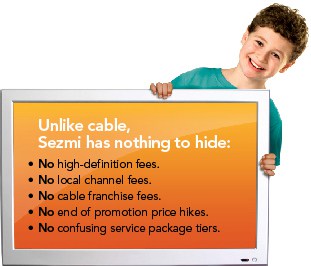
No Service After Sept. 26, 2011 didn't make the list.

What it also means is customers are stuck with a proprietary DVR box that won’t work with other services.

Sezmi’s business model was most operational in the Los Angeles market, where it leased unused spectrum from several LA-area television stations to carry its lightweight cable package.  In other markets, Sezmi simply wedded over the air digital free television stations with its online lineup of on-demand programming and charged $4.99 a month to watch.  It was never a compelling offer outside of Los Angeles, and even in that city, trouble brewed when Sezmi discontinued the cable package in December.

Among the difficulties Sezmi encountered:

  1. Finding cooperative local broadcasters willing to lease unused digital spectrum to Sezmi proved to be a difficult proposition.  Broadcasters are zealously guarding the frequencies they control now and do not want to get into long-term contracts with third parties.  Network owned stations in major cities may have already committed significant spectrum to their own sub-channels and other projects, or want to hold them in reserve for future use.  Besides, why lease spectrum to a company for a cable package large networks could theoretically build themselves.
  2. Sezmi lacked access to many popular cable channels, notably ESPN and HBO.  It’s difficult to get consumers to drop a cable or telco-TV subscription in favor of one that is limited to two dozen cable channels, some of which were hardly deal-sealers.  Efforts to move cable channel programming to online distribution were met with difficulty because content owners increasingly want a piece of the action.  Deep pockets are required to sustain video streaming businesses.
  3. Consumers never really understood the product and were not convinced to choose it over better known alternatives that included satellite TV.

Sezmi’s new focus on working with larger players could meet with some success, but Sezmi’s best chances of all could be developing the technology for ethnic audiences or other narrowcast opportunities where the lack of a hundred plus channel cable package would not be a factor.

Search This Site:

Contributions:

Recent Comments:

Your Account:

Stop the Cap!