Home » Consumer News » Recent Articles:

Alcatel-Lucent Announces VDSL2 Vectoring: 100Mbps on Copper Phone Lines

Phillip Dampier October 3, 2011 Broadband Speed, Competition, Consumer News, Public Policy & Gov't, Rural Broadband, Video Comments Off on Alcatel-Lucent Announces VDSL2 Vectoring: 100Mbps on Copper Phone Lines

While most rural telephone companies are selling customers 1-3Mbps copper-delivered DSL service, Alcatel Lucent has announced the commercial availability of VDSL 2 Vectoring, a new way of delivering up to 100Mbps over the copper wire telephone network most rural North Americans still depend on for telecommunications service.

VDSL2 combines a fiber-copper hybrid network similar to Bell’s Fibe or AT&T’s U-verse, with interference-cancelling technology called “vectoring” to deliver speeds much closer to the 100Mbps theoretical limit of current DSL technology.

“Alcatel-Lucent’s plan to make VDSL2 vectoring commercially available is very timely,” said Rob Gallagher, Principal Analyst, Head of Broadband & TV Research, Informa.  “VDSL2 Vectoring promises to bring speeds of 100Mbps and beyond to advanced copper/fiber hybrid networks and make super fast broadband speeds available to many more people, much faster than many in the industry had thought possible.”

A new way to boost copper speeds even faster.

Different flavors of DSL are currently in use around North America and beyond.  The most basic form, ADSL, also happens to be the most commonplace among phone companies offering basic broadband service.  For customers up to 12,000 feet away from a phone company central office, DSL delivers speeds usually at 1Mbps or faster.  Customers enjoying the fastest speeds must live much closer to the phone company facilities.  The further away you live, the slower your broadband speed.  In rural areas, consumers can live further away than the maximum distance of the central office, which means no DSL service for those subscribers.

A combination of signal loss and interference, called “crosstalk,” from adjacent copper wire pairs are both the enemies of DSL broadband, because they can drastically reduce speeds.

Telephone companies can address this problem by building new satellite central offices located halfway between customers and their primary facilities.  These offices, usually connected by fiber, can successfully reduce the amount of copper wire between the customer and the company, boosting speeds.  Many phone companies also deploy DSL extensions called D-SLAMs, which can be attached to a phone pole or enclosed in a metal box by the roadside.  A fiber cable connects the D-SLAM back to the phone company, while existing copper phone wires go back to individual subscribers.

More modern forms of DSL: ADSL2, ADSL2+, and VDSL, share some of those concepts.  The key is cutting as much copper wire out of the network as possible, replacing it with fiber optic cable which does not suffer signal loss or interference in the same way.

Many European and Pacific broadband networks rely on ADSL2/2+, which can usually deliver reliable speeds in the 20Mbps range.  VDSL networks offer even more bandwidth, and are the basis of U-verse and Fibe, which split up broadband, phone service, and television on the same cable.  When customers demand even faster speeds, phone companies can “bond” several individual DSL connections together to deliver faster speeds.  Some traditional ADSL providers do that today for their customers, especially in areas where low speeds prevail.

An argument the phone company will love.

Alcatel Lucent says VDSL2 with Vectoring is the next best thing to fiber to the home, because it is cheaper to deploy with fewer headaches from local authorities when streets and yards are dug up for fiber cable replacements.  It also meets the growing speed needs of average consumers.  Alcatel Lucent predicts the minimum speed North Americans will need to support the next generation of online video is 50Mbps, more than 10 times the speed phone companies like Verizon, AT&T, Frontier, and CenturyLink provide over their traditional DSL networks, especially in rural and suburban areas.

Vectoring can deliver results for phone companies with aging copper wire infrastructure, more prone to crosstalk and other signal anomalies.  Alcatel Lucent compares vectoring with noise-cancellation headphones.  By sampling the current noise conditions on copper cable networks, vectoring can suppress the impact of the interference, boosting speeds and delivering more reliable results.

With technologies like VDSL2 with Vectoring promising speeds far faster than what rural North Americans currently enjoy, the Federal Communications Commission may want to re-evaluate its national minimum speed standard for broadband — 3-4Mbps — found in its National Broadband Plan.  Alcatel Lucent promises they can do much better.

[flv width=”640″ height=”324″]http://www.phillipdampier.com/video/Alcatel Lucent VDSL2.flv[/flv]

Alcatel Lucent produced this video to promote its new VDSL2 with Vectoring technology.  The video targets cost-conscious phone companies who are being pressured to deliver faster service, but don’t want to spend the money on a fiber to the home network.  (6 minutes)

Cabot Cove Mystery: Maine Discovers Time Warner’s Digital Upgrade is Murder on VCRs

Phillip Dampier October 3, 2011 Consumer News 4 Comments

Even Jessica Fletcher can't solve the case of The Digitally Murdered VCR

Time Warner Cable customers in Maine are learning the cable operator’s move to digital cable is making VCR programming downright murder.

Although many of us have retired the videocassette recorder to closets, attics, or basements, millions of them are still being used on a daily basis to time-shift shows and to record one channel while watching another.  But in Maine, the first area to experience Time Warner’s shift to an all-digital cable experience, viewers like Nancy Blethen from Hallowell are learning those days are coming to an end.

Blethen shared her plight with the Kennebec Journal:

I read with interest the story about the converter box for Time Warner subscribers. Although, the idea of more channels is appealing, they really aren’t any that I care to watch.

Another point the story omitted is that if you have a VCR and connect the converter from your cable through the VCR to the TV set, you will only be able to record the channel you are watching. No more recording when you are not home or if you want to watch another channel while recording another program.

I spent at least 20 minutes on the phone with a tech person, and they checked with their supervisor and concluded that this is something subscribers will have to live with, at least for the present. You can avoid this by using one of their DVR recorders, but at an additional monthly fee. Time Warner is the only choice I have where I live so I have to forget recording on the VCR.

Although Time Warner Cable will happily supply a digital solution to this analog quagmire, it doesn’t come for free.  DVR service costs $13 a month or more each month.  While it solves the problem of the flashing 12:00-clock for confounded consumers, it also increases their cable bill by well over $100 a year, more than the cost of the VCR (and tapes) that used to let them record shows for free.

Time Warner Launches Free Slingbox Rebate Offer: NYC Customers Only

Phillip Dampier October 3, 2011 Consumer News, Online Video Comments Off on Time Warner Launches Free Slingbox Rebate Offer: NYC Customers Only

As we originally reported a few weeks ago, Time Warner Cable has launched a planned fall promotion offering new Wideband and SignatureHome customers a $300 rebate on a Slingbox PRO-HD purchased at a participating local Best Buy store or through the retailer’s website until November 30, 2011.

The high-end Slingbox allows customers to stream live cable programming and other video across their home broadband connection to computers, smartphones, or tablets (the latter two require a separate purchase of a $30 iPhone/iPad or Android app).

The offer is good only for Time Warner Cable customers serviced by the company’s New York City division who install new Wideband (50/5Mbps) standalone broadband service for $99 a month or who sign up for the company’s SignatureHome tier ($199/month), which includes Wideband service.  Existing Wideband or SignatureHome customers are not eligible, but current Time Warner customers who upgrade to either service are.

Time Warner Cable has configured the rebate offer to make sure customers pay on time and stay put for at least six months after signing up.  The rebate will appear as a $50 service credit for six months after being successfully processed.  If you pay your bill late or cancel service within six months, subsequent rebate service credits will be cancelled.

If you take advantage of this promotion, we strongly suggest you sign up for automatic payments to avoid a missed payment, which could cost you up to $300 — the value of the rebate — plus any associated late fees.  Remember, you also have to receive service from Time Warner’s NYC operation and the Slingbox must be purchased from Best Buy to qualify for the rebate.

Time Warner’s rebate website accepts online rebate submissions, so you can scan and keep your original receipts.  Since the cable operator will accept rebate submissions until February 15, 2012, there is plenty of time to refile if your original rebate request is lost.

[flv width=”640″ height=”331″]http://www.phillipdampier.com/video/SignatureHome Ad 9-2011.flv[/flv]

Time Warner Cable unveiled new advertising for its super-premium SignatureHome service last month.  The “concierge” service will bring your monthly cable bill to $199.  The concept of the $200 cable bill was unheard-0f just ten years ago.  (1 minute)

Verizon Wireless Fraudulently Pumped Up Prepaid Numbers, New Lawsuit Claims

Phillip Dampier September 29, 2011 Competition, Consumer News, Verizon, Wireless Broadband Comments Off on Verizon Wireless Fraudulently Pumped Up Prepaid Numbers, New Lawsuit Claims

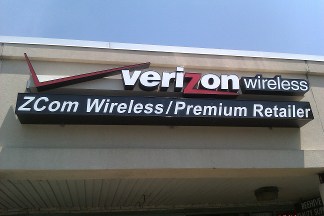
A ZCom owned Verizon Wireless store in New Jersey

Verizon Wireless executives forced independent authorized resellers of the company’s prepaid wireless service to buy cheap phones and activate them with their own money, fraudulently boosting the number of so-called “new activations” Verizon reports to its stockholders.

That is the chief allegation in a new lawsuit filed not against Verizon Wireless itself, but its largest franchisee, ZCom.

The NY Post reports Verizon Wireless executives who managed independent New York Verizon retailers masterminded the alleged scam by suggesting Verizon Wireless’ biggest franchisee, ZCom, “fraudulently increase the number of Verizon Wireless new account activations through the fabrication of fraudulent prepaid accounts,” the suit charges.

ZCom, which sub-leases authorized retail locations for Verizon products, was the defendant in the suit because ZCom can make or break independent store owners who sub-lease, staff, and manage the retail stores.

Plaintiff Shelly Bhumitra, who sub-leased several Suffolk County stores from ZCom, told The Post he was pressured to fraudulently activate pre-paid phones when a Verizon Wireless executive came to his store with ZCom’s owner, Iminder “Vikas” Dhall.

“They suggested that with our own money we should buy inexpensive phones [not smartphones],” and then load them with $30 of prepaid minutes, he said in an interview.

Bhumitra said he was then told to “give them away as bonus phones” to customers so that when used they would count as new activations.

The store owner said he was also instructed to load prepaid minutes onto phones that customers were throwing away and activate them with fictitious names. He was told to keep them in a drawer and make calls on them once or twice a month, echoing charges in the suit.

A store owner would ultimately earn $55 from each activation — enough to more than make up for the $30 outlay.

The three Verizon Wireless executives outed for allegedly taking part in the scheme have all recently resigned, according to the lawsuit.

Verizon itself is taking several measures to distance itself from the case.  Not being named as a defendant has allowed the company to avoid commenting, claiming it would be “inappropriate.”  The company also canceled its contract with ZCom, which generates $150 million in revenue for Big Red every year and holds the “master lease” to 130 Verizon Wireless stores, which are all over downstate New York.  For now, those store locations will remain open.

ZCom’s lawyer denied the allegations in the lawsuit.

Quarterly financial reports can make all the difference for shareholders who can make or break a stock based on financial results.  Verizon Wireless has had an increasingly challenging time managing to grow its prepaid division, which industry observers say used to charge more than its competitors for no-contract plans.  By inflating the number of new activations in company results, shareholder value is artificially protected.  Store owners can be convinced to play along because of lucrative new customer signing commissions, and to meet required sales targets.  Poorly performing store manager/owners can find their leases terminated and, in a worst-case scenario, the store location itself can be closed.

Bhumitra claims he was intimidated into going along with the alleged scam.

Verizon Wireless has tried to compete more aggressively in the prepaid category in 2011, with some success.  After creating new monthly packages bundling voice minutes with data and texting at lower pricing, the company added 879,000 new prepaid customers in the first quarter, and 1.3 million in the second, the Post reports.


Hype Over Comcast’s “Low Income Internet” Reaches New Levels of Ridiculousness

1.5Mbps "broadband" is not the cure-all Comcast claims it to be.

When multi-billion dollar Comcast Corporation decided it was the right time to acquire multi-billion dollar NBC-Universal, one of the concessions Comcast made to win federal approval of the deal was to deliver budget-priced Internet service to those too poor to pay the company’s current asking price of $40-60 a month.

Comcast Internet Essentials was the result, and as Comcast rolls its publicity train from city to city, promoting the new package, politicians and cable executives have teamed up to take credit, suggesting the company’s limited-access $9.95 1.5Mbps service will somehow erase the high-tech job deficit, eliminate the digital divide, and will even somehow help America’s broadband speed gap with the rest of the world.

But it will do none of those things for the vast number of income-challenged families who won’t actually qualify for the three year program, either because they already scrape up enough for Comcast service, don’t have children, or manage to miss a payment due date.  In fact, 1.5Mbps budget-priced Internet is a service providers should have been willing to offer all along, to anyone who wants the service.  But it took a colossal-sized merger concession to get Comcast to sort of do the right thing.

I say “sort of” because the terms and conditions that accompany the service resemble the gotcha fine print the banking industry so loves:

The program is only available to households that (i) are located where Comcast offers Internet service; (ii) have at least one child who receives free school lunches through the National School Lunch Program (the “NSLP”) and as confirmed annually while enrolled in the program; (iii) do not have an overdue Comcast bill or unreturned equipment; and (iv) have not subscribed to any Comcast Internet service within the last ninety (90) days (sections 1(i)-(iv) collectively are defined as “Eligibility Criteria”). This program is not available to households that have children who receive reduced price lunches under the NSLP. The program will accept new customers for three (3) full school years, unless extended at the sole election of Comcast. Comcast reserves the right to establish enrollment periods at the beginning of each academic year in which it accepts new customers that may limit the period of time each year in which you have to enroll in the program.

2. In order to confirm your eligibility for the program, Comcast will need to verify that your children receive free school lunches through the NSLP in the initial enrollment year and each subsequent year you are enrolled in the program. In order to confirm eligibility, participants in the program will be required to provide copies of official documents establishing that a child in the household is currently receive free school lunches through the NSLP. Each year you will be required to reconfirm your household’s current eligibility by providing Comcast or its authorized agent with up-to-date documentation. If you fail to provide documentation proving your eligibility in the program, you will be deemed no longer eligible to participate in the program.

3. You will no longer be eligible to participate in the program if (i) you no longer have at least one child living in your household who receives free school lunches under the NSLP; (ii) you fail to maintain your Comcast account in good standing; (iii) Comcast ceases to provide the Covered Service to your location; or (iv) your account opened under the program is closed. A change in address may result in your account being closed, even if you continue to receive Comcast services at a different address. Program participation also may be terminated if the Covered Service is upgraded, altered or changed by you for any reason. If you are no longer eligible for the program, but continue to receive the Covered Service from Comcast, regular rates, and any other applicable terms and conditions will apply to the Covered Service.

No kids in your home?  No discount Internet access for you!  Refuse on principle to accept a government handout to pay for school lunches?  Sorry, you need to buy the full-priced Internet Comcast will happily sell you.  Missed a cable bill payment because you needed to buy medicine this month?  It will cost you your inexpensive access.  Comcast even reserves the right to cancel your discounted service if you choose (or are forced) to move.

Most would-be customers who assume they are eligible because they, like so many others, are income-challenged these days, are thrilled to read and watch news accounts about the discount Internet program for their kids.  But like Santa reneging on Christmas, the excitement turns to disappointment when they discover they are ineligible for one reason or another.

In Baltimore, WBAL-TV got nearly breathless with excitement telling their audience, “Things are looking up for Maryland families — way up. A new effort is under way to help connect 250 families to cyberspace at an affordable price.”

Baltimore is a city of 620,000 people.  Before the Great Recession, 15.4% of families and 19.3% of Baltimore’s residents fell below the poverty line, excellent candidates for inexpensive Internet access.  That’s more than 32,000 people, but Comcast is apparently making room for just 250.

Despite those figures, Comcast’s David Cohen thinks his company’s discount Internet will make all the difference.

“We believe we have a shot to be able to make a real impact on the digital divide with this program,” he told the Baltimore TV station.

He might be right… for 250 families anyway.  Everyone else… pay up or go without.

Terms and conditions apply

WBAL Investigative reporter Jayne Miller got slightly carried away on behalf of Comcast, equating their program with a solution for high-tech jobs and increased Internet speed:

Internet access and speeds have become national issues. The U.S. lags behind other countries in broadband availability, hurting what some believe to be the nation’s ability to compete, said Miller.

In comparison, “China recently graduated over 440,000 engineers, and we in the U.S. graduated 65,000,” said U.S. Rep. “Dutch” Ruppersberger.

I’m sorry to bring people back to reality, but 250 families getting the right to buy up to three years of Internet access at speeds that are half of what the FCC National Broadband Plan defines as actual broadband is not an answer to anything beyond Comcast’s poor public relations in the customer service department.  It’s not going to help America’s broadband speed rating (it will actually hurt it at 1.5Mbps).

WBAL is hardly the only station overdoing their celebrations of Comcast (a prolific advertiser by the way).  I’ve watched reports that suggest Comcast is doing this out of the goodness of their heart, not because they agreed to as a condition of their mega-merger with NBC.  Considering the lawyer-like limitations that are certain to keep many people out of the program and others from downgrading their existing service to something more affordable, charity is hardly a word I would extend to the nation’s largest cable operator who found cause to limit access to even the lowest broadband speeds to protect its bottom line, which it hopes will get much fatter with the acquisition of NBC-Universal.  When the three year program ends, let’s just see how charitable Comcast is about extending it.

[flv width=”480″ height=”290″]http://www.phillipdampier.com/video/KASA Santa Fe Internet Accessibility with Internet Essentials 8-26-11.mp4[/flv]

KASA-TV in Santa Fe talks with their “very good friend at Comcast” about Internet Essentials and the company’s general Internet expansion plans in New Mexico.  The interview resembles an infomercial for Comcast products and services.  (5 minutes)

Search This Site:

Contributions:

Recent Comments:

Your Account:

Stop the Cap!