Home » Consumer News » Recent Articles:

Frontier Losing 8.5% of Customers Every Year; Products Like ‘Second Connect’ Explain Why

Frontier Communications continues to lose access line customers at a rate of 8.5 percent overall, 9.8 percent in the former Verizon service areas they acquired more than a year ago.  The company’s third quarter results show lackluster performance as revenue declines of 30 percent impacted both their residential and business customer units.

Company officials spent most of the question and answer session responding to Wall Street concerns about revenue, spending, promotions, customer churn, the company’s pension fund, and the outright defection of Frontier FiOS TV customers away from the fiber network the phone company inherited from Verizon.

Mike McCormack of Nomura Securities suggest the weak figures should concern investors because it may show Frontier unable to compete effectively with cable companies, which also offer phone service.

Frontier CEO Maggie Wilderotter put her best face forward trying to promote the company’s successes, particularly bringing DSL broadband to former Verizon service areas:

“Our broadband expansion reached an additional 126,000 new homes in the acquired properties during the quarter, bringing our year-to-date total to 352,000 which is on track to reach our 2011 goal of increasing broadband availability to more than 400,000 additional homes. Broadband availability in the acquired properties is now 80%, a significant increase from the mid-60% range when we acquired them. As a result of our expansion and sales efforts, we had a very strong quarter for broadband growth, adding 16,900 total DSL subscribers, a 38% sequential increase from Q2. We also added 2,300 wireless data customers. This growth reflected the effectiveness of our local engagement model, as well as organic demand for broadband in both legacy and acquired properties.

“We have also largely completed our efforts to migrate middle mile congestion, which now gives us the ability to more effectively market higher speeds in markets that were already enabled.”

Frontier executives sought to portray West Virginia as their biggest success story.

Daniel J. McCarthy, Frontier’s chief operating officer and executive vice-president, claims Frontier’s installation of 12 integrated fiber rings throughout the state provides broadband capacity and integrated network capability beyond what is available anywhere else in the United States from a state-wide perspective.  McCarthy claims Frontier is on track to turn West Virginia from one of the least connected states in the nation to one of the most connected.

But Margaret Kings from MacArthur, W.V. says she’ll believe it when she sees it, and she hasn’t seen it yet.

“My extended family has experienced endless problems dealing with Frontier in this state, and I have relatives in the Panhandle to boot,” Kings says. “We have collectively won more than $300 in service credits for out of service broadband and phone service, slow speeds when it rains, and missed appointments, billing errors, sneaky charges, and contract disputes.”

Kings’ immediate family left Frontier for Suddenlink more than a year ago when she moved.

“Why pay Frontier more for phone service and 1.7Mbps broadband when I can pay Suddenlink less for their phone service and 10Mbps Internet access,” she asks.

Frontier hopes to win back former customers with new broadband services, such as their newly-introduced “Second Connect” service, which delivers a second DSL line for existing broadband homes for what the company claims is $14.99 a month.  Frontier says a few thousand customers have signed up for the service, which is now being pitched aggressively by Frontier’s call centers.

But some customers who have signed up for the service are accusing Frontier of billing fraud for wildly misleading customers about the true cost of the service.

The $14.99 price tag Frontier advertises omits modem rental fees, taxes, surcharges, and other fees customers first discover on their monthly bill.

Chris Photoni discovered, after five calls and a combined two hours on hold, the true out-the-door price for Frontier Second Connect is actually $48 for him.  The Broadband Reports reader elaborates:

Don’t waste your time. Even after the ‘corrections’ the Second Connect line cost around $48. I say ‘around,’ [because] I haven’t met a staff member yet that could correctly calculate tax. How convenient for you Frontier. Their computer system can calculate it for your bill, but is unable to calculate it when inquiring about the service.

The new ‘taxes’ come to $27.64!

Frontier is one of the worst phone companies. They have terrible customer service, and the wait times usually seem to be 20-30 minutes per call. Most issues take at least THREE calls to resolve. I’ve actually have been on hold for 25 minutes as I’m writing this.

Kings said she wouldn’t have bothered inquiring about Second Connect in the first place.

“Let me understand this,” she writes. “The same phone company that offers 1.7Mbps to my house wants another $15 a month to ‘double my speed?’  I could pay $100 a month to Frontier for 3Mbps broadband along with my phone line or pay Suddenlink $100 for 10Mbps broadband, phone and cable-TV service.”

Other highlights from the conference call:

  • Frontier is getting into the home security business in a two state trial with ADT and Protection 1.  Customers will be strongly encouraged to bundle the home security service with other telecommunications products to hold them in contracts and provide discounts up to 15 percent;
  • Frontier will begin to resell AT&T wireless voice and data services in bundles with existing products. Frontier plans to trial this service during the first half of 2012 before expanding it nationally.  This service is only going to be available to bundled service customers.  Why customers wouldn’t pursue an agreement with AT&T themselves, without the phone company’s involvement, isn’t well-explained;
  • The company plans no significant high-value promotional offers for the 4th quarter.  They didn’t pitch any during the 3rd quarter either.  Customers with pre-existing promotions, including “free satellite TV for 2011” or “six months of free DSL” will find their bills rising considerably as those promotions expire in the next few months;
  • Frontier’s pension plan is not in the best shape.  The company had to contribute $58 million of real estate to the plan fund to manage investment losses for the year;
  • Frontier’s $500 FiOS installation fee has effectively kept new customers away from the fiber network.  Although the company claims it wants to maintain support for FiOS, video customers have left in droves and a smaller number of broadband customers have left as well, primarily for Comcast;
  • Frontier plans to continue investment in its middle mile network to handle broadband traffic growth in 2012 and 2013.

Why Does AOL Dial-Up Still Have 3.5 Million Subscribers?

Hurricane fast it isn't.

More than three and half million Americans are still paying AOL around $17.50 a month for painfully slow dial-up Internet access.

Long declared irrelevant by the technology elite, AOL continues to plod along with millions of customers more than a decade after the company stopped subsidizing the U.S. Postal Service with millions of sign-up disks mailed endlessly to American homes.

Among AOL’s holdout subscribers are the 7 percent of Americans who still believe dial-up is their best option.  Twenty percent of those surveyed by Pew Research said their commitment to dial-up was as sacred as their marriage vows, and nothing would get them to change.  But for most, the only things keeping them from throwing AOL under the bus are:

  • The cost: Almost one-third of those surveyed cited the high cost of broadband as the primary reason for not signing up;
  • Access: 17 percent are ready and willing, but their local providers are not.  Broadband is simply unavailable in many areas unserved by cable or deemed unprofitable by incumbent phone companies;
  • Other Reasons: Almost 30% cited other reasons for not switching, with the most likely being they don’t know or understand their broadband options, they are getting free dial-up access and free is always good, or their local providers didn’t deliver reliable service.

AOL -is- still in business.  While it has been a long time since AOL’s glory years, when the company provided more than 26 million Americans their Internet access, the company still counts today’s 3.5 million users a win.  That may be true for those who don’t need more than basic “You’ve got mail!” service or those suffering from today’s difficult economy.  But cable operators and phone companies do offer price-sensitive dial-up customers a faster alternative.  It’s too bad they rarely bother to market it.

So-called “light user” plans that offer 640kbps-1.2Mbps speeds — much faster than dial-up but hardly “broadband” — are available for $15-26 a month.  For someone paying AOL $17.50, some of these services are more expensive, but probably still within reach when compared to the traditional $45 standard broadband account companies do advertise.  But too often, these budget plans are the best secret in town, under-marketed because of a fear existing broadband customers might seek savings by downgrading traditional (and more profitable) broadband service.

Cablevision: An Attractive Takeover Target for Time Warner Cable, Says Barron’s

Phillip Dampier November 7, 2011 Cablevision (see Altice USA), Competition, Consumer News Comments Off on Cablevision: An Attractive Takeover Target for Time Warner Cable, Says Barron’s

Cablevision Systems may be engaged in a long term effort to position itself for a sale, some New York investment firms have come to believe.  The most likely buyer?  Time Warner Cable.

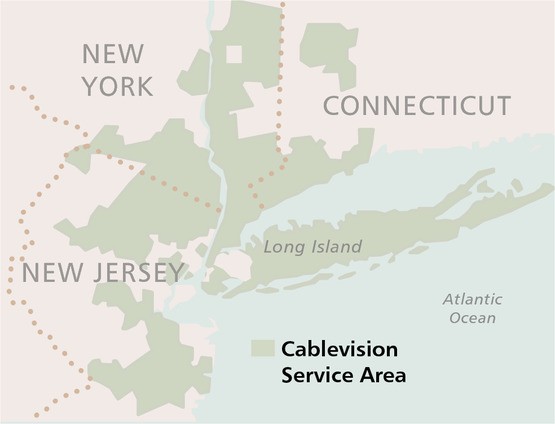
The bulk of Cablevision’s assets are located in several boroughs of New York, Long Island, New Jersey and Connecticut.  Virtually all of their service areas, outside of the acquisition of Bresnan Cable in the mountain west, are adjacent to Time Warner, making an acquisition by the nation’s second largest cable operator a natural fit.

This isn’t the first time rumors of a Cablevision sale have been floated.  The Dolan family has run the cable operator for decades, with family patriarch Charles Dolan still controlling a sizable interest in the company.  Barron’s notes the senior Dolan is currently in his 80s.  Son James, current president and CEO of Cablevision, seems more interested in his leadership role at Madison Square Garden, spun-off from Cablevision last year.

“I think the Dolans have positioned the company for a sale,” Mark Boyar, who heads Boyar Asset Management, told Barron’s.

Boyar points to Cablevision’s ongoing efforts to minimize their involvement in side businesses, such as MSG and cable networks like AMC, spun away from Cablevision on June 30.

Buyers like transactions to be simple and straightforward, and Cablevision’s operations increasingly meet both standards.

On its own, Cablevision’s growth opportunities come mostly from rate increases, which subscribers routinely complain about.  The company already enjoys the highest penetration rate among major cable operators and the highest average monthly revenue per subscriber — $150 a month vs. $113 for Time Warner Cable.  With a depressed economy and fierce competition from Verizon FiOS, growing the business (and the stock price) has become increasingly difficult in a maturing industry unlikely to attract new subscribers.

Among the only prospects for subscriber growth on the horizon comes from satellite TV subscribers.  But that alone may not be enough to keep investors satisfied, much less excited.  A sale could bring shareholders a massive return on their investment, particularly if a bidding war breaks out between likely buyers Time Warner Cable and Comcast.  Shareholders ultimately own the company, and should the Dolan family lose their love affair with cable, Cablevision and their subscribers will likely find themselves on the auction block.

Time Warner Cable Suffers Nationwide Outage, But At Least It Didn’t Last Long

Phillip Dampier November 7, 2011 Consumer News 4 Comments

The nationwide outage lasted just a few minutes for some, about 20 minutes for others.

Time Warner Cable customers across the country noticed a nationwide outage of the cable company’s broadband service this morning.

Customers from New York to California to Texas first noticed the outage at around 9am EST, which appeared to first affect the company’s DNS servers, but attempts to switch to other DNS providers only worked briefly before they began to fail as well.  Inbound and outbound traffic was impacted.

The outage lasted approximately 20 minutes for customers relying on Time Warner’s DNS servers and just a few minutes for those who don’t.  Thanks to Stop the Cap! reader Tom for dropping us a note and letting us know.  We already knew — Stop the Cap! HQ is powered by Time Warner Cable broadband and it was out of service here in Rochester, N.Y. as well.

The company acknowledged the “large but brief Internet outage affecting most of our service areas” and requested customers still impacted reboot their cable modems.  That’s advice unlikely to help those who can’t access the Internet to read those instructions, however.

Because the outage lasted less than one hour, and only a few minutes for many, customers are not entitled to service credits this time.

It could be worse.  Some AT&T and Cablevision customers in parts of Connecticut are expecting to be without Internet or cable service for as long as two weeks after the snow storm that struck the area Oct. 29-30, bringing down utility poles and cable lines.

At least 50,000 people in the Nutmeg State have begun their second week without electricity as Connecticut Light and Power missed their self-imposed deadline to get the lights back on by midnight last night.  Power isn’t expected to be fully restored until Wednesday.  Cable and telephone crews cannot begin repair efforts until electrical service is up and running.

Chanting “Verizon is Destroying the Middle Class,” Employees Join ‘Occupy’ Movement

[flv width=”360″ height=”290″]http://www.phillipdampier.com/video/WBGH Binghamton Verizon Supports Occupy Binghamton 10-28-11.mp4[/flv]

Verizon employees in upstate New York are joining the “Occupy” movement that began protesting Wall Street, but has since broadened to include criticism of some of America’s largest corporations.  Company employees are arriving at “Occupy” protests holding signs attacking the company for “destroying the middle class” through job and benefit cuts.  The protests are also impacting cable operators.  Several arrests were made this week by protestors at Comcast headquarters in Philadelphia.  Most of the protestors are concerned about jobs and the pervasive influence corporate lobbyists have on American public policy.  WBNG in Binghamton covers the protests against Verizon.  (2 minutes)

Search This Site:

Contributions:

Recent Comments:

Your Account:

Stop the Cap!