Home » Consumer News » Recent Articles:

Time Running Out on New England Cable/Phone Customers Seeking Storm-Related Credits

Phillip Dampier November 29, 2011 AT&T, Cablevision (see Altice USA), Charter Spectrum, Comcast/Xfinity, Consumer News, Cox, Dish Network, Public Policy & Gov't, Video Comments Off on Time Running Out on New England Cable/Phone Customers Seeking Storm-Related Credits

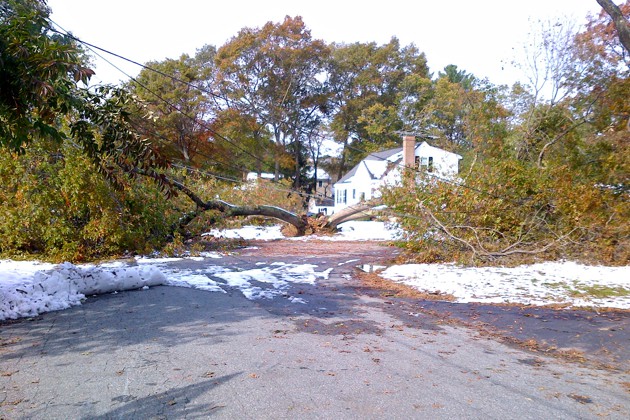
Storm damage in eastern Massachusetts. (Courtesy: WGBH Boston)

The northeastern United States got more than its fair share of severe storms these past few months.  Remnants of Hurricane Irene caused severe flooding, heavy rainstorms that followed didn’t help.  But one of the worst of all was the Halloween Nor’easter that left serious wind damage in some areas, heavy snowfall in others, leaving customers without power, phone, cable, and broadband service for days, if not weeks.

Telecommunications companies including Cablevision, Charter Communications, Comcast, Cox Communications, Dish Network, Time Warner Cable, and Metrocast Communications of Connecticut are under fire across the region for not providing automatic service credits for impacted customers.  Charter and Comcast are both facing a class action lawsuit filed last week by a Massachusetts law firm that accuses the cable operators of “gouging” their customers by not automatically crediting affected subscribers for lost service.

Jeffrey Morneau of Springfield, Mass. law firm Connor, Morneau & Olin says up to 1.2 million Charter and Comcast customers were without service, but the companies will only provide credits on a case-by-case basis, and only if customers request them within a short time after the outage occurred.

“If you pay for a service and you don’t get it, the company can’t keep your money,” Morneau said.

Stop the Cap! readers in Massachusetts and New Hampshire report Comcast will grant reasonable service credit requests, assuming you get through to ask for them.

“Hold times are epic,” reports Tom Turlin, a Comcast customer in Massachusetts.  “I managed to get my credit by using their web contact form instead.”

Most providers require consumers to request credits for outages within 30-60 days of the service interruption, and time is running out for Nor’easter credits.

“Most people think they will only get 50 cents back so why bother, but actually with today’s huge cable bills, credits can be substantial,” Turlin says. “I received almost $15 back on my bill.”

Only AT&T, Connecticut’s largest phone company, agreed to automatically credit customers the company determined were without service for at least 24 hours.  Customers who don’t receive credit automatically can appeal to the company for credit they believe they are entitled to receive.

Here’s how different companies are responding:

AT&T: “We will give U-verse TV customers in Connecticut who experience a service outage for longer than 24 hours a pro-rated credit,” AT&T said. “In addition, we will voluntarily give similar credits for U-verse Voice and U-verse High Speed Internet service customers who experienced a service outage for longer than 24 hours. Customers are not required to take any action: the credits will be applied automatically on the customer bill for impacted customers within the next several billing cycles.”

Cablevision: “While state law provides for consumer credits for qualifying outages for cable service only, Cablevision has been providing a credit to customers on an individualized basis for all their services,” Cablevision said. “Customers will be credited when they notify us that they had a service outage. We are extending our normal period to request refunds to 45 days from the date of the storm.”

Charter: Customers must call or visit the cable company offices in person to request service credit.  “We are providing credit to customers for the entire time they were without service, from the time they lost power to the time their Charter services were fully restored, and we are providing credit for all services,” Charter said.

Comcast: “In order to receive a credit, a customer must contact Comcast and identify the time period during which they did not have access to Comcast services,” Comcast said.

Cox: “We need our customers to call us after their service is restored to report that they were without Cox services, and for how long,” Cox said. “We then credit their accounts from the time of the service outage until service was actually restored.”

DISH Network: The satellite provider is waiving service and equipment fees for consumers who need their equipment realigned, reinstalled or repaired due to the storm. “DISH subscribers who indicated that they were without service due to the storm were provided a credit for their time without service,” DISH said. “In addition, DISH subscribers who needed to suspend their service due to storm damage were allowed to do so at no charge.”

MetroCast Communications of Connecticut: It will provide customers with a refund on their next invoice after contacting the company. “The credit equals a prorated amount of the affected customer’s monthly charges for all MetroCast services, calculated based on the number of days during which such services were interrupted, and are included in the customer’s next invoice,” MetroCast said.

Time Warner Cable: Customers must contact the cable company online, by e-mail or phone and request credit for the number of days they were without service.  Most service credit requests that can be verified are granted within hours, and will appear on the next billing statement.

[flv width=”640″ height=”380″]http://www.phillipdampier.com/video/WSHM Springfield City councilor Comcast disagree on cable rebates 11-21-11.mp4[/flv]

WSHM in Springfield covers the ongoing dispute city officials have with Comcast, who is refusing to automatically provide storm credits to customers impacted by the October Nor’easter.  (2 minutes)

Dear Valued Time Warner Cable Customer: Pay Us More… Or Not — Here’s How

Phillip Dampier November 29, 2011 Competition, Consumer News, Editorial & Site News 1 Comment

Pay $160 a month... or $89.99

Time Warner Cable attached their new rate schedule to my November cable bill which arrived in the mail last week.  It’s the second major rate increase in western New York this year, and it means customers who just want to watch standard basic cable television will now pay $80.50 a month to do so.  We’re a long, LONG way from the $20 cable TV package the industry used to advertise as “less expensive than a cup of coffee a day.”  This is Starbucks’ coffee pricing, with no end in sight.

Time Warner Cable’s Triple-Play package of phone, Internet, and television service will now run $160.49 a month here in Rochester.  It wasn’t too long ago that a bill that size was reserved for the gas and electric company, or perhaps for a used car payment.  That’s before taxes, franchise fees, and other pad-ons, too.  Need that extra set top box?  Add another $7 a month each with remote control.  Want to speed up your broadband?  $10 a month for that.  HBO?  Time Warner Cable’s premium channel-pricing completely ignores today’s economic and marketplace (Netflix/Redbox) realities.

The cable company does have competition in the television business. In the same day’s mail was the latest offer from DirecTV, which has nearly as many sneaky extra fees as local phone company Frontier Communications.  That $24.99 a month “amazing deal” starts to snowball as you build a package, and it also means a satellite dish on your roof, which some people just don’t want.

Assuming you stick with the cable company’s triple play package, the sobering truth is that doing business with Time Warner at their everyday-high-pricing will cost you at least $1,920 a year.  But you don’t always have to pay them the asking price.

So with rate increase notice in hand, what can you do?

  1. Call them up and tell them the relationship is over unless changes are made.  Good things come to those who wait for the other side of the relationship to start sacrificing for a change.  You’ve coped with rate hikes for years and cable companies keep shoveling more channels you never watch and then raise rates because of “increased programming costs.” This time, let the cable company give a little.  Call and tell them you want to disconnect your service two weeks from today.  A retention specialist will attempt to negotiate with you (starting with efforts to pare down your package, leaving you still paying regular price for fewer services).  Be non-committal,  because better deals will start to arrive by phone as early as a few hours after telling them you’re leaving.  (But you have to answer those unfamiliar Caller-ID calls to hear about them.)  The worst that will happen is you don’t win a significantly better deal. You still have two weeks to rescind the cancel request with no interruption in service and at least get something for your efforts.  Consolation prizes to sweeten a mediocre retention deal: free sample of premium channels, a free Turbo-class upgrade for Road Runner, and/or a break on DVR service.

  2. Compare prices.  If you live in an area with telephone company-delivered TV, offer to stay with the cable company if they will match the new customer offers you are probably already getting pelted with in your mailbox.  Most will.  There are customers who literally bounce back and forth between AT&T/Verizon and Comcast/Time Warner Cable year after year just to keep the $89-99 triple-play promotional price that effectively never expires.  Getting your existing provider to match it saves you and your provider the time and hassle of switching.

  3. Demand a new customer price.  Do a Google search for “Time Warner Cable deals” (or for your respective cable company) and at least a dozen offers will appear, mostly from third-party, authorized resellers.  Double-play offers for broadband and cable-TV often range between $75-85.  A triple play offer which adds phone service is usually just a few dollars more.  Some resellers pitch combo offers that deliver a discounted rate and a substantial rebate ($150), like the one below:

TURBO INTERNET, TV+HD, VOICE


  • Free DVR Service for 12 months
  • You Get $150 in Rebates!
  • No Fee HD
Features:

  • Digital Cable with Free On Demand Programming
  • On-Screen Program Guide
  • Parental Controls
  • Blazing High Speed Internet
  • Unlimited Calling anywhere in the US
  • No-Hassle standard Installation
  • Call Waiting, Caller ID, Call Forwarding and more are included at no extra charge
  • Plus You Get A 3 Month Free Trial of HD Service!
only
$99.99/mo
for 12 month

Ask Time Warner to match the price of these offers (you likely won’t get the rebate, however).  They certainly can come close on retention deals — in fact they will go as low as $85 a month for an annual triple play deal in some areas.

Some customers deal with intransigent retention agents by canceling service and quickly signing up as a new customer soon after.  That is more of a hassle, and some areas require a waiting period before they’ll offer a new customer promotion again, but the usual trick around this is to sign up under a spouse’s name.

It pays to shop around and read the fine print carefully.

For example, in the deal above, I highlighted three important features — the $150 rebate, which is important for reasons I’ll explain in a moment, the free DVR service, and “standard installation.”  In some cases, promotional offers for new customers do not include free installation or equipment, so it is always important to ask exactly what is included.  The $150 rebate will help defray those expenses, but some competing deals omit the rebate and knock $10 off the $99 monthly price for the same bouquet of services and installation is free.

  1. Drop services you don’t need.  Still paying for premium channels?  Why?  Also check your bill for extra mini-pay tiers for certain HD channels Time Warner Cable dropped a few years ago.  You may still be paying $5 a month or more for channels like HDNet Time Warner replaced with the hardly-comparable RFD-TV.  Some customers who signed up for a discounted promotional offer for Time Warner phone service are now paying upwards of $30 a month for the company’s regular-priced unlimited long distance plan.  Consider switching to the $20 “local calling only” plan.  You can make those long distance calls on your cell phone or Google Voice and save $120 a year.

Time Warner, like every other cable company, understands the word “cancel” very well.  The best way to put an end to endless rate increases is to refuse to pay them and being willing to cut the cord until they get the message.

Verizon FiOS TV Coming to Xbox

Phillip Dampier November 29, 2011 Consumer News, Online Video, Verizon 1 Comment

Want to turn your Xbox into a glorified set top box for Verizon FiOS TV?  Soon you can.

Through a collaboration between Verizon and Microsoft, customers who are Xbox LIVE Gold members and who subscribe to both FiOS TV and Internet service will be able to view select live channels through their Xbox consoles.  No extra hardware is required.  And for the first time, these customers will be able to integrate their TV experience with voice and gesture commands through Kinect for Xbox 360.

FiOS TV customers will have access to an app on their Xbox consoles, which will become available for download next month.  Once customers download the Verizon FiOS TV app on their console, they can begin watching live streaming FiOS TV channels – without the need to pay for another set-top box.  Customers must subscribe to both FiOS TV and Internet services.  Initially, 26 FiOS TV channels will be available, depending on the customer’s TV package.

A special discount offer for new customers also accompanies today’s announcement.

New customers who sign up online for FiOS TV service can take advantage of a special offer that includes triple-play service with FiOS TV, FiOS 35/35 Mbps Internet service and Verizon voice service, starting at $89.99 a month.  In addition, the offer includes a 12-month Xbox LIVE Gold Membership and the “Xbox Halo: Combat Evolved Anniversary” game.  The discounted offer is available through Jan. 21.

Verizon did not disclose any restrictions that could limit where you can watch.  Some providers limit online and console viewing to the home address where the account (and broadband gateway) is registered.

Jon Friedman’s Love-Hate Relationship With iPhone on AT&T

Phillip Dampier November 28, 2011 AT&T, Consumer News, Video, Wireless Broadband Comments Off on Jon Friedman’s Love-Hate Relationship With iPhone on AT&T

If your call doesn't get dropped....

Marketwatch columnist Jon Friedman has a l0ve-hate relationship with his Apple iPhone, with plenty of love for the phone, but “undependable” service from AT&T.

Friedman is another New Yorker that copes with daily frustration from his provider, which is notorious for dropping calls and a loss of service, even on the island of Manhattan.

“AT&T is not easy to work with,” Friedman reports:

I happened to be on the Upper West Side of Manhattan on Saturday afternoon, desperately trying to make a call to someone no more than 20 city blocks away. I tried and tried and tried. Out of luck and patience, I schlepped to a Radio Shack store and begged for help.

The salesman at Radio Shack asked me what service I used, and then he cackled when I said it was AT&T. By the time I got across town, 30 minutes later, I was able to complete my call.

Friedman is considering taking his business to another wireless carrier, if only to stop the hair-tearing experience of making and receiving calls on AT&T’s wireless network in the metropolitan New York region.

[flv width=”512″ height=”308″]http://www.phillipdampier.com/video/WSJ Jon Friedman’s Love-Hate Relationship 11-23-11.flv[/flv]

Jon Friedman talks with the Wall Street Journal’s Mean Street feature about his experience with an Apple iPhone on AT&T’s network.  (4 minutes)

Breaking News: AT&T Withdraws FCC Application to Buy T-Mobile: “The Deal is Over the Cliff”

AT&T executives with dreams of a consolidated wireless marketplace are not having a happy Thanksgiving holiday today as the company quietly released news it is withdrawing its application with the Federal Communications Commission to buy T-Mobile USA from German parent Deutsche Telekom.

“The deal is over the cliff and falling rapidly into the sea,” one unnamed analyst told Bloomberg News this morning.  “The only thing left to do is cut T-Mobile a check for $6 billion in cash and spectrum.”

AT&T’s accountants are evidently preparing to do just that, booking at least $4 billion in “one time costs” this quarter, representing a significant chunk of the breakup fee.  Even as AT&T’s bookkeepers bow to the likely unconsummated marriage with T-Mobile, AT&T’s spin for the media is that the deal is still a go; the company only withdrew the FCC application to fully focus on the Justice Department case against the merger.

Odds-makers on Wall Street don’t buy it.

“What that tells you is AT&T’s auditors have now concluded that the deal is likely to fail and have forced the company to take that charge,” Will Draper, an analyst at Espirito Santo told Bloomberg.

Andrew Schwartzman, policy director of Media Access Project, called the move an “act of desperation.”

T-Mobile executives insist the deal is still on, however. AT&T and Deutsche Telekom plan to renew their attempt to gain FCC approval “as soon as practical,” T-Mobile executives claim. “This doesn’t mean that anything is over,” said Andreas Fuchs, a spokesman for the German company.

One bonus for AT&T: the decision to withdraw the application from the FCC will let AT&T maintain confidentiality of documents filed with the Commission in support of the merger.  An unnamed FCC official has been leaking portions of them to the media all week.  Among the most important revelations: AT&T’s public claims that the merger will create jobs ran headlong into their own internal documents, which guarantee the exact opposite, according to the official.

If AT&T’s merger with T-Mobile is approved, it would create an industry behemoth with 134 million customers, dwarfing current market leader Verizon Wireless.

Draper says the $4-6 billion award to T-Mobile for a merger failure still won’t be enough for the company to upgrade its network.

“They’re still going to have a very, very big problem in the U.S., which is going to cost them maybe $10 billion to fix,” he said.

Search This Site:

Contributions:

Recent Comments:

Your Account:

Stop the Cap!