Home » Consumer News » Recent Articles:

Frontier Gouges Customers With New, Mandatory Modem Fee (Even If You Own Your Own)

Your modem needs an expensive upgrade, even if you own your own.

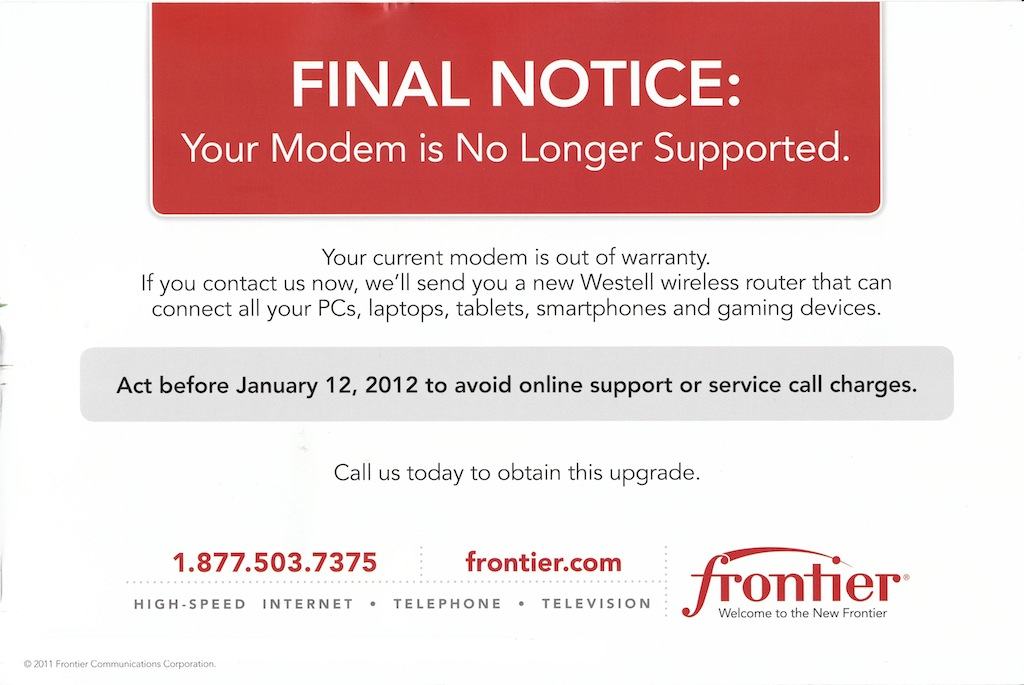
Stop the Cap! reader Paul in Illinois e-mailed us (along with several other readers) sharing news that Frontier Communications intends to charge their DSL customers a minimum of $6.99 a month for the rental of a DSL-ready modem-router, even if customers purchased and use their own equipment for Frontier’s High Speed Internet service.  Even worse, some customers are being told the monthly combined rental fee for the company’s wireless-ready DSL equipment is a whopping $14 a month — just for the equipment.

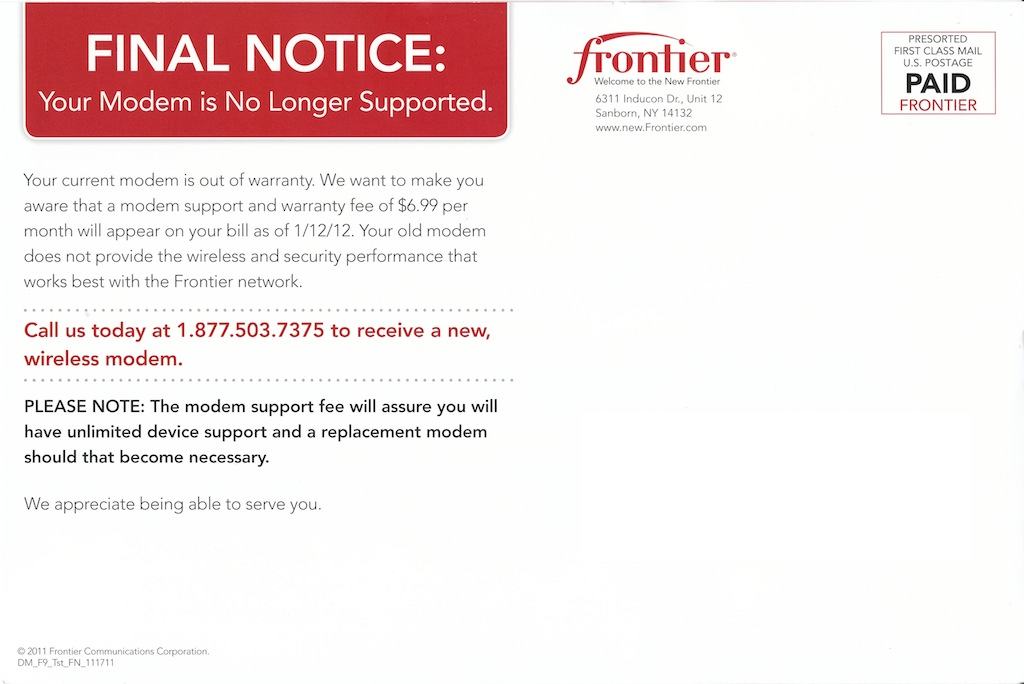
The bad news arrived in the form of a postcard notifying customers that their current modem is “out of warranty” and a new “modem support and warranty fee of $6.99 a month will appear on your bill as of 1/12/12.”

Frontier’s alarming notice tries to scare customers, telling them their existing outdated equipment represents a potential security risk, and explains only with their new mandatory “modem support fee” will customers get “unlimited support” and a replacement modem, if necessary.

Eric, a Stop the Cap! reader and Frontier customer notes Frontier has been piling on price increases in the form of mandatory surcharges and fees this year, including a monthly $1.99 “High Speed Internet Surcharge.”

“Former Verizon customers are now being gouged an additional $9.00 per month or $108 dollars per year,” Eric notes, adding up just the cost of the modem rental and the surcharge.

Paul is especially upset because he purchased his DSL modem direct from Verizon just before the phone company sold its business in Illinois to Frontier.

“In fact, the Verizon modem is more ‘advanced’ than the Westell equipment they want to rent me,” Paul says. “The security is better on Verizon’s unit, and I got it as part of a $29.99 ‘Internet for life’ special offer Frontier now wants to renege on.”
“Frontier is running a scam from top to bottom, offering you l0wball Internet pricing that never includes the outrageous add-on fees that you only find out about on your next bill,” Paul says.

Other Frontier customers on Broadband Reports’ Frontier forum are reporting Frontier has been inconsistent explaining the fees, and some are finding promotions that were supposed to protect them from price increases do nothing of the sort.

Stop the Cap! reader Isabella in Indiana wrote us to say her contact with Frontier customer service was likely going to be her second to last.

“Not only do they intend to collect the $7 a month from customers with their own equipment, those of us with wireless are being told it will cost $14 a month for two of their wireless routers we have on their ‘double DSL line’ promotion,” says Isabella.  “The price for their 3Mbps Internet, on special, was $14.99 a month with a multi-year agreement.  The add-on fees they never tell you about are more than the advertised price of the service.”

Isabella calls her Frontier service “bait and switch Internet” and says when the company applies any additional fees to her account, she will terminate her contract and will refuse to pay a penalty, claiming Frontier unilaterally changed the terms.

“The only ‘price protection’ Frontier offers is for the benefit of their bottom line; Frontier representatives told me there was no way for me to avoid these new fees, even though I am supposed to be guaranteed no price increase for two years,” she says.

Paul also ran into a brick wall with customer service.

“They will not exempt you from the fees — for my ‘convenience’ they will be automatically added to my bill starting next month, with or without the new equipment,” Paul shares. “I am beyond outraged.”

“I am contacting my state Attorney General on Monday to file a formal complaint against Frontier for cheating customers on ‘price protection’ plans,” Paul says.

Modem rental fees offer a lucrative opportunity for broadband providers to raise prices while still advertising a low monthly price for the service alone.  Equipment rental fees often run extra and are typically only disclosed in the fine print.  But must providers will exempt customers who purchase and use their own equipment.  Frontier is apparently ending this policy, forcing some customers to pay the fee for equipment they neither need nor want.  Frontier’s $7 a month fee is particularly steep, especially for equipment that can easily be purchased new or used for prices averaging $50 or less.  Frontier will earn back the cost of the equipment within the first year, with the rest simply padding profits.

One of our readers notified us Frontier customer service agreed to “note their account” to not send the new equipment or charge the fee, despite the fact the representative repeatedly encouraged the customer to “upgrade their router.”  But the customer isn’t so sure he believes the company, telling us an earlier victory getting them to waive the “HSI Surcharge” was hollow: Frontier simply began charging it anyway, and refused to remove it despite the earlier agreement.

“What is next — special fees for reading e-mail and visiting web pages?” asks Paul.

 

Yule Log Extreme 3D: Time Warner Cable Updates a Holiday Tradition

Phillip Dampier December 1, 2011 Consumer News, Video 1 Comment

The original Yule Log

Time Warner Cable is going extreme.  Refreshing last year’s reboot of the timeless holiday tradition of The Yule Log, the cable operator is unveiling a new 3D Holiday Fire experience for subscribers equipped with a 3D-ready television (and appropriate glasses) to make the crackling fire come alive.

The concept of running a looped film of a roaring fire backed by traditional Christmas music was made famous by WPIX-TV in New York and the nation’s cable systems that used to carry the “superstation” well beyond its local coverage area in New York, New Jersey, and Connecticut.  Fred Thrower, then-president and CEO of WPIX, envisioned showing several hours of a crackling fire Christmas Eve as a gift to New Yorkers who lacked fireplaces.  “Yule Log” premiered in 1966, simulcasting the easy listening Christmas music fare from WPIX-FM.

Originally, a fireplace at the governor’s mansion entertained viewers.  But the 17-second long 16mm film loop quickly deteriorated after two holiday seasons.  The Yule Log that most New Yorkers (and the rest of the country) are most familiar with was filmed on 35mm stock in 1970… in California… in the middle of a scorching hot August.  Viewers had caught on to the short-looped film in the original, but detecting the splice in the later version was much harder.  A clue: it happens at around 6 minutes, 3 seconds into the full screen fire.

For 23 years, WPIX ran the traditional Yule Log program for 2-4 hours Christmas Eve.  It was a ratings sensation, which probably says something about the quality of 1970s television programming, and it was soon duplicated by others.  It disappeared for a time during the late 1980s, but was brought back to comfort New Yorkers during the 2001 Christmas season, post-9/11.  Now a facsimile is available for free, on-demand, anytime during the holiday season from Time Warner Cable, along with repeats of last years’ offerings — “Winter Green” – snow falling on pine branches, and the self-explanatory “Snowman.”  Subscribers can find them under the “Yule Log” category on the Free Movies on Demand and Movies on Demand channels.

[flv width=”640″ height=”500″]http://www.phillipdampier.com/video/WPIX Yule Log.flv[/flv]

For those who prefer the original, here is a portion of WPIX’s version of The Yule Log from Christmas Eve, 1983.  (9 minutes)

Newspapers Teach Readers How to Cut Cable Cord, Even If It Means Going Underground for TV

Watch these shows online, if you want to risk some uninvited guests.

There is nothing new about news outlets promoting tips and tricks to lower your monthly cable bill.  We publish similar stories ourselves here on Stop the Cap!  But some newspapers take things further, openly advocating you disconnect your cable service for good and watch everything online.  This week, we found one even willing to publish website addresses that skirt copyright laws and take online video underground.

The State Press encourages Arizona State students to thumb their noses at Cox Communications’ latest offer — cable television for $29.99 a month, good for six months (regular price $70).  Instead, they encourage, take your viewing online to Netflix and Hulu — the former for movies, the latter for television series.  But with cable companies and Hollywood studios conspiring to tackle the growing problem of cord-cutting, new restrictions are finding their way to fans of both websites, including waiting periods, limited series runs, and higher subscription fees.  This means war to the State Press:

There is a dark side to these two corporate entities, however. In their attempt to slowly weasel their way into your pockets a bit more, Hulu has gone Plus and Netflix has divided their packages, limiting your viewing. Hulu has seemingly said, “You can pay a little more to watch it the day after, right? No? Well, then I guess you’re waiting five more days for that recent episode,” while Netflix has exclaimed, “Unlimited to our choosing! You’re going to have to pay up if you want every movie out there.” So we must retaliate and go a little dark ourselves.

The author advises readers there is a way around the roadblocks — visiting a website already shut down once by copyright enforcement action (but has since resurfaced with a Chinese web address), providing a list of links to other websites that host copyright-infringing videos you can’t watch on Hulu or Netflix.

While the author of the State Press story may not realize it, a brief test visit to the “pirate-streamed site” opened the door to some nefarious extras.  With the help of Malwarebytes’ Anti-Malware, we stopped unwanted browser toolbars, various intrusion attempts, and even a few pieces of actual malware that wanted in on the party.  Without the most robust security software, visits to websites with underground video content can wreak havoc, and there are not that many TV shows worth watching to make that headache worthwhile.

The website owner disclaims responsibility from just about everything:

“[This website] does not host, provide, archive, store, or distribute media of any kind, and acts merely as an index (or directory) of media posted by other webmasters on the internet, which is completely outside of our control. Whereas we do not filter such references, we cannot and do not attempt to control, censor, or block any indexed material that may be considered offensive, abusive, libellous, obnoxious, inaccurate, deceptive, unlawful or otherwise distressing neither do we accept responsibility for this content or the consequences of such content being made available.”

We encourage you to exercise caution visiting websites that are willing to skirt copyright laws.  Up-to-date antivirus and spyware detection software when visiting is a must at all times.  Many of these sites stay in business selling ad space to anyone, and those ads can come with unwanted malware that can find its way onto your computer long after the viewing is over.  Be careful.

Time Warner Introduces Android Tablet App: A Glorified Remote Control, Little More

Phillip Dampier December 1, 2011 Consumer News, Online Video 2 Comments

Time Warner Cable has introduced TWC TV, its first app for Android tablet owners.

The cable operator envisions the free app will eventually be as robust as its more feature-rich version for Apple’s iPad, which has been available for months.  But for now, the Android version leaves out one important feature — streaming live television.

Time Warner is calling its TWC TV app “the ultimate remote control.”

The app is only certified to run on a handful of Android tablets (smartphones are excluded entirely), including the Motorola Xoom and Samsung Galaxy Tab.  Other Android tablets may or may not work, depending on the version of Android installed and the resolution of the screen.  For now, Time Warner anticipates the app will work on Android 3.x (Honeycomb on up) tablets with a resolution of 1280×800.

Features include:

  • Change the channel on your TV from anywhere in your home;
  • Interactive program guide – view program listings for up to 7 days and change channels on compatible set-top boxes;
  • View a filtered guide showing favorite channels or HD channels only;
  • Search for programming by title or episode;
  • Schedule and manage upcoming DVR recordings on compatible DVRs.

Customers must subscribe to a Time Warner Cable video package at the Standard (Expanded Basic) level or higher and have registered for an account and password at the Time Warner Cable website.

AT&T Drops the Ball in the Dakotas and Montana: Customers Forced Off Alltel Regret It

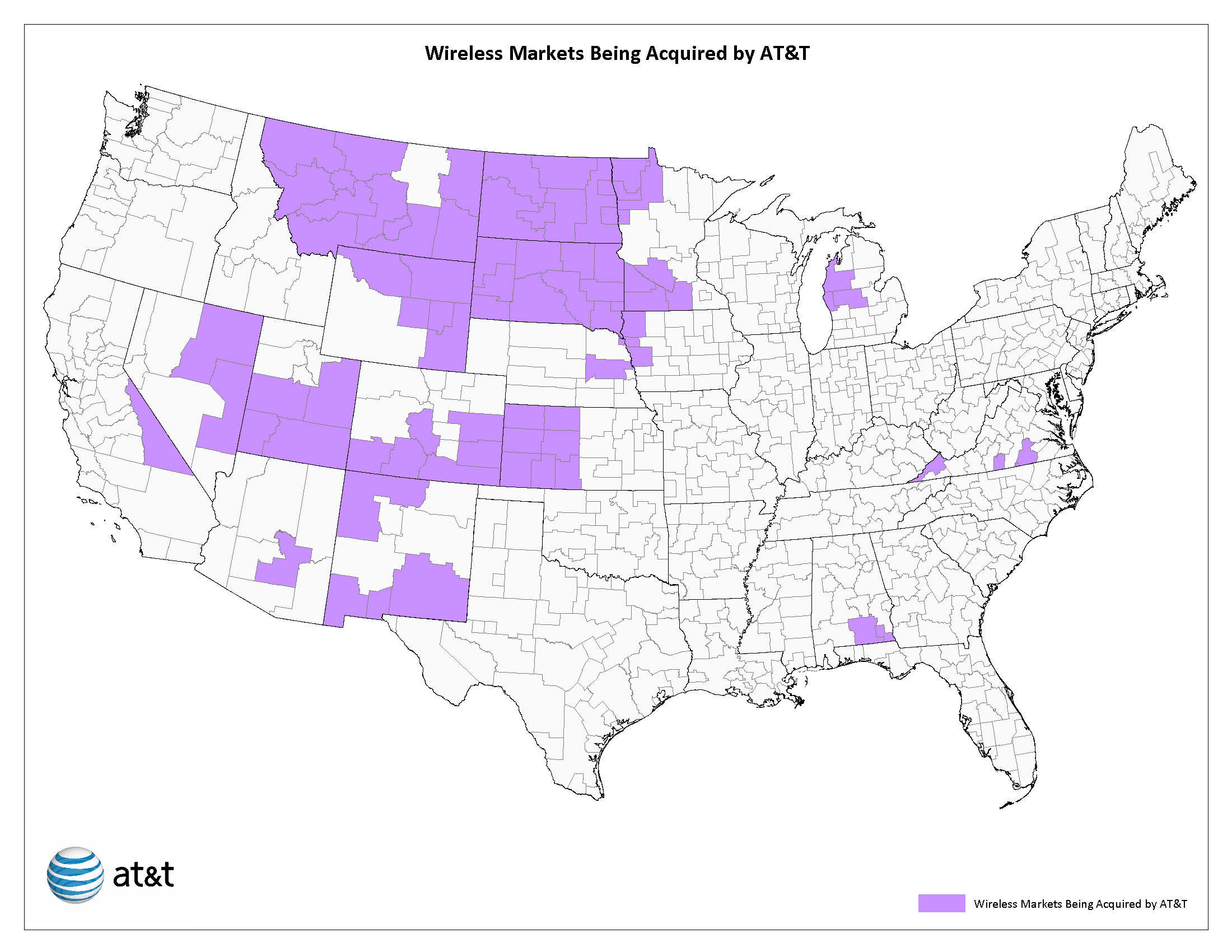
Alltel Service Areas Sold by Verizon Wireless to AT&T

When Verizon Wireless won approval of its takeover deal with formerly-independent wireless carrier Alltel, the federal government required Verizon to divest itself of Alltel’s assets in areas where the combined company would have a mega-share of the local wireless market.  The majority of affected customers, particularly in Montana and the Dakotas, were eventually acquired by AT&T, which uses a completely different network standard.  Customers were handed new phones that work on AT&T’s GSM network, but have since discovered those phones have little use in wide areas where AT&T simply doesn’t deliver a signal.

Even worse, Verizon’s robust network across the region is off-limits for roaming purposes, forcing customers that were perfectly satisfied with Alltel ready to throw their AT&T phones off Mount Rushmore.

“We got stuck with AT&T, which doesn’t care about the rural areas,” Mark Freeman of Harlowtown, Montana told a visiting reporter with the Wall Street Journal.

In the Black Hills, where AT&T’s network is as spartan as the landscape, some customers waited months before they could actually make and receive phone calls in places where Alltel’s old network (and their roaming agreement with Verizon Wireless) suited local residents just fine.

“We’ve been getting dropped calls, missed calls, and [have trouble] servicing [ATM] machines,” said Bill Huffman, an armored car worker in Sioux Falls frustrated by AT&T.  Area ATM machines depend on AT&T’s wireless network to alert drivers when local cash machines run low.  But AT&T’s network isn’t dependable, according to Huffman.

Ironically, customers are flocking to the carrier that would have been their new provider to begin with if not for the federal government divestiture order: Verizon Wireless.

[flv width=”512″ height=”308″]http://www.phillipdampier.com/video/WSJ In South Dakota Dropped Calls and Dead Spots 11-27-11.flv[/flv]

Verizon Wireless stores in the region have suffered periodic equipment shortages ever since AT&T switched on their own, less satisfactory network.  That’s because AT&T customers are dropping their contracts at a rate rivaling the number of calls AT&T itself drops across the region.  The Wall Street Journal visits with perturbed local residents in Montana and South Dakota.  (4 minutes)

Search This Site:

Contributions:

Recent Comments:

Your Account:

Stop the Cap!