Home » Consumer News » Recent Articles:

Verizon to Compete With Netflix With Standalone Streaming Video Service

Phillip Dampier December 7, 2011 Competition, Consumer News, Online Video, Verizon, Video Comments Off on Verizon to Compete With Netflix With Standalone Streaming Video Service

Verizon Communications plans to introduce its own standalone streaming video service that will compete head-to-head with Netflix, according to a breaking, exclusive report from the Reuters news service.

The phone company is said to be in negotiations with several programming partners that could make available popular movies and television shows on the service, which would be sold exclusively in areas not wired for Verizon’s fiber-to-the-home service FiOS, starting early next year.

Netflix stock once again took a pounding on the news, down as much as 5%.  Netflix has experienced serious challenges in its transition to a streaming service, including intransigent programmers who want to be paid considerably more to extend licensing deals.  Netflix has been forced to raise prices and split its DVD rental and streaming plans, provoking anger among subscribers.

Reuters reports the service will have a limited offering from the outset, perhaps picking up expiring contracts Netflix had with Liberty Media’s Starz Play and Viacom’s Epix.  Epix includes titles from Paramount, Lions Gate and MGM, and is set to expire at Netflix next September.

Verizon is said to be interested in expanding its services beyond its FiOS customer base to obtain better rates from programmers.  The more subscribers with access to your service, the better the volume discount.  By limiting the new movie service to non-FiOS areas, Verizon will protect from cannibalizing customers from its own fiber network while opening the door to lower per-subscriber costs for programming.

Analysts say the deal will likely be closer in comparison to Amazon’s limited streaming service, available at no charge to its Amazon Prime customers.  Netflix has a broader catalog of online titles.  But they expect Verizon to price the service competitively with Netflix to attract customers and compete for similar programming rights.

Verizon may repackage content originally intended for the standalone streaming service for its existing FiOS customers under a TV Everywhere concept, meaning the programming would be accessible to FiOS subscribers who maintain video subscriptions with the phone company, perhaps without any additional charges.

[flv]http://www.phillipdampier.com/video/CNBC Netflix Stock Takes a Hit 12-6-11.flv[/flv]

Netflix stock is still being pounded, now even more so after Verizon’s announcement it is entering their business space.  Will Netflix ultimately be sold to a bigger player to survive?  CNBC investigates.  (4 minutes)

[flv width=”512″ height=”308″]http://www.phillipdampier.com/video/WSJ Verizon May Enter Streaming Video Market 12-6-11.flv[/flv]

The Wall Street Journal digs into Verizon’s video announcement, and how it will likely impact Netflix and the online video marketplace.  With a programming bidding war, customers may actually end up paying more for online video.  (5 minutes)

Comcast and Verizon Merge, Without Merging: Detente — A Non-Compete Agreement

[flv width=”512″ height=”308″]http://www.phillipdampier.com/video/WSJ Comcast and Verizon Merge Without Merging 12-2-11.flv[/flv]

Comcast and Verizon are attempting a virtual merger, meaning that both sides are agreeing to work together by staying out of each other’s way, Peter Kafka reports on the Wall Street Journal’s digits.  (3 minutes)

[flv width=”512″ height=”308″]http://www.phillipdampier.com/video/WSJ Verizons 3-6 Billion Spectrum Deal Turns Heat on ATT 12-2-11.flv[/flv]

And what of AT&T?  The Wall Street Journal reports Verizon Wireless’ deal is ramping up pressure on rival AT&T, which is fighting to salvage its deal to take over T-Mobile USA, Greg Bensinger reports.  (5 minutes)

Silver and Gold: Wringing Customers Dry With Bell Holiday Rate Hikes & Higher Penalties

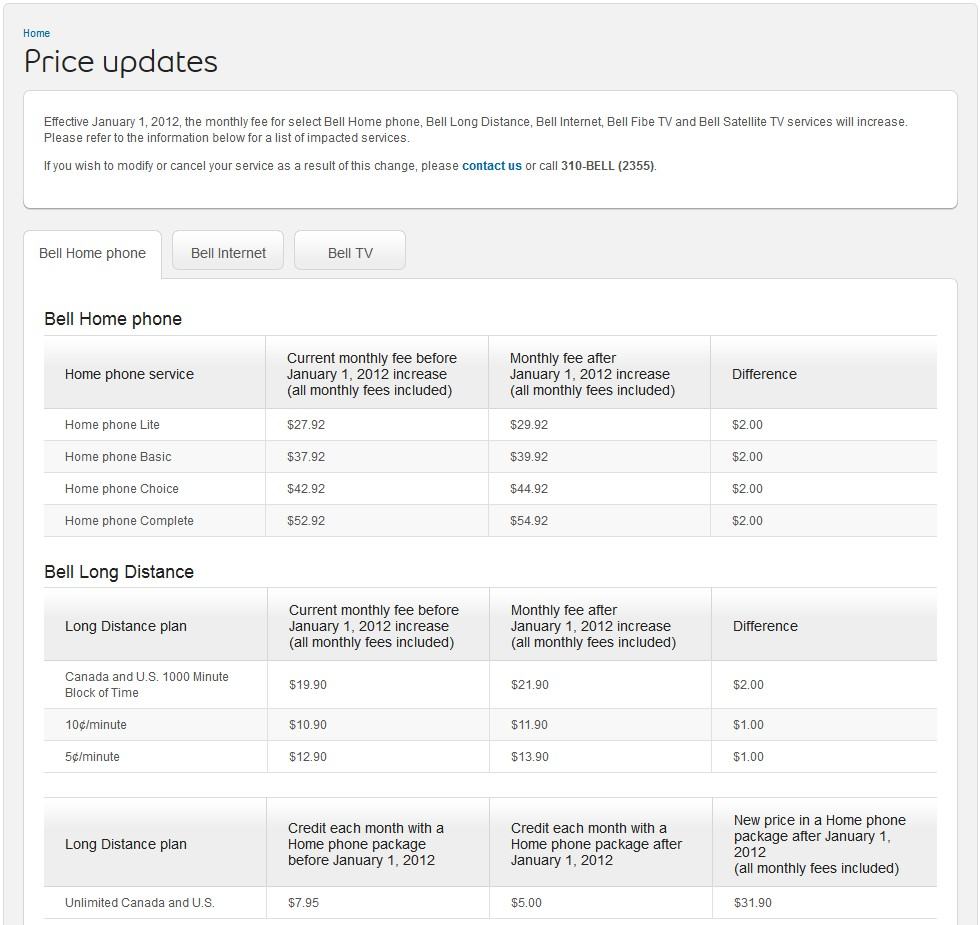
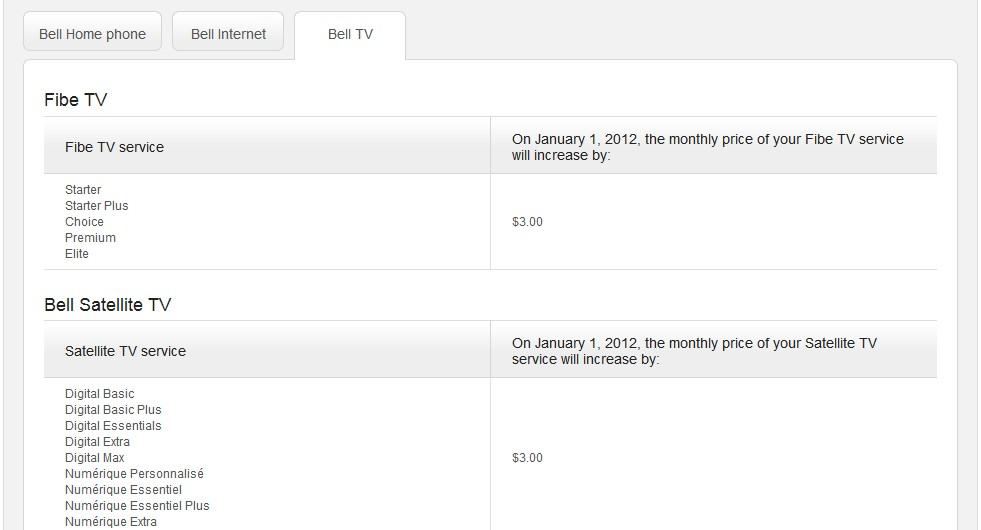
Regular Stop the Cap! reader Alex dropped us a note sharing the bad news: Bell Canada is hiking rates for virtually everything effective Jan. 1.  Except Bell doesn’t call them rate increases.  To the phone giant, they are “price updates.”  They are also considerable, with sweeping rate increases for phone, Internet, and television.  They are even hiking rates for individual phone calling features like three-way calling.

Bell reserves rate increases for its long-standing customers. Potential new customers served by Bell in eastern Canada, where the company is rolling out its fiber-to-the-neighborhood service Fibe (similar to AT&T U-verse), report offers as low as $19.95 a month for selected services during the first year.  But prices increase dramatically when the promotion expires.  By how much is detailed below:

Prices listed are for customers in Ontario.

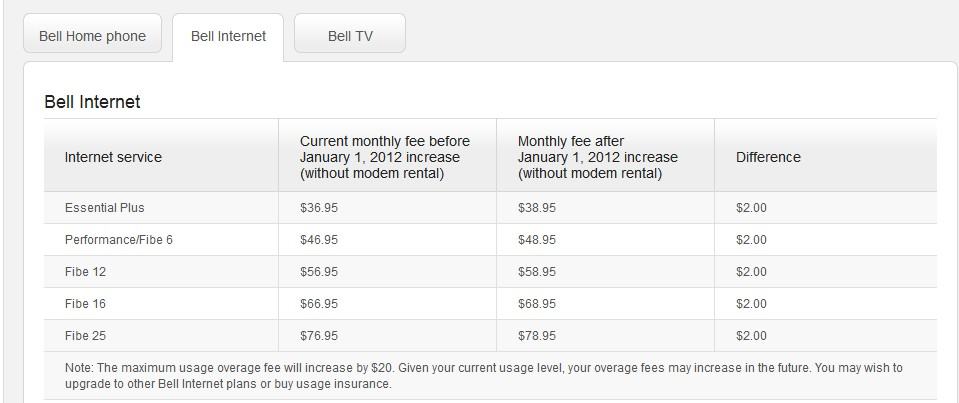
But Bell saves the worst for a footnote at the bottom of their Internet “price update.”  They are tinkering with the company’s notorious Internet Overcharging scheme, raising the bar on their overlimit penalty.  Customers who used to exceed their monthly broadband allowance originally faced a maximum penalty of $30.  But Bell has been revisiting that “maximum overlimit fee” regularly.  In 2010 the company raised the penalty cap to $60.  On Jan. 1, Bell is raising the maximum by an additional $20 — to $80 a month.  In our view, it is only a matter of time before the ceiling on overlimit fees is eliminated altogether, setting customers up for sky high bills.

Bell Fibe 25 customers with 25Mbps service will now pay $78.95 a month for Internet alone, and that plan comes with only 125GB of usage per month.  Want to use more?  You will have to buy Bell’s Usage Insurance in advance:

  • $5/month for an extra 40GB
  • $10/month for an extra 80GB
  • $15/month for an extra 120GB

But that may not help you avoid at least one month of overlimit fees.  Bell pro-rates customers adding Usage Insurance to their accounts, which means the first month’s extra allowance is limited by the number of days before your next billing cycle.

Bell’s prices for new customers are much lower, with Fibe 25 priced as low as $34.48 a month during the first year.  The real bite arrives when the promotion expires, when the price more than doubles.

Update #2: Verizon Wireless LTE Outage Impacts Service on East Coast

Phillip Dampier December 7, 2011 Consumer News, Verizon, Wireless Broadband 27 Comments

Verizon Wireless has confirmed a major LTE outage is impacting their data customers up and down the east coast as of late last night.

4G service works only intermittently this morning for impacted customers.  Many Verizon Wireless 4G phones are also not stepping down to the older 3G network properly during the outage, which means no data service at all, unless you are near a Wi-Fi hotspot.

The largest service area affected is New York City, but the outage is also impacting 4G customers in western New York, Pennsylvania, and northern Virginia.

Verizon has no estimated time when the problem will be repaired.

Updated 3:46pm ET — Readers report the outages now extend south into South Carolina, west into Ohio, Indiana, and Illinois, and one reader tells us service is out in California.  Verizon has acknowledged the problem on their Twitter channel, with no time estimates for repair.

Updated 4:58pm ET — Verizon is telling some customers the outage is impacting those with SIM cards, which effectively means LTE/4G.  Customers with 3G only phones still have access, but many 4G phone owners cannot downgrade to 3G service, even when they turn LTE off. 

AT&T Scores Last (Again) in Consumer Reports’ Ratings; Oddly AT&T Reseller Scores Highest

AT&T has once again scored dead last in a nationwide survey (subscription required) of wireless providers commissioned by consumer magazine Consumer Reports.

Among national coverage carriers, Verizon Wireless again scored the highest, but not highest overall when including smaller independent and regional carriers.  Top honors were won by Consumer Cellular, a relatively small company in Portland, Ore. that ironically depends on bottom-rated AT&T’s network to deliver service.  What sets Consumer Cellular apart from other carriers is its near-exclusive focus on selling phone service to America’s senior population.  Working with groups like the AARP to market simple cell phones to older, less technologically-comfortable customers, over 85% of Consumer Cellular customers are over the age of 50.  The vast majority are occasional cell phone users, primarily using cell phones to make and receive calls.

Regional carrier U.S. Cellular, which used to top Consumer Reports‘ surveys, scored second.  Most U.S. Cellular customers are in the Pacific Northwest, Midwest, and parts of the East including New England.  CREDO, better known under its former name Working Assets Wireless, scored third.  It provides service over the Sprint network.

Among major-sized providers, only Sprint managed to escape the poor ratings for value received by AT&T, Verizon, and T-Mobile.  Also ironic, T-Mobile continued to score better than AT&T, which is still working feverishly to acquire the German-owned carrier.

AT&T also did poorly in delivering reliable voice and data services, according to respondents.  Customer service was also deemed lacking.

Consumer Reports

“Our survey indicates that subscribers to prepaid and smaller standard-service providers are happiest overall with their cell-phone service,” said Paul Reynolds, electronics editor for Consumer Reports. “However, these carriers aren’t for everyone. Some are only regional, and prepaid carriers tend to offer few or no smart phones.”

Consumer Cellular being a prime example. 

Consumer Reports surveyed 66,000 Americans for its 2011 Wireless Satisfaction Survey and found little had changed from last year.  The consumer magazine recommends consumers who don’t make or receive a lot of calls or are not addicted to wireless data services consider a prepaid plan instead of a two-year contract.  Competition in the prepaid arena continues to force prices down, and most providers offer month-to-month service plans that can be automatically renewed through a checking account or credit card, eliminating any hassle purchasing “top up” cards.

Most of the prepaid providers resell service provided by AT&T, Sprint, or Verizon Wireless.  Two that don’t: MetroPCS and Leap Wireless’ Cricket, received little regard from those surveyed.  MetroPCS scored second from the bottom and Cricket didn’t make the ratings at all.  Two prepaid plans to consider first: TracFone, excellent for occasional calling, and Straight Talk, sold by Wal-Mart — better for those who like to talk a lot on their phones.  If you don’t need the sexiest handset around, Stop the Cap! also recommends Page Plus, which relies on the Verizon Wireless network, especially if you don’t need a lot of data services.

Search This Site:

Contributions:

Recent Comments:

Your Account:

Stop the Cap!