Home » Consumer News » Recent Articles:

Time Warner Cable’s Annual Holiday Program Disputes: This Time MSG is Threatened

Phillip Dampier December 21, 2011 Consumer News, Video 2 Comments

It’s the holiday season which means it is a safe bet Time Warner Cable is in dispute with at least one of their programmers over rights fees.  This year, MSG Networks is threatening to pull the plug on Time Warner subscribers if the cable operator does not agree to a wholesale rate increase in contract renewal talks.

MSG is letting cable customers know their favorite sports teams are facing a video blackout if the cable operator doesn’t sign a renewal by the end of the month.

Time Warner Cable’s Jeff Simmermon says MSG is demanding a 53% rate increase, and double that if the cable company doesn’t put back MSG Media’s Fuse music channel, which Time Warner dropped in many markets.

It turns out there is plenty of room to negotiate between MSG’s 53% request and what Time Warner thought it had earlier agreed to — a milder 6.5% hike.  Time Warner spokeswoman Maureen Huff said if MSG gets their way, the sports network will become the most expensive channel on the cable dial — an expense that will inevitably find its way into the next rate hike for every cable subscriber.

The contract is due to expire Dec. 31.  Time Warner says it won’t pull the channel from its lineup, effectively daring MSG to block reception by switching off Time Warner’s digital satellite authorization for the networks.

MSG and MSG Plus are in the crossfire, and the biggest impact from the loss of either will be felt in Buffalo and New York City.

[flv width=”360″ height=”290″]http://www.phillipdampier.com/video/WIVB Buffalo Dispute may kick Sabres off Time Warner 12-16-11.mp4[/flv]

WIVB in Buffalo warns Time Warner subscribers to brace themselves for the potential loss of the wildly-popular Sabres hockey team.  (1 minute)

Copper Thieves Wipe Out Phone Service in Eugene, Oregon

Phillip Dampier December 20, 2011 CenturyLink, Consumer News, Video Comments Off on Copper Thieves Wipe Out Phone Service in Eugene, Oregon

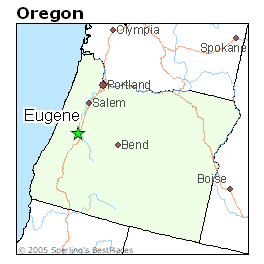
Copper thieves left thousands of phone customers in Eugene, Ore. without telephone service, forcing volunteer firefighters to get walk-in reports of fire and medical emergencies after 911 service was disrupted.

Authorities are looking for the suspects who scaled telephone poles and removed several hundred feet of critical phone wiring that provided service in the Eugene area.  CenturyLink officials rushed to pull new cables across phone poles to get service restored, and much of Eugene had their telephone landlines back within 24 hours.

CenturyLink and Oregon authorities claim copper thieves are now primarily targeting copper landlines because electrical lines are more dangerous and phone wire insulation is easier to burn or strip off, leaving the thieves with spools of bare copper wiring easily sold to scrap dealers.

Copper prices have spiked over the past few years, increasing interest among thieves.  Officials in several states have partnered with scrap dealers to try and limit illicit sales, and criminal penalties have been increased.

Occasionally, copper line theft also disrupts cell phone service, because many cell towers are still connected via copper circuits, especially in rural areas thieves favor.

[flv width=”360″ height=”290″]http://www.phillipdampier.com/video/KMTR Eugene Phone Service Restored in Eugene 12-19-11.mp4[/flv]

KMTR in Eugene covers the latest copper caper affecting CenturyLink phone customers in Oregon.  (2 minutes)


Hype: Clear Cast — A $38 ‘New Invention’ That Eliminates Cable/Satellite Bills Forever?

Phillip Dampier December 19, 2011 Consumer News, Editorial & Site News, Video 160 Comments

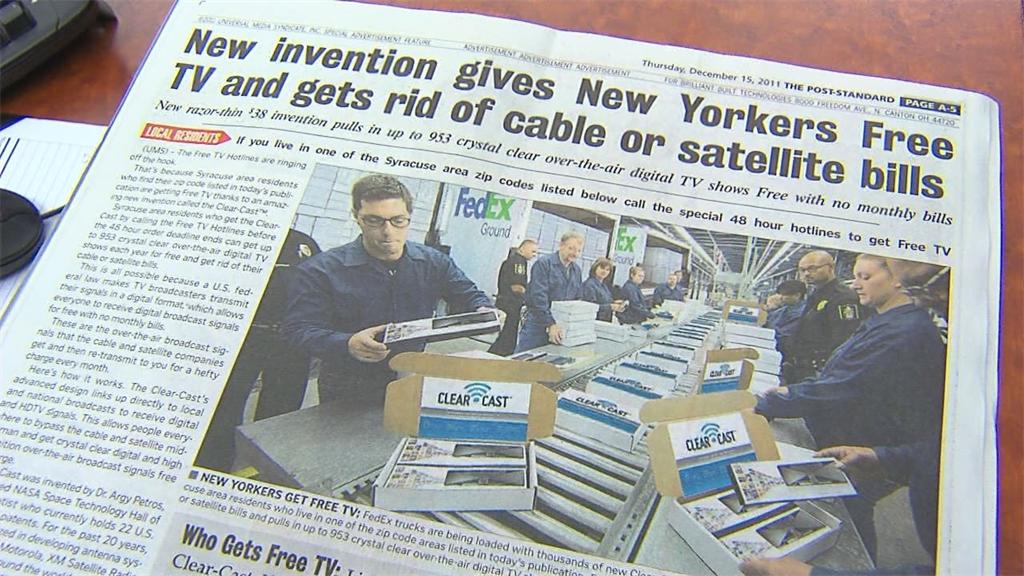
An ad in the Syracuse Post-Standard announces a new invention -- a variation on the bow tie antenna design originally designed in the 1950s.

Last Thursday, Syracuse newspaper readers were treated to news of an impressive breakthrough that promises to deliver salvation from high cable and satellite TV bills forever.

Clear Cast, a “razor thin” indoor digital HDTV antenna lets you watch television… for free.

The product is shown being packaged up for shipping while an impatient-looking FedEx driver tries to coordinate the apparent extraordinary demand for a downright revolutionary development in television engineering.

Local residents called the newspaper and other local news outlets to try and learn more about the curious new device.

Stop the Cap! can now report the revolution can be postponed.

In fact, the published account  about the “new invention” was actually a paid advertisement-designed-to-look-like-a-news-story.  Clear Cast is effectively a variation on the traditional indoor UHF bow tie antenna your local Radio Shack used to sell for $1.49.  The major difference is that it is designed to be attached to a window with accompanying suction cups.  That is a valid approach to improving reception, but whether it is worth the asking price of $38 is another matter.

As consumers seek alternatives to higher cable and satellite TV bills, overhyped ad copy promising freedom from high bills cannot be far behind.  Repackaging basic antennas that were part of our lives from the 1950s-on can go too far when leaving some residents with the impression they are getting more than a basic television antenna.

In fact, over-the-air viewing can be easily accomplished in strong signal areas with the cheapest antenna, as long as it is designed for both VHF and UHF reception.  Many VHF stations with channel numbers from 2-13 quietly relocated to the UHF dial, but still advertise their original channel numbers.  If your television is not equipped with a UHF antenna, reception may be difficult.

For the benefit of those under the age of 40: most televisions used to come equipped with both antenna designs — two elongated antenna rods some used to call “rabbit ears” and an accompanying round loop antenna, or often a bow tie design that clipped to one of the two longer aerials.  The long straight antennas are designed for VHF signals, the bow tie or loop design accommodated improved UHF reception.

Over the last decade, marketing has attempted to revolutionize what remains basic, sober, antenna design — with an accompanying “revolutionary” price tag.  When satellite television was first introduced, some manufacturers redesigned set top aerials to look like a satellite dish and then pitched them as “saving you the high price of satellite TV because it is not satellite!”  In today’s HD-ready era, marketers have done it again.

Will Clear Cast work?  Undoubtedly, but probably not much better than any other traditional bow tie design that costs $35 less.

If you are cutting cable’s cord and want to rely on over-the-air television, our best advice is to start with something inexpensive and upgrade only when necessary.  In urban and suburban areas, an effective indoor antenna can cost less than $5.  Try repositioning it until you find the best spot to receive the most channels with the least signal reception errors.  Directional indoor antennas can offer mild signal improvement, especially in areas where adjacent signals from nearby cities create reception problems.  Because the American digital broadcast standard is frankly less robust than the European counterpart, those in more distant suburbs or rural areas will really need to invest in a rooftop antenna to enjoy consistent reception.  A potential compromise would be to mount an outdoor antenna in the attic.

Avoid “futuristic” designs and powered indoor antennas and read consumer reviews carefully.  We’ve found most indoor antennas priced above $35 to be more hype than performance-per-dollar.  If you need an outdoor antenna, check your local Yellow Pages for antenna specialists who understand local reception conditions and can recommend high quality, long lasting antennas that will work for the stations you want to receive.

[flv width=”480″ height=”290″]http://www.phillipdampier.com/video/WSYR Syracuse Newspaper ad for free TV The Real Deal 12-15-11.mp4[/flv]

WSYR in Syracuse investigates the ‘revolutionary’ new indoor TV antenna that is so popular, only residents in certain zip codes can order it.  (2 minutes)

Time Warner Cable Introduces Android App, But Will Wait for ‘Ice Cream’ Before Streaming Video

Phillip Dampier December 19, 2011 Consumer News, Online Video Comments Off on Time Warner Cable Introduces Android App, But Will Wait for ‘Ice Cream’ Before Streaming Video

Time Warner’s new Android app

Time Warner Cable has introduced a new free app that will eventually allow subscribers with an authenticated cable television package to stream dozens of channels over their Android-powered portable phones and tablets like that graphic drawing tablet with screen.

The TWC TV™ App for Android lets your Android device change the channel on your TV from anywhere in your home and manage your DVR inside or outside of your home.

Other features include:
– Interactive program guide – view program listings for up to 7 days and change channels on compatible set-top boxes
– View a filtered guide showing favorite channels or HD channels only
– Search for programming by title or episode
– Schedule and manage upcoming DVR recordings on compatible DVRs
– Adjust recording start/end times and change save time

Requirements
– Compatible Android smartphone or tablet (see below)
– Time Warner Cable video package at the Standard (Expanded Basic) level or higher
– Compatible set-top box or DVR (Motorola iGuide equipment is currently unsupported)
– Internet connection (WiFi or 3G)
– Time Warner Cable user name and password

Compatibility
– TWC TV supports most smartphones running Android 2.1 (Éclair) and higher
– TWC TV for tablets supports the Motorola Xoom, Samsung Galaxy Tab 10.1 and Sony Tablet S running Android 3.x. Other Honeycomb 3.x tablets with 1280×800 resolution should also work.

Those hoping to stream Time Warner Cable’s video lineup will have to wait.

“Once manufacturers and cellular carriers begin to upgrade their phones to Android 4.0 (Ice Cream Sandwich), we will release an update to offer in-home live TV on these devices,” Jeff Simmermon, Time Warner Cable’s director of digital communications wrote on the company’s blog. “We expect to see those upgrades early next year.”

A brief test of the new app at Stop the Cap! HQ ended quickly because Time Warner Cable’s My Services authentication portal has been down this morning.  That causes the app to generate an error message stating it cannot find a compatible DVR or set top box.  This is one of the problems customers face from online authentication systems.  If they go down, your access to “TV Everywhere” content goes with it.

Simmermon adds that Apple iPhone owners will be able to obtain the app sometime in January.  For now, only Apple iPad owners can view streamed video content.

Living With AT&T: Wisconsin Fox Station Repackages AT&T Infomercial as a Feature Story

Phillip Dampier December 14, 2011 Astroturf, AT&T, Consumer News, Editorial & Site News, Video Comments Off on Living With AT&T: Wisconsin Fox Station Repackages AT&T Infomercial as a Feature Story

A Fox affiliate in Green Bay, Wisc. has some trouble drawing distinctions between informational programming and infomercials after it repackaged a four minute ad for AT&T U-verse into a feature story on “Living With Amy,” its morning show targeting women viewers.

As well as failing to disclose to viewers the four minute “segment” was actually a paid commercial, AT&T doesn’t appear anywhere on the show’s sponsor page, potentially confusing viewers into believing the positive U-verse feature was produced by WLUK-TV as an unbiased news story.

It’s just the latest example of a series of “news reports” we’ve found (here and here) that highlight the blurring of the line between journalism and paid advertising.  In most cases, cable companies like Comcast and phone companies like AT&T are “invited guests” of the show’s host, who proceeds to gush over the products and service on offer without informing viewers those companies paid to be there.

This time, the Fox affiliate didn’t even bother with a “sit down” and ran a short infomercial for AT&T’s U-verse instead.

[flv width=”360″ height=”290″]http://www.phillipdampier.com/video/WLUK Green Bay ATT U-verse 12-14-11.mp4[/flv]

This “story” appeared on WLUK’s “Living With Amy” show earlier this week.  It’s little more than a four minute commercial for AT&T U-verse, but viewers couldn’t tell because the station never disclosed it was paid advertising. (4 minutes)

Search This Site:

Contributions:

Recent Comments:

Your Account:

Stop the Cap!