Home » Consumer News » Recent Articles:

Updated: Stop the Cap! Helps Verizon Wireless Customers Sign Up for Unlimited Data Through Loophole

Phillip Dampier January 3, 2012 Consumer News, Data Caps, Verizon, Wireless Broadband 1 Comment

No need to be herded into a Verizon Wireless usage-limited mobile data plan.

New to Verizon Wireless and unhappy being constrained with a usage-capped wireless data plan?  Thanks to a loophole, customers can buy their way into an unlimited access plan Verizon was supposed to discontinue last July.

Some background: Verizon Wireless spent 2011 enticing customers to upgrade to their new 4G LTE phones which use the company’s much faster mobile broadband network.  One of the benefits early adopters received was a free, ongoing trial of Verizon’s mobile hotspot feature, which turns your phone into a Wi-Fi device your other devices (and friends’ phones) can share.  When Verizon elected to discontinue its unlimited data plans in July, the free trial of the mobile hotspot feature went with it.  In its place, Verizon pitched 4G phone owners an unlimited mobile hotspot feature add-on for $30 a month (in addition to the price of your data plan.)

Those who travel often or who want a backup Internet service in case their home or business Internet connection goes down found this a reasonable deal, especially because it carries no data limits or speed throttling, and works on both Verizon’s 3G and 4G networks.

But it turns out this little-known add-on promotion also unlocks the door to an unlimited smartphone data plan Verizon intended to stop selling last summer.

As we explained earlier, just signing up for the unlimited use mobile hotspot plan involved jumping through a few hoops.  But with the help of a feature code, any Verizon representative should be able to look it up and add it to your account.

When they do, something interesting happens.  Verizon cancels any existing usage-limited plan and converts it into an unlimited use plan ($29.99) they stopped selling.  That leaves you with Verizon’s Mobile Hotspot feature for $30 a month and unlimited smartphone data for $29.99 a month.  But here is the exciting part: you can quickly cancel the $30 mobile hotspot feature and will remain grandfathered on Verizon’s unlimited use smartphone data plan.

Slickdeals provides a helpful step-by-step guide, and it sometimes takes a few calls to reach a representative who can manage this successfully:

  1. Dial *611 from your Verizon phone, or 1-800-922-0204 from any phone.
  2. Wait for computer CSR to go through the main menu. You will need your Verizon phone # and account PIN or last 4 of SSN.
  3. Hit option 4.
  4. When it asks you what you would like to do today say “Add a feature.” You will be transferred to a live Verizon Customer Service representative.
  5. If you have a 3G device (which includes all iPhones): Say you would like to add the $20 2GB 3G Mobile Hotspot FEATURE to your phone. When you add this MHS feature, you will be charged $20/month in addition to the $29.99 unlimited data plan.
    If you have a 4G device: Say you would like to add the $30 Unlimited 4G Mobile Hotspot FEATURE to your phone. According to http://stopthecap.com/2011/07/12/…r-account/ , they may be able to locate this feature via referencing feature code #76153. When you add this MHS feature, you will be charged $30/month in addition to the $29.99 unlimited data plan.
  6. After one of the MHS features above are added to your account, you will now have the $29.99 unlimited data plan, which can be verified via the My Verizon app on your device or at http://www.verizonwireless.com/myverizon
  7. {OPTIONAL – if you don’t want the Mobile Hotspot feature} Log into My Verizon and remove the Mobile Hotspot FEATURE from your account. It is recommended to wait at least a day to remove the feature. The $29.99 unlimited data plan should remain on your account.
  8. If they say they can’t add that feature to your plan, or that you must bundle your data + mobile hotspot service together as a single data plan, tell them thank you, hang up, and repeat the steps above.

Updated 2:45pm EST:  Our regular reader Duffin reports this loophole may be in the process of being closed.  See this article from The Consumerist for further details.

Ex-Shaw CEO Rakes in Cash While Leaving Customers With Higher Bills, Poor Service

Phillip Dampier January 2, 2012 Canada, Consumer News, Editorial & Site News, Shaw Comments Off on Ex-Shaw CEO Rakes in Cash While Leaving Customers With Higher Bills, Poor Service

Ex-CEO Jim Shaw earns even more not working for the cable company his father founded.

The ex-CEO of Shaw Communications is a charter member of the 1% Club, raking in more than $25 million from a golden parachute retirement package cable customers are paying as part of their ever-increasing monthly cable bills.

Jim Shaw earned $1.2 million in 2011 from his duties as chief executive.  But when the 53-year old decided early retirement was right for him, the company that shares his name provided a generous $25.5 million parting gift.  That’s a golden parachute package equivalent to what more than 2,000 lower-middle class Canadians earn each year.

What makes Jim Shaw worth that much?  Company officials claim the departing CEO helped the company earn new revenue.  But Shaw subscribers know the recipe for higher revenue is easy to make — annual rate increases and overpriced products and services.

Shaw didn’t have much of a fight justifying his departing pay package.  Not with his father J.R. Shaw holding 79 percent of the cable company’s Class A voting stock.  The Shaw family has been especially generous with themselves in 2011.  Brother Brad pocketed $15.8 million this year for himself.

The Shaw Executive Money Party has grown so large, the company’s top six paid officers collectively walked away with compensation of $82.2 million in 2011, $1.5 million more than Shaw Communications earned in the entire fourth quarter of 2010.  Imagine one-quarter of your company’s earnings headed straight into the pockets of a half-dozen employees, often immediate family members of the CEO or company founder.

Even those sums are dwarfed by the $330 million the company has now set aside to guarantee executive pensions, even as Shaw’s lower level employees (and most of their customers) see their incomes continue to stagnate, if not outright decline.

That three Shaw family members collectively grabbed $58.6 million from the company accounts is not welcome news for shareholders.  Jim Shaw’s exit package in particular proved galling for some, particularly because he effectively sabotaged his own standing with image-damaging public comments and an abrasive management style.

“There was a lot of institutional backlash over the pension given to Jim on his departure because it was rather monstrous,” one pension fund adviser was reported as saying in the Edmonton Journal. “This is just another piece that will get everybody upset.”

Shareholders are also unimpressed with the value of their Class B Shaw stock, which has remained lackluster since 2006.

While top management earned big, Shaw has alienated customers with legendary call holding times that can extend for hours, annual rate increases for cable service, and less-than-impressive customer satisfaction scores.

Shaw is western Canada’s dominant cable operator.


Mutual Blame Game: Time Warner Cable <-> Pulls the Plug on <-> MSG Networks

Phillip Dampier January 2, 2012 Consumer News, HissyFitWatch, Video 7 Comments

Time Warner Cable subscribers who are passionate about their hockey and basketball won’t be watching all of the Buffalo Sabres or New York Knicks games, thanks to another year-end programming dispute primarily affecting cable subscribers in New York State.

MSG terminated their program feed for approximately 2.8 million Time Warner customers early Sunday, leaving the cable operator to make amends with irritated subscribers.

Once again, the cost of sports programming was the issue. MSG has raised prices at least 70 percent over the last five years, according to cable research group SNL Kagan.  The package that includes MSG and MSG Plus now sells at a wholesale price of more than $4.50 per month, rivaling the most expensive sports network ESPN, which will charge $5.06 a month in 2012.  Time Warner reportedly balked at a renewal deal for 2012 that would have increased prices well beyond the six percent the cable operator offered to pay.

Time Warner has e-mailed subscribers indicating MSG pulled the plug, and is offering some replacement programming to ease the suffering of sports-addicted subscribers:

At Time Warner Cable, we’re sports fans too – that’s why we fight hard to keep the sports you love on the air at a price you can afford.

With the game clock running down, MSG Networks rejected all proposals, refused to engage in any meaningful way, and refused to allow us to keep the channel on. In the end, MSG pulled the plug on Time Warner Cable customers. We regret that MSG Networks has taken away their sports programming, but remind fans that even without MSG, Time Warner Cable will carry nearly 20 percent of this season’s remaining Sabres games, and dozens of other NHL and NBA games and most of the NHL and NBA playoffs. For information on where to find your favorite teams, visit www.twcconversations.com/MSG.

We don’t think that MSG’s actions are fair to sports fans, so Time Warner Cable is offering the following in appreciation of our customers:

    • A special month-long preview of the Time Warner Cable Sports Pass, a package of more than 15 sports-oriented channels. This package—which normally costs $5.95 per month for residential customers—will be available from January 1 – 31, 2012. (Visit www.timewarnercable.com/sportspass to see the full list of channels and channel numbers.)
    • A free preview of the NBA League Pass premium sports package which offers up to 40 live games per week. This offer is good through January 8th and more details are available at www.twcconversations.com/MSG.
    • The launch of YNN Hockey Tonight, a new nightly hockey show, premiering January 2nd on YNN in Western New York, including the Buffalo and Rochester areas. YNN Hockey Tonight will feature live interviews & analysis, plus scores, standings and information from all around the world of hockey, every night at 11:15 PM through the end of the NHL season.

We think MSG is being unreasonable – and unfair to fans. They continue to demand a 53% price increase for their programming, which just doesn’t make sense. We do want MSG to return to our channel lineup, and we will continue to work hard to reach an agreement that gives you the sports you love at a price you can afford to pay.

Don’t forget: every TV provider is at risk for blackout threats. Last year MSG pulled the plug on DISH – so switching is not a solution. If MSG really cared about the fans, they wouldn’t be holding your sports hostage.

Thank you for your patience and continued loyalty.

Tell MSG to Get Real and Do the Deal.

MSG is telling Time Warner customers to cancel their cable service and sign up for Verizon FiOS TV or one of the satellite dish providers instead.  But those alternative providers are not happy with the rising cost of sports programming either.

DirecTV’s Michael White and Dish Network Corp. Chairman Charlie Ergen have both repeatedly criticized price inflation for sports networks, and both have fought their own battles over the issue.

[flv width=”480″ height=”290″]http://www.phillipdampier.com/video/WHAM Rochester MSG Pulls Programming Disappoints Sports Fans 1-1-12.mp4[/flv]

WHAM-TV in Rochester talks with irritated sports fans about the loss of MSG Networks on Time Warner Cable.  (3 minutes)

[flv width=”360″ height=”290″]http://www.phillipdampier.com/video/Bloomberg Harrigan Says Time Warner-MSG Deal Will Take Time 12-30-11.mp4[/flv]

Bloomberg News reports that wholesale rates for sports programming have grown so great, cable operators may be prepared to drop sports networks off cable television altogether.  (4 minutes)

Verizon Wireless Will Charge Customers $2/Month to Pay Their Bill; Admin Fees Also Increasing

Verizon Wireless has tucked some unpleasant news into their “change of terms” notices buried on the back pages of your monthly bill.

Effective Jan. 12, the wireless carrier will charge a $2 “convenience fee” when paying by phone or through Verizon’s website.  Only customers enrolled in autopay, authorize an electronic check payment, or who still mail a check to the phone company every month will escape the new bill padding fee.

Most likely impacted are customers who make their payment at the last minute or face disconnection over an overdue bill if they don’t authorize a partial payment immediately.  Verizon says the new fee will defray the costs of accepting online and phone payments, but considering an automated attendant usually handles pay-by-phone bill payments, the costs to Verizon are likely far less than the revenue the company stands to earn from the new fee.

Verizon Wireless’ “administrative fee” is also increasing, effective Jan. 1:

Notice Of Administrative Charge Increase
Effective 1/1/2012, the monthly Verizon Wireless Administrative Charge
for voice and email plans will increase from $0.83 to $0.99 per line for all
eligible customers. The charge for Mobile Broadband customers will
remain at $.06. For information regarding this charge, call
1-888-684-1888. Please consult your Customer Agreement for
information about rate changes.

More money in Verizon's pocket

While we used to indicate these changes were enough to allow customers to escape their two-year contracts under the “materially adverse” clause in the company’s subscriber agreement, Verizon considers that loophole effectively closed with the current terms and conditions made effective this past September:

What Charges Are Set by Verizon Wireless?
You agree to pay all access, usage and other charges that you or the user of your wireless device incurred. For Postpay Service, our charges also include Federal Universal Service, Regulatory and Administrative Charges, and we may also include other charges related to our governmental costs. We set these charges; they aren’t taxes, they aren’t required by law, they are not necessarily related to anything the government does, they are kept by us in whole or in part, and the amounts and what they pay for may change.

However, nobody says you have to agree to pay them.  If you call or write Verizon Wireless before 1/1/12 and tell them you do not agree to pay the increased fee and consider it materially adverse and grounds for terminating your service, customer service representatives have been authorized to refund the difference between the old and new administrative fee for the remainder of your two-year contract (or a straight $5 courtesy credit in some instances).

Stop the Cap! recommends using autopay for your monthly Verizon bill, and if you are in the habit of paying your credit card bill in full every month, associate your Verizon account with a credit card that offers a rewards program.  With cell bills routinely running $100 or more, earning something extra from a cashback or airline miles card is better than nothing.  Just make sure you don’t run a balance.  The interest rate charged on most rewards cards is well in excess of the value of the reward.

Tired of the gouging?  You can e-mail Verizon Wireless’ executive customer service team and let them know what you think:

[email protected]
[email protected]
[email protected]
[email protected]

Then tell the FCC, your two senators, and member of Congress.

AT&T’s U-verse a Flop in Chattanooga — Only 821 Signed Up; EPB Wins Comcast Customers

Phillip Dampier December 27, 2011 AT&T, Broadband Speed, Comcast/Xfinity, Community Networks, Competition, Consumer News, Data Caps, EPB Fiber Comments Off on AT&T’s U-verse a Flop in Chattanooga — Only 821 Signed Up; EPB Wins Comcast Customers

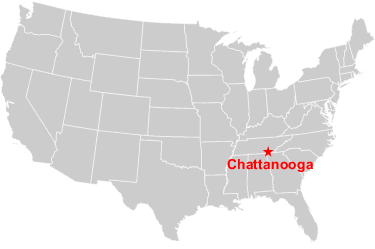
AT&T’s fiber to the neighborhood service is not exactly winning consumers over in Chattanooga, Tenn.  As of this past spring, AT&T only managed to convince 821 local customers to sign up for U-verse service, in part because the competition delivers faster service, and one doesn’t slap broadband customers with an Internet Overcharging scheme.

While Comcast remains the dominant cable company in the city with more than 100,000 customers, community-owned EPB Fiber has made major advances, primarily against Comcast, picking up at least 33,000 customers in the city since the summer of 2010.

EPB is turning into a major success story for community-owned broadband, typically maligned as a financial failure by cable and phone company competitors.  EPB offers residential customers usage cap free gigabit broadband, television, and telephone service and is competing effectively against the nation’s largest cable operator.

EPB has been raking in more than $3.8 million a month in telecommunications revenue from residential customers alone.  In less than two years, EPB, which also delivers electricity in Chattanooga, has built a $45 million a year telecommunications business.  As a community-owned utility, most of that revenue stays in Chattanooga, benefiting the local economy and allowing EPB to reinvest in its network and improve service.

Comcast, in contrast, has seen its revenue drop by 8.4 percent during the first six months of 2011, primarily because of departing customers. That has forced the dominant cable company to become more aggressive in its efforts to retain those calling to cancel, primarily by slashing prices if wavering customers agree to stay.

Remarkably, AT&T’s U-verse has merited also-ran third place status — the victim of limited availability, the ongoing trend of customers dropping landline service, and the far-superior broadband speeds available from the competition.  AT&T’s Internet Overcharging scheme is also the stingiest, limiting broadband customers to just 150GB for its DSL service, 250GB for U-verse broadband, charging overlimit fees when the caps are exceeded.  Comcast has a usage cap of 250GB with no overlimit fee.  EPB has no limits.

The Chattanooga Times Free Press compares all three providers’ strengths and weaknesses:

EPB Broadband speeds are the fastest in the nation.

AT&T — Very aggressively priced introductory offers, more HD channels than its competitors, plus a “quad-play” bundle that includes AT&T wireless service.  But AT&T’s landline network is still the least equipped to compete on broadband speed, an increasing number of residents continue to turn their back on AT&T when they cut landline service, and U-verse’s usage caps come with overlimit fees.

Comcast — Has a substantial number of on-demand programs to access, can be cheaper than EPB during the initial year of service, and is testing home security and automation services.  Also offers two-hour service call windows and aggressively priced retention deals.  But Comcast’s regular prices are high, its broadband service usage-limited, and its reputation questionable after more than a decade of rate hikes and service complaints.

EPB — The fastest broadband speeds anywhere, EPB runs an advanced fiber to the home network, and maintains a very aggressive attitude about expanding and improving service.  EPB is a formidable competitor.  Community-0wned, its service benefits local residents with a locally-staffed call center, revenues that stay in Chattanooga, and management that answers to customers, not Wall Street.  No caps either.  But EPB can be a harder initial sell for price-sensitive customers because it doesn’t offer heavily discounted service to attract new customers.  But EPB prices don’t rise dramatically after the first year, either.  EPB’s television lineup is less robust than others, in part because it lacks a nationwide presence that brings the kind of volume discounts AT&T and Comcast receive.

Search This Site:

Contributions:

Recent Comments:

Your Account:

Stop the Cap!