Home » Consumer News » Recent Articles:

Former Cablevision COO Hits Pay Powerball as New CEO of Charter: $90+ Million Salary

Phillip Dampier January 5, 2012 Charter Spectrum, Consumer News Comments Off on Former Cablevision COO Hits Pay Powerball as New CEO of Charter: $90+ Million Salary

Payday for Rutledge

Cablevision’s former chief operating officer Tom Rutledge has hit executive pay Powerball, scoring a compensation package worth more than $90 million dollars as the incoming CEO of formerly-bankrupt Charter Communications.

Documents filed with the Securities and Exchange Commission reveal why Rutledge abruptly resigned from his position at Cablevision on Dec. 15.  Just four days later, Charter announced Rutledge would become its new CEO this February, replacing Mike Lovett who earlier announced his departure plans.

Rutledge will be extremely well compensated in his new position, scoring $8,000 a week in walk-around money until February when the executive suite opens up.  After that, his base salary will amount to $2 million annually, with yearly increases possible.  But the real money will come from Rutledge’s bonus and incentives package.  In addition to an annual bonus worth up to $3.5 million annually, Rutledge will also get more than one million shares of Charter stock, worth more than $70 million at present.  If Rutledge focuses on boosting that stock price, he could earn considerably more.

That’s a remarkable pay package for a cable company that declared bankruptcy just two years ago.  It’s also a lot more money for Rutledge, who collected just over $28 million at his old job at Cablevision.

In 2010, soon-to-be-former Charter CEO Mike Lovett earned just under $11 million in total compensation.

‘HBO/Max Go’ Online Video is Here for Some Time Warner Cable Customers

Phillip Dampier January 5, 2012 Consumer News, Online Video Comments Off on ‘HBO/Max Go’ Online Video is Here for Some Time Warner Cable Customers

HBO's Go service streams HBO movies, specials, and series to "authenticated" HBO subscribers

Time Warner Cable began testing its HBO and Cinemax Go “TV Everywhere” online video services Wednesday, starting with a private beta test for their super-premium Signature Home customers who pay $199+ for cable, broadband, and phone service.

Signature Home customers signed up for HBO and/or Cinemax will receive e-mail from the company that includes login instructions for the authenticated video service, which will be included in the cost for both premium channels.  Customers must subscribe to one or both premium channels for access.  Time Warner Cable’s Jeff Simmermon says other Time Warner Cable premium channel subscribers will get access as soon as next week.

For now, Time Warner’s implementation of the online video services will support Mac and PC computers.  Tablet and smartphone owners will have to wait for respective apps coming at a later date.

The cable company’s gradual rollout of the streaming video service is designed to prevent subscribers from overloading the company’s servers, which happened with the introduction of its iPad online viewing app.

“Rather than spend time aggregating a large list of volunteers across our footprint, vetting them against various eligibility requirements, and making sure that each of our markets is equally represented to arrive at a final approved master list, we’re going with all SignatureHome customers,” Simmermon said. “This will allow us to take a representative sampling from across all markets — which have varied tech infrastructures — without overloading our systems.”

Time Warner is one of the last major cable operators to unveil the premium movie channel streaming service.

More than 1,400 movies, specials and series are available for streaming from HBO Go.  Cinemax’s counterpart is more limited — just over 400 movies and soft core adult entertainment from its Max After Dark series.

Comcast’s Roach Motel: Illinois Family Infested By Bugs Reportedly Inside Set-Top Box

Phillip Dampier January 4, 2012 Comcast/Xfinity, Consumer News Comments Off on Comcast’s Roach Motel: Illinois Family Infested By Bugs Reportedly Inside Set-Top Box

An Illinois family’s home is now infested by roaches, and the Aurora resident is blaming Comcast’s reportedly bug-infested set top box for the problem. Read up about these pest facts that are not commonly know so you’ll know how to deal with them.

Antonio Muñoz recently signed up for Comcast cable service, but tells the Beacon News cockroaches began crawling out of the refurbished cable box installed in his parents’ room.

In addition to the roaches he has collected in a plastic bag to show the cable operator, the Muñoz family has now seen several of the bugs running loose around the home.

Muñoz is upset with the cable company for dragging their feet on replacing the infested equipment.  He’s since sealed the box in question and dropped it off at Comcast’s local cable store.  But the cable company refused to exchange it with a new box until a technician could be sent to the Muñoz home.

“Given the rigorous quality control processes we have in place, it’s difficult to say exactly what happened,” a Comcast representative said. “As our goal is to do right by our customers, our immediate focus is to resolve the issue to Mr. Muñoz’s satisfaction.”

It’s not the first time Comcast has faced allegations of roach-infested equipment, prompting more rigorous and Detailed pest removal inspections to ensure customer safety and hygiene.

More than a dozen current and former employees of a Comcast facility on Chicago’s South Side are part of a federal class-action lawsuit filed last month alleging racial discrimination and a hostile, bug-infested work environment.

The suit claims Comcast management ordered technicians to install equipment in customer homes regardless if it was defective or infested by vermin.

The plaintiffs claim Comcast facilities are plagued not only with roaches but also rats.  Some supervisors are accused of telling some Comcast workers that equipment given to African American employees would be stolen, and there was little reason to provide those installers with a complete set of installer tools.

Most cable equipment is recycled and re-used as customers turn in equipment.  Cable operators routinely refurbish and test equipment before it is put back into service.  But cable equipment can offer an inviting home for invading insects or small rodents.  Customers receiving obviously used equipment should inspect it carefully for plant debris, dead insects, or points of potential entry for unwelcome visitors before allowing the installer to leave.

The Muñoz family has since received a new box, but no word if the special visitors that arrived in the original equipment have been effectively evicted.

Updated: AT&T Roadside Ripoff: Florida Customers Getting Their Money Back for Unwanted $3 Extra

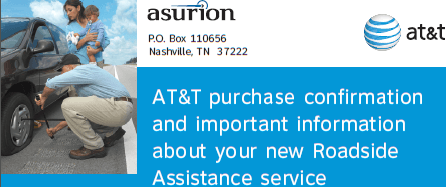
AT&T Mobility has agreed to refund Florida wireless customers for a $2.99 Roadside Assistance Plan many never signed up for and didn’t want.

An agreement with Florida Attorney General Pam Bondi could net full refunds for as many as 600,000 Florida customers who discovered they were enrolled in the add-on plan. The agreement requires AT&T to fully refund all charges for those who didn’t ask for the plan and never used it.

“All customers who paid for unwanted services deserve to be made whole, and we have guaranteed that AT&T Mobility will fully refund their money,” the Attorney General said. “Additionally, AT&T Mobility must notify customers via text message of added charges and service cancellation procedures.”

Specifically, AT&T will send a text message to customers five days after enrolling in the option confirming forthcoming charges.  The message will include cancellation instructions.

Customers complained AT&T automatically enrolled them in a 30-day free trial of Roadside Assistance without their knowledge or consent and began charging them for the service when the trial expired.  Some claim they were never given notification of the trial and assumed the charges were part of their cellular service.

In addition to full refunds for Florida customers, AT&T Mobility will:

  • Provide prepaid telephone cards with a face value of $550,000 for donation to members of the U.S. military;
  • Donate $10,000 to the Florida Law Enforcement Officer of the Year program;
  • Pay $1.2 million to the Attorney General’s Office for future enforcement and attorneys’ fees and costs.

Impacted customers will be notified by postcard or letter with further details about the AT&T settlement at a future date.

[Updated 12:35pm EDT 3/21/2012: Please note Stop the Cap! is in no way affiliated with AT&T.  Readers have been leaving comments attached to this article requesting removal/refunds for the Roadside Assistance program. We are not AT&T so we cannot handle these requests.  We recommend you scrutinize your AT&T monthly bill and look for a $2.99 charge labeled “Roadside Assistance.” If you see this on your statement, you -are- being billed for this feature. If you do not see it specified, you are not being billed for it.

Those who have been charged should call AT&T customer service at the number shown on your bill. 

We recommend you follow this procedure:

  1. Tell AT&T you never requested this feature.
  2. If you have never used this service, ask AT&T to retroactively credit you for -ALL- charges billed to your account all the way back to the first month you were billed for them. This would appear as a credit on a future AT&T invoice.
  3. Make sure AT&T removes future charges from your bill as well.

At some point in the future, you will receive a plain-text settlement postcard in the mail from the class action settlement fund. But you can pursue a full refund from AT&T yourself without waiting around for that. Just remember you cannot get your money back telling us about it. You need to contact AT&T directly.]

Verizon Wireless Shoots Itself in the Foot With $2 “Convenience Fee,” Now Rescinded

Verizon Wireless became the Bank of America of late 2011 when it attempted to impose a $2 “convenience fee” on select customers who prefer to pay their monthly phone bills online or through an automated telephone attendant.  It’s just the latest experiment in customer gouging — the same kind of toe-in-the-water strategic experimenting that unleashed ubiquitous baggage fees on airlines, low balance fees on checking accounts, and the increasingly-common practice of charging customers extra to mail them their monthly bill.

An entire industry of consultants pitch their creative talents to companies like Verizon who want “a little extra” from captive customers.  These specialists sell their expertise identifying the most vulnerable (and least likely to leave), who will grin and bear just about any kind of abuse heaped on them. Many income and resource-challenged consumers are left feeling powerless to protest and reverse unwarranted extra charges.

The consultant gougers-for-hire made millions for large banks when they figured out how to score the biggest bounced check and overdraft fees (simply pay the biggest check first, opening the door to $39 bounced check fees for all the little checks that follow).  Verizon’s $2 fee targeted customers who couldn’t afford to let the company automatically withdraw their monthly payment, or didn’t trust the company to do it correctly.  Even more, Verizon’s fee would target more desperate past-due customers who needed to make a fast payment to avoid service interruption.  Consumer advocates wondered if Verizon was successful charging these customers more, would they expand the fees to cover all online or pay-by-phone payments?

We’ll never know because the public outcry and intensive media coverage during a slow holiday week combined to force Verizon into a fourth quarter revenue retreat, rescinding the fee 24 hours after announcing it.  But Verizon may be pardoned if they feel they were unfairly singled out.  That is because other telecommunications companies have been charging certain customers bill payment fees of their own for years:
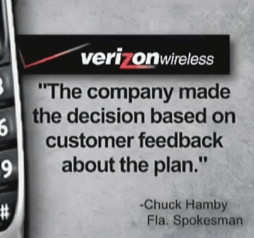
Verizon's evolved position on the $2 convenience fee (Courtesy: WTVT)

  • Stop the Cap! reader Larry writes to share TDS Telecom, an independent phone company, charges a $2.95 “third party processing fee” when accepting payments by phone.  “In its place you either have to revert to U.S. Postal Service, or agree to electronic billing for on-line payment access.”
  • AT&T charges a $5 bill payment fee for “certain customers.”
  • Sprint/Nextel not only has its own $5 bill payment fee for those paying at the last minute,  it also forces customers with spotty credit to sign up for auto-pay to avoid a mandatory surcharge.  Want a paper bill?  That’s $2 extra a month.
  • Comcast charges a $5.99 payment fee, but only in certain states.
  • Time Warner Cable charges fees ranging from an “agent assisted payment” fee ($4.99) to a statement copy fee ($4.99) in some locations.

While Verizon has agreed to drop its latest new charge, the company’s carefully-named bill-padding extra fees attached to monthly bills remain.  In addition to breaking out and passing along all government fees and surcharges, Verizon also bills customers administrative and regulatory recovery fees that, for other companies, would represent the cost of doing business.  These latter two go straight into Verizon’s pocket, despite the implication they are third party-imposed mandatory surcharges.

Had Verizon called their new $2 “convenience” fee a “business efficiency accounting recovery fee,” would they have snookered enough consumers to get away with it?

[flv width=”360″ height=”290″]http://www.phillipdampier.com/video/WTVT Tampa Verizon cancels planned 2 bill-pay fee 12-30-11.mp4[/flv]

WTVT in Tampa says Verizon did a complete 180 on its $2 bill payment “convenience fee.”  (3 minutes)

[flv width=”640″ height=”380″]http://www.phillipdampier.com/video/CNN Verizon Dumps Fee 12-30-11.flv[/flv]

CNN hints the FCC’s potential involvement in Verizon’s business may have had something to do with the quick shelving of the $2 fee.  (2 minutes)

 

Search This Site:

Contributions:

Recent Comments:

Your Account:

Stop the Cap!