Home » Consumer News » Recent Articles:

Rate Increases for One and All: AT&T, Comcast, Cox, DirecTV — Up, Up and Away

Customers of some of the largest cable, phone, and satellite companies will pay an average of 3-6 percent more for service in a series of rate increases taking effect between now and the end of February.
AT&T U-verse

If your introductory offer has expired, expect to pay more for just about everything as of Feb. 9.

Cable TV:

  • U-family will increase from $54 to $57,
  • U100 will increase for some from $54 to $59 and for others from $59 to $64,
  • U200 will increase from $69 to $72/U200 Latino will increase from $79 to $82,
  • U300 will increase from $84 to $87/U300 Latino will increase from $94 to $97,
  • U400 will increase from $109 to $114,
  • U450 will increase from $117 to $119/U450 Latino will increase from $127 to $129.

For high speed Internet customers who ordered their current speed before June 12, 2011, effective with the February 2012 billing statement, the monthly price for Basic will increase from $19.95 to $25, Express will increase from $30 to $33, Pro will increase from $35 to $38, Elite will increase from $40 to $43, and Max will increase from $45 to $48. If you are paying a monthly high speed Internet equipment fee for the Residential Gateway, the amount will increase from $4 to $6.

For Voice Unlimited, effective on February 1, 2012, the monthly price will increase from $33 to $35.

AT&T blames increased programming costs and “the cost of doing business” for the rate increases.  AT&T is increasing broadband pricing despite enjoying further cost reductions from their Internet Overcharging scheme implemented in 2011.

Comcast

Comcast implements rate increases at different times of the year throughout its national service area.  But a preview of what is forthcoming can be seen in south Florida and Minnesota, where Comcast’s new rates for 2012 have increased an average of 5.8 percent.  That comes after a 2 percent rate hike last year.  It’s a bitter pill for many customers to swallow, because Comcast has also been moving popular cable channels like Turner Classic Movies into the more expensive Digital Preferred package.  The price of that full basic package will now run just short of $85 a month. Customers in Minneapolis are staring down these new rates:

  • Basic 1: no change in most franchise areas.
  • Digital Economy: increases from $29.95 a month to $34.95 a month, or 16.7 percent.
  • Digital Starter: increases from $62.99 a month to $66.49 a month, or 5.6 percent.
  • Digital Preferred: increases from $80.99 a month to $84.49 a month, or 4.3 percent.

Comcast blames increased programming costs and upgrade expenses associated with its now completed DOCSIS 3 project.  Comcast also has converted many of its service areas to all-digital service, which has opened up additional room to sell more expensive broadband packages, add additional HD channels, and make room for new product lines relating to home automation and security.

Cox Cable
Broadband Reports readers are sharing anecdotal evidence Cox has begun its own 2012 rate increase campaign.  In Florida, cable TV rates are up yet again:

Prices for Cox TV and Cox Advanced TV will be as follows:

  • Cox TV Starter will change from $19.55 to $22.85/mo.
  • Advanced TV will change from $5.50 to $4.20/mo.
  • Advanced TV Standard Definition receivers will change from $5.55 to $6.99/mo.
  • Advanced TV High Definition, High Definition/DVR & DVR receivers will change from $7.45 to $7.99/mo.

Advanced TV Paks will change:

  • Any 1 Pak (excluding Variety Pak) from $4.00 to $4.25/mo.
  • Any 2 Paks (excluding Variety Pak) from $8.05 to $8.50/mo.
  • Any 3 Paks from $12.00 to $12.50/mo.
  • Variety Pak will be $4.00/mo.

Premium pricing will change:

  • 1 premium channel from $13.99 to $14.99/mo;
  • 2 premium channels from $23.99 to $24.99/mo;
  • 3 premium channels from $30.99 to $34.99/mo;
  • 4 premium channels from $36.99 to $44.99/mo.
  • (Pricing for the 3rd and 4th Premium channels will be grandfathered at the current price for existing customers.)

Cox’s Preferred Internet tier is increasing from $49.99 to $53.99 a month.  Basic phone service increases from $11.75 to $13.18, and popular calling features like Caller ID are also increasing (from $5.95 to $9.00 per month).

Rates vary in different franchise areas.

DirecTV

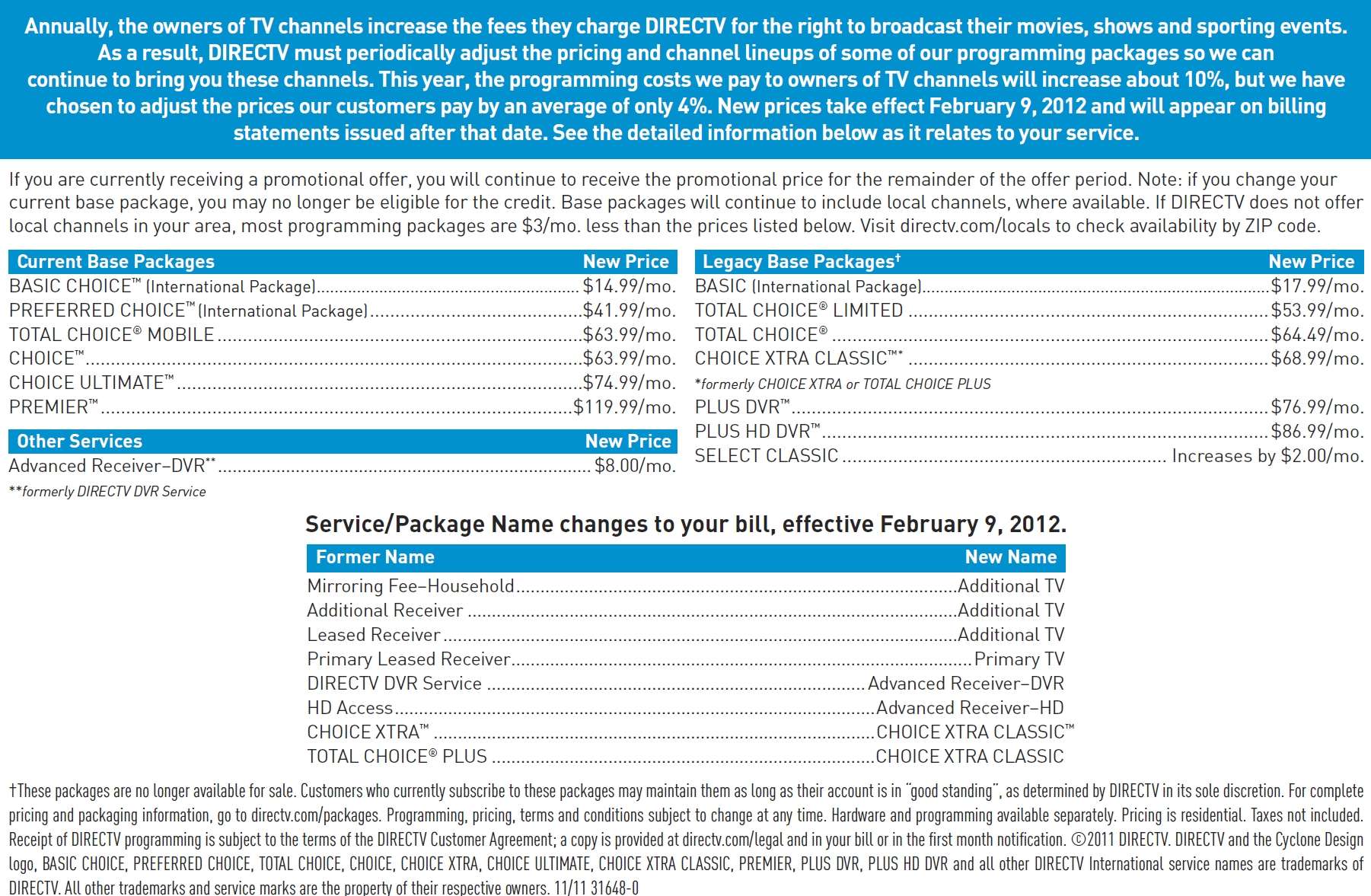
The satellite TV provider will raise rates on Feb. 9 by 4 percent on average. Its costs are going up by more than that, the company said on its website: “The programming costs we pay to owners of TV channels will increase by about 10 percent.”

DirecTV defends its rate increase, noting it will introduce new features in 2012 that include more than 170 HD channels and the most 3D viewing options of any television provider.  The full breakdown is provided from DirecTV:
Rate increases effective February 2012. Click image to enlarge.

Consumer Tips

  1. Customers who subscribe to bundled services will see the fewest rate increases.  The more services you bundle, the lower the typical cost of each component within the bundle.  It rarely pays to have one company as a TV provider and another delivering your broadband because standalone service pricing is increasingly the most expensive option.
  2. Ask for an extension of your introductory or promotional rate.  Request pricing from the competition and be prepared to summarize it with your current provider when arguing for a lower rate.  If your current provider thinks you are serious about jumping to another provider, they may lower your rates to keep your business.
  3. Be prepared to switch.  Cable companies base their retention offers on several factors: what the competition offers, how long you have been a customer (2+ years guarantees a better retention deal) and how you pay your bill.  If you are a late payer, expect a much more difficult time negotiating a lower rate.  You may encounter a brick wall if you are labeled a “flipper” that jumps between providers’ introductory pricing offers.  But even these customers will be welcomed back, with lower rates, when they inevitably return.  They just won’t get their promotional offer renewed.
  4. Some companies reserve their most aggressive pricing for customers who actually schedule a disconnect or turn in their equipment.  Cable companies have gotten wise to empty threats from negotiating customers.  If you schedule a complete service disconnection two weeks in advance, some companies will take you seriously and call you with the most aggressive “win back” offers available, especially if you turned in your cable equipment.
  5. Dump extras overboard.  Premium channel pricing has skyrocketed recently after remaining relatively stable for nearly two decades.  HBO is now at or above $15 a month in many areas.  As customers try to economize, premium movie channels are usually the first to go, and many cable operators are starting to lose preferred wholesale volume pricing discounts.  They are passing along new, higher prices to the dwindling number of premium customers left.  Scrutinize your cable bill carefully for potential savings.  Look for mini-pay tiers of HD channels you never watch, consider downgrading your “digital phone” package to local-only calling if you rarely make long distance calls, and consider tossing “Turbo” broadband speed packages that only incrementally increase download speed.  Many customers originally signed up to obtain higher upload speeds, but as cable companies boost speeds for all of their customers, the extra boost may no longer be worth the money.
Wall Street Encourages Verizon to Get Completely Out Of Landline/FiOS Business

Wall Street is encouraging Verizon Communications to sell off its landline telephone operations to clear a path for a potentially-profitable merger with British mobile phone company Vodafone Group Plc.

Analysts at Goldman Sachs Group are behind the research report, which suggests Verizon’s recent non-aggression treaty with Comcast and Time Warner Cable makes the sale of Verizon’s landline phone and FiOS fiber to the home network more likely. Verizon will earn a percentage of every cable TV/phone/broadband subscription sold, effectively making Verizon’s own wired network redundant. Potential buyers could include Frontier Communications, CenturyLink, or Windstream, which all have business plans that depend on landline networks fewer Americans are using.

Should Verizon clear away its legacy landline and FiOS networks, Goldman Sachs suggests, a merger with Vodafone would be a “clear fit” for the two companies.

“The remaining wireless and enterprise businesses would have faster growth and a clear fit with Vodafone’s assets and strategy, making it a more attractive merger partner,” Bloomberg News quotes from the report.

“Given that it no longer faces the threat of integrated cable competitors, Verizon could potentially spin off its remaining [landline] assets,” along with “large” pension and benefit liabilities, the Goldman analysts added.

Verizon would also eliminate its ongoing dispute with the two largest unions representing its landline workers — Communications Workers of America and the International Brotherhood of Electrical Workers.  Both unions are still trying to negotiate a new contract with Verizon after a brief, but contentious, summer strike. Verizon Wireless is almost entirely non-unionized.

Vodafone’s share price has been rising recently, perhaps anticipating a potential merger that would give Vodafone a stronger hand in the U.S. marketplace.

Verizon’s investment in its landline network, along with interest in expanding its well-regarded FiOS fiber to the home service, has remained stalled for the past few years.  Recently, the company indicated an interest in moving away from fiber optics to serve broadband customers, and rely on its wireless LTE 4G network instead.

Verizon’s new CEO Lowell McAdam comes from Verizon’s wireless division, and has not shared his predecessor’s enthusiasm for fiber upgrades.

Merger Partner?

While the prospect of an all-wireless future for Verizon may seem good for shareholders, consumers are likely to pay the price:

  1. The Justice Department is reviewing the antitrust implications of the non-aggression treaty between Verizon and its cable competitors;
  2. The sale of Verizon’s landline network to an independent provider could doom the company’s fiber optic network and limit rural Verizon customers to 1-3Mbps DSL;
  3. Verizon Wireless’ prices reflect its market share and lack of strong competition.  The company’s LTE wireless network, although fast, has suffered from reliability problems and is heavily usage-limited.  It may prove unsuitable as a home broadband replacement for rural customers;
  4. Reduced competition for telephone, video, and broadband will likely result in higher prices for existing cable subscribers, too.

Verizon is hardly the first phone company to ponder getting out of the phone business.  AT&T has been lobbying to rescind rural universal service requirements for years.  If successful, AT&T could abandon its rural landline network and provide customers with higher-priced cell phone service instead.

[flv width=”640″ height=”380″]http://www.phillipdampier.com/video/CWA Parody of Verizon Video.flv[/flv]

Verizon’s unionized workers are still fighting for a new contract, and released this parody video in response to a company-produced DVD mailed to union workers’ homes.  (3 minutes)

Time Warner Cable Interested In Spending Billions to Buy Los Angeles Dodgers

Phillip Dampier January 9, 2012 Consumer News, Editorial & Site News 2 Comments

At a time when cable television rates continue to spiral upwards in excess of the rate of inflation, Time Warner Cable’s interest in spending several billion dollars to acquire a professional baseball team seems strange.

The Los Angeles Times reports the cable giant is considering buying the Los Angeles Dodgers at a price that could exceed $2 billion.  It would compliment two new regional sports cable channels Time Warner plans to launch in southern California featuring the Los Angeles Lakers.

Time Warner Cable Sports president David Rone confirmed the cable company has a strong interest in carrying the Dodger games.  Purchasing the team outright could be much easier (and eventually cheaper) than negotiating against competing broadcasters and cable networks just to acquire the airing rights.

But at the same time customers are facing higher cable bills after the latest round of rate increases, it is ironic a cable operator complaining about programming costs and expenses would suddenly be willing to part with billions for a single baseball team.  For New York sports fans coping with the loss of MSG, sports programming Time Warner calls too expensive, it could prove counter-productive to complain about the cost of sports on the east coast while considering a $2+ billion purchase out west.

NY City Wants Time Warner Cable to Refund Cable Customers for MSG-Less Cable Lineup

Liu

While Buffalo residents fume about missing the latest matchup between the Buffalo Sabres and Edmonton Oilers, the city of New York is pressuring Time Warner Cable to start compensating their subscribers for the loss of one of the most expensive channels on the basic cable dial.

New York City Comptroller John Liu has asked the Department of Information Technology and Telecommunications, which oversees cable franchise agreements for the city, to make certain Time Warner compensates customers for the loss of MSG and MSG Plus, both removed over a contract renewal dispute.

“Consumers deserve to be compensated for what they have gone through as a result of this dispute, plain and simple,” Mike Loughran, a spokesman for Liu, told Bloomberg News in an e-mail. Loughran said the comptroller’s office would discuss compensation plans with the Department of Information Technology and Telecommunications.

Time Warner says it has already effectively compensated impacted customers, primarily in New York State, with a free month of the company’s added-cost sports programming tier.  Time Warner has also replaced the two MSG networks with NBA TV and NHL Network, which are now likely to remain part of the basic package even if Time Warner reaches an agreement with MSG.  (Sorry football fans, NFL Network is still too costly to be deemed a suitable replacement network.)

Time Warner says there is no way they would pay MSG’s asking price for a renewed carriage contract, which the cable company says represented a 53% rate increase.

As Stop the Cap! reported earlier, the dispute is renewing rumblings about how pay television providers handle expensive sports programming.  An increasing number of cable executives are considering breaking sports networks out of the basic cable package and forcing interested sports fans to pay extra to receive them.  But sports remains a lightning rod issue for many pay TV companies, both among subscribers and politicians.  Disrupt a major sporting event at your peril — something Cablevision learned from an earlier dispute with Fox.

In Buffalo, some customers are dropping Time Warner Cable for Verizon FiOS, at least where that fiber to the home service is available.  Residents served by Frontier Communications or Verizon’s DSL have fewer choices — one of two satellite TV companies.

Verizon already carries a standard definition feed of MSG Networks.  AT&T announced this week it was adding MSG in HD to its U-verse lineup in Connecticut.  MSG has spent this week rubbing salt in Time Warner’s wounds, throwing MSG viewing parties in both Buffalo and New York City.  Now that the city of New York is pressuring Time Warner to cough up refunds as much as $4 or more a month for the loss of MSG, the dispute could prove increasingly expensive.  Some customers tell Stop the Cap! they are already receiving informal compensation for the loss of MSG after contacting the cable company by phone or e-mail to complain.

“I wrote Time Warner on their web contact form and a representative gave me a $5 courtesy credit for the loss of the channels after I explained I was shopping around for another provider,” writes Neil Thomowski who lives in Cheektowaga, near Buffalo.

[flv width=”360″ height=”290″]http://www.phillipdampier.com/video/WNLO Buffalo Sabres fans dismayed by cable dispute 1-3-12.mp4[/flv]

Buffalo Sabres fans who have Time Warner Cable were left in the dark Tuesday night and couldn’t watch the match-up between the Sabres and the Edmonton Oilers.  WNLO in Buffalo has the story.  (2 minutes)

South Korea Set to Launch 100Mbps Wireless, Seamlessly Combines Mobile Broadband & Wi-Fi

Phillip Dampier January 5, 2012 Broadband Speed, Consumer News, Wireless Broadband Comments Off on South Korea Set to Launch 100Mbps Wireless, Seamlessly Combines Mobile Broadband & Wi-Fi

While you ponder Verizon Wireless’ latest LTE 4G outage or try to convince yourself Sprint really is selling “4G” service from Clearwire, South Korea’s Sunkyoung Telecom (SK Telecom) is deploying new technology to enormously boost wireless Internet speeds to as high as 100Mbps.

SK Telecom has developed new Heterogeneous Network Integration Solution (HNIS) technology that weds 3G/4G service with any open Wi-Fi network to deliver speeds many times faster than North Americans can get from their wireless providers.  The technology is designed to work without a lot of consumer intervention.  For example, HNIS will automatically provision open Wi-Fi access wherever subscribers travel.  The combination of mobile broadband with Wi-Fi works seamlessly as well.  Currently, smartphones can use Wi-Fi or mobile data, but not both at the same time.  HNIS changes that.

While mobile operators cope with spectrum and capacity issues, HNIS can reduce the load on wireless networks, without creating a hassle for wireless customers who used to register with every Wi-Fi service they encountered.  The theoretical speed of an HNIS-enhanced 3G and Wi-Fi connection in South Korea will be 60Mbps when SK Telecom fully deploys the technology this year.  As SK expands the technology to its 4G networks, theoretical maximum speeds will increase to 100Mbps.

SK is so confident in the technology, it plans to equip all of its smartphones with the new technology starting in 2013.

Byun Jae-Woan, CTO of SK Telecom said, “SK Telecom will provide customers with a data service of much greater speed with Heterogeneous Network Integration Solution, which represents one of the company’s world’s top-level network operation technologies. By realizing the speed of fixed-line services with wireless networks, SK Telecom will allow its customers to experience a new and innovative mobile life.”

Operators like AT&T are installing their own Wi-Fi hotspots in heavy use areas to try and offload data traffic to Wi-Fi.  But customers have to make the connection themselves. HNIS quietly handles this process in the background while staying in touch with SK’s 3G and 4G networks to maintain a consistent data connection.


Search This Site:

Contributions:

Recent Comments:

Your Account:

Stop the Cap!