Home » Consumer News » Recent Articles:

Comcast Wraps Up ‘Town Hall’ Meetings in Savannah Over Hundreds of Customer Complaints

Phillip Dampier February 14, 2012 Comcast/Xfinity, Consumer News, HissyFitWatch, Public Policy & Gov't, Video Comments Off on Comcast Wraps Up ‘Town Hall’ Meetings in Savannah Over Hundreds of Customer Complaints

[flv width=”640″ height=”380″]http://www.phillipdampier.com/video/WSAV Savannah Final Meeting With Comcast 2-9-12.flv[/flv]

Comcast has concluded the last of four public meetings to address consumer complaints with the quality of the cable company’s products and customer service in Savannah, Ga.

Dozens of customers filled Armstrong Center to complain about billing, hold times, and service issues. Comcast technicians were on hand and literally followed some customers home to address long-standing problems on the spot.

The public meetings came at the urging of Savannah city officials who have received hundreds of complaints about Comcast’s poor performance in the Georgia city. 

“We are committed to continuously improving the services that we offer and the way we deliver the service, said Andrew Macke, vice president of government and community affairs. “There’s ongoing efforts to improve that, but certainly as we value our relationship with the city, we’ll continue to work with them to highlight some of the things that we’re doing but also address some of the common themes.”  (2 minutes)


Comcast’s Discount ‘Internet Essentials’ Off Limits Because of One Late Bill 10 Years Ago

Phillip Dampier February 14, 2012 Comcast/Xfinity, Consumer News, Public Policy & Gov't 3 Comments

A Philadelphia community group is accusing Comcast of keeping its low-income budget Internet program a secret and denying needy families access for the flimsiest excuses.

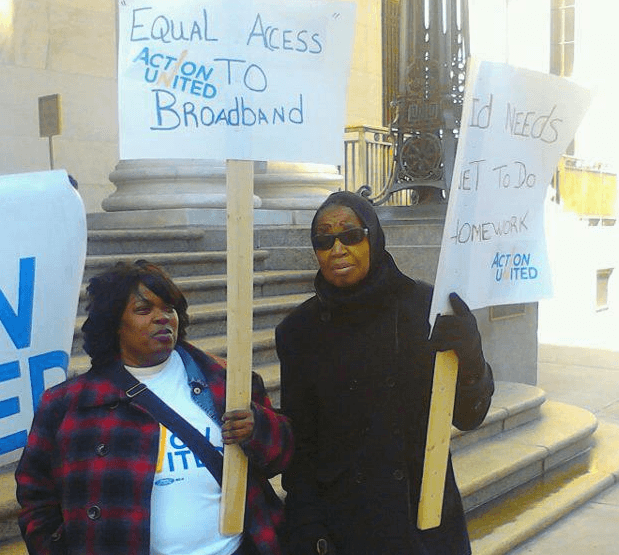
Action United, which fights for low and moderate income Pennsylvanians, dropped off complaints with federal officials in Philadelphia from residents who are upset because they never heard of the discounted Internet access program or were disqualified from applying.

Comcast’s Internet Essentials offers families who qualify for the federal student lunch program access to 1.5Mbps broadband for around $9.95 a month.  But an informal survey by the group found scores of residents who never heard of the program and would have applied if they had known it existed.

The group, which says it has 44,000 members in Philadelphia, Pittsburgh, Harrisburg and Allentown, says it could find only two families among its members that actually qualified to sign up for the service.  Some were disqualified because they didn’t participate in the school lunch program, others because they already have Internet service or had a long-forgotten past due bill.

“I feel as though the Internet service will help my son to progress in math, reading, spelling,” Dawn from North Philadelphia told CBS Philadelphia. But she says Comcast refused to sign her up.

“They told me I had a back bill from 10 years ago, so I was not qualified,” Dawn said.

As Stop the Cap! reported in September, Comcast’s program is effectively designed to reap positive publicity for the cable company while discouraging customers from applying and actually obtaining the service.

Action United protests the digital divide in downtown Philadelphia. (Courtesy: Action United)

Action United says area schools, an obvious place to promote low cost Internet for students, knew nothing about the program.

Comcast counters it sent mailings about Internet Essentials to 4,000 school districts, which covers 30,000 schools.

The group originally planned to protest Wednesday in front of Comcast’s corporate headquarters in Philadelphia to draw attention to the problem.  Earlier today, Action United announced it had reached an agreement to meet with Comcast executives to discuss the program and help cut some of the red tape for families experiencing trouble applying.

Comcast’s decision to offer budget Internet service came as a result of negotiations with the federal government to approve its merger with NBC-Universal. Critics contend Internet Essentials is too restrictive and requires applicants to navigate through a cumbersome qualification process.  After approval, the program only provides discounted service for a period of three years and can be terminated if a family falls past due on their account.

From the byzantine terms and conditions for enrollment in the Comcast Internet Essentials program:

The program is only available to households that (i) are located where Comcast offers Internet service; (ii) have at least one child who receives free school lunches through the National School Lunch Program (the “NSLP”) and as confirmed annually while enrolled in the program; (iii) do not have an overdue Comcast bill or unreturned equipment; and (iv) have not subscribed to any Comcast Internet service within the last ninety (90) days (sections 1(i)-(iv) collectively are defined as “Eligibility Criteria”). This program is not available to households that have children who receive reduced price lunches under the NSLP. The program will accept new customers for three (3) full school years, unless extended at the sole election of Comcast. Comcast reserves the right to establish enrollment periods at the beginning of each academic year in which it accepts new customers that may limit the period of time each year in which you have to enroll in the program.

2. In order to confirm your eligibility for the program, Comcast will need to verify that your children receive free school lunches through the NSLP in the initial enrollment year and each subsequent year you are enrolled in the program. In order to confirm eligibility, participants in the program will be required to provide copies of official documents establishing that a child in the household is currently receive free school lunches through the NSLP. Each year you will be required to reconfirm your household’s current eligibility by providing Comcast or its authorized agent with up-to-date documentation. If you fail to provide documentation proving your eligibility in the program, you will be deemed no longer eligible to participate in the program.

3. You will no longer be eligible to participate in the program if (i) you no longer have at least one child living in your household who receives free school lunches under the NSLP; (ii) you fail to maintain your Comcast account in good standing; (iii) Comcast ceases to provide the Covered Service to your location; or (iv) your account opened under the program is closed. A change in address may result in your account being closed, even if you continue to receive Comcast services at a different address. Program participation also may be terminated if the Covered Service is upgraded, altered or changed by you for any reason. If you are no longer eligible for the program, but continue to receive the Covered Service from Comcast, regular rates, and any other applicable terms and conditions will apply to the Covered Service.

Time Warner Cable Support to Customer: “What Did You Do That Was Wrong?”

Phillip Dampier February 14, 2012 Competition, Consumer News, Video 4 Comments

Time Warner Cable dropped the ball… right on the heads of temporary customers Alice and Dan Beissel, who signed up for service and canceled just ten days later.

The Corpus Christi, Texas couple decided to cancel service from AT&T and give the cable company a try and, according to them, it was trouble right from the start.

The Beissels say the cable service never worked right, with picture outages and other equipment troubles that came and went.  Frustrations mounted when a service call found nothing wrong, until the Time Warner truck pulled out of the driveway and the picture again went blank.

But the final straw was a conversation Dan Beissel had with the company’s customer service support center.

“What did you do that was wrong,” the representative asked Beissel.

Beissel must have thought the answer was ‘signing up for cable service,’ because the family decided to cancel after that call ended.

Now the couple has been forced to turn to KZTV’s Troubleshooter consumer reporter in an effort to collect an overdue refund check for their service.  The station ran into the same kind of frustration the Beissel family did:

We’ve made several calls to Time Warner Cable in an attempt to speak with anyone who can help the couple.

Unfortunately, there is no customer service contact in Corpus Christi.

Time Warner Cable says refund checks are normally processed within four weeks and mailed from a California office.  A local employee working for the cable company in the Corpus Christi area said he would look into the missing refund check.


KZTV in Corpus Christi is helping one family find a missing refund check owed to them by Time Warner Cable.  (2 minutes)

Another Ridiculous Online Surveillance Bill; ‘If You’re Against It, You’re Pro-Child Porn’

Openmedia.ca's campaign against increased government surveillance

Two weeks ago, Ontario Provincial Police arrested at least 60 people in connection with one of the largest child pornography rings ever seen in the country.

Under current Canadian law, authorities obtained warrants to identify names associated with the IP addresses police say were engaged in the trade of lurid sexual imagery of minors, as well as recruiting potential new victims in online chat rooms and social networks.

Provincial police were able to identify at least five dozen suspects within the province and successfully staged a coordinated raid in Windsor, London, Toronto, Barrie, Niagara, Sudbury and Ottawa, charging them with more than 200 criminal offenses.

But some lawmakers believe existing privacy laws are inadequate and hamper police investigations, and plan to allow authorities new latitude in chasing down online crime.

An “Act to enact the Investigating and Preventing Criminal Electronic Communications Act and to amend the Criminal Code and other acts” is scheduled to be introduced in Parliament later today, and some of its supporters are attacking online privacy advocates of being “pro-child porn” if they oppose the measure.

“He can either stand with us or with the child pornographers,” Public Safety Minister Vic Toews said to one government critic of the new privacy bill.

The proposed legislation is nothing new — similar bills have come and gone through Ottawa for a few years now. Most seek to demolish the pesky and inconvenient process of obtaining a warrant to compel service providers to hand over personal information about those police are investigating. If the new legislation passes, providers will be able to track every call you make and every website you visit:

  • Require ISPs to provide, on request, your name, IP address(es), device identification numbers that allow authorities to track your cell phone and/or modem, and all contact information including unlisted phone numbers;
  • Require manufacturers and Internet providers to install “back door” access, allowing on-demand surveillance without a warrant;
  • Allow authorities limitless access to archived data including e-mail and other communications logs providers store;
  • Compel other parties to preserve and produce electronic evidence, such as received e-mail, online order histories and other financial transactions.

Together, these new police powers would allow the government to engage in real-time surveillance of your phone calls and online activity without any court supervision or oversight. If it turns out you were unlucky enough to secure an IP address that was formerly used by a subject of an investigation, authorities could begin digging into your background and potentially charge you with an unrelated crime if they happen to find something not part of their original investigation.

[flv width=”640″ height=”380″]http://www.phillipdampier.com/video/CBC Online surveillance critics accused of supporting child porn 2-13-12.flv[/flv]

CBC News outlines Canada’s latest effort to broaden online surveillance powers and the ensuing controversy. (2 minutes)

Online privacy advocates call the new legislation chilling, and are unpersuaded by supporters who think the process of obtaining a court-issued warrant is too burdensome and time consuming.

When pressed by the media, law enforcement officials have yet to identify a single criminal investigation hampered or delayed by current privacy laws, which require police to obtain sufficient evidence to convince a judge an invasion of privacy is warranted to pursue a criminal investigation. With this new legislation, authorities could launch endless “fishing expeditions” of those they suspect might be involved in a crime, but lack evidence to pursue. Even more concerning is that national security agencies could monitor political opponents, protest organizations, and other groups deemed threatening by the current government.

Proponents say such abuses are unthinkable and the bill is no more threatening than issuing an IP “phone book” for authorities, showing who is using what IP address. But Michael Geist details the legislation is much more than its backers would have you believe.

Without any proof current law is insufficient to handle criminal cases like the one noted above, it is prudent to reject this bill and avoid handing the government unchecked new powers of surveillance. That some in government are willing to play the ‘you are with us or with the child predator’-card as part of reasoned debate is as reprehensible as those in Washington who accused opponents of broad new surveillance powers after 9/11 as being “with the terrorists.”

For more information and to sign a petition opposing the measure, visit Openmedia.ca’s Stop Online Spying website.

[flv width=”640″ height=”380″]http://www.phillipdampier.com/video/Stop Online Spying.flv[/flv]

Openmedia.ca’s campaign against online spying includes three professionally-produced ads that put the bill in terms even technically-unaware Canadians will understand. (2 minutes)


AT&T: Pay Us $36 If You Really Want to Upgrade That Smartphone

Phillip Dampier February 13, 2012 AT&T, Competition, Consumer News, Wireless Broadband 1 Comment

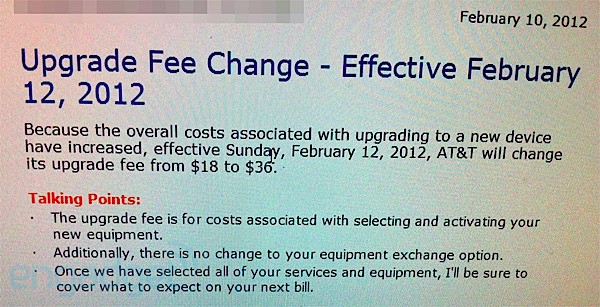
AT&T increases upgrade fee. (Photo courtesy: Engadget)

AT&T has announced it is doubling the price of its equipment upgrade fee, now charging $36 when a customer activates a new phone on their wireless account.

Our regular reader Scott sent word AT&T raised the upgrade fee Feb. 12, from $18 to $36, to “cover their costs. ” The fee now matches that charged by Sprint.

From AT&T’s official statement:

Wireless devices today are more sophisticated than ever before. And because of that, the costs associated with upgrading to a new device have increased and is reflected in our new upgrade fee. This fee isn’t unique to AT&T and this is the first time we’re changing it in nearly 10 years.

Wireless companies in North America encourage more frequent phone upgrades because of their business model: pitching subsidized phones in return for a two-year contract commitment, along with higher-priced service plans which gradually recoup the cost of the subsidy.

Consumers who hang on to their phones longer than two years continue to pay higher prices for service plans designed for those who always upgrade phones every two years at contract renewal time.  Phone companies also prefer customers who live under a term contract because they are less likely to switch providers.

In the past, loyal customers not only received extra incentives and discounts when they renewed their contracts, they also had these kinds of service fees waived.  No more.  Most companies have discontinued extra upgrade discounts for existing customers and increasingly refuse to waive service and equipment fees.

Search This Site:

Contributions:

Recent Comments:

Your Account:

Stop the Cap!