Home » Consumer News » Recent Articles:

Mobile Phone Companies Seek to Curtail Free Text/Calling Alternatives

Phillip Dampier February 29, 2012 Competition, Consumer News, Wireless Broadband Comments Off on Mobile Phone Companies Seek to Curtail Free Text/Calling Alternatives

As wireless carriers watch their revenues from texting and calling begin to decline as consumers increasingly turn to third-party applications that offer free alternatives, some companies are striking back.

Vodafone Group (part owner of Verizon Wireless) and Deutsche Telekom (owner of T-Mobile USA) are introducing new instant messaging applications this summer that will directly confront free services offered by Google and third party providers like WhatsApp.

Operators have already lost nearly $14 billion is text/SMS revenue in 2011 as subscribers shut off lucrative texting and messaging plans, according to Ovum, a mobile market researcher.

The companies blame messaging competitors like WhatsApp, Apple and Skype for the loss of that revenue and will confront them with the launch of Joyn, a new service that will offer a suite of features such as instant messaging and video-calling.  Joyn will quickly achieve prominence as carriers intend to automatically install the application on smartphones as the service launches.

Joyn will first be offered in Spain and Germany, and possibly also eastern Europe.  But providers expect to expand the service to North America if the initial launch is successful.

In Europe, Vodafone already bans Skype calls that travel over the company’s data network unless customers pay an additional charge.  Deutsche Telekom blocks these external services for customers in the United Kingdom altogether.  In the United States, Verizon Wireless routes domestic Skype calls over Verizon’s network.

KPN, the largest mobile phone company in the Netherlands, summed up providers’ attitudes about third-party apps and services bypassing the company’s own services by raising rates on smartphone customers to win back the revenue they lost.

“You can’t just have free services,” Deutsche Telekom’s Kobus Smit told Bloomberg News. “Because who is going to pay for it.”

Cablevision Capitulates on New Customer Promos; Verizon FiOS’ Price Slashing Really Hurt

Phillip Dampier February 28, 2012 Broadband Speed, Cablevision (see Altice USA), Competition, Consumer News Comments Off on Cablevision Capitulates on New Customer Promos; Verizon FiOS’ Price Slashing Really Hurt

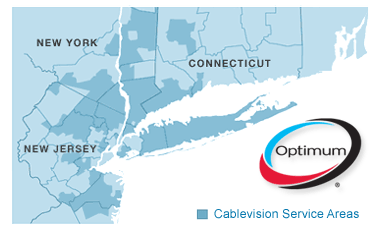
The cable company best known for serving suburban New York City.

Cablevision Industries has cried “uncle” in light of relentlessly aggressive competition from Verizon Communications, which offers its fiber to the home FiOS service in much of the cable operator’s service area.

Cablevision’s 4th quarter and year-end financial results, reported earlier today, are underwhelming investors.  Cablevision executives warned the company will have lower cash flow in 2012 due to increased investments in set-top boxes, network upgrades, and more importantly — no planned subscriber rate increases this year.

Some highlights:

Video – Losing Customers Like Everyone Else: Cablevision lost 14,000 video customers in the last quarter, many to Verizon FiOS and ongoing cord-cutting.  Analysts expected just 9,000 defections.  Cablevision will soon launch both HBO and Max Go online video for their customers nationwide.  Additional on-demand video options, online and off, are also anticipated.

Broadband – Cablevision finally admitted its own network was responsible for last year’s faltering broadband speeds that delivered poor marks in ongoing FCC speed tests.  The company originally denied the speed test results were accurate.  Today CEO James Dolan told investors the company invested in its broadband network to improve speeds and service.  Cablevision feels strongly it must compete effectively with Verizon to survive.  The company added 20,000 high-speed data customers and 31,000 phone subscribers in the quarter.  The company is doing well allowing customers easy access to broadband speed upgrades.

Wi-Fi – Cablevision sees strong value in its wireless broadband network as customers increasingly take their content mobile and need connectivity to the web.

Upgrades – CEO Jim Dolan said 2012 will be “a year of investment” in Cablevision upgrades and improvements.  The company is even accelerating projects originally envisioned for 2013.  Cablevision will continue to expand its “next day” installation offer across the eastern United States by the end of the first quarter.

Promotions – The escalating war of promotions between Verizon and Cablevision are likely to cease as Cablevision yanks their most aggressive new customer offers.  Earlier this year, Verizon was pitching a two year triple play offer that included an incredible $500 prepaid card rebate as part of the promotion.  “I don’t think you’ll see those [low introductory rates from Cablevision] again ever,” said Dolan.

“The main theme that people should take away from the call today is that we continue to be focused on moving the business in a direction where we both retain existing subscribers and have attractive, economically sensible offers for new subscribers,” said Cablevision chief financial officer Gregg Seibert.

How to Renew a Broadband Promotion With Bright House/Time Warner Cable

Phillip Dampier February 28, 2012 Competition, Consumer News Comments Off on How to Renew a Broadband Promotion With Bright House/Time Warner Cable

Last fall, our regular reader Scott wrote us about recent rate increases Bright House Networks imposed on broadband-only customers: $50/month for Internet access.  He learned from Stop the Cap! that a virtually identical, but lesser-known provider was ready and willing to provide six months of essentially equivalent Internet service for $20 less a month.

If your new customer promotion with Bright House or Time Warner Cable has ended, Earthlink can deliver essentially equivalent cable Internet service for $29.99 a month for six months. You do not receive the Powerboost temporary speed jump or a Road Runner/Bright House e-mail account, but you do save $120 over the promotional period.

Scott’s six month promotion with Earthlink was almost up, so he started calling Bright House looking for a returning customer promotion from them, and ran into a brick wall.

A Bright House promotion from a third party reseller

“Corporate wouldn’t budge,” Scott shares. “Two people kept giving me the run-around and excuses.”

“I was able to make the switch back to Bright House from Earthlink to keep my $30 a month promotional price for a second consecutive six month period,” Scott explains. “[But] I had to call an authorized [reseller] to give me the price as a ‘new customer.'”

But it wasn’t easy.  Involving third party resellers can become complicated because those independent businesses rely on commissions earned when new customers sign up.  An existing cable customer bouncing between providers may not be eligible for a commission, and can stall the switching process.

Scott spent an hour on the phone with Bright House getting them to apply the promotion to his account.

In general, Time Warner Cable customers have been able to bounce between new customer promotions from Earthlink and the cable company and back again without too much trouble.  Time Warner’s own promotion offers $29.99 a month Internet for a year, which is actually better than Earthlink’s six month deal.  Do a Google search for “Bright House promotions” and you will find third-party resellers all pitching six months of Bright House broadband service for $29.99 a month.

We recommend calling providers directly to establish service where possible, and if they refuse, you can always threaten to walk.  Providers become a little more willing to deal if you’re prepared to pull the plug.

Is Public Wi-Fi Safe? Indianapolis TV Station Finds Black Hat Wi-Fi Networks Abound

Phillip Dampier February 28, 2012 Consumer News, Video, Wireless Broadband 2 Comments

[flv width=”360″ height=”290″]http://www.phillipdampier.com/video/WISH Indianapolis Is public WiFi really safe 2-21-12.mp4[/flv]

WISH in Indianapolis produced this special investigative report on open, public Wi-Fi networks.  While offering an enticing chance to get free access to the Internet, the reporter found several serious potential security risks relying on the goodwill of others, some of whom may be spying on your online activity.  (5 minutes)

Our Concerns About Time Warner Cable’s New Usage-Based Billing

Phillip "Keeping an Eye on Time Warner's Eye" Dampier

Today’s announcement by Time Warner Cable that it is reintroducing usage based billing, at least optionally for customers in southern Texas, is a concerning development that requires further examination and vigilance.  But before we delve into that, I’d like to thank the company for avoiding the kind of mandatory usage billing/cap system we’ve seen appearing at certain other providers.  We also welcome the company’s admission that they have earned enormous profits from unlimited consumption plans and consider that pricing part of the success story they’ve had selling Internet access.

Stop the Cap! has never opposed optional usage-based billing tiers for customers who feel their light usage justifies a service discount.  However, industry trends so far have made no provisions for truly unlimited usage plans that sit side by side tiered plans without quietly diluting the value of flat rate Internet with tricks and traps in the fine print.  We have serious concerns this “foot in the door” to Internet Overcharging could eventually become mandatory for all customers.  Perhaps Time Warner Cable will be different than all the rest.  We can only hope so.

Let’s break it down:

First, Time Warner Cable’s admission it blew it the first time it experimented with these pricing schemes is most welcome.  Being on the front lines of the battle against the company’s Internet Overcharging experiment in 2009 remains very-well-documented on this website.  We confronted arrogant local management that argued usage billing was “fair” and would barely affect any customer.  In fact, the original plan a later revision would have tripled flat rate Internet access to a ridiculous $150 a month.

The company’s 2009 “listening tour” was also a farce, with a number of e-mailed comments deleted unread (we know, because Time Warner’s comment system sent e-mail to customers telling them exactly that.)  Local media outlets, newspaper editorials, and customers made it quite clear: customers want their unlimited Internet access left alone.  They do not want to learn the mysteries of a gigabyte, they don’t want to watch a gauge to determine how much usage they have left, and they sure don’t want to pay any more for broadband service.

If Jeff Simmermon, Time Warner Cable’s director of digital communications, now represents the prevailing attitude about unlimited Internet access among Time Warner Cable’s executive management, that is a very welcome change indeed.  But we’re not completely convinced.  For nearly two years, Time Warner executives have talked favorably about usage-based billing as the “fairest way” to bill for Internet usage.  Besides Simmermon’s comments, we have seen nothing from CEO Glenn Britt or CFO Irene Esteves that indicates they have changed their original views on that.

Unfortunately, we’ve learned over the last three years today’s promises may not mean a lot a year from now.  We’ve watched too many companies introduce these pricing schemes and then gradually tighten the noose around their customers.  Once broadband usage is monetized, Wall Street looks to the practice of charging for usage as a revenue source, and they pressure companies to keep that money flowing.  What begins as an optional tiered plan can eventually become the only plan when flat rate broadband is “phased out.”

Canadians understand this is not unprecedented.  They’ve been down this broadband road before, and it is loaded with expensive potholes and broken promises to repair them.  Usage allowances have actually dropped at some Canadian providers.  The fixed maximum on overlimit fees has gradually been relaxed or removed altogether, exposing Canadian consumers to broadband bill shock.

Time Warner Cable customers are now paying upwards of $50 a month for broadband after consecutive annual rate increases.  That’s plenty, and usage should remain unlimited for that kind of money.

Still, Stop the Cap! has never been opposed to truly optional usage-based billing plans.  We’re just unconvinced companies will keep the wildly popular flat rate pricing if boatloads of additional revenue can be made dragging customers to tiered usage plans, particularly in the absence of aggressive competition.  Just ask AT&T.

Second, as we’ve seen on the wireless side, “unlimited Internet access” means one thing to consumers and all-too-often something very different to providers.  For example, companies have discovered they can claim to provide unlimited access but then de-prioritize flat rate traffic, or even worse, throttle speeds and give preferential treatment to usage-based billing traffic.  Time Warner Cable needs to commit that unlimited access means exactly that — no traffic prioritization, no speed throttles, and no sneaky fine print.

Third, we don’t expect Time Warner will get too many takers for their Broadband Essentials Internet program.  The discount, just $5 a month, is quite low for broadband service limited to 5GB per month.  Exceeding that limit is quite easy, and after just 5GB of “excess usage,” the discount is eaten away and the penalty rate of $1/GB kicks in.  That could ultimately risk up to $25 a month in extra charges.  I’m uncertain how many customers would want to risk exposing themselves to that for a modest discount.

While we are not issuing a Call to Action over these developments, we will be watching them very closely.  Time Warner Cable should make no mistake: if their usage billing plans begin to eat away at fairly priced unlimited access plans, we will once again picket the company and do whatever is necessary to bring political and consumer pressure to force them to rescind these kinds of pricing schemes yet again.


Search This Site:

Contributions:

Recent Comments:

Your Account:

Stop the Cap!