Home » Consumer News » Recent Articles:

Indiana Newspaper Falls All Over Itself Praising Frontier Communications’ Broadband

Frontier Communications is enjoying “press release”-like praise for its broadband service in the state of Indiana, courtesy of The Times newspaper:

There are a lot of companies you can go for your internet service. Every day, you are bombarded with promises and special offers. Yet, when choosing the service best suited for you and your needs, perhaps you should turn to the company that is active in your community.

Frontier Communications is that company. Since entering the Northwest Indiana region back in July 2010 (Verizon sold all of their phone lines in this region), Frontier has made their presence known with not only a long list of unsurpassed internet services, but also with their active participation in everything from the Northwest Indiana Economic Forum to the Porter Country Jobs Commission. “We live, work and breathe customer and community,” explains Communications Manager Matt Kelley.

[…] Right now, Frontier Communications is offering a special offer of $20 per month for 12 months of high speed internet. This offer is good until the end of March. But perhaps, the greatest advantage to having your business connect with Frontier is their dedication to your success and access to cutting edge Internet technology to make a true difference in the lives of their customers.

The Porter County edition of the paper elicited a slightly less enthusiastic response from Thomas Dodge, one of our Indiana readers:

“I’d like to know what company they are talking about, because it doesn’t sound like the Frontier Communications we dealt with last year,” Dodge writes. “They made their presence known alright — 1.5Mbps Internet for about two weeks, before we canceled and switched to the cable company for 10Mbps Internet.”

Dodge says he appreciates Frontier does seem to have more interest in the community than Verizon ever did, but the company needs to invest money on broadband that delivers speeds more suitable for 2012.

“I don’t know where all the money is going, but it sure isn’t in our neighborhood,” he says. “That $20 offer sounds good until you read the fine print that includes a modem surcharge, taxes, fees, and a contract commitment.  They’re hopelessly oversold here as well, and those slow speeds actually dropped at night as people got online.”

Would Dodge give Frontier another try?

“Not after that.  I’d have to see it working better to believe it.”

If Your Password is ‘Password1’, Change It: Everyone Knows

Phillip Dampier March 5, 2012 Consumer News 1 Comment

Internet security firm Trustwave knows your password, if it happens to be “Password1.”

It turns out that is among the most popular password choices now in use on websites and work computers — even more popular than old favorites like “qwerty” and “asdf.”

The security firm noted around 5% of all Internet passwords include a variation on the word “password.”  Second runner-up?  “Welcome,” which appears more than 1% of the time.

But why “Password1”?

Website password security has gotten increasingly robust in recent years, now demanding users include at least one capital letter and number.  “Password1” also stays within the usual requirements for passwords longer than six characters (and often fewer than 10).

The West Australian newspaper reports:

Exploiting weak or guessable passwords was the top method attackers used to gain access last year. It played a role in 29% of the security breaches Verizon’s response team investigated.

Verizon’s scariest finding was that attackers are often inside victims’ networks for months or years before they’re discovered. Less than 20% of the intrusions Verizon studied were discovered within days, let alone hours.

Even scarier: Few companies discovered the breach on their own. More than two-thirds learned they’d been attacked only after an external party, such as a law-enforcement agency, notified them. Trustwave’s findings were almost identical: Only 16% of the cases it investigated last year were internally detected.

So if your password is something guessable, what’s the best way to make it more secure? Make it longer.

Adding complexity to your password — swapping “password” for “p@S$w0rd” — protects against so-called “dictionary” attacks, which automatically check against a list of standard words.

Updated for 2013: Getting a Better Deal from Time Warner Cable… Five Minutes to Save Almost $700

Readers: Please find our 2015 Guide to Getting a Better Deal from Time Warner Cable here. You will find the latest negotiating strategies and deal information in that updated article. 

Time Warner Cable just won’t let you say goodbye, if they can help it.

A year ago, your editor fought for a better deal from the cable company that has served him since the 1980s.  With a tough economy and downsizing, paying a cable bill that was approaching $175 a month in early 2011 for ‘all their best’ was simply no longer an option.  Time Warner Cable’s customer retentions office responded with a promotion that slashed the bill to just $88.44 for Turbo Internet, cable-TV, and unlimited “digital phone” service with nationwide calling.  Incidental charges included leasing a whole house DVR ($7.04), a second cable box ($6.84), $1 for “digital programming” and $0.34 for the remote control.

When the cable operator introduced DOCSIS 3 broadband speed upgrades, an additional $20 a month brought 30/5Mbps speeds.  The total — $123.66 (before taxes and fees).  That’s a whole lot less for a great deal more service.

When the promotion ended in February, the rate shot back up to $160, but $7.95 of that was for a year of Showtime at a special promotional price.  Showtime was destined for the cancel corner anyway (we didn’t watch more than two hours of anything on Showtime in the last year), but even without it, the rate increase was on the steep side.

So we complained.

Unlike last year, which resulted in considerable confusion and arguing back and forth with different representatives to find the best deal, this year we let Time Warner’s social media representatives do the hard work for us.  Within 24 hours, our rate for all of the same services, plus a special promotion that includes HBO, Cinemax, Showtime, and The Movie Channel at no additional charge, brought the bill down even lower than we managed last year: $102.33 a month for a year.  That includes the 30/5Mbps Road Runner Extreme, Whole House DVR, and one extra cable box.  It doesn’t include taxes and fees, which typically add another $6.50 to the bill.

The whole process was painless, and you can follow in our footsteps if you have a Twitter account:

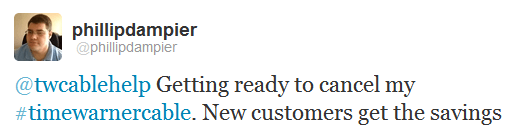
Step One: Tweet Time Warner (Note the Twitter address has changed from @twcablehelp to @TWC_help):

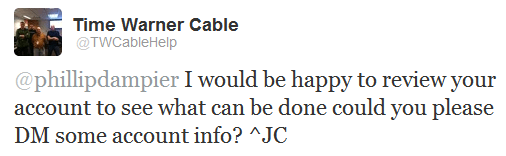
The key phrase in whatever Tweet you send is to include: @TWC_help, which brings you to their social media customer service representatives.  I also “followed” @TWC_help so I could see how active they were.  During business hours, you should expect to see a reply like this within the hour:

For those new to Twitter, “DM” refers to a “direct message” — a private Tweet seen only by the intended recipient.  I finally found the menu option that allows me to send a “direct message” on Twitter’s page for Time Warner Cable:

Note the red box around the option on the top right.  By clicking that you will see a drop down menu that includes an option to “Direct Message” TWC_help.  You will want to include your Time Warner Cable account number (as seen on your bill) and include your contact phone number.

Within 24-48 hours, a senior retentions specialist should call you to negotiate a better offer for your service.  Make sure you answer those unfamiliar caller ID calls!  But before they call, visit Time Warner Cable’s website and note any currently running new customer promotions.  Also check to see if the competition is offering anything even lower.  Those prices are typically the starting point for your negotiations, and the company should have little trouble meeting them.  However, customers with a poor payment record or past due account may discover the company less willing to negotiate.  Bring account balances current before negotiating for a lower rate.

Some Time Warner Cable territories offer “price protection agreements” or term contracts that lock customers into 1-2 years of service.  Negotiating around these contracts can be difficult to impossible.

An alternative contact method is to direct e-mail Time Warner at: [email protected] (don’t forget the “.” in twcable.help).

The total time spent this year on finding a better deal that will save us $58 a month — $696 a year — about five minutes, far less than the time it took to write this article.  Give it a try and let us know in the comments what kind of deals you can negotiate.

Wall Street: We Expect Time Warner’s Usage Based Billing to Become the Rule, Not the Exception

Phillip Dampier February 29, 2012 Broadband "Shortage", Consumer News, Data Caps, Online Video 7 Comments

Moffett

On the heels of Time Warner Cable’s recently announced return to usage-based billing, some Wall Street analysts are sending signals they expect the cable operator not to dabble in usage-based pricing for long, but rather jump right in, charging all of their customers usage fees to boost revenue and profits.

Time Warner Cable’s careful effort to position usage pricing as an “option” does not seem to impress Sanford Bernstein’s Craig Moffett, who expects the cable company to roll out Internet Overcharging schemes to all of their customers.

“Over a period of years, as the market becomes more accustomed to (usage-based pricing), we expect these plans to become the rule rather than the exception,” Moffett wrote in a research note to his investor clients.

The concept of usage pricing is also provoking Netflix, dubbed one of the net’s biggest usage offenders by some providers, to become more vocal in its support for flat rate broadband.

With some Netflix movies coming in at nearly 3GB in high definition, Time Warner’s usage-limited Internet Essentials customers will rapidly erode their usage cap into the overlimit territory.

Netflix executives dismiss provider claims that broadband traffic explosions are undermining profits, especially considering the cost of delivering broadband traffic to consumers continues to plummet.

One Wall Street analyst looking to maximize those provider profits chastised Reed Hastings, founder of Netflix, for putting service providers under “financial pressure.”

“Yeah, that 92% Comcast operating margin is really under a lot of pressure,” Hastings responded at the Morgan Stanley Technology, Media and Telecom conference in San Francisco. “There is no financial pressure on ISPs.”

Variety reports Time Warner has said nothing about keeping flat rate broadband at its current $40-50 price point.

Moffett points out there is plenty of room for Time Warner Cable to accustom subscribers to a metered future. 

The analyst believes Time Warner will eventually move flat rate Internet to an “ultra premium” price point that will be far more expensive than customers today are accustomed to paying.

In 2009, Time Warner offered customers scheduled to participate in its failed usage pricing experiment flat rate service for $150 a month.

Comcast Applauds Time Warner for Trying Usage Billing; Not Brave Enough to Try Themselves

Phillip Dampier February 29, 2012 Comcast/Xfinity, Consumer News, Data Caps 4 Comments

Angelakis

Comcast says it admires Time Warner Cable for risking subscriber wrath over plans to introduce usage-based billing Time Warner says will be optional for customers in southern Texas.  But Comcast admits it is not brave enough to try similar pricing schemes themselves, fearing a customer backlash.

“We have a very high customer satisfaction rating and we don’t really want to rock the boat on [our broadband product],” Comcast chief financial officer Michael Angelakis told an audience Tuesday at a Wall Street bank-sponsored media and telecom conference in San Francisco. “I give them credit for trying different things, [but] we have real momentum in that business and the goal is to keep it.”

Comcast was a spectator of the consumer and political backlash against Time Warner Cable when it last experimented with usage pricing in April 2009.  Within two weeks, Time Warner Cable CEO Glenn Britt shelved the plan under pressure from both customers and lawmakers.

Now Time Warner Cable wants to reintroduce the concept as an option for customers of a new “Internet Essentials” discounted broadband tier that would include a $5 monthly discount if customers kept usage under 5GB per month.

Some veterans of the 2009 battle suspect Time Warner is trying to slowly slip usage pricing past customers waiting to fight its return by first suggesting it is only an option, but later herding broadband customers into usage based plans by substantially raising the price of flat rate service.

“Looks like a trial run the company could easily expand to all of their Internet customers,” shares Stop the Cap! reader Jeff in San Antonio, Tex., one of the cities that will participate in the upcoming usage-based plan. “I have a hard time believing Time Warner is going through all the effort developing usage meters and billing support for usage pricing just to market a handful of customers a $5 discount.”

Jeff, who helped fend off the cable company’s original Internet Overcharging experiment in 2009, suspects Time Warner’s earlier attempt to market a “flat rate” broadband option at $150 a month could still be a blueprint for how the company could push customers out of their unlimited plans.

“They can claim they want to keep unlimited Internet, but have remained silent about how much they will charge for it,” Jeff says. “We need something in writing that this company will not gouge customers with the fine print going forward.”

Stop the Cap! posed several similar questions to Time Warner Cable’s Jeff Simmermon, director of digital communications, through the cable company’s blog.  The company, to date, has offered no response.

Search This Site:

Contributions:

Recent Comments:

Your Account:

Stop the Cap!