Home » Consumer News » Recent Articles:

New York City Broadband “Sucks,” Says Village Voice

Waiting for FiOS

For those who admire the apparent pervasiveness of competition between Time Warner Cable and Cablevision Industries vs. Verizon Communications’ FiOS, the idea the Big Apple has a broadband problem seems a bit ridiculous, particularly if you can’t get your local cable company to pick up their phone and AT&T will only hand you a 1.5Mbps DSL line, if you can get it.

But according to the Village Voice, New York City broadband “sucks,” and it will continue to suck for at least the next eight years.

“Though entrepreneurs in most parts of the city can access a fast broadband connection today, many of those we interviewed said that New York’s telecom infrastructure is well behind where it should be for a city vying to be one of the nation’s two leading technology hubs,” the study notes.

What it comes down to is that New York — despite being the world’s media capital — does not have adequate access or bandwidth to support tech companies’ needs.

For example, some companies might be able to get either FiOS or Time Warner Cable, but not both, which means they can’t have broadband backup.

“It’s like the elephant in the room is that bandwidth here sucks,” one entrepreneur told the researchers. “You should be able to walk into any building and have at least 150 megabit connection available to you. There has to be ways for the city to construct much better bandwidth availability for start-ups.”

Many cited told the researchers that their internet routinely goes down. And startups who want to set up shop in cheaper, industrial districts often can’t, because the cable companies would rather provide service to more lucrative residential areas. Sometimes, telecom concerns are willing to dig up streets and lay cable, but at a hefty price — around $80,000.

That $80,000 bill is handed to a prospective customer and does not come from cable operators’ capital expense fund.

Researchers gave New York a broadband grade of B to B-, which isn’t too bad considering what broadband is like in the mid-south, the midwest, and the rural west. But it doesn’t cut it for helping New York become a bigger tech city.
Waiting for "Business Class"

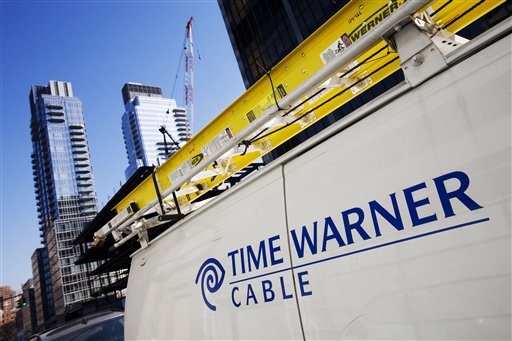
While Time Warner Cable and Cablevision have wired multi-dwelling units and homes across New York City, cable operators have only recently started to turn their serious attention to corporate business customers.  Time Warner Cable agreed, as part of its franchise renewal deal with the city, to invest $1.2 million per year for fiber connections to commercial buildings yet to be wired for cable. Cablevision, which can be found in boroughs like Brooklyn and out on Long Island, agreed to spend a more modest $600,000 a year for the same purpose.

Time Warner Cable has already warned investors its capital spending on wiring commercial office buildings across the country is increasing as the company sees lucrative new revenue opportunities competing with their usual nemesis — the phone company.

Verizon treats FiOS deployment in New York City as a long, long-term project. There are neighborhoods in Manhattan that can’t wait much longer for the fiber optic network as Verizon increasingly lets its old copper wiring go to pot, leaving some New Yorkers without phone service for weeks.  The city of New York has given Verizon until 2014 to wire the city, and the company appears likely to need those two additional years at their current pace, and that agreement only covers residential properties, not commercial ones.

Robust broadband is essential for many high technology startups and the multi-million dollar data centers that support them. New York mayor Michael Bloomberg considers it a top priority to reduce the city’s economic dependence on Wall Street, which generates considerable tax revenue for both the city and state. High tech enterprises fit that bill. But the city’s broadband grades do not.

“For a city that’s trying to be a tech powerhouse, we need to have an A,” said Jonathan Bowles, the author of the study, “New Tech City.”

Rogers’ “Next is Now” Foreshadows How Company Will Milk Canadians for Connectivity

Phillip Dampier May 17, 2012 Canada, Competition, Consumer News, Data Caps, Editorial & Site News, Public Policy & Gov't, Wireless Broadband Comments Off on Rogers’ “Next is Now” Foreshadows How Company Will Milk Canadians for Connectivity

Rogers Communications has following up its “Next is Now” corporate video from 2010 with a sequel: “Next is Now… More Than Ever,” which highlights how Canadians are increasingly relying on mobile communications for news, entertainment, social life, work, and education.

While Rogers wanted the video to promote how the company would be a part of that telecommunications transformation, many of their customers can’t help but reflect on the fact the revolution is well-tempered with Internet Overcharging schemes like usage caps.

Stop the Cap! reader Alex is among them, noting the video says nothing about the company’s restrictive usage limits on home broadband and the even harsher caps on its mobile services.

Rogers, like most telecommunications companies, repeatedly tells investors there is real money to be made attaching meters to monetize megabytes.  Charging for broadband usage is a growth industry, and with the company’s own projections for data growth, they are well-positioned to be in the money for years.

With broadband dependency being as pervasive, if not more so, in Canada as in the United States, the barely regulated services on offer in both countries often come at a steep (and increasing) price — all for something even Rogers hints is becoming a utility — one as important as electricity, gas, and clean water.

[flv width=”640″ height=”380″]http://www.phillipdampier.com/video/Rogers Next is Now More than Ever 5-12.flv[/flv]

Rogers Communications’ “Next is Now… More Than Ever” has broader implications than the company realizes. (3 minutes)

Verizon Preparing to Kill Grandfathered Unlimited Data Plans, Hike Rates for FiOS

Verizon Wireless will force customers off of their grandfathered unlimited data plans when they reach the end of their current two-year service contracts, according to the company’s chief financial officer.

It is all part of the cell phone company’s strategy to boost the average bills of customers with new, more expensive tiered family-shared data plans. With a significant number of current customers grandfathered on unlimited data plans that users likely will not forfeit voluntarily, Verizon will force the issue as customers come up for contract renewal.

The plan received considerable approval at today’s JPMorgan Chase TMT conference, a gathering for Wall Street investors and tech companies like Verizon.  Executive vice-president and chief financial officer Fran Shammo laid out the plan to switch customers to forthcoming family “data share” plans that are priced based on anticipated usage:

As you come through an upgrade cycle and you upgrade in the future, you will have to go onto the data share plan. And moving away from, if you will, the unlimited world and moving everybody into a tiered structure data share-type plan.

So when you think about our 3G base, a lot of our 3G base is unlimited. As they start to migrate into 4G, they will have to come off of unlimited and go into the data share plan. And that is beneficial for us for many reasons, obviously. So as you pick what tier you want to be and we think that there will be some price up in those tiers.

“Price up” is code language for bill hiking. Customers adopting family share plans may be able to share data across a larger number of devices, but at consumption pricing, many customers will find their Verizon bills substantially higher than before.

Shammo

“And the important part of that is we want the connections to come in and the way we have designed our plan, this plan is built on tiers and as we look at the future growth of LTE consumption because of the speeds and video consumption and consumption of other M2M-type devices, it is going to be more important that people will start to upgrade in their tiers as they start to really realize the benefits of the LTE network,” Shammo said. “As [customers] add more devices, they are going to have to buy up into tiers. So again, you will see the revenue increase there.”

Those revenue predictions were not sufficient to satiate Phil Cusick, an analyst at JPMorgan Chase. He questioned Shammo about the prospects for Verizon further increasing revenue with across-the-board rate increases on service plans.

Shammo would not commit to that, but was pleased with the lack of customer protests over their recent introduction of a $30 equipment upgrade fee. He called the new fee “the right thing to do.” More fees and surcharges are likely, according to Shammo.

“I think implementing these additional fees is probably where we are at,” he said. “With the construct that we have dealt with around data share and where we see consumption of LTE going, when you put the combination of them together, we are fairly confident that we will see people start to uptake in the tiers, which is really where we will get the revenue accretion in the future.”

Shammo also said Verizon’s fiber to the home network FiOS has gotten such rave reviews, it almost sells itself. That means the company will pull back on promotional offers and plans a general rate increase for all customers in the coming months, if only to bolster company profits.

“We have to do a better job in discipline of price increases and I think that you’ll see us do some price increases here over the next two quarters to offset the content increase and that will also contribute more profitability to the bottom line,” Shammo said. “You are going to have to concentrate more on reducing the amount of promotions, reducing the amount of retention that you put on the table to retain a customer and then also you are seeing that the industry is pricing up.”

Verizon FiOS customers will find rate increases applying both to equipment rental and service pricing nationwide, according to Shammo.

“We were actually below-market compared to our competitors on the amount of fee that we charge on the rental of a set-top box or a digital converter box,” Shammo explained. “We are switching around our bundles and the customers that are coming out of the current bundles will be priced up to the newer bundles. So you are going to see really a shift over the next two to three quarters in price-ups coming out of FiOS.”

As far as FiOS expansion goes, the company does not expect any major expansion in the service for the next several years.

“If we can penetrate the market and really turn the wireline profitability, could we potentially build out to other areas? Yes, but that is a decision that will be made in years out, not right now,” Shammo said. “So from a capital perspective, we are being very disciplined with where we are going to put that capital.”

Time Warner Cable & Viacom Make Peace: Comedy Central, MTV Coming to Apps

Phillip Dampier May 16, 2012 Consumer News, Online Video 1 Comment

Time Warner Cable and Viacom have ended their dispute over whether the cable company had the right to stream Viacom-owned cable networks over its lineup of streaming apps for portable devices and home computers.

This means the cable company will be restoring streams of Comedy Central, MTV, VH1 and other Viacom networks over the coming weeks.  In return, Time Warner Cable has agreed to carry/continue Viacom’s Country Music Television on its cable systems.

From the official statement:

Viacom and Time Warner Cable have agreed to resolve their pending litigations. All of Viacom’s programming will now be available to Time Warner Cable subscribers for in-home viewing via internet protocol-enabled devices such as iPads and Time Warner Cable will continue to carry Viacom’s Country Music Television (CMT) programming. In reaching the settlement agreement, Time Warner Cable and Viacom were also able to resolve other unrelated business matters to their mutual satisfaction. Neither side is conceding its original legal position or will have further comment.

The dispute had no effect on traditional cable carriage of these networks. Only online streaming was impacted.

Rural Ohio Woman Fed Up With No Broadband, Wants Grant to Start Smoke Signal Business

$118 million up in smoke as far as rural Ohio residents are concerned. Where did the money go?

Rural Ohio is still waiting for broadband… –any– broadband.

The state has spent millions of taxpayer funds on deficient broadband maps produced by the industry-connected Connected Nation and on gold standard broadband networks individual consumers and businesses are forbidden to access.  Dellroy resident Salva Sedlak wonders where all that money has gone, because it hasn’t produced any new broadband service in her area.

Sedlak and her husband can’t get broadband for either their home or their Carroll County business, and it isn’t from lack of trying.

Time Warner Cable won’t extend their lines an extra four miles to their neighborhood, Frontier Communications has the family on some type of waiting list, Verizon is marketing 4G wireless broadband in an area with no 4G reception, and Ohio-based Horizon says service to their area is “undetermined” at this time.

Sedlak is taking matters into her own hands, using a proven technology that worked for America’s Native Americans for hundreds of years:

In August 2010, that $118 million of grant money from the American Recovery and Reinvestment Act were available to Appalachian counties. Obviously, none of the above mentioned companies are using any of this money in my area, so I am going to apply for grant money to finance my smoke signaling business.

I figure there will be a lot of demand for my new skills. All of those companies that are supposed to be moving into Ohio to support oil fracking are going to need rapid communication.Since they will probably experience the same problems with obtaining broadband that I have, there should be a demand for smoke signals. The only downside I can see is I will not be able to use an on-line instructional video for training purposes.

I once said I would vote for any politician who could make broadband happen. So far, I have heard a lot of promises, but no actual service. As I said, I’m just going to have to take matters into my own hands.

Search This Site:

Contributions:

Recent Comments:

Your Account:

Stop the Cap!