Home » Consumer News » Recent Articles:

Rogers’ “Unconscionable” Service Contracts & Bell’s Touch-Tone Fee Ripoff

Phillip Dampier May 29, 2012 Bell (Canada), Canada, Consumer News, Rogers, Video Comments Off on Rogers’ “Unconscionable” Service Contracts & Bell’s Touch-Tone Fee Ripoff

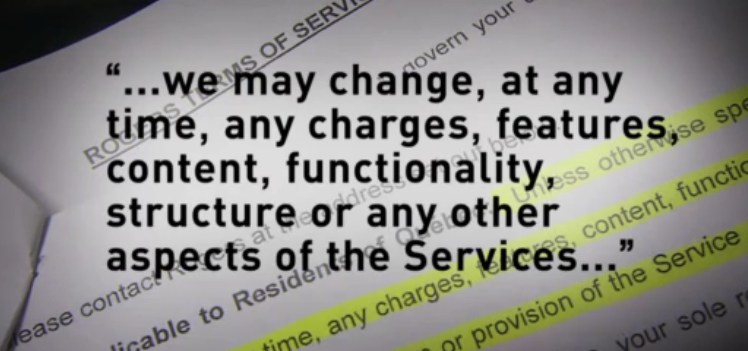
Rogers' "unconscionable" service contract allows the company to do just about anything.

Did you know that signing a contract with Rogers Communications for your broadband, phone, and cable television service will not protect you from the company’s annual rate increases?

It represents a classic example of an “unconscionable term” in a contract, according to Anthony Daimsis, a contract law professor at the University of Ottawa. Not because Rogers has inserted language that allows the company to raise rates on contract customers at will, but rather because consumers cannot escape the contract without paying a stiff early termination fee, usually approaching $200.

Rogers says its service contracts do not guarantee stable rates, instead providing a discount for bundling its services together. Most Canadians asked by CBC’s Marketwatch thought otherwise, believing it should lock in current rates for the term of the agreement.

The consumer show also chases Bell for charging Canadians $2.80 a month for touch-tone service — a fee that disappeared off most other phone company bills 20 years ago. Bell claims the touch-tone fee was introduced because the company met opposition from rotary phone customers when it tried to bundle the fee into its general price for phone service.

These days, buying a rotary dial phone requires a visit to an antique shop, but should you acquire one just to escape paying the phone company an extra $33 a year, it won’t work. Bell says the fee is now mandatory for all customers, rotary or otherwise — no one can “opt out.”

Bell’s touch tone bill padding rakes in an extra $100 million a year in revenue, all for a service upgrade paid for decades ago.

[flv width=”640″ height=”380″]http://www.phillipdampier.com/video/CBC Busted 04-2012.flv[/flv]

CBC Marketplace presents “Busted,” a special marathon edition exposing consumer ripoffs and deceptive advertising. In this clip, the show chases down Bell’s bill padding touch tone fee and Rogers’ notorious service contracts that lock customers in place -and- subject them to annual rate increases.  (13 minutes)

PBS Documentary: Subcontracting Cell Tower Work Has a Human Toll

Phillip Dampier May 24, 2012 AT&T, Consumer News, Public Policy & Gov't, Sprint, T-Mobile, Verizon, Video, Wireless Broadband Comments Off on PBS Documentary: Subcontracting Cell Tower Work Has a Human Toll

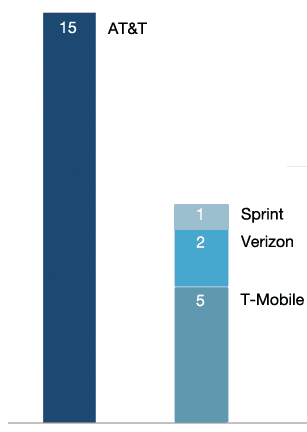
Data provided by OSHA statistics

A new joint investigation by Frontline and ProPublica reveals serious lapses in safety for America’s cell tower workers, a career now considered one of the most hazardous and life-threatening in America.

In the last eight years, 50 climbers have died, with many more injured installing and servicing cell sites for AT&T, Verizon Wireless, Sprint, and T-Mobile. The investigation finds many of these deaths and injuries were preventable, but as America’s profitable cell phone companies outsource jobs to cut-rate subcontractors (and the sub-contractors they often use themselves), safety measures take a back seat to low-ball bidding and profits.

Efforts to hold companies accountable are stymied by the byzantine layers of third party companies hired to do the work, an under-equipped federal safety agency, and difficulty assessing where the responsibility lies when things go wrong.

From ProPublica and Frontline:

From their perch atop the contracting chain, carriers typically set many of the crucial parameters for work on cell sites, including deadlines, pay rates and even technical specifications, down to the exact degree an antenna should be angled. An analysis of cell tower deaths by ProPublica and PBS “Frontline” showed that tight timetables and financial pressure often led workers to take fatal shortcuts or to work under unsafe conditions.

“We’ve had a number of situations where we think that accidents were caused by companies trying to meet deadlines and … cutting corners on safety in order to meet those deadlines,” said Jordan Barab, OSHA’s deputy administrator.

But Barab said it’s difficult for the agency to hold cell companies responsible for safety violations involving subcontractors. In most cases, federal officials have interpreted OSHA regulations to mean that carriers can be held accountable only if they exercised direct control over subcontractors’ work or were aware of specific unsafe conditions.

OSHA has not sanctioned cell carriers for safety violations implicated in any subcontractor deaths on cell sites since 2003, a review of agency records by ProPublica and PBS “Frontline” found.

OSHA has made little effort to systematically connect the deaths of tower workers to specific carriers and had not known until ProPublica and PBS “Frontline” told them that there have been 15 fatalities on AT&T jobs since 2003 – more than at the other three major carriers combined over the same period.

The agency attempted to fine a carrier just once and failed, losing a nearly three-year legal battle with a regional cell company in Kentucky. The agency has never taken on the four major carriers – Verizon, T-Mobile, AT&T and Sprint – even though there have been almost two dozen fatalities on jobs done for their networks.

Most of OSHA’s enforcement efforts have focused on a transient cast of small subcontractors, though they, too, typically have eluded significant penalties. Over the last nine years, the median fine levied for safety violations linked to a fatal tower accident was $3,750, an analysis by ProPublica and PBS “Frontline” showed.

[flv width=”512″ height=”308″]http://www.phillipdampier.com/video/PBS Frontline Cell Tower Deaths 5-23-12.flv[/flv]

Watch this segment from PBS Frontline exploring ‘Cell Tower Deaths,’ and what can be done to stop them.  (30 minutes)

Broadband for Rural Minn. Threatened By Diversion of Ratepayer Money to AT&T and Verizon

Northern Minnesota's Paul Bunyan Communications is threatened by FCC reforms that they claim favor larger phone companies.

Northern Minnesotans will have to wait longer for broadband after a telephone co-op announced it was suspending its $19 million broadband expansion project because funding is being diverted to more powerful phone companies like AT&T and Verizon — neither of which have any concrete plans to improve rural wired broadband.

Bemidji-based Paul Bunyan Communications, which serves 28,000 hearty Minnesota customers, has been working on broadband expansion for several years, bringing broadband to customers who have known nothing except dial-up since the Internet age began. Only now the project is threatened because of well-intentioned plans by the Federal Communications Commission to expand rural broadband, but in ways that cater primarily to larger phone companies that lobbied heavily for the changes.

At issue is Universal Service Fund reform, which plans to divert an increasing share of the surcharge all telephone customers pay away from rural basic phone service and towards broadband expansion in rural America.

Paul Bunyan used their share of USF funding to scrap the company’s existing, antiquated copper-wire network in favor of fiber optics. Other phone companies have traditionally used the money to keep their existing networks running. Now the independent phone company says large phone companies like Verizon and AT&T have successfully changed the rules in their favor, and will now benefit from a larger share of those funds, ostensibly to expand broadband to their rural customers.

Bissonette (Courtesy: MPR)

But neither AT&T or Verizon have shown much interest in rural broadband upgrades. AT&T, which recently announced it concluded its U-verse rollout in larger cities, has also thrown up its hands about how to deal with the “rural broadband problem” and plans no substantial expansion of the company’s DSL service.

Verizon also announced it had largely completed the expansion of FiOS, a fiber to the home service. Verizon has also been discouraging customers from considering its DSL service by limiting it only to customers who also subscribe to landline phone service.

Verizon Wireless has introduced a wireless home broadband replacement that costs considerably more than traditional DSL, starting at $60 a month for up to 10GB of usage.

As a result of the funding changes, Paul Bunyan is reconsidering plans to expand its broadband, phone and television services to Kjenaas and about 4,000 other residents in rural Park Rapids and a township near Grand Rapids.

It may also have to cut workers.

“It’s kind of ironic,” Paul Bunyan’s Brian Bissonette tells Minnesota Public Radio. “The mantra of these changes is to create jobs. It’s killing jobs.”

Minnesota Public Radio explores how rural Minnesota broadband is being threatened by a telecom industry-influenced plan to divert funding to larger companies like AT&T and Verizon for rural broadband expansion those companies have no plans to deliver. (May 23, 2012) (4 minutes)
You must remain on this page to hear the clip, or you can download the clip and listen later.

Time Warner Cable Ready to Expand Usage Based Billing to “Save Customers Money”

Phillip Dampier May 24, 2012 Consumer News, Data Caps, Public Policy & Gov't 6 Comments

A green light for usage-based billing at Time Warner Cable.

Time Warner Cable announced its intention to expand its usage-based billing system for broadband beyond southern Texas, and is now considering new pricing tiers that will emphasize usage levels over broadband speeds, according to CEO Glenn Britt.

Appearing at the industry-sponsored Cable Show in Boston, Britt suggested consumers can “save money” opting out of unlimited broadband with its Internet Essentials program, which provides a $5 discount for customers who agree to keep their usage below 5GB per month.  The company is now also considering additional service tiers that will offer different usage allowances at progressively higher prices.

Britt insisted the company will retain the option of unlimited use service, but did not specify whether that would be sold at the same price customers currently pay for the cable company’s Internet service.

Federal Communications Commission chairman Julius Genachowski yesterday told cable industry executives he supports usage-based pricing, making it unlikely the FCC will intervene if companies substantially raise broadband pricing.

In 2009, consumers and elected officials protested the cable company’s earlier experimental foray into usage pricing which would have tripled the price of unlimited broadband service to $150 a month. The company quickly relented after customers picketed the cable operator in Rochester, N.Y., and Greensboro, N.C., in a campaign coordinated by Stop the Cap! The cities of Austin and San Antonio, Tex. also made their opposition clear through public meetings and input from local officials.

6 University Towns Will Get Gigabit Broadband Through New Public-Private Partnership

Phillip Dampier May 24, 2012 Broadband Speed, Community Networks, Competition, Consumer News, Public Policy & Gov't, Video Comments Off on 6 University Towns Will Get Gigabit Broadband Through New Public-Private Partnership

Six college towns will benefit from the nation’s first multi-community broadband gigabit deployment, thanks to $200 million in capital funding to get the broadband networks off the ground.

The Gigabit Neighborhood Gateway Program leverages local government, universities, private capital, and the public to jointly support and foster the development of new fiber optic networks.

The new program claims it will offer competitively-priced super-fast broadband through projects that will cover neighborhoods of 5,000-10,000 people and communities up to 100,000 in size.  Selection of the six winning communities will be announced between this fall and next spring.

“Gigabit Squared created the Gigabit Neighborhood Gateway Program to help select Gig.U communities build and test gigabit speed broadband networks with speeds from 100 to 1000 times faster than what Americans have today,” the company said in a statement.

“The United States is behind in the world for Internet speed,” said Mark Ansboury, Gigabit’s president and co-founder. “The goal is to help get us out front for a platform of innovation.”

That platform is certainly not forthcoming from the country’s largest broadband providers, who according to Ansboury have been pulling back on wired infrastructure upgrades in recent years, shifting focus to more profitable wireless networks.

Gigabit Squared defines the next generation of broadband Internet in terms of speed, declaring 2,000Mbps (2Gbps) as the target to achieve.

The winning projects will be sponsored by Gig.U members, which include:

  • Arizona State University
  • California Institute of Technology
  • Case Western Reserve University
  • Colorado State University
  • Duke University
  • Florida State University
  • George Mason University
  • The Georgia Institute of Technology
  • Howard University
  • Indiana University
  • Michigan State University
  • North Carolina State University
  • Penn State University
  • University of Alaska – Fairbanks
  • University of Arizona
  • University of Chicago
  • University of Colorado – Boulder
  • University of Florida
  • University of Hawaii
  • University of Illinois
  • University of Kentucky
  • University of Louisville
  • University of Maine
  • University of Maryland
  • University of Michigan
  • University of Missouri
  • University of Montana
  • University of Nebraska – Lincoln
  • University of New Mexico
  • University of North Carolina at Chapel Hill
  • University of Oklahoma
  • University of South Florida
  • University of Virginia
  • University of Washington
  • Virginia Tech
  • Wake Forest University
  • West Virginia University

Blair Levin, executive director at Gig.U, believes private American telecom companies will always be constrained from delivering world class broadband comparable to South Korea or Japan because of Wall Street opposition to the investment required to construct them. In the eyes of investors, today’s slower networks, in their estimation, do just fine.

Gig.U believes that they have a solution, at least for towns with a sizable university system that can serve as host of the next generation broadband network:

First, any community that wants its residents to have access to a network that delivers world-leading bandwidth can do so. The barrier is not technology or economics. The barrier is organization; specifically, organizing demand and improved use of underutilized assets, such as rights of way, dark fiber, or in more rural areas, spectrum. The responses identified a multitude of ways local communities can improve the private investment case by lowering investment and risk, and increasing revenues for private players willing to upgrade or build new networks without budget outlays from the local government.

Second, the responses confirmed that university communities have the easiest organizing task and greatest upside. Their density, demographics and demand make the current economics more favorable for an upgrade than other communities. For example, the high percentage of the population in university communities living in multiple dwelling units makes the economics of an upgrade far more favorable than for communities composed largely of single-family homes. With the growing importance of Big Data for the economy and the society, university communities are the natural havens for such enterprises to be born and prosper. Through the Gig.U process, our communities are already exploring more than a half-dozen paths to achieve an upgrade; paths that will be replicable for others and will deliver a major step forward in providing America a strategic broadband advantage.

Outside of a handful of upstart private competitors like California-based Sonic.net, most fiber broadband expansion come from private companies like Google — building an experimental fiber-to-the-home network in Kansas City, community-owned broadband services coordinated by local town or city government, co-op telecommunications companies owned by their subscribers, or municipal utilities.

While those efforts are typically committed to the concept of “universal service” — wiring their entire communities — the Gig.U project targets funding only for networks in and around university campuses.

The New America Foundation builds on Gig.U’s premise in its own recent report, “Universities as Hubs for Next Generation Networks,” which argues affordable expansion of broadband can win community support when the public has the right to also benefit from those networks. While Gig.U’s approach suggests the project will target fiber broadband directly to the homes qualified to receive it, the New America Foundation supports the construction of mesh wireless Wi-Fi networks to keep construction costs low for neighborhoods targeted for service.

An earlier project in Orono and Old Town, Maine may afford a preview of Gig.U’s vision, as that collaboration between the University of Maine and private fiber provider GWI is already in its construction phase. For those lucky enough to live within range of the fiber project, broadband speeds will far exceed what incumbents Time Warner Cable and FairPoint Communications deliver. FairPoint has fought similar projects (and GWI specifically) for years.

Will private providers object to the Gig.U effort to win local governments’ favor in the six cities eventually chosen for service? History suggests the answer will be yes, at least to the extent local cable and phone companies demand the same concessions for easy pole access, reduced pole attachment fees, and easing of zoning restrictions and procedures Gig.U project coordinators expect.

Levin has stressed Gig.U projects are based on university and private funding sources, not taxpayer dollars. That may also limit how much objection commercial providers may be able to raise against the projects.

[flv]http://www.phillipdampier.com/video/WABI Bangor Orono Maine Getting Faster Service 5-16-12.flv[/flv]

WABI in Bangor previews the new gigabit broadband network being constructed in Orono and Old Town, Maine.  (2 minutes)

Search This Site:

Contributions:

Recent Comments:

Your Account:

Stop the Cap!