Home » Consumer News » Recent Articles:

Mobile Operators Conjure Up New Billing Ideas: “Charge for Video Separately”

Dispensing with “all-you-can-eat” data plans was the first step towards monetizing mobile broadband. Now some mobile operators are considering how to implement stage two: charging different pricing for different online applications to boost profits.

At the TM Forum Management World conference in Dublin, Ireland, mobile operators discussed managing and monetizing data usage, charging customers different rates for using various online services and applications. Total Telecom covered the conference and found mobile operators conjuring up new pricing schemes to maximize revenue opportunities.

Vikram Chadha, senior marketing director at United Arab Emirates-based Du, offered that mobile operators should bill for video traffic separately from standard data.

″Video is another beast,″ Chadha told the audience of executives. ″Operators need to look at video data in a totally different manner. It’s important to treat video as a different data element.″

Monetizing video streaming can “get high value out of that customer,” Chadha said.

Chadha

He also believes as general browser traffic declines, real money can be made charging different rates for customers accessing different apps. Providers could charge higher data pricing when customers use certain non-preferred apps, at the same time discounting traffic from apps that partner with wireless phone companies.

Chadha pointed to NTT DoCoMo’s partnership with Hulu. Both Hulu and the service provider market the service, with the one making the sale the beneficiary of most of the proceeds. That technically takes revenue away from Hulu and diverts it to NTT, which can engineer customized marketing efforts to target customers for the service.

But it does not stop there, according to Chadha. Mobile operators can generate even greater revenue by introducing Quality of Service (QoS) technology and billing customers extra for additional priority on the company’s wireless network, an important consideration for online video.

Chadha says his company now charges $1.25 for 30 minutes of video streaming from YouTube using “best available” network protocols. Customers who want to assure minimal buffering can buy a VIP Pass from Du for $2.50 for the same 30 minutes, and get priority on Du’s network.

″The [VIP pass customer] is assured of the bandwidth he gets and that gives the operator the opportunity to maximize his revenue,″ he said. ″[Apply] different QoS for different apps and you can charge differently. Or use location, and sell data more cheaply where networks are less congested, or at less busy times of day.”

Chadha’s worst enemy would be a strong Net Neutrality policy, which would prohibit operators from discriminating against or prioritizing different types of traffic. None of these pricing schemes would likely work if Du provided a flat rate mobile service either.

In the absence of such net protections, revenue and profit opportunities abound.

″Application-based charging is going to be very important and so is value-based charging,″ he predicted.
Chattanooga’s Gigabit Fiber Network Part of City’s Digital Transformation & Job Growth

Phillip Dampier May 30, 2012 Broadband Speed, Community Networks, Competition, Consumer News, Editorial & Site News, EPB Fiber, Public Policy & Gov't, Video Comments Off on Chattanooga’s Gigabit Fiber Network Part of City’s Digital Transformation & Job Growth

[flv]http://www.phillipdampier.com/video/CNBC Business Booming in Chattanooga 5-29-12.flv[/flv]

While telecom industry-backed groups dismiss community broadband as a waste of taxpayer dollars and an excuse for customers to watch illicit videos and steal content, CNBC reports Chattanooga’s infrastructure improvements, including their gigabit fiber network owned by public utility EPB are contributing to the city’s enormous economic growth and falling unemployment rate. Private companies are pouring into Chattanooga and find a city ready to welcome them and meet their digital needs. Community broadband: a waste of taxpayer money or exactly the right fuel to power American cities into the 21st century digital economy?  (2 minutes)

Randall’s Revenge: AT&T CEO Fills GOP Coffers After Democrats Diss T-Mobile Buyout

Phillip Dampier May 30, 2012 AT&T, Competition, Consumer News, HissyFitWatch, Public Policy & Gov't, Wireless Broadband Comments Off on Randall’s Revenge: AT&T CEO Fills GOP Coffers After Democrats Diss T-Mobile Buyout

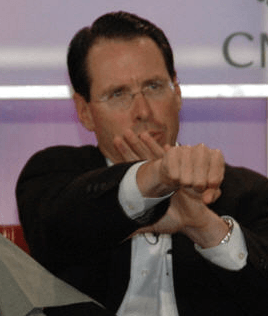
Stephenson: Payback time.

Six weeks after AT&T’s colossal $39 billion dollar merger with T-Mobile USA fell apart, AT&T CEO Randall Stephenson opened his checkbook and donated $30,800 (the maximum allowed under federal law) to the Republican National Committee.

That contribution dwarfs Stephenson’s largest previous donation over the past twenty years: $5,000, according to the Center for Responsive Politics.

Bloomberg reports that Stephenson took a credibility and pay hit from the merger debacle, forcing AT&T to turn over $4 billion in deal penalties to its rival, T-Mobile, including precious wireless spectrum. The deal’s collapse personally cost Stephenson more than $2 million in bonus pay.

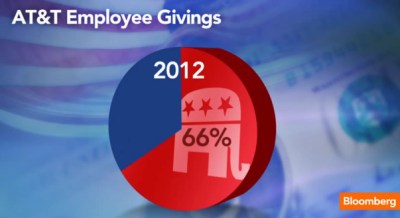
Although AT&T is not commenting, Wall Street analysts are, and they suspect Stephenson is sending the Obama Administration a clear message that he is upset with the decision to challenge the merger. The rest of AT&T appears to be following suit, with nearly two-thirds of political contributions, mostly from company executives, going to the Republican party which has traditionally maintained a much more friendly relationship with the communications giant.

Several Republicans criticized the Justice Department and Federal Communications Commission for interfering with the merger deal which consumer advocates argued would reduce competition and raise prices for wireless services. Republicans have also expressed near-universal support for AT&T’s policy positions on Net Neutrality, community broadband, usage-based pricing, spectrum and price deregulation, removal of state oversight of telecommunications services, and marketplace consolidation.

AT&T is a major sponsor of this summer’s Republican National Convention in Tampa, Fla. Several former lobbyists for AT&T are now working with the Romney campaign and its money bundling operations on behalf of the Republican presidential candidate.

The center reports no personal political contributions from the heads of either Verizon Wireless or Sprint.

Roger Entner, an analyst with Recon Analytics in Dedham, Massachusetts, notes AT&T was still trying to make nice with Obama Administration officials as late as last December, sending ornate cupcakes to various administration officials, including those at the FCC.

Entner noted it didn’t work.

[flv width=”640″ height=”380″]http://www.phillipdampier.com/video/Bloomberg ATT CEO Stephenson Maxes Contribution to GOP 5-29-12.flv[/flv]

Bloomberg News takes note AT&T CEO Randall Stephenson maxed out in contributions to the Republican Party just six weeks after the Obama Administration effectively nixed the $39 billion merger between AT&T and T-Mobile.  (2 minutes)

AT&T Forcing Some DSL Customers to Upgrade to U-verse or Face Service Suspension

Phillip Dampier May 29, 2012 AT&T, Broadband Speed, Competition, Consumer News 6 Comments

Upgrade or else.

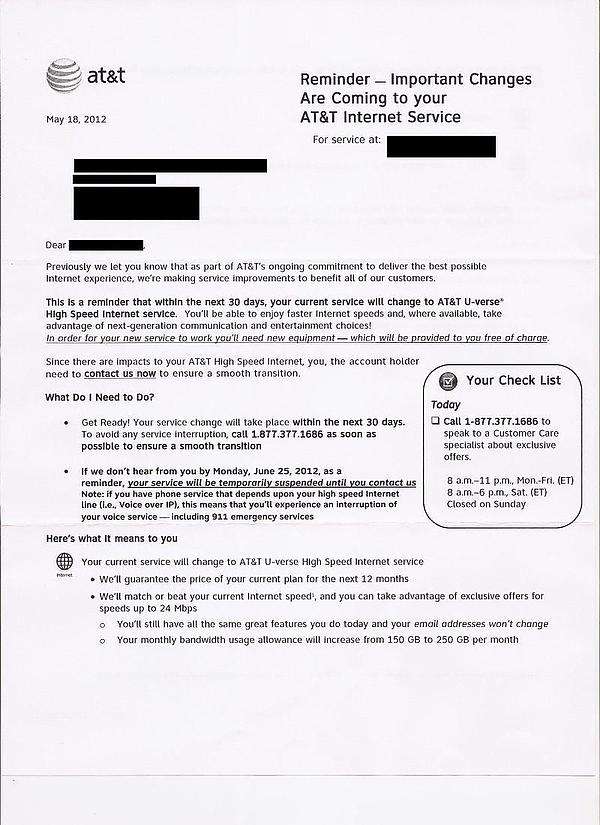
AT&T is now forcing some of their customers relying on the company’s traditional DSL service to upgrade to AT&T U-verse or face service suspension.

The latest customers impacted by AT&T’s forced upgrade are in parts of Connecticut.

“This is a reminder that within the next 30 days, your current service will change to AT&T U-verse High Speed Internet,” reads the letter mailed to customers facing the mandatory transition. Unfortunately, customers have to call AT&T to arrange for new equipment if they want their service to continue uninterrupted — existing DSL modems don’t work with U-verse.

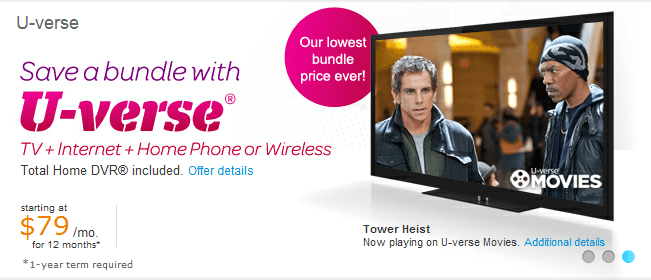
Callers who dial the toll-free number in the letter get to order the U-verse equipment for free, but they routinely endure a hard sales pitch selling U-verse video and phone service as well, at a corresponding higher price. Customers are sent self-install kits at no charge and are offered the same rate they currently pay for DSL, sometimes with faster speeds on the U-verse network. But after one year, regular U-verse prices apply, and they are often significantly more expensive than traditional DSL service.

A Broadband Reports reader in Conn. shared a copy of the AT&T U-verse upgrade letter posted on that site's AT&T forum.

The promotional prices offered to Stop the Cap! reader Ralph were not as good as what he was currently paying for basic DSL on a promotion he purchased earlier.

“I am now paying $14.95 a month under the promotion I am on now and AT&T first tried to sell me a plan that cost $5 more,” Ralph writes. “They quickly agreed to keep my current promotional price after I told them about it, but what they will not tell me is what I will pay after the one year is up, nor can I find U-verse regular pricing on AT&T’s website.”

This special offer bundle comes with a surprise after the promotion ends -- a much higher bill.

AT&T is currently promoting Internet-only promotional pricing as follows: Basic Internet: $19.95, Express Internet: $19.95, Pro Internet: $19.95, Elite Internet: $24.95, Max Internet: $29.95, Max Plus Internet: $34.95, Max Turbo Internet: $44.95. We could not find a disclosure of what the regular prices would be after the one-year contract expired, and that bothers Ralph.

“I realize they are going to match my 3Mbps service on U-verse, but somehow I suspect the regular U-verse price is going to come higher than the DSL service I have been using,” he says.

Ralph’s intuition is correct. Stop the Cap! called AT&T at the number provided on the letter and spoke with a customer service representative at the AT&T Web Sales Center. Although AT&T will ship the required equipment (a wireless router/modem combo) at no charge, AT&T will eventually make that money back charging customers higher prices for Internet service.

Current regular pricing for Ralph’s DSL service after his promotion ends will cost him $24 a month for 3Mbps service.  U-verse charges $38 a month (off promotion) for the same speed service — a $14 monthly difference.

“That sucks,” Ralph said after we shared the news. “Why should I have to change what works fine right now?”

AT&T says keeping DSL in certain U-verse upgrade areas is not possible. In fact, AT&T’s letter warns, if customers do not call to arrange for the U-verse “upgrade” by a certain date, their broadband service will be suspended. That could be a problem for customers who also use their broadband account with an Internet-based phone line.

“There goes 911 or any other emergency calling,” Ralph reminds us. “Thanks, AT&T.”

Some customers who have completed their U-verse upgrade report AT&T messed up their subsequent billing, charging full price instead of an agreed-upon promotion. Slickdeals members report AT&T often requires constant reminding to fix billing errors that generally hand customers higher bills than they expected.

“I am trying real hard to figure out how this represents the ‘next evolution of communications’ AT&T writes about in their letter,” Ralph concludes. “All I am going to eventually get is a much higher bill for a service I don’t want or need. I guess it’s time to call the cable company again.”

FCC Announces Open Internet Advisory Committee With No Consumer Representatives

Phillip Dampier

The Federal Communications Commission has announced the composition of its new Open Internet Advisory Committee to help track and evaluate the effects of the agency’s Net Neutrality policies, but has no member directly representing the interests of consumers.

The OIAC will focus on important Net Neutrality policies like transparency, reasonable network management practices, the differences governing policies for wired and wireless broadband, and issues like usage caps and speed throttling. But there are no voices on the committee that speak directly on behalf of end users — individual customers who use the Internet in their daily lives.

The FCC instead packed the panel with business, social policy and educational interests, many with direct financial ties to large telecommunications companies.

Selected members include:

  • Harvey Anderson, Vice President of Business Affairs & General Counsel, Mozilla
  • Brad Burnham, Founding Partner, Union Square Ventures
  • Alissa Cooper, Chief Computer Scientist, Center for Democracy & Technology
  • Leslie Daigle, Chief Internet Technology Officer, Internet Society
  • Jessica Gonzalez, Executive Board, Media and Democracy Coalition; Vice President for Policy & Legal Affairs, National Hispanic Media Coalition (representing NHMC)
  • Shane Greenstein, Professor and Kellogg Chair of Information Technology, Kellogg School of Management, Northwestern University
  • Russell Housley, Chair, Internet Engineering Task Force; Founder of Vigil Security, LLC (representing Vigil Security, LLC)
  • Neil Hunt, Chief Product Officer, Netflix
  • Charles Kalmanek, Vice President of Research, AT&T
  • Matthew Larsen, CEO, Vistabeam
  • Kevin McElearney, Senior Vice President for Network Engineering, Comcast
  • Marc Morial, President & CEO, National Urban League
  • Elaine Paul, Senior Vice President, Strategic Planning, The Walt Disney Company
  • Jennifer Rexford, Professor of Computer Science, Princeton University
  • Dennis Roberson, Vice Provost & Research Professor, Illinois Institute of Technology (representing T-Mobile)
  • Chip Sharp, Director, Technology Policy and Internet Governance, Cisco Systems
  • Charles Slocum, Assistant Executive Director, Writers Guild of America, West
  • Marcus Weldon, Chief Technology Officer, Alcatel-Lucent
  • Michelle Zatlyn, Co-Founder & Head of User Experience, CloudFlare

Missing are the voices of consumers who want an open Internet and do not believe in Comcast and AT&T’s definitions of “reasonable network management” that include Internet Overcharging schemes like usage caps and overlimit fees.

Consumers will instead have to depend on Internet businesses and institutions that coincidentally share an active dislike of traffic control measures, primarily for their own business reasons.

By excluding the consumer’s voice in policy debates, it is no wonder FCC Chairman Julius Genachowski increasingly seems amenable to the companies he is supposed to independently oversee — spending a considerable amount of time opening industry conventions with keynote speeches, reviewing lobbyist briefs about various communications issues, and talking directly with the corporate leadership of the companies involved. It is disturbingly clear he is listening less and less to consumers. A clear sign of that was his vocal support for the kinds of usage-based Internet pricing schemes that consumers generally loathe.

Genachowski and his staff need to spend more time listening to individual Internet users and the customers of providers and less time attending industry-sponsored events.

The OIAC is a good place to start. Consumers deserve a seat at the table in a debate that will impact every American Internet user.

Search This Site:

Contributions:

Recent Comments:

Your Account:

Stop the Cap!