Home » Consumer News » Recent Articles:

Verizon Leaves Ailing Elderly N.Y. Couple Without Phone Service for Three Weeks

Phillip Dampier June 20, 2012 Consumer News, Public Policy & Gov't, Verizon Comments Off on Verizon Leaves Ailing Elderly N.Y. Couple Without Phone Service for Three Weeks

An 85-year-old woman with dementia and her ailing 90-year-old husband in Rockaway were left without telephone service for three weeks because Verizon could not contact them on their out-of-service phone line.

The couple’s daughter, Rita Burgess, made at least 13 calls to Verizon Communications trying to get the couple’s phone line back up and running, but to no avail. A Verizon spokesperson later told the New York Daily News the company couldn’t get the line repaired because they couldn’t call the couple… on the phone line that was out of service.

“You people put me through hell,” Burgess thought after Verizon finally reached out to get the phone line repaired.

By then it was too late. Burgess took matters into her own hands and switched the family to Time Warner Cable’s phone service.

The incident has turned into a cause célèbre for consumer advocates, who claim Verizon continues to neglect its landline network in favor of its limited fiber optic FiOS service. New York consumer groups want the state to more aggressively regulate Verizon’s landline network to make certain extended outages like this cannot happen.

Burgess, who lives on Long Island, found herself cut off from her parents at a time when her father was hospitalized. Both father and daughter were unable to reach Mrs. Burgess, who requires regular attention because of dementia.

Bob Master, legislative and political director for the Communications Workers of America, told the Daily News the couple’s ordeal is not unique.

“They’re diverting resources from basic phone services,” Master said of Verizon. “That’s the business model, to divert resources to the most lucrative areas.”

Verizon counters the union is in dispute with the phone company over stalled contract negotiations and points to a 2012 first quarter report from the state Public Service Commission showing Verizon is meeting standards for reliability and repair times.

But Verizon has also lost half of its landline customers in New York State, which could also account for a declining number of complaints.

The Burgess family has decided to stick with Time Warner Cable for phone service.
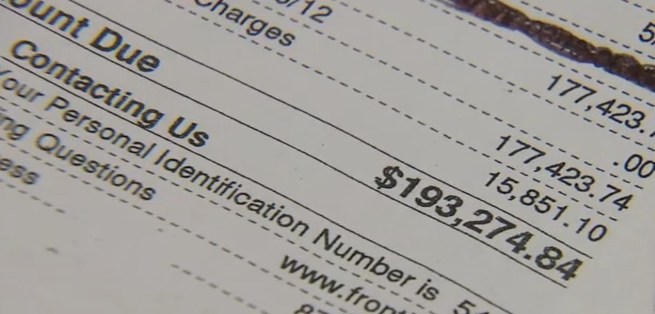
Ohio Foster Care Agency Gets $193,274.84 Bill from Frontier; Charged $195 to Stop Fraud

Phillip Dampier June 20, 2012 Consumer News, Frontier, Video 1 Comment

When the Oasis Therapeutic Foster Care Network in Albany, Ohio opened their April bill from Frontier Communications, they had the shock of their lives.

It totaled $177, 423.

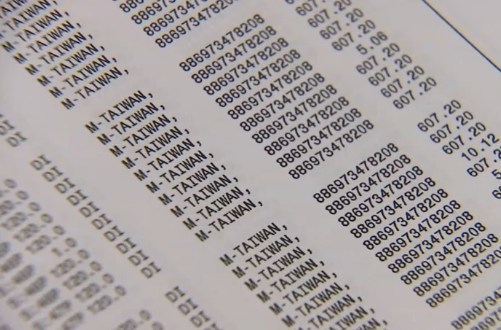
The multi-page phone bill had pages of international calls, all to the same number in Taiwan, most lasting 120 minutes.  A two hour phone call to Taiwan runs Frontier customers $607.20 each, and with more than 450 calls listed on April 22, the agency’s bill ran up fast.

A subsequent bill added another $16,000 in calls to Taiwan the first day of the next billing cycle.

Kay Wheeler, the administrator of the non-profit care network, said that phone bill could have put the agency in financial peril. Oasis almost never makes international calls, and their usual bill runs an average of $250 a month.

Frontier, to its credit noticed the unusual calls, many of which ran simultaneously on that single evening in April, and was able to eventually block them. Frontier also called the agency alerting them to the unusual calls, but that did not stop the company from initially billing Oasis nearly $194,000.

Frontier initially told Wheeler they were willing to negotiate the long distance charges down to $3,000, but the company later credited the non-profit the entire amount.

The company suspects the PBX business phone system Oasis uses was hacked. The system, installed by a third party provider, still had its default password in place. With that password, a hacker could reprogram the phone system in a myriad of ways, including diverting calls abroad.

Unfortunately for Wheeler, and other business customers that wish to avoid international long distance fraud, blocking calls to international numbers does not come free. The price of peace of mind with an international call block: $195.

Wheeler considers it a small price to pay to prevent fraud like this from happening again, but Jim Barnet, a Stop the Cap! reader in Ohio who shared the story, wonders why anyone needs to charge such a high amount to block potentially fraudulent calls.

“It’s a software block, enabled with a few commands on their computer, and it stops fraudulent long distance calls Frontier often has to eat,” Barnet writes. “So why in the world discourage business customers from signing up with a ridiculous $200 fee?”

Frontier has released a comprehensive guide to help companies avoid this kind of fraud.

[flv width=”640″ height=”358″]http://www.phillipdampier.com/video/ONN Fraudulent Bill 6-19-12.f4v[/flv]

The Ohio News Network covered the enormous phone bill and talked with Frontier Communications about how this kind of calling fraud happens.  (2 minutes)

Court Invalidates Existing Cable Franchise Agreements in Texas; TWC ‘Unshackled’

Time Warner Cable and other Texas cable operators are now free from their obligations to Texas towns and cities after winning a victory by default in the U.S. Supreme Court that invalidates local cable franchise agreements across the state.

By refusing the hear a case filed by the Texas Public Utility Commission, the court let stand a lower court ruling that found Texas franchise laws discriminated against cable operators by holding them to local agreements its competitors never had to sign.

At the behest of AT&T, in 2005 the Texas state legislature passed a statewide franchise law that would allow the phone company to apply at the state level for permission to operate its U-verse cable system anywhere in Texas. But the law also compelled incumbent cable operators to remain committed to their existing local franchise agreements until they expired.

The Texas Cable Association, a statewide cable lobbying group, and Time Warner Cable filed suit in federal court challenging the law, winning their case when it reached a federal appears court in New Orleans. The appeals court judge ruled the Texas law discriminated against “a small and identifiable number of cable providers.”

Under the court’s ruling, Time Warner and other cable operators are free to tear up their franchise agreements in cities like Irving, Dallas, and Corpus Christi. In practical terms, the court ruling could allow cable operators to stop supporting local public, educational, and government access channels, reduce franchise fee payments to local communities, and stop providing discounted service to public institutions.

The “statewide video franchise” is a concept heavily pushed by both AT&T and Verizon because it reduces the number of communities phone companies have to negotiate with to provide video service. It also allows company lobbyists to specifically target a handful of state officials that end up with the responsibility of monitoring cable systems in the state. That is much easier to manage than dealing with dozens, if not hundreds, of individual community governments to win permission to serve different areas on different terms.

Unfortunately, critics contend the agreements remove local control and oversight of cable operations, and also cuts into franchise fee payments to local communities, because many states routinely keep up to half of all franchise fees for state government coffers.

The cable operators involved in the case did not blame the state for the provision in the law that kept them “hobbled” under their pre-existing local franchise agreements. Their court papers instead put the blame at the feet of lobbyists for AT&T, which they say has continued to heavily lobby officials to enact policies that disadvantage cable companies like Time Warner Cable in Texas.

Rogers Cable Subcontractor Technicians Prepare for Strike in Ontario

Phillip Dampier June 19, 2012 Canada, Consumer News, Rogers Comments Off on Rogers Cable Subcontractor Technicians Prepare for Strike in Ontario

The union representing at least 200 service technicians working on behalf of Rogers Communications, Inc., in Ontario are planning to strike this Friday at 8am.

The contract employees, represented by the Communications, Energy, and Paperworkers Union of Canada, are employed by Intek Communications and Dependable Home Tech — outsource firms that contract with the cable giant for technicians who handle routine service calls including installations and certain repair work.

The union claims that employees are paid on a “piece-work” system, which typically means on a “per-call” or “per-function” basis. That can create financial difficulty for contractors who cannot depend on a paycheck that remains steady from week to week.

It is not the first strike action against Rogers. Other Rogers’ contractors voted to strike the company last month, leading to tentative settlements.

Rogers employs thousands of technicians in the province, so the strike is not expected to have a major impact on the company’s ability to handle service requests.

PC Magazine Hands Out Fastest Wireless Data Awards, But Does It Matter?

Won first place nationally for the best 4G LTE network with the fastest overall speeds and best performance.

PC Magazine went to a lot of effort to test the data speeds of America’s wireless providers, traveling to 30 U.S. cities sampling both 3G and 4G wireless networks to see which carrier delivers the most consistent and fastest results.

After 240,000 lines of test data, the magazine declared the results a bit “muddy.”

They have a point.

Depending on which carrier’s flavor of “4G” is being utilized, where reception was strongest, how much spectrum was available in each tested city, and how many people were sharing the cell tower at the time of each test, PC Magazine was able to deliver the definitive results. And it was effectively a draw.

Verizon Wireless achieved victory in 19 cities, AT&T won in ten others, and T-Mobile came in pretty close behind, and that carrier does not even operate an LTE 4G network. But taking all factors into account, including upload and download speeds, whether or not test downloads actually completed, and whether streamed media was tolerable, Verizon Wireless won first prize nationwide.

But by how much?

Not enough to matter, if you are using Verizon, AT&T, or T-Mobile.

But the results do offer some things to think about.

  1. MetroPCS is a mess. Despite the fact this smaller carrier is building its own 4G LTE network, results were simply terrible. Either its backhaul network from cell towers offers lower capacity or its backbone network is screaming for an upgrade.
  2. Cricket was not willing to participate in the test. Their network, still 3G, delivers dependably “meh” results in the places where they actually provide coverage. The company has been reducing data allowances on their mobile broadband plans and raising prices on others. In one conference call with investors, company executives admitted they have been losing mobile broadband customers and expect that to continue at the prices they are charging.
  3. Sprint needs their forthcoming 4G LTE network more than ever. Their 3G data service turned in mediocre results and their 4G WiMAX network was yesterday’s news a year ago. Sprint’s 3G network is also notorious for dead-end downloads, a situation I have witnessed on friends’ phones for several months.
  4. Verizon Wireless remains far ahead of AT&T in covering more cities with their 4G LTE network. But more customers are also starting to use Verizon’s newer network, and the more customers piling on, the slower the speeds get for everyone. AT&T turned in some superior speed results in several cities, but those networks are often used less than the competition, for now.
  5. No network is good if you cannot afford to use it. As America’s wireless carriers keep raising prices and reducing usage allowances to keep data usage under control, there will be a breaking point where customers decide the money they spend for wireless data just is not worth it, especially if they live in a place where Wi-Fi is free and easy to find.
  6. What you test today will probably be different tomorrow. Wireless networks are constantly evolving and changing, with a wide range of factors contributing to their overall performance. Perhaps a more useful test would have been measuring how wireless carriers respond when their networks need upgrading and how long it takes them to respond to changing usage patterns. Verizon seems particularly aggressive, AT&T less so based on these results. The real surprise seems to be how well T-Mobile’s older technology is performing, and how quickly Sprint is now falling behind. On Cricket and MetroPCS, “you get what you pay for” seems to apply.

Search This Site:

Contributions:

Recent Comments:

Your Account:

Stop the Cap!