Home » Competition » Recent Articles:

Hulu’s Streaming Live TV Launches; $39.99 for Hulu, 50 Live TV Channels + Cloud DVR Service

Phillip Dampier May 3, 2017 Competition, Consumer News, Online Video, Video 3 Comments

The long anticipated wait for Hulu’s live streaming cable-TV replacement is over with today’s soft launch of Hulu with Live TV, offering 50 cable networks and local affiliates of ABC, CBS, NBC, and FOX in select larger cities.

“Hulu can now be a viewer’s primary source of television,” said Hulu CEO Mike Hopkins. “It’s a natural extension of our business, and an exciting new chapter for Hulu.”

The new service will bundle Hulu’s live/linear TV service with its well-known on-demand package of movies and television shows. The service represents a direct challenge to cable television subscriptions and for Hulu’s owners — Disney, 21st Century Fox, Comcast’s NBCUniversal and Time Warner, Inc., is the first major industry effort to keep subscription fees closer to home, and cuts out the cable middleman.

The lineup includes many, but not all, popular cable networks. There are very significant gaps — notably Viacom networks Hulu says it has no plans to add (Nickelodeon, Comedy Central, MTV). Also missing: AMC, Discovery Networks, HBO/Cinemax and Starz. Showtime is available for $8.99 a month.

The lineup:

Fox
Fox Local Station (New York, Los Angeles, San Francisco, Philadelphia and Chicago)
Big Ten Network
Fox Business Network
Fox News Channel
Fox regional sports networks
Fox Sports 1
Fox Sports 2
FX
FXX
FXM
National Geographic Channel
National Geographic Wild

Disney
ABC Local Station (New York, Los Angeles, San Francisco, Philadelphia and Chicago)
ESPN
ESPN2
ESPNU
ESPNEWS
ESPN-SEC Network
Freeform
Disney Channel
Disney XD
Disney Junior

Comcast/NBCUniversal
NBC Local Station (New York, Los Angeles, San Francisco, Philadelphia and Chicago)
Telemundo Local Station (New York, Los Angeles, San Francisco, Philadelphia and Chicago)
Comcast RSNs
NECN
USA Network
Bravo
E!
Syfy
MSNBC
CNBC
NBCSN
Golf Channel
Chiller
Oxygen Network
Sprout

A+E Networks
A&E
History
Lifetime
Viceland
Lifetime Movie Network (LMN)
FYI

Scripps Networks Interactive
Food Network
HGTV
Travel Channel

Turner Broadcasting
CNN
HLN
CNN International
TBS
TNT
TruTV
TCM
Turner Classic Movies
Cartoon Network & Adult Swim
Boomerang

CBS
CBS Local Station (New York, Los Angeles, San Francisco, Philadelphia and Chicago)
CBS Sports Network
POP
Showtime ($8.99 per month extra)

(Broadcast stations may be available in certain other cities, but not all network affiliates are included.)

Hulu with Live TV is available on Microsoft’s Xbox One, Apple TV (fourth generation), iOS and Android mobile devices, and Google’s Chromecast. Future support for Roku, Amazon’s Fire TV and Fire TV Stick and Samsung Smart TVs will come later. Oddly, desktop viewing on a Mac or PC is not currently supported.

The new service joins an increasingly crowded marketplace of online cable television replacements, including Dish’s pioneering Sling TV, Sony’s game console-platform PlayStation Vue, AT&T’s DirecTV Now, and YouTube TV — the newest before today.

Hulu’s most formidable competitor in the streaming TV space will likely be AT&T’s DirecTV Now service, which offers a broader range of networks and has become popular for its promotional equipment offers. Hulu plans to counter AT&T with a marketing effort that highlights its existing on-demand service of more than 3,000 TV shows and movies is included with every subscription.

Hulu also comes bundled with its own limited cloud DVR storage service, which will record up to 50 hours of programming. But similar to Google’s YouTube TV, customers will not be able to skip the commercials that are included in the shows they record. In fact, advertisers will be able to dynamically change their advertising spots in recorded shows as long as the customer keeps them in their personal recordings library. Customers will need to upgrade to “Premium DVR” service ($14.99) to enable fast-forwarding through ads. The premium DVR add-on also includes 200 hours of storage, unlimited simultaneous recordings, and the ability to watch recorded shows outside of the home.

Customers signed up to the base package will be able to create up to six individual profiles for the household, which allows each user to track and “favorite” TV shows and movies they enjoy the most. The service will provide recommended shows based on each person’s viewing habits. The feature also allows each family member to choose their favorite sports teams and Hulu will automatically record any available game that includes a favorite team.

Base subscribers get up to two simultaneous streams of live and recorded content. An “Unlimited Screens” add-on ($14.99) removes the limit and allows unlimited home streams and up to three concurrent streams outside of the home. Customers who want both Premium DVR and Unlimited Screens can bundle both features together for $20 a month — a $10 savings.

An introduction to Hulu’s new interface and live TV option. (1:55)

Charter Blames Departing Time Warner Cable Customers for Customer Losses

Phillip Dampier May 2, 2017 Charter Spectrum, Competition, Consumer News 6 Comments

Buh, bye Charter!

Despite happy talk from Charter Communications about a “new day” with Spectrum packages and pricing, some former Time Warner Cable customers are voting with their feet and canceling service when their promotional pricing packages end and rates have nowhere to go but up.

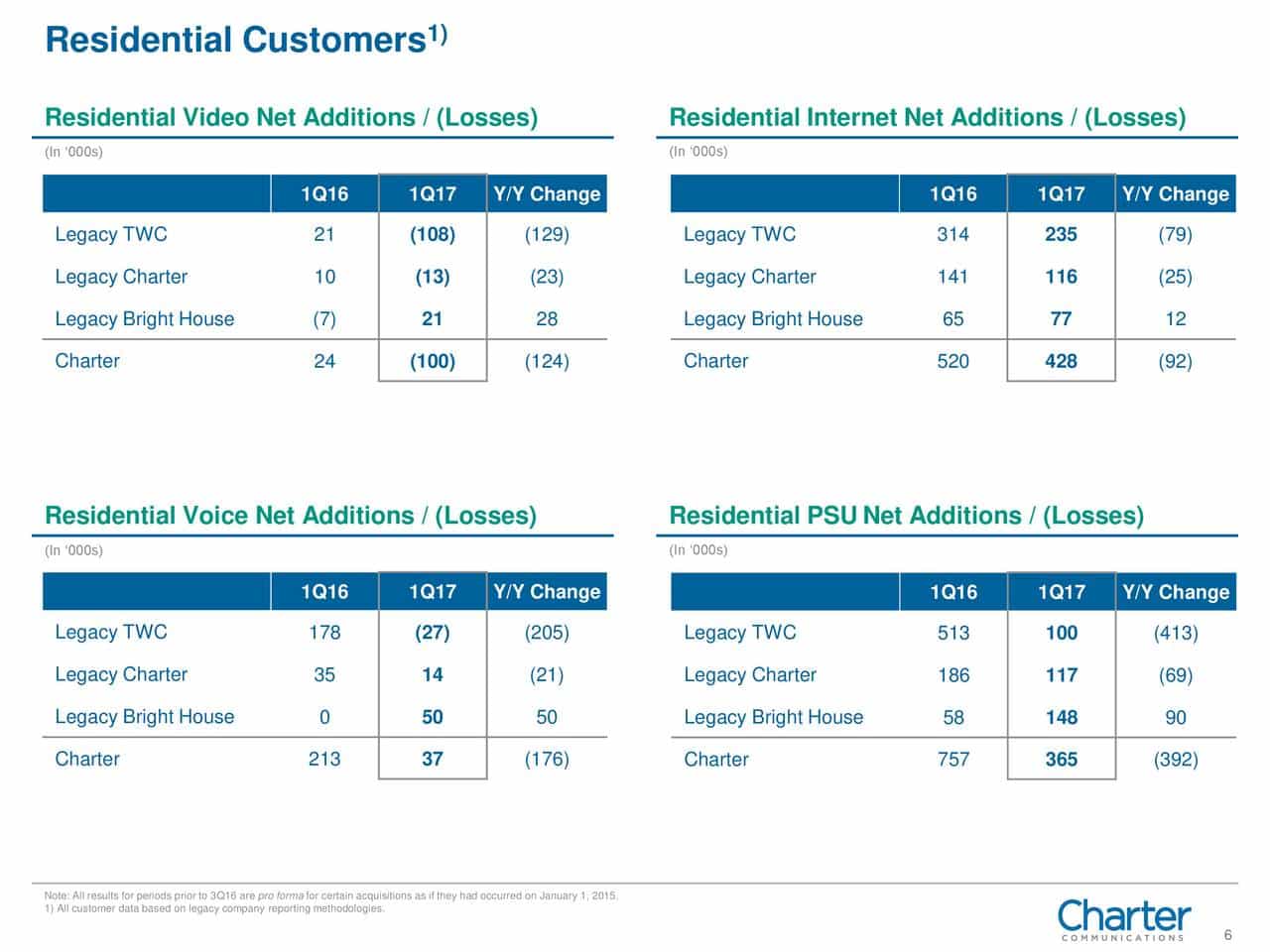
More than 100,000 video customers left Charter during the first quarter of 2017, the majority former TWC customers facing repricing and package changes as their bundle pricing and promotions expired. At that point, rates spike dramatically and customers have to choose a Spectrum package many don’t like or leave.

With only 17% of Time Warner Cable and Bright House Networks customers nationwide having switched to Spectrum plans and pricing, Charter has a long way to go and a lot of customers to lose because of the company’s unwillingness to negotiate.

“As we’ve implemented consistent retention policies nationwide, we’re managing through higher churn at TWC in the short term,” noted Charter’s chief financial officer Christopher Winfrey. “As we migrate and replace the legacy base through a disciplined approach, legacy TWC churn will improve.”

In plain English, Charter has dramatically curtailed promotional customer retention offers and has refused to negotiate with customers that have been on promotional packages for years. Hardest hit are Time Warner Cable customers, and Charter is willing to let them walk instead of extending lower prices.

“The TWC churn, somebody was given a $10 unlimited video basic package, where can you move them?” asked Winfrey. “And they have an exploding offer. It was promotional offer. Where can you move them that’s a satisfactory place relative to what they were given before.”

This Dexter, Mich. Charter customer delivers a “thumbs-down” to the company’s “terrible service.”

CEO Thomas Rutledge has been harshly critical of Time Warner Cable’s penchant to reach for promotional pricing to keep customers happy. He has instituted “discipline” to get customers away from the idea they can get a lower cable bill just by asking. Rutledge understands most of his customers don’t have a great alternative and are effectively captive to limited competitive options. For Rutledge, by taking away discounted options, customers can be retrained to accept higher prices as a fact of life.

So far, many former Time Warner Cable customers are not willing to be led to a higher bill and as their legacy promotions expire, families are having conversations about dropping service(s) as a result of price and Charter’s intransigence about lowering it.

First quarter results show the first, and widely expected victim of Charter’s “repricing” is Time Warner Cable’s home phone product, which has been offered in bundles for $9.99 a month over at least the last four years. Charter discontinued Time Warner Cable’s popular international calling feature which offered free calling to the European Union, parts of Latin America and Asia. It also raised the promotional price to $19.99 a month, and now limits free long distance calling to the U.S., Canada, Mexico, Puerto Rico, Guam, U.S. Virgin Islands, and the Northern Marianas.

As customers transition to Spectrum plans, they are leaving their voice lines largely behind as a result. During the first quarter of 2017, Charter only picked up 37,000 new Spectrum phone customers signing up for a Spectrum package versus 213,000 last year. Price was the only factor mentioned for the decline.

Decisions about cord-cutting are also being made at many former Time Warner Cable and Bright House Networks homes when Spectrum’s new cable television offer is presented to customers. Cindy Sims of Apopka, Fla., summed it up this way: “They are raising prices and doing nothing different.”

Customers with limited budgets or fixed incomes are being priced out of Spectrum.

Sims is former Bright House Networks customer who saw her bill jump from $150 to $175 a month after Charter Communications took over. Since she is a “new customer” of Charter Communications, she hoped to get an introductory offer from the company but Charter no longer considers its acquired customers “new customers,” so she was forced into Spectrum’s regular pricing, which is higher than what she paid before. She is not alone. Charter executives admit customer cancellation/retention call center contacts from former Time Warner Cable customers are 50-60% higher than those of legacy Charter customers that have been with the company for several years.

The last straw for many is the fact customers often find they have to upgrade to the most expensive TV package to keep the channels they had before.

“They are kicking the old customers in the butt,” she added, noting that some Charter representatives handling customers threatening to leave have gotten downright nasty and rude on the phone.

Given no good alternative, some customers decide the time is right to cut cable-TV for good, and TWC’s video net loss was 129,000 worse than last year. The company claims over 90% of the losses were from budget-priced, limited-basic TV disconnects. Charter prefers to sell customers large bundles of channels for considerably more, while Time Warner Cable offered local channels and a small selection of cable networks for as little as $10 a month to certain internet-only customers.

The customer losses are expected to continue for up to a year as the other 83% of customers still on a legacy Time Warner Cable or Bright House Networks package see their prices jump as promotions end. For now, Charter won’t force customers to move to a Spectrum package, but by refusing to negotiate lower prices for legacy packages, the rate increases that happen after regular rates return are enough to push many customers to make a decision to switch or cancel service.

How much of a rate jump? Consider one Time Warner Cable triple-play package with Whole House DVR service, phone and 50/5Mbps internet access reset from $129 a month to $180 after the year-long promotion expired. A comparable package from Spectrum is still $30-40 higher than what Time Warner Cable used to charge.

The impact of the transition to Charter’s Spectrum plans and pricing is also dragging down growth of its internet service. Customers signed up for less expensive and slower tiers with Time Warner Cable are being priced out of the market by Charter’s single-advertised offer – 60 or 100Mbps for approximately $65 a month ($45 for new customers), depending on the area. Higher speed tiers are available if customers call in, if only to give them the bad news a $199 upgrade fee typically also applies.

As a result, residential internet growth among customers signing up for a Spectrum plan was 428,000 during the quarter versus 520,000 last year.

Despite the concerning numbers, Rutledge declared victory and claimed Charter would continue full-speed ahead.

“As we near the first anniversary of the close of our transformative transactions in May of last year, the execution of our integration and operating plan remains on track,” Rutledge said in a statement. “We have now launched our Spectrum pricing and packaging to nearly all of the homes we pass in our new footprint. We are already seeing the benefits of our customer-focused strategy in those markets, including greater connect volumes and the sales of higher quality products, all of which will lead to higher customer satisfaction, lower churn, and faster customer and financial growth in future quarters.”

California Legislature Wants to Give $300 Million of Your Money Away to AT&T, Frontier, and Big Cable

Delivering 21st century broadband speeds to rural Californians just doesn’t interest incumbent phone companies like AT&T and Frontier Communications, so the California legislature has been hard at work trying to entice upgrades on the taxpayer’s dime while reassuring ISPs they won’t have to break a sweat doing it.

Steve Blum from Telus Venture Associates reports the California Advanced Services Fund (CASF), California’s equivalent of the FCC’s Connect America Fund (CAF) – is about to get a makeover sure to delight the two phone companies while throwing some cash at cable operators like Comcast, Cox and Charter to keep them happy as well.

The changes are encompassed in Assembly Bill 1665, sponsored by Assemblyman Eduardo Garcia (D–Riverside County), who counts AT&T as his sixth biggest contributor. The phone company has cut checks to the former mayor of Coachella not less than a dozen times amounting to $16,700. Garcia has also received special attention from AT&T’s lobbyists, who invited him to appear side-by-side with AT&T officials at press-friendly events where the phone company donated $10,000 to an abused women’s shelter and $25,000 to the Court Appointed Special Advocates of Imperial County.

Blum reports that the bill has been largely a placeholder until now as negotiations and dealmaking happened behind the scenes. The result is a corporate welfare bonanza that will raise $330 million for the CASF by reinstating a telephone tax on consumers and businesses than ended last year. Of that, $300 million will end up in the pockets of phone and cable companies, $10 million will go to regional broadband efforts, and the remaining $20 million will be designated for schools, libraries, and non-profit groups to promote broadband use, but only where providers already offer service or will shortly. In effect, that $20 million will turn public institutions into sales agents for ISPs.

The corporate giveaway bill will also sell Californian consumers down the river:

  • The bill effectively replaces the FCC’s minimum definition of broadband (25/3Mbps) with California’s own minimum: 6/1Mbps — conveniently about the same speed telephone company DSL provides. As Blum writes, the language “makes 1990s legacy DSL technology the new 21st century standard.”
  • AT&T and Frontier Communications get monopoly protection with exclusive CASF rights in areas where they currently receive federal CAF funding. This means both companies will get to double-dip federal and state money to expand inferior DSL or fixed wireless service and never have to worry about taxpayer funding going to their competitors or communities that might choose to build their own superior broadband networks. It virtually guarantees rural California will be stuck with sub-standard internet access indefinitely, and at the taxpayer’s expense.
  • CASF funding has always been exclusively for infrastructure construction — building out the last mile to deliver internet access to consumers and businesses. But the new bill now allows the money to also be spent on “operating costs,” a rat hole where millions can quickly disappear with little improvement in broadband expansion or service.
  • The new bill suggests that provider contributions — where providers agree to kick in a percentage (usually 30-40%) of their own money on expansion projects in return for getting taxpayer subsidies, is just too hard on struggling phone companies like AT&T and Frontier. Under the new proposal, this requirement should be eliminated.
  • Individual homeowners would be able to apply for grants to get broadband connections, a direct nod to the state’s cable companies that routinely ask would-be customers just out of reach of the nearest cable line to pay tens of thousands of dollars to build a line extension. If approved, cable companies could set the installation price as high as the sky and get taxpayers to foot the bill, enriching themselves while avoiding any regulatory scrutiny.

Cable companies also get another wish granted — keeping subsidized broadband out the hands of many poor Californians that need connections for education, job-seeking, and training. The bill proposes to ban funding for broadband facilities in public housing. Cable companies have been irritated spending capital on broadband expansion to public housing only to find many of its customers would likely to qualify for their “internet for the poor” programs that cost as little as $10 a month.

Blum reports the language isn’t final and is likely to be amended as negotiations continue. A hearing of the Communications and Conveyance Committee at the State Capitol, Room 437 is scheduled for 1:30pm PDT today on the bill. You can listen to the hearing when in session here.

Sling TV Offers $50 AirTV Player for Subs Who Prepay 3 Months of Service

Phillip Dampier April 25, 2017 Competition, Consumer News, Online Video, Sling Comments Off on Sling TV Offers $50 AirTV Player for Subs Who Prepay 3 Months of Service

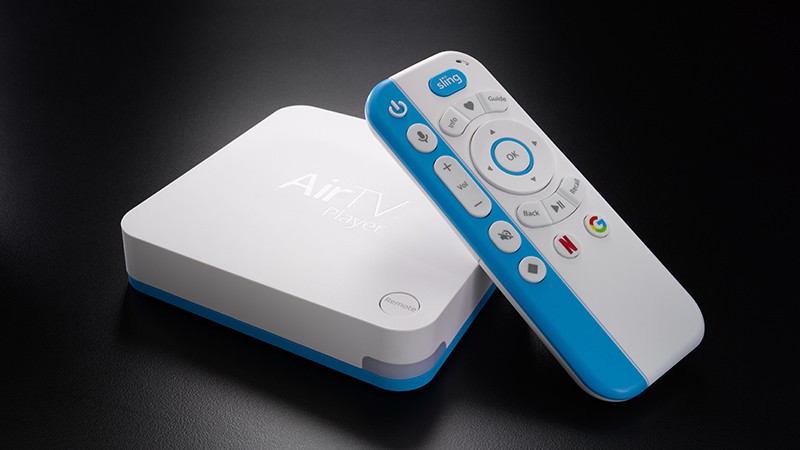
AirTV Player

Sling TV subscribers that prepay for three months of Sling TV’s $20/mo “Orange” 30-channel streaming cable TV plan can get an AirTV Player + Adapter for $50, a discount of $79.99 off the $129.99 retail price.

Dish Network’s Sling TV service rebranded its service today, in light of competitive pressure from AT&T’s DirecTV Now and new streaming services from YouTube and Hulu. The company ditched its “basic TV” marketing pitch and has now recast the service as “A La Carte TV,” but the changes are in name-only. There is nothing different about the packages or pricing, just the marketing message pushing their packages.

“A La Carte TV is choice in an industry that prevents it,” the Sling TV website states. “Personalize your own channel lineup. Start with the service that’s best for you, then customize with Extras in your favorite TV genres like Sports, Comedy, Kids, News, Lifestyle, Hollywood Movies, and Spanish TV. Change your service online anytime.”

“As we expected, competitors are coming out of the woodwork,” wrote Sling TV CEO Roger Lynch in a blog post. “However, we didn’t expect that they’d drag three key pieces of Old TV baggage with them: bloated bundles, higher prices and lack of flexibility. The only choices these competitors give consumers is a big bundle or even bigger bundles. That isn’t the choice consumers want. Plus, they’re making people pay for features and channels they may not want. The ‘new guys’ are missing the point and re-creating the sins of Old TV.”

Lynch admits Sling TV isn’t true “a la carte,” because subscribers still end up with channels they don’t want.

“Every consumer would love to just pay $20 and then choose the twenty channels they want,” Lynch wrote. “And we would love that too. We would do that in a heartbeat if programmers would let us…but they won’t.”

Sling TV is also attempting to find a niche targeting international audiences with packages of international networks that are either not available on cable, or can cost a fortune.

“Sling TV is the only pay-TV service that offers the ability to subscribe only to programming from a specific region, including Mexico, Spain, South America and the Caribbean,” Lynch wrote, adding the service now offers more than 300 channels across more than 20 language groups.

The total price of the three-months of prepaid Orange service and the AirPlay TV + Adapter is $124.97, before state and local sales taxes are applied. Subscribers can also qualify for the deal with other packages:

  • Prepay for four months of Sling TV if your monthly payment is between $15-$20 and get AirTV Player and AirTV Adapter for $50.
  • Prepay for six months of Sling TV if your monthly payment is under $15 and get AirTV Player and AirTV Adapter for $50.

Sling TV customers can visit sling.com/devices/airtv to buy the bundle. A separate deal offering a 25% discount off an RCA indoor TV antenna was not working at the time this article was written. Existing Sling TV customers can also qualify for this promotion by writing to the company’s social media team on Sling TV’s Facebook page.

The AirTV Player allows users to combine over-the-air free TV with streaming services without having to change viewing sources on your television.

Big Gets Bigger: Sinclair Acquires 14 TV Stations from Bonten Media

Phillip Dampier April 24, 2017 Competition, Consumer News, Public Policy & Gov't Comments Off on Big Gets Bigger: Sinclair Acquires 14 TV Stations from Bonten Media

Sinclair Broadcast Group is getting 14 stations larger with the announced $240 million acquisition of TV stations in small markets owned and operated by Bonten Media.

  • WCYB (NBC) and WEMT (Fox) serving eastern Tennessee and western Virginia
  • WCTI (ABC) and WYDO (Fox) in North Carolina
  • KCVU (Fox), KRCR (ABC), KRVU (MNT), KUCO (UNI), KAEF (ABC), KBVU (Fox), KECA (CW) and KEUV (UNI) in California
  • KECI (NBC), KCFW (NBC) and KTVM (NBC) in Montana
  • KTXS (ABC), KTES (Me-TV) and KTXE (ABC) in Texas

The station acquisitions will increase Sinclair’s presence in states where it already operates, and could directly affect cable and satellite TV customers because of Sinclair’s usual practice of demanding high compensation fees for permission to carry its stations on the pay TV dial.

WCTI-TV New Bern/Greenville/Washington/
Jacksonville, N.C. is just one of the stations being acquired by Sinclair.

The acquisition allows Sinclair to make advertising opportunities available on a larger number of stations and will help Sinclair expand the number of stations that carry its digital subchannel networks including Comet, a sci-fi channel, Charge!, which airs action-oriented programming, and TBD, a short-form programming network that relies heavily on online media productions.

“We look forward to welcoming the Bonten employees into the Sinclair family and are pleased to be growing our regional presence in several states where we already operate,” said Sinclair CEO Chris Ripley in a statement. “We believe our economies of scale help us bring improvements to small market stations, including investments in news, other quality local programming, and multicast opportunities with our emerging networks.”

The current deal is only a preview of the kind of TV station consolidation expected with Sinclair’s anticipated acquisition of Tribune Media, which owns familiar large market stations like WPIX-New York, KTLA-Los Angeles and WGN-Chicago.

Last week, FCC chairman Ajit Pai led the Commission to make it easier for large station owner groups to acquire more stations. Sinclair is currently the second-largest TV station owner in the U.S. (behind Nexstar Media Group) with 165 stations if its deal with Bonten is approved by regulators. Should it acquire Tribune, it would become the nation’s largest TV station operator by far.

Search This Site:

Contributions:

Recent Comments:

Your Account:

Stop the Cap!