Home » Competition » Recent Articles:

Wall Street’s Sprint/T-Mobile Merger Drum Circle

Wall Street wants a deal between T-Mobile and Sprint rich with fees and “synergies,” but nobody counting the money cares whether consumers will actually get better service or lower prices as a result of another wireless industry merger.

Recently, more players have entered the T-Mo/Sprint Drum Circle, seeming in favor of the merger of America’s third and fourth largest wireless carriers. Moody’s Investor Service wouldn’t go as far as Sprint CEO Marcelo Claure in playing up the deal’s “synergy savings” won from cutting duplicate costs (especially jobs) after the merger, but was willing to say the combination of the two companies could cut their combined costs by $3 billion or more annually. Based on earlier mergers, most savings would come from eliminating redundant cell sites, winning better volume pricing on handsets, dramatic cuts in employees and back office operations, and spectrum sharing.

“Imagine if you had a supercharged maverick now going after AT&T and Verizon to stop this duopoly,” Claure told an audience in Miami.

Wells Fargo called Sprint’s large spectrum holdings in the 2.5GHz band undervalued, and could be an important part of any transaction.

Sprint has more high-band spectrum than any other carrier in the U.S. Much maligned for its inability to penetrate well indoors and for its reduced coverage area, most carriers have not prioritized use of these frequencies. But forthcoming 5G networks, likely to offer a wireless alternative to wired home broadband, will dominate high frequency spectrum, leaving Sprint in excellent condition to participate in the 5G splash yet to come.

Wall Street banks can expect a small fortune in fees advising both companies on a merger deal and to assist in arranging its financing. Any deal will likely be worth more than the $39 billion AT&T was willing to pay for T-Mobile back in 2011. With that kind of money at stake, any merger announcement will likely be followed by millions in spending to lobby for its approval. Washington regulators ultimately rejected AT&T’s 2011 buyout, arguing it was anti-competitive. Reducing the U.S. marketplace to three national cellular networks is likely to again raise concerns that reduced competition will lead to higher prices.

A merger is also likely to be disruptive to customers, particularly because Sprint and T-Mobile run very different operations and systems. Moody’s predicted it could take up to five years for any merger to fully consummate, giving AT&T and Verizon considerable lead time to bolster their networks and offerings. Moody’s notes Sprint also has a history with bad merger deals, notably its acquisition of Nextel, which proved to be a distracting nightmare.

“If [another merger] stalls or is derailed by operational missteps, the downside is catastrophic,” Moody’s noted.

Cord-Nevers Still Not Interested, Even With “Skinny Bundles”

Phillip Dampier June 14, 2017 Competition, Consumer News, Online Video 4 Comments

Consumers who refuse to pay for cable television today still won’t pay for it tomorrow, even if they are offered a slimmed-down “skinny bundle” of cable networks for less money.

Sanford Bernstein media analyst Todd Juenger continued a series of focus groups with consumers to find if alternatives to cable television are attractive to consumers. The under-40 sample mixed cord-cutters and current cable and satellite customers and presented them with a range of recently available options from Sling, DirecTVNow and YouTube TV and asked if they would subscribe.

Once again, Juenger discovered the group most likely to subscribe to a cable-TV alternative already had pay television and often paid for the top-tier of service. So far, many of those customers are sampling different services but have not taken the last step of dropping their existing cable television package.

Multichannel News reports most won’t disconnect because of the lack of DVR service from most cable-TV alternatives. Until robust cloud-based DVR service is widely available and not hobbled by a lack of fast-forwarding functionality, new streaming services like DirecTVNow probably will never replace cable television.

Cable-nevers — mostly younger consumers that have never paid for cable television, still don’t seem to be willing to pay for online alternatives either. Most cited the fact they watched individual shows, not channels, and most “skinny bundles” invariably lacked certain networks with the programming they wanted to watch. Many would prefer to subscribe to television shows, not networks.

Cable TV pricing, widely slammed by many customers as too high, didn’t seem to matter as much to those participating in the series of focus groups. When asked what cable networks they would be willing to pay $5 a month each to watch, ESPN was rated on top, followed by Food Network, FX, HGTV, Logo, NBCSN, Syfy and VH1 — many carrying niche shows and original content not available elsewhere. If all eight networks were bundled together, that would cost $40, considerably more than the per channel price of much larger packages.

While older cable subscribers tend to watch programming from the same 6-10 cable networks, younger viewers seek out specific shows, and may not be able to identify what cable networks air them. They also watch on-demand more than older viewers.

As Expected, Altice’s IPO Raising Money for Possible Cox, Mediacom Acquisitions

Phillip Dampier June 12, 2017 Altice USA, Competition, Consumer News, Cox, Mediacom, Public Policy & Gov't Comments Off on As Expected, Altice’s IPO Raising Money for Possible Cox, Mediacom Acquisitions

Altice USA today revealed the terms of its long-expected initial public offering likely to bring more than a billion dollars to the company’s merger and acquisition fund that many Wall Street analysts now expect will be spent to acquire privately held Cox Communications and/or Mediacom.

Cox has long claimed it is not for sale. But Altice founder Patrick Drahi has a history of being willing to overpay for the companies he covets, including Cablevision, which was a reluctant seller for at least a decade before Altice made an offer the Dolan family that founded Cablevision couldn’t refuse.

Telsey Group analyst Tom Eagan told his Wall Street clients he expected Altice would be “active” in American cable consolidation, with Cox and Mediacom systems being likely targets. Other analysts have downplayed potential interest in Cable ONE, another likely target, because of the company’s recent aggressive rate increases and the fact its systems are often in economically depressed areas. An acquisition of Cox and/or Mediacom would make Altice the third largest cable company in the country, but it would still be far behind Comcast and Charter Communications, which hold first and second place respectively.

Any acquisition would likely not get much scrutiny on the federal level by the FCC and Justice Department, and most states would likely give the deal only a perfunctory review before approving it.

Altice USA has applied to be listed as “ATUS” on the New York Stock Exchange.

Fox Spars With Its Own Affiliates, Quietly Launching Streaming Network Feed on Hulu

Phillip Dampier June 12, 2017 Competition, Consumer News, Online Video 1 Comment

Subscribers to Hulu’s live-streaming TV service last week discovered live Fox network programming was available on the service whether a local Fox affiliate agreed to stream its programming to viewers or not.

The network quietly launched a new national 24-hour streaming feed of Fox Network shows filled out with programming from other Fox-owned networks in more than 70 markets where its affiliates have yet to sign an agreement to stream local stations.

For now, the national Fox Network feed is only available over Hulu’s live TV service, part-owned by 21st Century Fox. But sources told the Wall Street Journal the network intends to launch it on other streaming platforms in the near future (subscription required to read linked story).

The feed offers the full Fox Network schedule. At times when local stations normally carry syndicated programming, infomercials, or local news, the national Fox feed airs shows from other Fox-owned cable networks including National Geographic, Fox News Channel, Fox Business News, and content from Fox’s enormous library of programming offered by 21st Century Fox Television Studio.

The move has angered Fox’s affiliates, who are angling to strike their own more lucrative carriage deals for streaming services. Fox affiliates complain Fox’s terms for local station participation on Hulu’s streaming platform are inferior to the compensation offered to affiliates of rival networks, often by more than 50%.

Fox set the terms allowing the launch of the feed sometime ago as part of their affiliate renewal contract. Fox affiliates cannot compel the network to switch the feed off, but in markets where local stations do manage to sign deals with streaming services, the local station will replace the national feed.

The announcement is bad news for Sinclair Broadcast Group, the largest local station owner in the country. Sinclair has yet to sign a contract with Hulu to allow carriage of its owned and operated Fox-affiliates, so where a local Sinclair Fox affiliate operates, streaming services will carry the national Fox feed instead.

Viewers will be able to watch all Fox Network shows, including whatever NFL game Fox’s national feed chooses to carry. But missing from the lineup will be local news and other programming.

Comcast Introduces Gigabit DOCSIS 3.1 Broadband in 7 New Cities: $70-109.99/Month

Comcast may be undercutting its own fiber broadband aspirations by introducing a cheaper way for customers to get gigabit broadband service over their existing Comcast cable connection.

Customers in seven new areas, including most of Colorado, Oregon, southwest Washington State, and the cities of Houston, Kansas City, San Francisco and Seattle now have access to Comcast’s DOCSIS 3.1-powered gigabit downloads. (Upload speeds are limited to a much less impressive 35Mbps.)

Comcast announced the new communities as part of their gradual rollout of DOCSIS 3.1 — the standard that powers cable broadband — across their national footprint. These communities join Utah, Detroit, Tennessee, Chicago, Atlanta, and Miami where Comcast has already introduced the new speeds.

It is Comcast’s latest foray into gigabit speed broadband, and it is decidedly focused on the cities outside of the northeast (except Boston) where Comcast has not faced significant competition from Google Fiber or AT&T Fiber, both delivering gigabit speed internet access. Verizon FiOS, predominately in the northeast, only recently introduced gigabit speed options for its residential customers. Comcast continues to be among the most aggressive cable operators willing to boost broadband speeds for its customers, in direct contrast to Charter Communications, the second largest cable operator in the country that is predominately focused on selling 60-100Mbps internet packages to its customers.

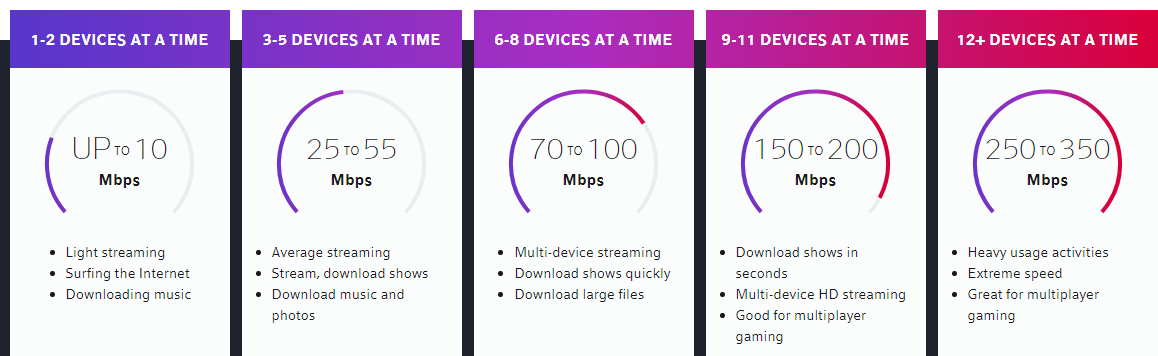
Comcast sells multiple broadband speed tiers to its customers.

Comcast’s efforts may undercut its own fiber-on-demand project, which wires fiber to the home service for some Comcast customers seeking up to 2Gbps service. That plan comes with a steep installation fee and term commitment, making it a harder sell for customers. Comcast’s DOCSIS-powered gigabit will retail for $159.95 a month, but Comcast is offering pricing promotions ranging from $70-109.99 a month with a one-year term commitment in several cities. The more competition, the lower the price.

In Kansas City, where Google Fiber premiered and AT&T is wiring its own gigabit fiber, Comcast charges $70 a month, price-locked for two years with a one-year contract. Customers who don’t want a contract will pay dearly for that option — $160 a month, which is more than double the promotional price.

In Houston, where AT&T has not exactly blanketed the city with gigabit fiber service and Comcast has been the dominant cable operator for decades, gigabit speed will cost you $109.99 — almost $40 more a month because of the relative lack of competition. Customers who bundle other Comcast services will get a price break however. Upgrading to gigabit service will cost those customers an additional $50 to $70 a month, depending on their current package.

“Additional prices and promotions may be tested in the future,” the company said in a news release.

Comcast does not expect many customers will want to make the jump to gigabit speeds and a higher broadband bill. Rich Jennings, senior vice president of Comcast’s Western/Mountain region, told the Colorado Springs Gazette that gigabit service was a “niche product for people who want that kind of speed.”

Comcast does suspect a number of signups will be from broadband-only customers who don’t subscribe to cable television.

Mike Spaulding, Comcast’s vice president of engineering, thinks the service will appeal most to those who rely entirely on a broadband connection for entertainment and communications.

“There’s not a lot of need for gigabit service for one customer to do one thing,” Spaulding told the Denver Post. “But what it does is enable an even better experience as more devices in the home are streaming, whether it’s video or gaming or whatever they are doing in the home. Most of our customers subscribe to the 100Mbps package today. Less than 10 percent of our customers are in the 200-250Mbps. We’ll see where one gig takes us.”

One place a gig may take customers is perilously close to Comcast’s notorious 1TB usage cap, which is currently enforced in Alabama, Arizona, Arkansas, California, Colorado, Florida, Georgia, Idaho, Illinois, Indiana, Kansas, Kentucky, Louisiana, Michigan, Minnesota, Mississippi, Missouri, New Mexico, Western Ohio, Oregon, Tennessee, Texas, South Carolina, Utah, Southwest Virginia, Washington, and Wisconsin, even for this premium-priced internet tier. Customers exceeding it will automatically pay a $10 overlimit fee for each 50GB of excess usage, up to a maximum of $200 a month. An unlimited ‘insurance plan’ is also available for $50 a month, which removes the 1TB cap.

Customers will have to use a new modem if they upgrade to gigabit service, either renting one from Comcast for around $10 a month or buying a compatible DOCSIS 3.1 modem. Two of the most recommended: the Arris Surfboard SB8200 ($189) or the Netgear CM1000 ($171.99) (prices subject to change).

Search This Site:

Contributions:

Recent Comments:

Your Account:

Stop the Cap!