Home » Competition » Recent Articles:

FCC Quietly Allows Sinclair to Take Control of 7 More TV Stations in Friday Night News Dump

The Federal Communications Commission on Friday quietly approved the transfer of seven high-power television station licenses owned by Bluestone Television/Bonten Media to Sinclair Broadcast Group without informing the sole Democratic commissioner Mignon Clyburn of the agency’s action.

An FCC letter informing Sinclair it approved of the transfer of licenses also included an authorization allowing KCFW (NBC) Kalispell, Mont., to continue operating as a satellite station of KECI (NBC) Missoula.

“Given that KCFW is the only full-power television station in its community of license, is located in a community of license with limited economic viability, and is costly to operate as a stand-alone station, it is unlikely that an alternative operator would be willing and able to purchase or operate the station as a stand-alone facility,” the FCC wrote. “Moreover, KCFW has operated as a satellite of KECI under Commission authority for almost 50 years, most recently reauthorized in 2007 in the Missoula DMA, and we see no evidence in the record that continuing the satellite exemption will harm competition in that market,” the FCC added.

The transfer may put Sinclair over the FCC’s station ownership cap, unless the agency changes its rules to favor Sinclair’s ongoing expansion. Sinclair is already the nation’s biggest owner of local television stations.

Commissioner Clyburn was reportedly not happy to learn about the FCC’s decision only through media reports and tweeted her displeasure this morning, calling the announcement part of a “Friday night news dump.”

The stations involved:

  • WCYB (NBC) Tri-Cities, Tenn./Vir.
  • KRCR (ABC) Chico-Redding, Calif.
  • KECI (NBC) Missoula, Mont.
  • KCFW (NBC) Kalispell, Mont. (satellite station simulcasts KECI)
  • KTXS (ABC) Abilene-Sweetwater, Tex.
  • KTVM (NBC) Butte-Bozeman, Mont.
  • KAEF (ABC) Eureka, Calif.

Most of the television stations are in smaller television markets but will still profit Sinclair because most operate profitable local news operations.

Sinclair’s growing domination of local television station ownership concerned HBO’s John Oliver enough that he spent almost 20 minutes of his Last Week Tonight with John Oliver show discussing how Sinclair’s owners have a history of skewing local newscasts to cater to its own political agenda. (Strong Language) (19 minutes)

Charter Spectrum Introduces $19.95 Sports-free Online Cable TV Alternative

If you can’t beat ’em, join ’em.

Charter Communications this week quietly announced a cord-cutters cable TV package that works on your tablet, smartphone, Xbox One, Roku, and Samsung Smart TVs.

Spectrum TV Stream ($19.95/mo) gives access to a sports-free, slimmed down basic cable TV package of popular cable networks and, rare among online streaming services, access to your local ABC, CBS, FOX, NBC, and PBS stations. You also get access to Spectrum News (where available), a 24/7 local news service carried over from the days of Time Warner Cable and Bright House Networks.

The basic cable networks covered include:

  • CNN
  • Bravo
  • A&E
  • AMC
  • Discovery
  • Food
  • TBS
  • Lifetime
  • FX
  • National Geographic Channel
  • HGTV
  • The History Channel
  • Freeform
  • Hallmark Channel
  • Hallmark Movies
  • Animal Planet
  • E!
  • Lifetime Movie Network
  • Oxygen
  • TNT
  • TLC
  • USA
  • WGN America
  • Spectrum News

Remarkably, customers can buy premium movie channels in this package for less than what they would pay with Spectrum’s traditional cable TV package. For 36 months, customers can get HBO, Showtime, Starz, Starz Encore, and The Movie Channel for $15 more per month (or $7.50 each). Oddly, Cinemax and Epix are not included.

(Image courtesy of Ian Littman)

Customers who sign up will also be able to access Spectrum TV apps and have an authenticated subscriber login to access on-demand programming from the respective websites of the networks included in the package. Spectrum also will include about 5,000 free on-demand streaming titles.

There are some restrictions with the service. You must be a Spectrum broadband customer. We are uncertain if customers still holding on to their Time Warner Cable or Bright House packages will qualify. You must not owe any past due balance to Charter Communications (or TWC or BH), and it seems likely Spectrum will charge you the Broadcast TV surcharge (usually $4-7 a month depending on the market), plus taxes and fees.

There may be availability restrictions as well. We do know the service is available in parts of California and Texas, but you may need to call to ascertain availability in your area.

To protect the cable TV industry from any undue competition, the service is only being sold in Charter/Spectrum service areas, so if you thought this would help you cancel Comcast or Cox cable TV, forget it.

A Deal With Charter, Comcast Could Further Burden Sprint’s Poor-Performing Network

With Sprint and T-Mobile reportedly far apart in prospective merger talks, Sprint has given a two-month exclusive window to Charter Communications and Comcast Corp. to see if a wireless deal can be made between the wireless carrier and America’s largest cable operators. But any deal could initially burden Sprint’s fourth place network with more traffic, potentially worsening performance for Sprint customers until additional upgrades can be undertaken.

The two cable companies are reportedly seeking a favorable reseller arrangement for their forthcoming wireless offerings, which would include control over handsets, SIM cards, and the products and services that emerge after the deal. Both Charter and Comcast also have agreements with Verizon Wireless to resell that network, but only within the service areas of the two cable operators. Verizon’s deal is far more restrictive and costly than any deal Charter and Comcast would sign with Sprint.

Such a deal could begin adding tens of thousands of new wireless customers to Sprint’s 4G LTE network, already criticized for being overburdened and slow. In fact, Sprint’s network has been in last place for speed and performance compared with AT&T, T-Mobile, and Verizon for several years. A multi-year upgrade effort by Sprint has not delivered the experience many wireless customers expect and demand, and Sprint has seen many of its long-term customers churn away to other companies — especially T-Mobile, after they lost patience with Sprint’s repeated promises to improve service.
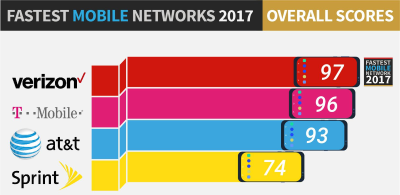
PC Magazine’s June 2017 results of fastest mobile carriers in United States shows Sprint in distant fourth place.

At least initially, cable customers switching to their company’s “quad-play” wireless plan powered by Sprint may find the experience cheaper, but underwhelming.

Sprint chairman Masayoshi Son was initially aggressive about upgrading Sprint’s network with funds advanced by parent company Softbank. But it seems no matter how much money was invested, Sprint has always lagged behind other wireless carriers. In recent years, those upgrades seem to have diminished. Instead, Son has been aggressively trying to find a way to overcome regulator and Justice Department objections to his plan to merge Sprint with third place carrier T-Mobile USA. Likely part of any deal with Charter and Comcast would be a substantial equity stake in Sprint, or some other investment commitment that would likely run into the billions. That money would likely be spent bolstering Sprint’s network.

A deal with the two cable companies could also give Sprint access to the cable operators’ large fiber networks, which could accelerate Sprint’s ability to buildout its 5G wireless network, which will rely on small cells connected to a fiber backhaul network.

Less likely, according to observers, would be a joint agreement between Charter and Comcast to buy Sprint, which is currently worth $32 billion but also has $32.6 billion in net debt. Sprint’s talks with Charter and Comcast do not preclude an eventual merger with T-Mobile USA. But any merger announcement would likely not come until late this summer or fall, if it happens at all.

Wall Street is downplaying a Sprint/T-Mobile combination as a result of the press reports indicating talks between the two companies appear to have gone nowhere.

“We didn’t give a Sprint/cable deal high odds,” wrote Jonathan Chaplin of New Street Research.  “While a single cable company entering into any transaction with Sprint has a strong likelihood of regulatory approval, a joint bid raises questions that add some uncertainty. However, the deal corroborates our view that Sprint isn’t as desperate as many thought and T-Mobile didn’t have the leverage that most seemed to assume.”

Malone

“An equity stake or outright acquisition is less likely in our view, but not out of the realm of possibility,” said Mike McCormack of Jefferies. “In our view, this likely suggests major hurdles in any Sprint/T-Mobile discussions and could renew speculation of T-Mobile and Dish should Sprint talks falter.”

Marci Ryvicker of Wells Fargo believes Comcast will be “the ultimate decision maker” as to which path will be taken. Amy Yong of Macquarie Research seems to agree. “We note Comcast has a strong history of successfully turning around assets and could contribute meaningfully to Sprint; NBCUniversal is the clearest example. But she notes Charter is likely to be distracted for the next year or two trying to integrate Time Warner Cable into its operations.

Behind the cable industry’s push into wireless is Dr. John Malone, Charter’s largest shareholder and longtime cable industry consigliere. Malone has spent better than a year pestering Comcast CEO Brian Roberts to join Charter Communications in a joint effort to acquire a wireless carrier instead of attempting to build their own wireless networks. But both Roberts and Charter CEO Thomas Rutledge have been reluctant to make a large financial commitment in the wireless industry at a time when the days of easy wireless profits are over and increasing competition has forced prices down.

For Malone, wireless is about empowering the cable industry “quad play” – bundling cable TV, internet, phone, and wireless into a single package on a single bill. The more services a consumer buys from a single provider, the more difficult and inconvenient it is to change providers.

Malone also believes in a united front by the cable industry to meet any competitive threat. Malone favored TV Everywhere and other online video collaborations with cable operators to combat Netflix and Hulu. He also advocates for additional cable industry consolidation, in particular the idea of a single giant company combining Charter, Cox, and Comcast. Under the Trump Administration, Malone thinks such a colossal deal is a real possibility.


NY Post: Charter Wants to Buy Cox Communications; Alaska’s GCI Will Eventually Become Charter

Three unnamed sources told the New York Post Charter Communications is seeking to acquire privately held Cox Communications, despite repeated assertions from the family owned Cox it is not for sale.

“Tom wants to buy Cox,” said one “highly placed cable source.” Another confirmed the news, but notes Charter has not yet approached Cox with a deal. “If they’re going to sell it to anyone, they’re going to sell it to an old cable guy.”

Cox is America’s third-largest cable company with 6.2 million subscribers. A combination with Charter would still leave Comcast as the nation’s largest cable company. Wall Street has pushed cable companies towards further consolidation, and if Charter doesn’t approach Cox, it is highly likely Altice USA will.

Cox told the newspaper all of this attention is unwanted.


“Cox has been very clear and consistent that we are not for sale and, in fact, we’re aggressively investing in our network, products and strategic partnerships and investments of our own,” Cox spokesman Todd Smith told The Post on Wednesday.

But some cable watchers expect Cox may not want to stay in the family if the price is right. In April, Alex Taylor, the great-grandson of founder James Cox was named Cox’s next CEO, starting Jan. 1, 2018.

Charter may also eventually grow by at least 100,000 new subscribers as John Malone’s Liberty Interactive’s ownership of Alaska-based GCI might not last long. Cable watchers predict Malone will flip GCI to Charter Communications after the deal closes, which would result in a likely quick rebrand of GCI as Charter/Spectrum.

Wall Street Hissyfit: Raise Broadband Prices to $90/Month Immediately! (Or Else)

If the average customer isn’t paying $90 a month for broadband service, they are paying too little and that needs to stop.

That is the view of persistent rate hike advocate Jonathan Chaplin, a Wall Street analyst with New Street Research, who has advocated for sweeping broadband rate increases for years.

“We have argued that broadband is underpriced, given that pricing has barely increased over the past decade while broadband utility has exploded,” Chaplin wrote in a note to investors. “Our analysis suggested a ‘utility-adjusted’ ARPU target of ~$90. Comcast recently increased standalone broadband to $90 with a modem, paving the way for faster ARPU growth as the mix shifts in favor of broadband-only households. Charter will likely follow, once they are through the integration of Time Warner Cable.”

Companies that fail to raise prices risk being downgraded by analysts with views like these, which can have a direct impact on a stock’s share price and the executive compensation and bonus packages that are often tied to the company’s performance.

But there is a dilemma and disagreement between some cable industry analysts about how much companies can charge their customers. Companies like Cable ONE have been aggressively raising broadband prices to unprecedented levels in some of the poorest communities in the country, which worries fellow Wall Street analyst Craig Moffett from MoffettNathanson LLC.

“Never mind that the per capita income in Cable ONE’s footprint is the lowest (by far) of the companies we [Moffett’s firm] cover, or that the percentage of customers living below the poverty line is the highest (also by far),” Moffett told his investor subscribers. “What matters is that there is very little competition in Cable ONE’s footprint. If you want high-speed broadband, where else are you going to go? The unspoken fear among their larger peers is that over-reliance on broadband pricing invites regulatory intervention, not just for Cable ONE, but for everyone.”

Chaplin thinks the risk from gouging broadband customers is next to zero. With cable TV becoming less profitable every day, all the big profits that can be made will be made from broadband, where cable operators often enjoy a monopoly on high-speed service.

According to Chaplin, if customers value internet access, they will pay the higher prices cable companies charge. So what are companies waiting for? Raise those prices!

Search This Site:

Contributions:

Recent Comments:

Your Account:

Stop the Cap!