Home » Competition » Recent Articles:

Wall Street Analyst on TV Network Fees: “Companies Are Not Supposed to Make That Kind of Money”

Phillip Dampier July 26, 2017 Competition, Consumer News, Online Video 1 Comment

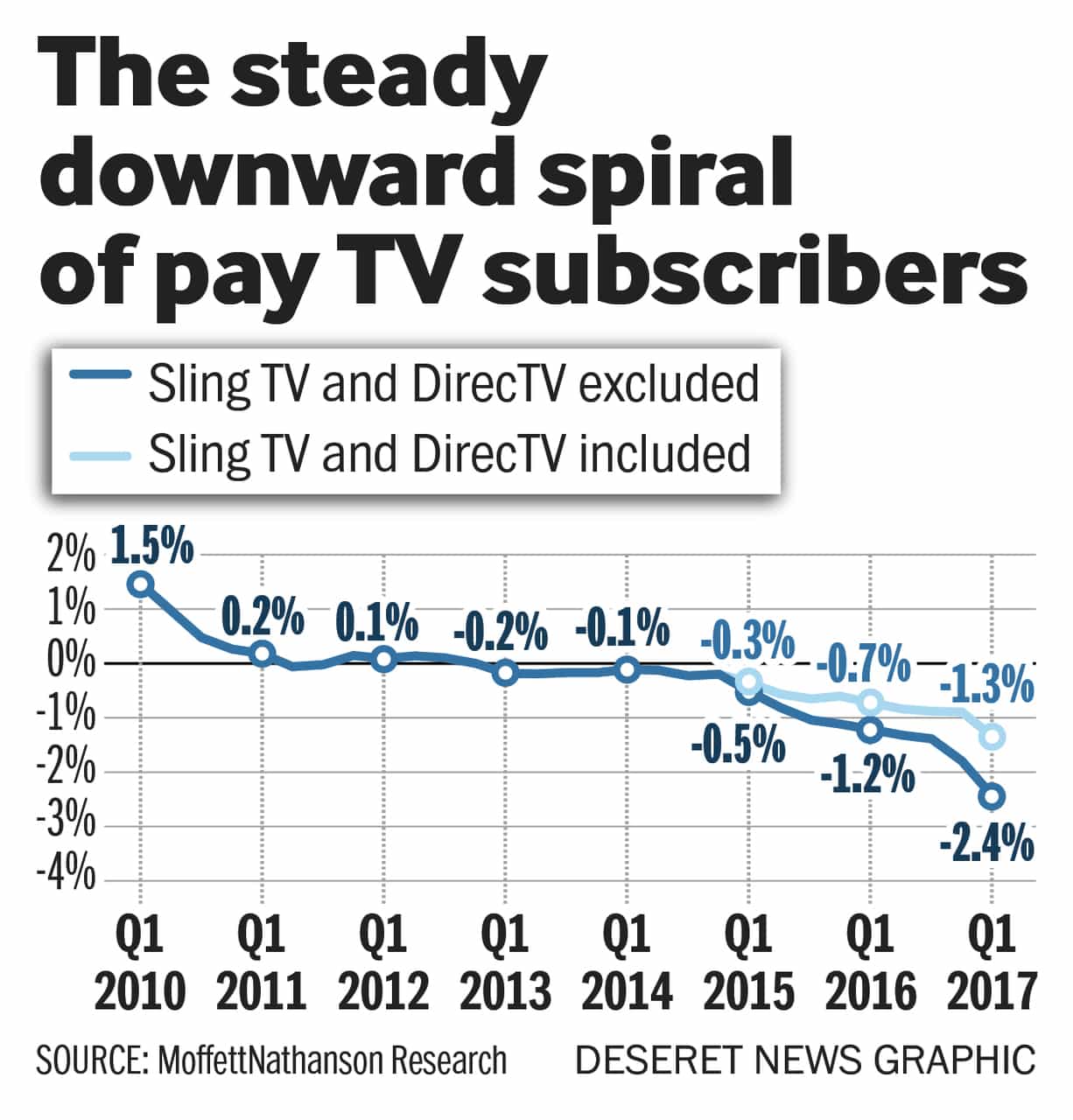
A Wall Street media analyst called today’s television model of high returns and relentless rate increases passed on to pay television customers unsustainable.

Sanford Bernstein media analyst Todd Juenger told attendees of The Independent Show (courtesy: Multichannel News) in Indianapolis that media companies expecting to profit from linear TV’s increased advertising revenue and retransmission or carriage consent fees are going to get slapped in the face soon as consumers revolt.

Juenger, like BTIG’s Rich Greenfield, is becoming increasingly pessimistic about today’s costly bundled-TV model. Juenger warns high revenue and profit expectations are only going to accelerate the growth of disruptive technologies like on-demand, online video.

Juenger notes cable and television networks never seem satisfied with the massive amounts of revenue they are already earning, and keep seeking ways to raise prices further. The TV business, Juenger notes, already enjoys some of the highest profit margins of any U.S. business in modern history.

“This is a very, very rare thing,” Juenger said. “Companies are not supposed to make that kind of money.”

Most cable networks now expect 40% annual revenue increases and a 30% return on capital, which is what causes runaway programming rate increases to be passed on year after year to consumers. Yet the quality of those networks has not significantly improved in many cases, and consumers are gradually shifting away from watching live television (and the commercials that accompany it).

Viewers, starting with younger generations, are increasingly ditching linear-live television and finding on-demand content to be more appealing. Much of that viewing isn’t taking place on the cable industry’s on-demand or TV Everywhere platform, which has become as littered with advertising as live television. Instead, viewers are drawn to original productions produced by Hulu, Netflix, Amazon, and other content platforms — often commercial-free, and on-demand network shows on platforms like Hulu.

“The whole reason for being for networks is called into question,” Juenger said.

Juenger dismisses the current industry trend of creating virtual online alternatives to cable television bundles — skinny or otherwise — for streaming online. Those efforts, like Sling TV, DirecTV Now, and PlayStation Vue still depend on linear television as their core product, and cord-cutters are showing a growing lack of interest in this model.

Cord-cutters and cord-nevers don’t want smaller, more economical bundles of cable networks delivered online, according to Juenger.

“I don’t think there is anybody who wants these products on an incremental basis,” Juenger said. “If the purpose of these services is to recapture subscribers that were lost, they’re not going to work.”

Viewers want an entirely new model, built around on-demand access to individual shows without viewing restrictions or having to pay for unwanted channels. Many are also willing to pay a little more to avoid commercials altogether.

AT&T Using $9.7 Million in Public Dollars to Bolster its Cell Towers in South Carolina

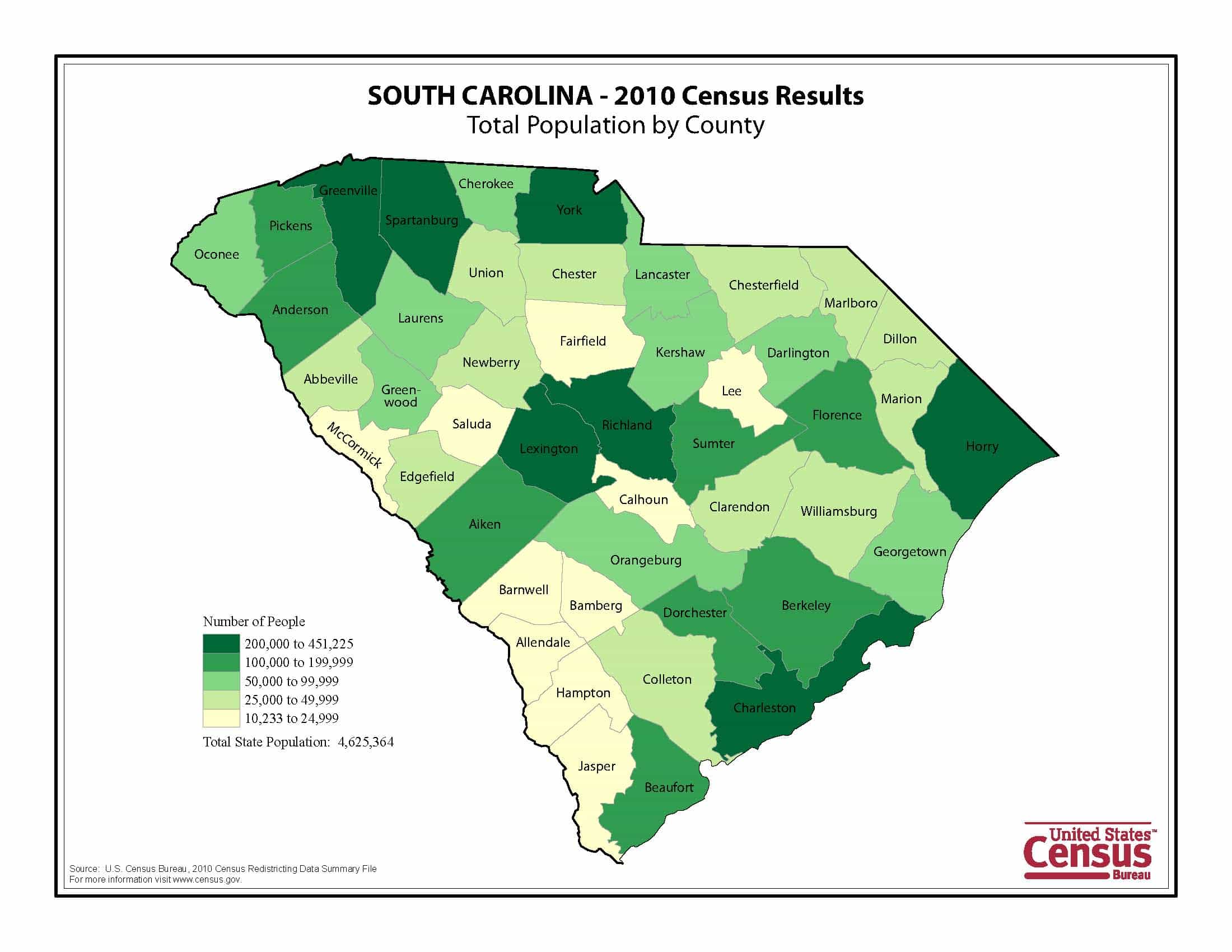
AT&T will spend $9.7 million in annual public subsidies to bolster its cell tower network in South Carolina in part to expand its rural wireless broadband program. Perhaps services like mobile tower lease would come in handy.

The Federal Communications Commission approved the funding, which is expected to cost Americans nearly $10 million annually until 2020 to boost wireless coverage in 20 mostly rural counties in South Carolina to reach an estimated 12,000 new homes and businesses by the end of this year. Nationwide, the company is getting almost $428 million a year to extend access to 1.1 million customers in 18 states, the FCC says.

AT&T plans to spend the money to improve cell towers it already has in place for its mobile phone customers. The company admitted it will rely on existing infrastructure and won’t lay a single new strand of fiber optics. Instead, wireless broadband customers will share space with AT&T’s existing mobile customers on AT&T’s backhaul network.

“Because of the wireless aspect of it and the greater ability to deliver that last-mile connection, it does help to overcome any obstacles that may be in the cost equation,” Hayes said. “This initial build, with it being infrastructure that we have in place with these towers, that comes from years of investment.”

AT&T will also be able to promote its own products and offer customers discounts and free installation when they agree to sign up for other AT&T services. Hayes said the service will cost $60 a month for everyone else, along with a one-time installation fee of $99.

“Because of the wireless aspect of it and the greater ability to deliver that last-mile connection, it does help to overcome any obstacles that may be in the cost equation,” spokesman Daniel Hayes told The Post and Courier. “This initial build, with it being infrastructure that we have in place with these towers, that comes from years of investment.”

AT&T is treating the fixed wireless program, which offers up to 10Mbps service, as an alternative to wiring fiber optics in outer suburban and rural areas.

With taxpayer/ratepayer dollars financing a significant part of the cost, AT&T will have a de facto monopoly in its rural service areas where it has traditionally declined to offer or maintain DSL service or consider fiber optic upgrades, leaving these areas without broadband service until the subsidy program began.

America’s First $3 Cord Cutter’s Bundle Coming from Discovery/Scripps Networks?

Phillip Dampier July 24, 2017 Competition, Consumer News, Online Video 1 Comment

Discovery Communications, occasionally left out of online video alternative bundles targeting cord-cutters, is preparing to retaliate with a $3-4 web-delivered bundle of channels featuring Discovery Channel, Animal Planet, TLC and other affiliated networks and possibly Scripps Networks’ bouquet of channels including HGTV, Food Network, and the Cooking Channel.

Discovery is one of two bidders (Viacom is the other) vying to take charge of Scripps Networks Interactive, one of the few remaining independent network owners not affiliated with a cable company or Hollywood studio.

Bloomberg News reports Discovery wants the networks to bolster its forthcoming inexpensive online video bundle, which will sell for $3-4 a month. While Discovery has advocated selling a sports-free package of networks in partnership with Viacom and AMC for under-$20 since April, those negotiations appear to be stalled, so Discovery is reportedly moving forward on its own.

Discovery Networks¹

Channel Launch Date U.S. Households 2015 Notes
Discovery Channel 1985 91 million Flagship network
TLC 1980 89 million Acquired by Discovery Communications in May 1991, previously known as The Learning Channel.
Animal Planet 1996 88 million
Investigation Discovery 1996 84 million Formerly Discovery Times, Discovery Civilization
OWN 2011 77 million Joint venture ownership with Harpo Productions
Velocity 2002 71 million Formerly Discovery HD Theater and HD Theater
Science 1996 68 million
Discovery Family 1996 61 million Initially launched as Discovery Kids in 1996, relaunched as The Hub in 2010, renamed Hub Network on 2013 and rebranded as Discovery Family in 2014.[55]
40% of the network is owned by Hasbro.
American Heroes Channel 1999 53 million Formerly Discovery Wings, Military Channel
Destination America 1996 52 million Formerly Discovery Home and Leisure (1998–2004), Discovery Home (2004–08), and Planet Green (2008–12)
Discovery Life 2011 46 million Merger of Discovery Health Channel and FitTV, previously known as Discovery Fit & Health
Discovery en Español 1998 6 million Spanish-language version of the Discovery Channel Unavailable in HD
Discovery Familia 2007 5 million Unavailable in HD

If Discovery successfully snares Scripps, it will own five of the top 20 U.S. cable networks. That is likely to be important in future negotiations with cable and satellite providers at contract renewal time. Discovery, like most cable network owners, pitches cable companies bundles of networks sold at wholesale prices, whether a cable operator wants all the channels in that bundle or not. Discovery plans to avoid alienating cable and satellite providers by using them to market the bundle direct-to-consumers. A prospective customer would call their local cable or satellite provider to order the bundle of web-streamed networks, not Discovery. Cable operators would likely also handle billing and customer service issues.

Scripps Interactive Networks¹

Channel Launch Date U.S. Households 2015 Notes
HGTV 1994 96 million households Frequently among the first networks to appear on digital cable.
Food Network 1993 97 million households Part owned by Tribune, which means Sinclair will own a stake in this network if acquisition deal approved.
DIY Network 1999 61 million households At initial launch, DIY was often skipped over by cable systems.
Cooking Channel 2010 62 million households A spinoff of Food Network.
Great American Country 1995 59.5 million households Started with country music videos, was uncommon outside of southern U.S. until the 2010s
Travel Channel 1987 91.5 million households Originally owned by Trans World Airlines, sold to Discovery, which sold it to Cox, which sold it to Scripps.

This type of sales partnership is not unprecedented. Before the era of DirecTV and Dish Networks, home satellite dishowners using C band TVRO satellite dishes as large as 12 feet across often ordered satellite-delivered programming from cable companies, particularly those owned by John Malone’s Tele-Communications, Inc. (TCI) and sold through its home satellite programming division Netlink. Customers would be billed directly by the nearest TCI cable system on an ongoing basis, which irritated a lot of dishowners in the 1990s who sought satellite reception as an alternative to dealing with the cable company.

The practice did not come without problems. Many local TCI systems were baffled when their customer audits revealed they had customers in cities 100+ miles outside of their immediate service area. Many were accidentally disconnected after their subscriptions were purged from TCI’s systems in error. By 2005, TCI was five years out of the cable business and had sold Netlink to Echostar, which owns Dish Networks. That same year TVRO owners were informed they could no longer subscribe to a number of networks for their giant backyard dishes and were converted to Dish Network small dish service instead.

¹-Information sourced by Wikipedia and Stop the Cap!

Net Neutrality: A Taste of Preferential Fast Lanes of Web Traffic in India

Unclear and unenforced Net Neutrality rules in India give a cautionary tale to U.S. internet users who could soon find Net Neutrality guarantees replaced in the U.S. with industry-written rules filled with loopholes or no Net Neutrality protections at all.

As India considers stronger enforcement of Net Neutrality protection, broadband providers have been merrily violating current Net Neutrality guidelines with fast lanes, sometimes advertised openly. Many of those ISPs are depending on obfuscation and grey areas to effectively give their preferred partners a leg up on the competition while claiming they are not giving them preferential treatment.

Medianama notes Ortel advertises two different internet speeds for its customers – one for regular internet traffic and the other for preferred partner websites cached by Ortel inside its network. The result is that preferred websites load 10-40 times faster than regular internet traffic.

Ortel’s vice president of broadband business, Jiji John, said Ortel is not violating Net Neutrality.

“Cache concept is totally based on the Internet user’s browsing. ISP does not control the contents and it has nothing to do with Net Neutrality,” John said in a statement.

Critics contend ISPs like Ortel may not control the contents of websites, but they do control which websites are cached and which are not.

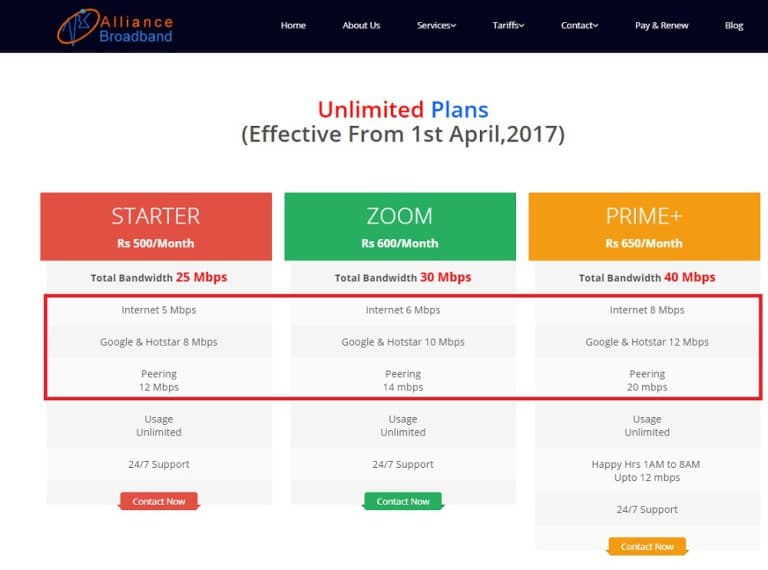
Alliance Broadband, a West Bengal-based Internet provider, goes a step further and advertises higher speeds for Hotstar — a legal streaming platform, Google and popular movie, TV and software torrents, which arrive at speeds of 3-12Mbps faster than the rest of the internet. Alliance takes this further by establishing a reserved lane for each service, meaning regardless of what else one does with their internet connection, Hotstar content will arrive at 8Mbps, torrents at 12Mbps and the rest of the internet at 5Mbps concurrently. This means customers can get up to 25Mbps when combining traffic from the three sources, even if they are only subscribed to a much slower tier.

Alliance Broadband’s rate card. Could your ISP be next?

Which services are deemed “preferred” is up to the ISP. While Alliance may favor Google, Wishnet in West Bengal offers up preferential speeds for YouTube videos.

The ISPs claim these faster speeds are a result of “peering” those websites on its own internal network, reducing traffic slowdowns and delays. In some cases, the ISPs store the most popular content on its own servers, where it can be delivered to customers more rapidly. This alone does not violate Net Neutrality, but when an ISP reserves bandwidth for a preferred partner’s website or application, that can come at the expense of those websites that do not have this arrangement. Some ISPs have sought to devote extra bandwidth to those reserved lanes so it does not appear to impact on other traffic, but it still gives preferential treatment to some over others.

Remarkably, Indian ISPs frequently give preferential treatment to peer-to-peer services that routinely flout copyright laws while leaving legal streaming services other than Hotstar on the slow lane, encouraging copyright theft.

American ISPs have already volunteered not to block of directly impede the traffic of websites, but this may not go far enough to prevent the kinds of clever preferential runarounds ISPs can engineer where Net Neutrality is already in place, but isn’t well defined or enforced.

The Great American Telecom Oligopoly Costs You $540/Yr for Their Excess Profits

Phillip Dampier July 19, 2017 Competition, Consumer News, Data Caps, Net Neutrality, Online Video, Public Policy & Gov't Comments Off on The Great American Telecom Oligopoly Costs You $540/Yr for Their Excess Profits

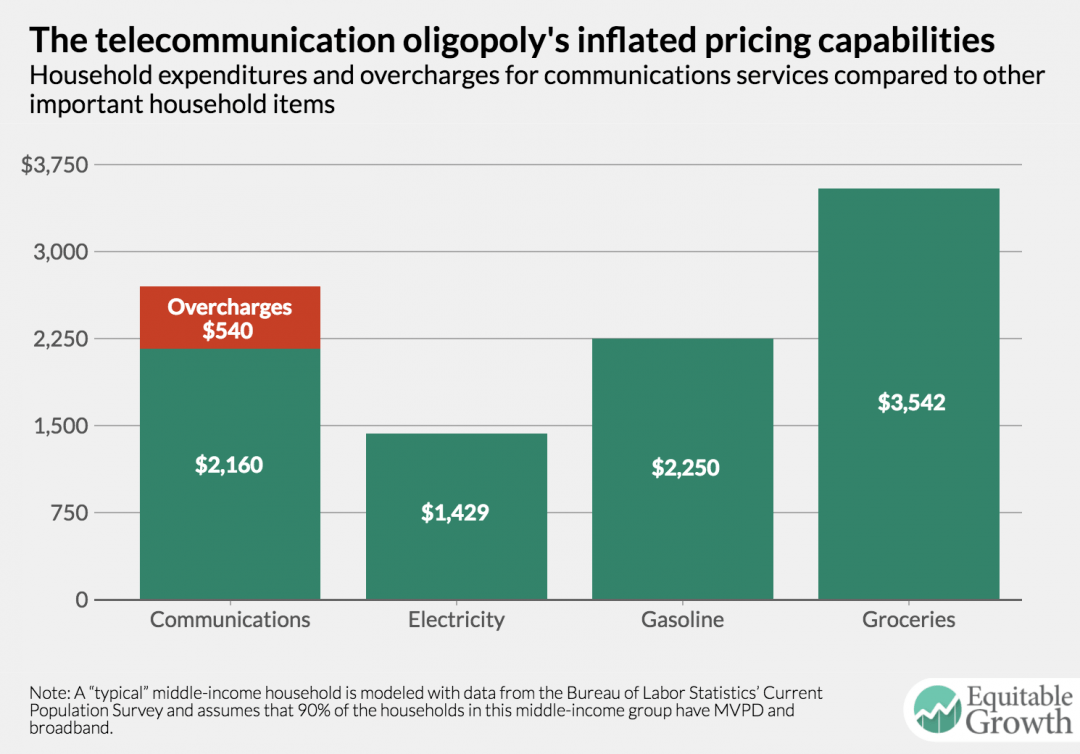
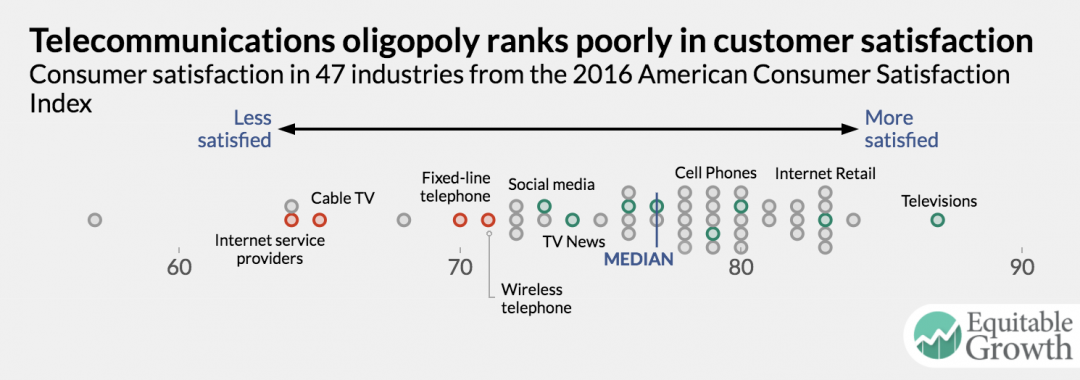
Like the railroad robber barons of more than a century ago, a handful of phone and cable companies are getting filthy rich from a carefully engineered oligopoly that costs the average American $540 a year more than it should to deliver vital telecommunications services.

That is the conclusion of a new study from the Washington Center for Equitable Growth, authored by two men with decades of experience representing the interests of consumers. They recommend stopping reckless deregulation without strong and clear evidence of robust competition and ending rubber stamped merger approvals by regulators.

The trouble started with the passage of the 1996 Telecommunications Act, a bill heavily influenced by telecom industry lobbyists that, at its core, promoted deregulation without assuring adequate evidence of competition. It was that Act, signed into law by President Clinton, that authors Gene Kimmelman and Mark Cooper claim is partly responsible for today’s “highly concentrated oligopolistic markets that result […] in massive overcharges for consumer and business services.”

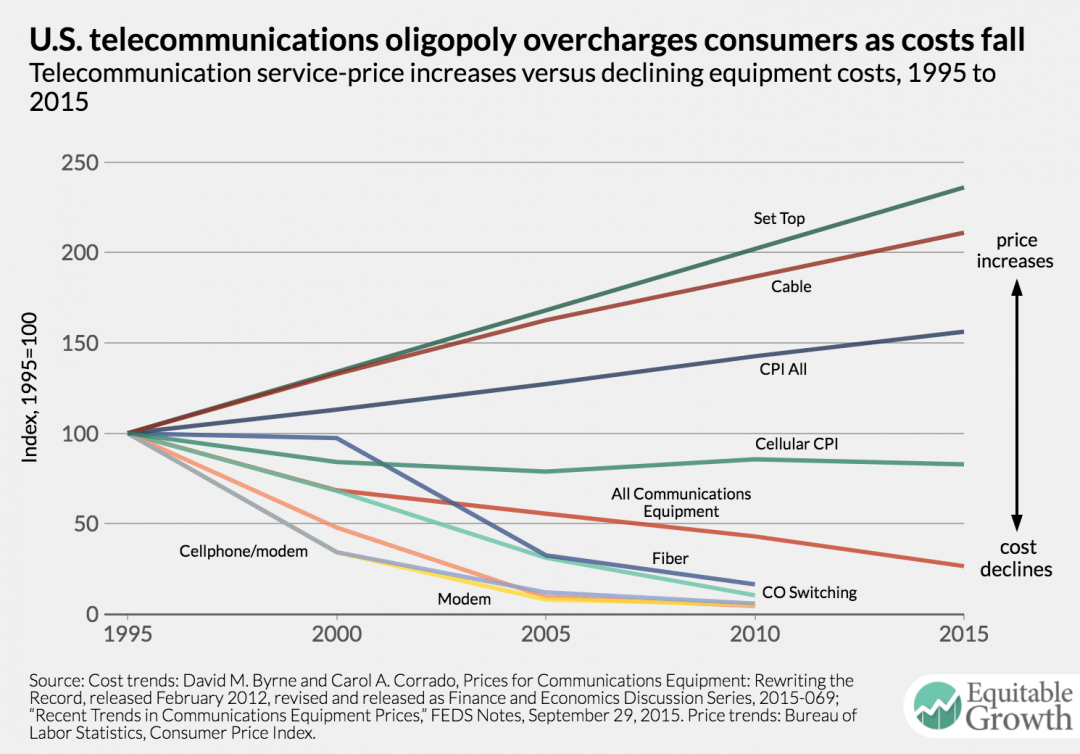
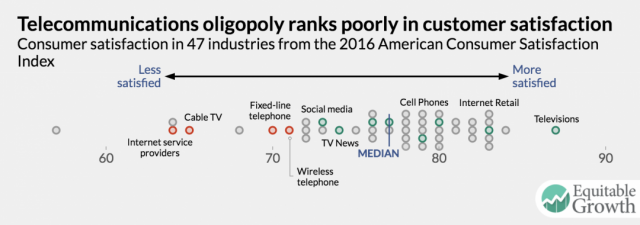
“Prices for cable, broadband, wired telecommunications, and wireless services have been inflated, on average, by about 25 percent above what competitive markets should deliver, costing the typical U.S. household more than $45 per month, or $540 per year, for these services,” the report states. “This stranglehold over these essential means of communication by a tight oligopoly on steroids—comprised of AT&T Inc., Verizon Communications Inc., Comcast Corp., and Charter Communications Inc. and built through mergers and acquisitions, not competition—costs consumers in aggregate almost $60 billion per year, or about 25 percent of the total average consumer’s monthly bill.”
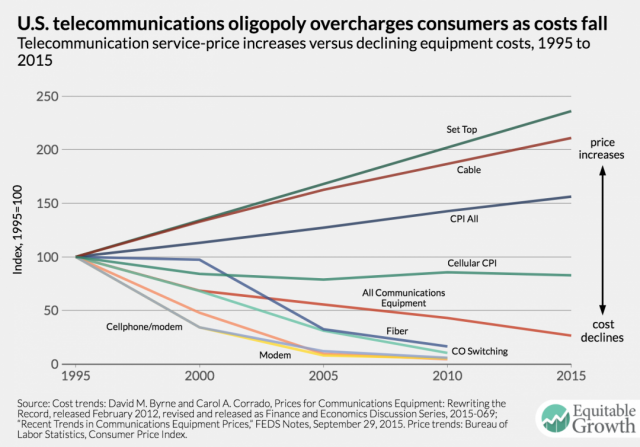
The cost of delivering service is plummeting even as your bill keeps rising.

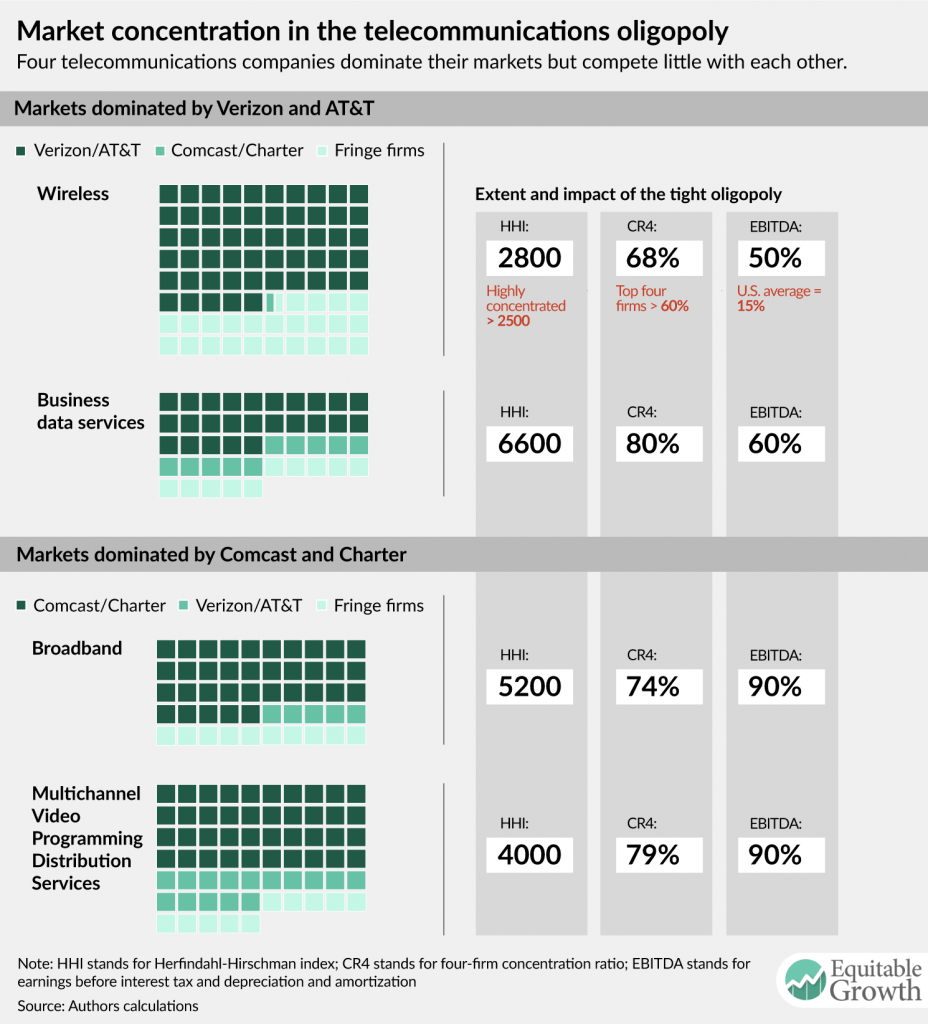
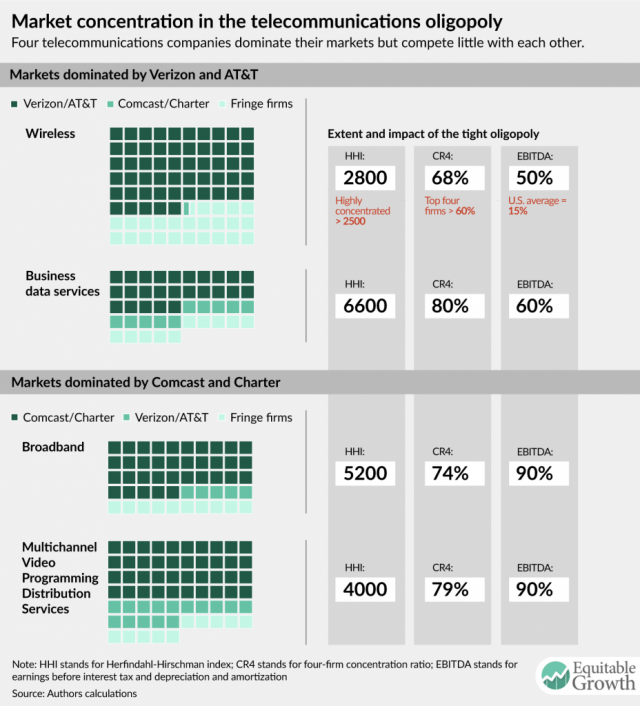
The authors also claim that these four companies earn astronomical profits — between 50 and 90% — on their services, compared with the national average of just under 15% for all industries.

The only check on these profits came from the 2011 rejection of the merger of AT&T and T-Mobile, which started a small price war in the wireless industry, saving customers an average of $5 a month, or $11 billion a year collectively.

But antitrust enforcement alone is inadequate to check the industry’s anti-competitive behavior. Competition was supposed to provide that check, but policymakers too often kowtowed to the interests of telecom industry lobbyists and prematurely removed regulatory oversight and protections that were supposed to remain in place until real competition made those regulations unnecessary.

Attempts to force open closed networks to competitors were allowed in some instances — particularly with local telephone companies, but only for certain legacy services. Newer products, particularly high-speed broadband, were usually not subject to these open network policies. The companies lobbied heavily against such requirements, claiming it would deter investment.

The framers of the ’96 Act also mandated an end to exclusive franchise agreements that barred phone and cable companies from entering each others’ markets. This was intended to allow phone and cable companies to compete head to head, setting up the prospect of consumers having multiple choices for these providers.
Current FCC Chairman Ajit Pai frequently cites the 1996 Communications Act as being “light touch” regulation that promulgated the broadband revolution. But in reality, the Act sparked a massive wave of corporate consolidation in broadcasting, cable, and phone companies at the behest of Wall Street.

“[Cable companies] refused to enter new markets to compete head to head with their sister companies [and] never entered the wireless market,” the authors note. “Telephone companies never overbuilt other telephone companies and were slow to enter the video market. Each chose to extend their geographic reach by buying out their sister companies rather than competing. This means that the potentially strongest competitors—those with expertise and assets that might be used to enter new markets—are few. This reinforces the market power strategy, since the best competitors have followed a noncompete strategy.”

Wall Street sold consolidation on the theory of increased shareholder value from eliminating duplicative costs and workforces, consolidating services, and growing larger to stay competitive with other companies also growing larger through mergers and acquisitions of their own:

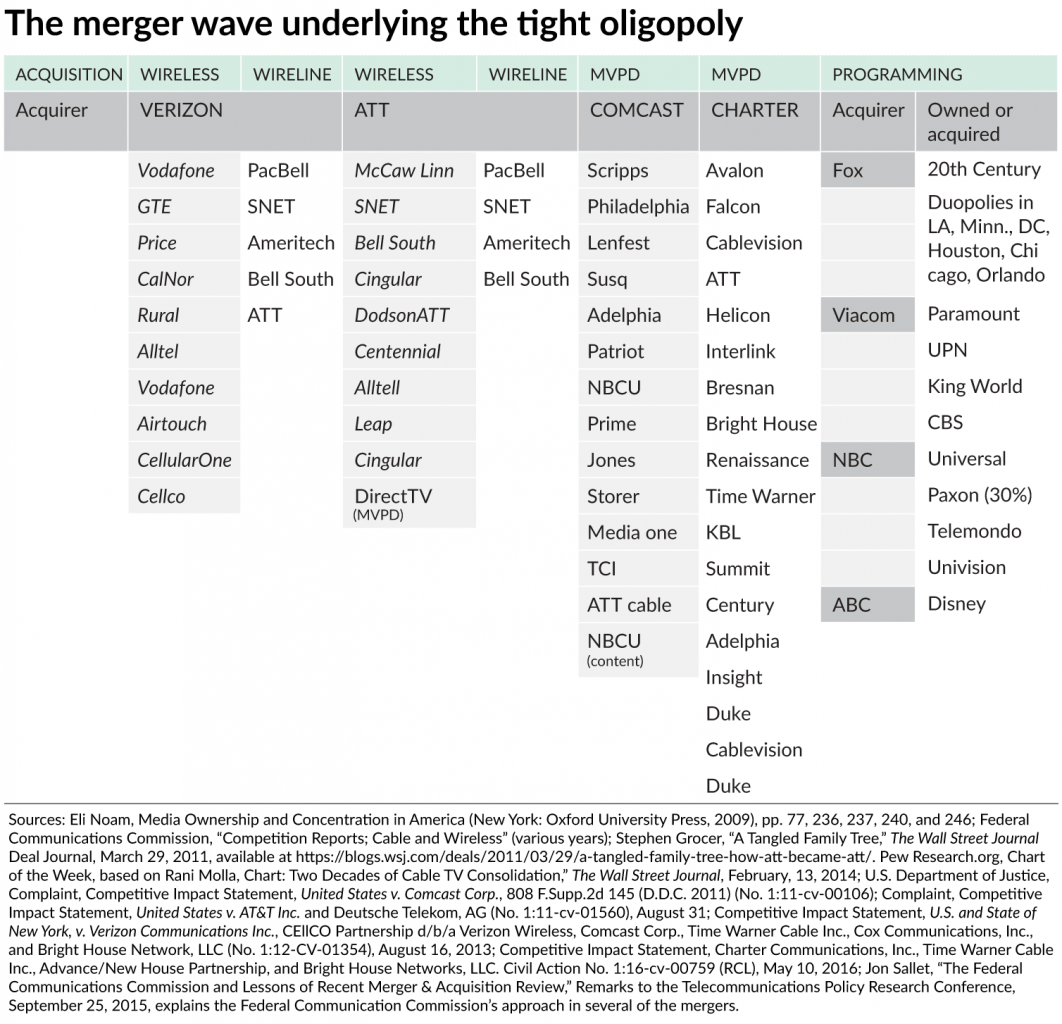
  • The eight regional Baby Bells created after the breakup of AT&T’s national monopoly in the mid-1980s eventually merged into two huge wireline and wireless companies — AT&T and Verizon. The authors note these companies didn’t just acquire those that were part of the Ma Bell empire. They also bought out independent companies like GTE and long distance companies like MCI. Most of the few remaining independents provide service in rural areas of little interest to AT&T or Verizon.
  • The cable industry is still in a consolidation wave combining large players into a handful of giants, including Comcast and Charter Communications, which also have close relationships with content providers. Altice entered the U.S. cable business principally on the prospect of consolidating cable companies under the Altice brand, not overbuilding existing companies with a competing service of its own.
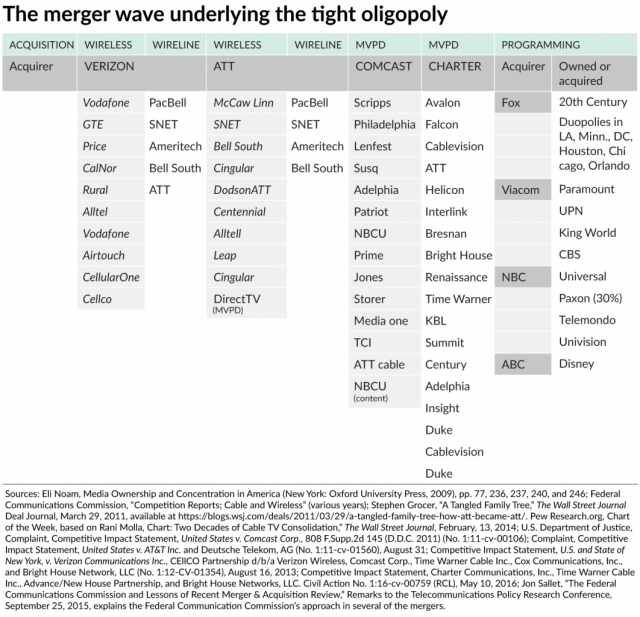
Such consolidation wiped out the very companies the ’96 Act was counting on to disrupt existing markets with new competition. Comcast, Charter, and Verizon even have agreements to cross-market each others’ products or use their infrastructure for emerging “competitive” services like mobile phones and wireless broadband.

“By the standard definitions of antitrust and traditional economic analysis, a tight oligopoly has developed in the digital communications sector,” the report states. “While some markets are slightly more competitive than others, the dominant firms are deeply entrenched and engage in anti-competitive and anti-consumer practices that defend and extend their market power, while allowing them to overcharge consumers and earn excess profits.”

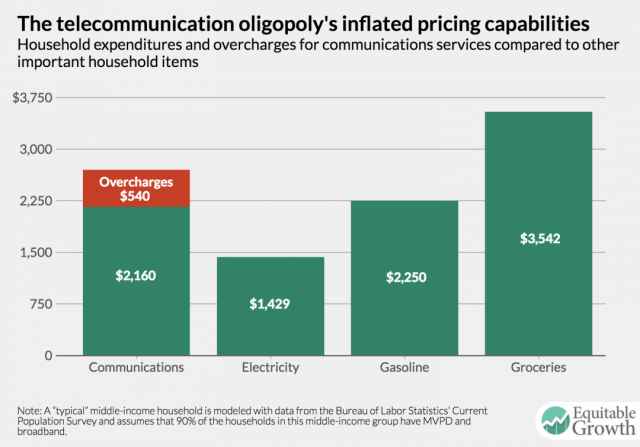
“The impact of this abuse of market power on consumers is clear. According to the most recent Consumer Expenditure Survey by the U.S. Bureau of Labor Statistics, the ‘typical’ middle-income household spends about $2,700 per year on a landline telephone service, two cell phone subscriptions, a broadband connection, and a subscription to a multichannel video service,” the report indicates. “Adjusting for the ‘average’ take rate of services in this middle-income group, consumers spend almost twice as much on these services as they spend on electricity. They spend more on these services than they spend on gasoline. Consumer expenditures on communications services equal about four-fifths of their total spending on groceries.”

The authors point out the Obama Administration, unlike the Bush Administration that preceded it, was the first since the 1996 Act’s passage to begin implementing policies to enhance and protect competition, and also check unfettered market power among the largest incumbent providers:

  • It blocked the AT&T/T-Mobile merger, which would have removed an important competitor and affect wireless rates in just about every U.S. city. The Obama Administration’s opposition not only preserved T-Mobile as a competitor, it also made that company review its business plan and rebrand itself as a market disruptor, forcing wireless prices down substantially for the first time and collectively saving all wireless customers in the U.S. billions from rate increases AT&T and Verizon could not carry out.
  • It blocked the Comcast/Time Warner Cable merger, which would have given Comcast unprecedented and unequaled control over internet access and content providers in the U.S. It would have immediately made other cable and phone companies potentially untenable because of their lack of market power and ability to achieve similar volume discounts and economy of scale, and would have blocked emerging competitors that could not create credible business plans competing with Comcast.
  • It blocked informal Sprint/T-Mobile merger talks that would have combined the third and fourth largest wireless carriers. Antitrust regulators were concerned this would dramatically reduce the disruptive marketing that we still see today from both of these companies.
  • It placed restrictions on Comcast’s merger with NBC Universal and Charter’s acquisition of Time Warner Cable. Comcast was required to effectively become a silent partner in Hulu, a vital emerging video competitor. Charter cannot impose data caps on its customers for up to seven years, helping to create a clear record that data caps are both unnecessary and unwarranted and have no impact on the cost of delivering internet services or the profits earned from it.
  • Strong support for Net Neutrality, backed with Title II enforcement, has given the content marketplace a sense of certainty and stability, allowing online cable TV competitors to emerge and succeed, giving consumers a chance to save money by cutting the cord on bloated TV packages. If providers were given the authority to discriminate against internet traffic, it would place an unfair burden on competitors and discourage new entrants.
The authors worry the Trump Administration and a FCC led by Chairman Ajit Pai may not be willing to preserve the first gains in broadband and communications competitiveness since mergermania removed a lot of those competitors.

“The key lesson in the communications sector is that vigorous regulation and antitrust enforcement can create the conditions for market success. But balance is the key,” the reports warns. “Technological innovation and convergence are no guarantee against the abuse of market power, but the effort to control the abuse of market power should not stifle innovation. If the Trump administration jettisons the enforcement practices of the past eight years, then the telecommunications sector is likely to see a wave of new consolidation and a dampening of the price cutting and innovative wireless and broadband services that have been slowly emerging.”


Search This Site:

Contributions:

Recent Comments:

Your Account:

Stop the Cap!