Home » Competition » Recent Articles:

DirecTV Now Starts Inviting Customers to Beta Test Their DVR

Phillip Dampier August 1, 2017 Competition, Consumer News, DirecTV, Online Video 2 Comments

If you are a DirecTV Now customer, check your email for an exclusive invitation to become a beta tester of the service’s new cloud based DVR service.

Little is known yet about the scope of the service or how many customers have been invited (Stop the Cap! HQ is a subscriber and we were not) to take part in the trial about to get underway.

One of the most requested features from cord-cutters is a suitable replacement for the cable or satellite provider’s DVR. Several services, including PlayStation Vue, Hulu, Sling TV, YouTube TV, and fuboTV now offer DVR-like features, although some don’t allow customers to skip commercials and others come as a costly add-on. AT&T, owner of DirecTV Now, has yet to indicate what, if anything, it plans to charge subscribers for the service or what storage capacity it will offer.

The company has focused efforts on fine tuning its streaming service to resolve the capacity issues and technical faults that were common during the first few months of service.

Discovery Builds Leveraging Power in Scripps Networks Acquisition

Phillip Dampier July 31, 2017 Competition, Consumer News, Online Video, Reuters Comments Off on Discovery Builds Leveraging Power in Scripps Networks Acquisition

NEW YORK (Reuters) – Discovery Communications Inc is acquiring Scripps Networks Interactive Inc for $11.9 billion in a deal expected to boost the company’s negotiating leverage as it seeks new audiences.

The acquisition, announced on Monday, brings together Scripps’ largely female-focused lifestyle channels such as HGTV, Travel Channel and Food Network with Discovery’s Animal Planet and Discovery Channel, whose viewers are primarily male.

Despite expectations of $350 million in total cost synergies, many analysts questioned how the combined company would compete long term as viewers cut cords to cable providers and as advertising and ratings decline.

Discovery shares ended regular trading down 8.2 percent at $24.60 while those of Scripps finished up 0.6 percent at $87.41.

Discovery is paying 70 percent cash and 30 percent stock for Scripps. The total price of the deal is $14.6 billion including debt.

“While we believe the two companies are likely better positioned together, rather than apart, the longer-term issues facing the industry still remain,” wrote John Janedis, an analyst at Jefferies, in a note on Monday.

Both Discovery and Scripps reported quarterly earnings on Monday that reflected the challenges facing U.S. media companies. Scripps missed its second quarter ad guidance and lowered its full-year estimates, and Discovery reported flat advertising and lower affiliate revenue.
U.S. television networks and cable providers are under pressure as more viewers watch shows and movies on phones and tablets. There is also increased competition for viewers from streaming services such as Netflix Inc and Amazon.com Inc.

Five of the largest U.S. pay TV providers posted subscriber losses during the second quarter.

The combined company’s larger programming slate might give it an advantage in negotiations for inclusion in skinny bundles, or economy-priced cable packages that offer fewer channels than a standard contract.

After the merger, the company will offer 300,000 hours of content and capture about a 20 percent share of ad-supported cable audiences in the United States, Discovery said on an analyst call Monday morning.

“The transaction supports and accelerates Discovery’s pivot from a linear TV-only company to a leading content provider across all screens and services around the world,” David Zaslav, Discovery’s chief executive, told investors.

The combined company would also have more muscle in negotiations with cable and other distributors when contracts come up for renewal, executives said.

By adding Scripps programming, Discovery could also launch its own “skinny bundle” of networks at a low cost, executives said.

The combined company would be home to five of the top cable networks for women with more than a 20 percent share of women prime-time viewers in the United States, according to Discovery.

Discovery will evaluate the Scripps channels, as it has its own, to figure out if any could be web-based, Zaslav said on the call.

Scripps has been considered a takeover target since the Scripps family trust, which controlled the company, was dissolved five years ago.

Under the terms of the deal, Scripps CEO Ken Lowe would join the board of the combined company.

The deal requires regulatory and shareholder approvals. Major shareholders including cable magnate John Malone, Advance/Newhouse Programming Partnership and members of the Scripps family, support the deal, the companies said.

Discovery had tried unsuccessfully twice before to buy Scripps. Discovery outbid Viacom Inc for Scripps, Reuters reported first last week.

Guggenheim Securities and Goldman Sachs served as financial advisers to Discovery. Allen & Co LLC and J.P. Morgan Securities served as financial advisers to Scripps.

Evercore Group served as financial adviser to the Scripps family.

Reporting by: Jessica Toonkel; Editing by Jeffrey Benkoe and Steve Orlofsky

Charter Turns Down Offer to Merge With Sprint, Now Softbank May Acquire Charter Itself

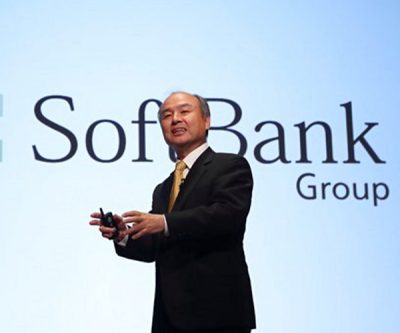
Masayoshi Son, chairman of SoftBank Group

Charter Communications is a prime target for a takeover by Japanese giant SoftBank Group Corp., and chairman Masayoshi Son appears not to be willing to take no for an answer.

Last week, Charter executives rejected a bid by Son to combine Spectrum with Sprint, the nation’s number four wireless carrier controlled by SoftBank. Now Son is attempting to put together an offer Charter’s shareholders can’t refuse.

Son could make an announcement as early as this week, according to Bloomberg News.

SoftBank would be acquiring America’s second largest cable operator estimated to have a market value of $101 billion. SoftBank itself is worth approximately $89 billion. The Japanese conglomerate already carries $135 billion in debt, the second most indebted non-financial company in Japan, outdone only by Toyota.

For most Charter customers, a merger would make the second transition in two years, after Charter acquired Time Warner Cable and Bright House Networks.

Son originally planned to combine Charter and Sprint into a new public company. Something similar would likely happen if SoftBank attempts a direct takeover of Charter Communications. Son’s investment in Sprint has not paid off. The wireless carrier has lost billions since SoftBank took control of Sprint in 2013.

“We understand why a deal is attractive for SoftBank, but Charter has no interest in acquiring Sprint,” Charter said in a statement over the weekend before Bloomberg reported Son’s latest plans. “We have a very good MVNO relationship with Verizon and intend to launch wireless services to cable customers next year.”

But Charter’s largest shareholder, Liberty Broadband Corp., controlled by Dr. John Malone, is interested in a deal bringing Charter together with a wireless carrier. But there is no word if Malone approves of a tie-up with Charter and SoftBank.

“Overall our view is that Charter likely does not want to sell, but that SoftBank is one of the few companies that could put a bid in big enough to take control,” analysts at JPMorgan Chase & Co., led by Philip Cusick, said in a note. “While we don’t see a deal as very likely, especially given later headlines that Charter is cool to the idea, Masa is never to be counted out as a buyer.”

Son’s urgency to do a deal may be related to Sprint’s ongoing losses and the bonds used to finance that acquisition near maturity.

Citigroup Urges Comcast to Buy Verizon; Nice Monopoly if You Can Get It

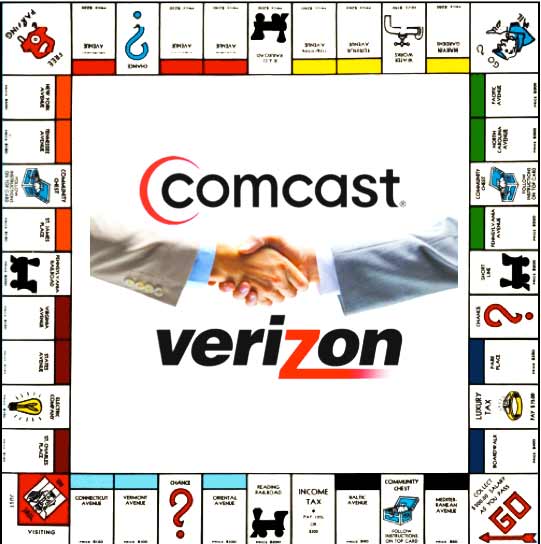
Citigroup is advocating for another super-sized merger, this time lobbying Comcast to buy Verizon Communications — a deal worth up to $215 billion.

Citigroup analyst Jason Bazinet believes the more corporate friendly Trump Administration would not block or impede a deal that would bring together the nation’s largest cable operator and wireless provider. Such a merger would leave a significant portion of the mid-Atlantic, northeast, and New England with a monopoly for telephone and broadband service.

Bazinet offers four reasons why the deal makes sense to Wall Street banks like his:

  • Verizon Wireless could give Comcast customers internet access seamlessly inside and outside of the home;
  • The cost of expanding fiber optics to power faster internet and forthcoming 5G wireless broadband would be effectively split between the two companies and there would be no need to install competing fiber networks;
  • Verizon would benefit from additional wireless consolidation because it would no longer face significant emerging wireless competition from Comcast;
  • A combined Comcast-Verizon could see their corporate tax rate slashed by a considerable percentage, reducing tax liabilities.

We’d add Wall Street banks that win the enviable position of advising one company or the other on a merger deal stand to make tens of millions of dollars on consulting fees as well.

Such a merger would be unthinkable under prior administrations, if only because a combination of Verizon and Comcast would eliminate the only significant telecommunications competitor for tens of millions of Americans, giving the combined company a monopoly on telecommunications services.

Some Wall Street analysts believe a deal is still possible with Republicans in charge in Washington. But some spinoffs are likely. One scenario would involve selling off Verizon’s wireline assets in areas where Comcast and Verizon compete. But increasing questions about the financial viability of a likely buyer like Frontier Communications may make a deal bundling old copper wire assets and FiOS Fiber in New Jersey, the District of Columbia, Maryland, Delaware, Massachusetts, and Virginia a difficult sell for other buyers.

“If Brian came knocking on the door, I’d have a discussion with him about it,” Verizon CEO Lowell McAdam reportedly said this spring, according to Bloomberg News, referring to Comcast CEO Brian Roberts.

McAdam shouldn’t wait in his office, however. This morning, as part of a quarterly results conference call, Roberts made clear he wasn’t particularly interested in a merger with a wireless provider.

“I thought we were really clear last quarter,” Roberts said. “Yes, we always look at the world around us and do our jobs related to the opportunities that are out that. But we love our business. No disrespect to wireless, but that’s a tough business.”

FCC Planning to Allow Sweeping Mergermania for Local TV Stations

Phillip Dampier July 26, 2017 Competition, Consumer News, Public Policy & Gov't 1 Comment

(Image: Free Press)

Along with a new TV season starting this fall, the Federal Communications Commission plans to launch a new season of sweeping deregulation in the broadcasting industry, allowing a handful of companies to acquire masses of local TV stations as a result of easing ownership limits.

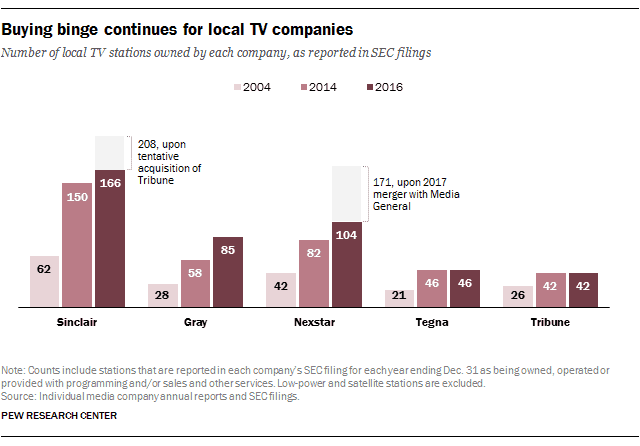
Bloomberg News reports FCC Chairman Ajit Pai, with likely support from fellow Republican commissioner Mike O’Rielly, will unveil new rules that will allow TV station owners like Nexstar, Tegna, E.W. Scripps, and Meredith to acquire dozens of local stations, even in cities where they already own stations.

The new rules, likely to pass on a party line vote, would allow companies to own two of the four most-viewed stations in a market, in addition to several other lesser-rated outlets. Broadcasters are also heavily lobbying Republicans to insert another new rule that would lift the current ban on owning both the local daily newspaper and a TV station.

Broadcasters have been itching to launch a sweeping wave of station ownership consolidation to boost advertising revenue, cut costs, and gain more leverage over cable and satellite companies as they continue to raise fees charged for consent to carry those stations on pay television lineups.

The Obama Administration not only supported existing rules designed to protect local media diversity, it also strengthened them. The former administration believed that allowing local stations to consolidate was stripping some cities of competing local newscasts, reducing diversity of voices on local stations, and shifting local broadcasting further away from its public service obligations.

Public policy groups have criticized deregulation efforts for decades, particularly the 1996 Telecom Act, signed into law by President Bill Clinton. That legislation lifted ownership limits on radio stations, triggering a sweeping consolidation tsunami that allowed companies like iHeartMedia (formerly Clear Channel Communications) to build an empire of more than 1,200 stations nationwide (as many as eight stations in a single market) after a $30 billion spending blitz.

As a result of its heavy indebtedness, the company has struggled to pay back its $20 billion outstanding debt and has committed to multiple rounds of slashing expenses at its stations, resulting in dramatic cuts in local service and staff, and turning many of its stations into automated music jukeboxes with no local announcers or staff. Listener ratings declined as a result and on April 20, the company warned investors that it may not survive the next 10 months without bankruptcy reorganization protection. These groups worry consolidation will have a similar effect on free over-the-air TV’s sense of localism.

Ironically, Sinclair Broadcasting, now attempting to acquire the station portfolio owned by Tribune Media, will not be able to participate in the next wave of consolidation because it arguably has already broken another long-standing FCC rule prohibiting one company from owning over-the-air TV stations that reach more than 39% of the U.S. audience. That rule would not be changed as a consequence of the current deregulation proposals, but it would surprise no one to see Mr. Pai and Mr. O’Rielly attempt to repeal or modify it next year.

Pai and O’Rielly have been extremely critical of ownership restrictions in general. Pai has thus far advocated loosening local-TV limits, but O’Rielly has gone further calling for their complete repeal, arguing it “defies belief” that over-the-air stations have limits while they compete with “literally hundreds of competitive pay TV channels and essentially unlimited competitive internet content”

The Obama Administration argued the difference between over the air broadcasting and pay TV networks was primarily in their public service obligations. As a license holder, TV stations are required to provide service in the public interest in return for being granted a license to use the publicly owned airwaves. Since pay television networks do not use public property, they are not required to meet those obligations. Local stations, particularly those with local newsrooms, also have a long tradition of being critically important in times of public emergencies. Without an in-house staff, stations airing little or no local programming would be unlikely to continue that tradition.

Large TV owner conglomerates are already arranging financing for the impending station roundup. John Janedis, an analyst with Jeffries, told Bloomberg all of the larger TV station owners are eager for the relaxation of ownership rules so they can purchase their peers.

“The reality is everyone is talking to everybody,” Janedis said. “There are a lot of buyers out there.”

Search This Site:

Contributions:

Recent Comments:

Your Account:

Stop the Cap!