Home » Competition » Recent Articles:

2017 Edition of Comcast’s Customer Service Makeover (Rebooted)

It’s the end of summer and that means it is time for the 11th annual Comcast Customer Service Makeover — the annual ritual of going through the motions of saying you are going to improve the customer experience, without actually doing so.

Since at least 2006, Comcast has promised it would get better, but somehow never does. That the cable company remains one of America’s most-hated companies 11 years after first promising to do better, evidently doesn’t faze J.D. Keller, the latest executive assigned to win customers over. At least Keller admits it will be a tough job to turn around one of the country’s greediest and nastiest companies. He likens it to “turning a ship around.” We’re not talking about a weekend pleasure craft either. We’re talking a colossal toxin-filled tanker here. That’s an appropriate vision of Comcast, where the craft of alienating customers with impenetrable offshore customer service and local cable stores complete with bulletproof glass to protect the employees from customers has been finely honed for years.

To paraphrase Lily Tomlin’s Ernestine, Comcast’s customer service experience is best summed up as: “We don’t care — we don’t have to. We’re the cable company.”

Somehow, Comcast has spent another $300 million of ratepayer’s money for a three-year “corporatewide push,” beginning in 2015, to fix the damage. Considering the company’s war-criminal-like reputation score has barely budged, one wonders if the $300 million was spent on a golden Band-Aid… that has since fallen off. Comcast’s bullet points of new wonderfulness doesn’t seem to impress:

  • Comcast has opened eight Apple-style XFINITY retail stores in the Twin Cities, notes the Star Tribune. Have you ever been excited visiting your phone, gas, or mobile company store? Didn’t think so. Shiny and new doesn’t help if you are still standing in line for 30-60 minutes to swap out a cable box.
  • Comcast has beefed up its call center staff. But many customers tell us that is more of the same S&M experience they get now from offshore call center representatives, who apparently delight in having their revenge against evil and annoying Americans. Comcast’s customer service representatives are excellent at reading scripts, but when you ask for credit or above-and-beyond help with a service problem, suddenly their English skills go missing. “Twice nothing is still nothing.”
  • Comcast has put more technicians on the street. But they would not have to if their cable infrastructure wasn’t ineptly maintained in some areas of the country.
  • Comcast has developed online tools so customers can fix problems themselves. That’s a slight improvement, if only because you don’t have to call for a verbal torture session with the Philippines call center. But in fact such tools benefit Comcast more than customers, because it cuts their costs.

Mr. Keller:

“When I interviewed with Steve White [Comcast’s West Division president] and CEO Dave Watson, all they talked about was customer experience. Dave Watson regularly calls clients deep in our organization to ask, ‘How’d we do?’ He’s out on the street listening to people. There is no ivory tower here. We have a long way to go to respect our customers and do a better job. Our goal is to be recognized by our customers and J.D. Power as the No. 1 communications company in the world. That’s what brought me to Comcast. A recent American Customer Satisfaction Index report gave Comcast its highest marks in 15 years [although it still trailed Verizon, AT&T and Charter Communications].”
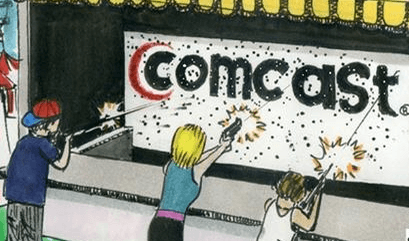
Indeed, it trails among many, many, many, many, many other companies. What does “clients deep in our organization” mean, exactly? Comcast is calling itself? We also find it impossibly hard to believe a division president in manning a booth on the street asking random customers how they feel about Comcast. At least not without his bodyguard. Comcast is the very definition of an “ivory tower” corporation, completely out of touch with the wants and needs of its own customers. Want evidence? Junk fees, channel shoveling, data caps, offshore customer service, constant rate increases, tricky promotions, and those bullet-proof glass windows at the customer service center, for a start.

Every year, Comcast reminds customers it has a long way to go to repair its emotionally abusive relationship with customers, who feel trapped with a company many wish they could ditch once and for all. Like other tragic relationships gone bad, the promises that things will get better are often empty.

Keller’s out-of-touchness shines as he talks about “respecting our customers and their time.” Comcast commits to two-hour service windows, and claims they text or call 30 minutes ahead of let customers know when the truck will arrive. Customers tell us that is true in some places, but not in others. The arrival of a repair crew does not guarantee the problem will be adequately addressed during that call either. Many tell us they have to get several crews out before a problem is really fixed. Keller also claims Comcast reads all the feedback customers give the company, but doesn’t mention it routinely ignores most of that feedback. Otherwise, those constant annoyances and policies that gave the company its horrific reputation would have been dispensed with a decade ago.

“We believe if customers are happy with us in the first 90 days, they’re going to stay with us for life,” Keller said with a straight face, forgetting that many customers don’t have a choice. Swapping one cable company for another is about as common as choosing where you get your tap water. It’s Choice “A” or Choice “A.” You decide.

Keller suggests he thought long and hard before accepting a job at the most loathed cable company on the planet.

“I took the time to take a deep breath and spend time with my wife and three children,” Keller claimed. “I knew I wanted to challenge myself. I’m not happy unless there’s some big boulder I have to push up the hill.”

Somehow, and probably with the help of a generous compensation package, he got over his concerns.

There are two ways to deal with Comcast’s nightmarish reputation. Either blow it up and start a new relationship with customers or convince yourself that your poor reputation barely exists at all and is easily fixed. The latter is what Comcast’s annual exercise in “improving the customer experience” is all about. Define a problem as fixable, pretend to fix it, and next year tell customers you are making progress. After a decade, this annual ritual is now a tradition.

Until customers have adequate competitive options to send a real message Comcast cannot afford to ignore (“I and all my friends are canceling service”), expect more of the same.

Deutsche Telekom: We’ll Build a Nationwide Fiber Network If You Let Us Monopolize It

German Chancellor Angela Merkel examines fiber optic telecommunications cables.

Germany has an internet access problem not very different from the one afflicting the United States and Canada. The national phone company, still partly owned by the government, remains mostly dependent on a decades-old wireline telephone network to deliver landline and DSL broadband service. The only way Deutsche Telekom will invest adequately to replace it with optical fiber is if they get assurances from the federal government they will be allowed to monopolize access to it.

According to the business weekly WirtschaftsWoche, a sister publication of Handelsblatt, Telekom executives have agreed to build a fiber-optic network everywhere in Germany provided that it is excluded from European anti-monopoly rules so that Deutsche Telekom wouldn’t be forced to open its network to competition.

The proposal from the German telecom giant was particularly audacious because many in the country blame it and its uncompetitive behavior for creating Germany’s slow broadband problem, but that did nothing to stop the company from asking to be shielded from competition.

“A fundamental departure from the kind of logic that viewed regulation of Deutsche Telekom (DT) as the normal state in the last 20 years is urgently needed,” the company said in a filing with the German Federal Network Agency, which regulates the internet in the country.

For most Germans, DT is the problem. The phone company has proven itself a formidable competitor across many parts of eastern Europe, where it bought control of privatized telecommunications companies that used to operate as government monopolies. But back home in Germany, it has been happy to continue offering DSL service that the rest of Europe cannot get rid of fast enough. In certain larger cities like Munich and Cologne, upstart fiber to the home providers have filled the broadband gap and have wired significant parts of both cities, and DT has responded with a fiber offering of its own without complaining about the cost of building a fiber network or the return on its investment.

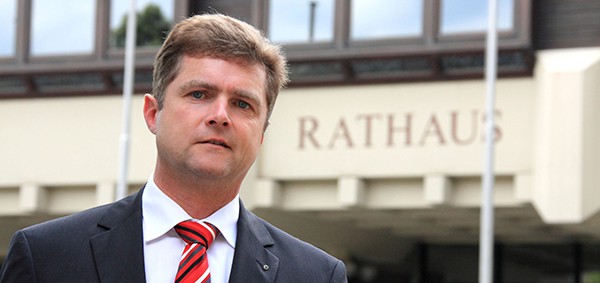
Oberbürgermeister Wolff

But in smaller towns and villages across Germany — particularly in the eastern states, broadband has been terrible for years and under DT’s “leadership” it has not gotten much better, allowing other countries in the EU to sail past Germany in broadband rankings. Like AT&T and Verizon in the U.S., DT claims that where it has not upgraded its network, there is either no demand for fiber fast internet speed or inadequate return on investment. Also like in the U.S., DT has spent its money on other technologies, notably wireless, while investment in landline networks has not kept up.

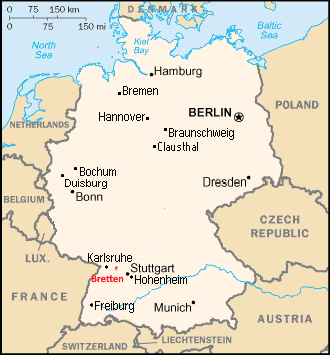
Some German communities like Bretten, fed up with inaction, have taken charge of their own broadband future and are building their own fiber to the home networks. Martin Wolff has dreamed of a digital economy boost for his town of 28,000 located near Karlsruhe in western Germany.

As mayor, he has begged and pleaded with DT to give Bretten something beyond lackluster DSL service, which is now too slow to handle the kind of 21st century internet applications that better wired communities take for granted. Mayor Wolff wants Bretten known as a gigabit city. DT, in contrast, wants to leave Bretten as a forgotten digital backwater. The phone company had repeatedly told the community the broadband it gets now is more than good enough and nobody should hold their breath waiting for something better. DT’s few competitors, including Britain’s Vodafone, weren’t interested either. Bretten is too small… too… irrelevant to matter to their investors.

“They are only interested in serving the cream of the crop in the cities and don’t come to rural areas,” the mayor said.

Like in North America, Germans are asking themselves who should be in charge of their digital future — investor-owned telecom companies or the community itself. The country’s continued embarrassing showing in European broadband rankings has become an issue of national pride and has sparked a loud debate between established telecom companies and the public that wants faster and better broadband.

The noise of the debate has attracted the politicians, and the issue of German broadband has now taken center stage in the parliamentary elections, which will be held Sept. 24. Handelsblatt reports the issue of inadequate broadband now interests German voters more than the latest economic policy position paper or how Germany will manage to deal with U.S. President Donald Trump for the next three years. Many Germans have plenty of time for these kinds of offline debates, because online, it can take a minute to load a webpage on some of the country’s dial-up like DSL connections.

“Germany is one of the most under-supplied countries in Europe, especially in terms of rural coverage,” wrote Bernd Beckert, an internet expert at the Fraunhofer Institute for Systems and Innovation Research, in a recent study of European broadband. He said countries such as Switzerland, Spain and even tiny Estonia are far ahead of Germany. In fact, the Baltic states and many former Eastern bloc countries are moving towards a fiber future while Germany considers wrapping itself even tighter in copper wiring installed in the 1960s. More than 70% of German internet users get internet access through a DT-provided, ADSL-equipped landline. Many connect at just 1-6Mbps, about the same speed users were getting in the late 1990s when DT’s internet monopoly was abolished.

Since then, DT has done everything possible to encourage “competitors” to not build competing networks. In fact, most competing ISPs like 1&1, Versatel, Telefonica Deutschland, and Vodafone rent DT DSL-capable landlines to provision service to their customers. That means they cannot compete on speed and they are forced to rely on DT to maintain its wireline network. It is no accident that German adoption of fiber optics is stuck at only 1.8%, fifth from last place among the 35 member states of the Organization of Economic Cooperation and Development (OECD). In comparison, Japan and South Korea have more than 70 percent of their customers on fiber to the home connections.

Germany’s largest political parties that have been in government since 2005, the Christian Democratic Union (CDU) and the Christian Social Union in Bavaria (CSU) have tolerated DT and its anemic upgrade policies. Broadband stagnancy, many believe, would not be possible without acquiescence and appeasement by those in control of the country. That conspiracy theory is backed by many of Germany’s smaller political parties which believe it is time to change the government’s involvement with DT.

The Left Party’s platform supports nationalizing DT and returning it to a state-owned enterprise that will answer to the public policy priorities of the next government. The capitalist, pro-business Free Democratic Party wants to get the government completely out of its 32% remaining stake in DT and hope that free market solutions will emerge. In the meantime, that party proposes to use the proceeds of any sale to fund a national broadband subsidy fund to convince private telecom companies to upgrade their networks in underserved areas.

DT has not stayed quiet in the public policy debate either. After disappointing the German public by rejecting a proposal to build an open, nationwide fiber to the home network, the company has instead promised to upgrade existing DSL lines to newer technologies like VDSL and vectoring, which DT claims could deliver up to 100Mbps service. American phone companies like Verizon have been reluctant to head in a similar direction, admitting many of the next generation DSL technologies work better in the lab than in the field. Many of the technologies promoting the most dramatic speed improvements have also proved to be vaporware so far.

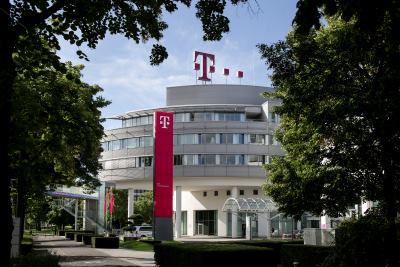
Deutsche Telekom HQ Bonn, Germany

“We are committed to vectoring, because it is the only way to provide people in rural areas with faster lines quickly,” Deutsche Telekom said in a blog post published in August. “If we are fixated on [fiber to the home], those in the countryside will remain left behind for years. It is simply impossible to roll out fiber lines to homes everywhere in the country. Neither the construction capacity nor the funding is available for that. Plus, there is quite simply no demand for it.”

Some of the other competitors in the market seem to agree with DT.

“No provider can achieve fiber optic expansion on its own,” said Valentina Daiber, a member of the board of Telefonica. Daiber said DT was already nearly $60 billion in debt. Daiber said she hoped a solution could be found after the election.

But just a week after Daiber made that claim Vodafone announced it will spend $2.4 billion on a new fiber to the premises network targeting 100,000 companies in 2,000 German business parks. The company will also spend up to $450 million partnering with municipalities to extend the network to about one million rural homes, in addition to boosting its current broadband speeds delivered to German cable customers to 1Gbps.

That announcement could cause DT’s DSL plans to eventually collapse, if Vodafone follows through on its fiber buildout.

Mayor Wolff has no intention of waiting to see how it all plays out. Wolff has convinced private fiber optics company BBV to install the fiber infrastructure and has a Dutch investor partner arranging $12 million in financing, which is always the biggest stumbling block to get fiber buildouts underway. Upfront construction costs often deter many municipalities and would-be competitors from launching. But for Wolff, where there is a will, there is a way to deliver fiber fast broadband, and he is making certain it happens sooner rather than later.

T-Mobile Giving Away Free Netflix to its ONE Family Plan Customers

Phillip Dampier September 6, 2017 Competition, Consumer News, Online Video, T-Mobile, Video, Wireless Broadband Comments Off on T-Mobile Giving Away Free Netflix to its ONE Family Plan Customers

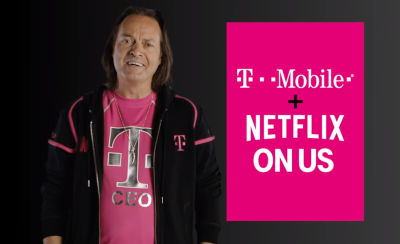
John Legere, CEO of T-Mobile USA

T-Mobile ONE family plans now come with a free subscription to Netflix, the wireless carrier announced today.

“Now, the Un-carrier is going ALL IN on unlimited by adding Netflix — the world’s leading entertainment service — to T-Mobile ONE family plans,” T-Mobile said in a press release. “Which means anyone with two or more qualifying T-Mobile ONE lines can get Netflix On Us. And T-Mobile ONE with unlimited everything — and now with Netflix included — is still just $40 per line for a family of four. As always, monthly taxes and fees are included.”

“The future of mobile entertainment is not about bolting a satellite dish to the side of your house or resuscitating faded 90’s dotcoms. The future is mobile, over-the-top and unlimited,” said John Legere, president and CEO of T-Mobile. “While the carriers spend billions on their franken-strategies to cobble together carrier–cable–content mashups, the Un-carrier just leapfrogged them all by partnering with the best and giving it to customers at no extra charge. Because that’s what we always do. Give more to you without asking more from you.”

T-Mobile claimed the move to incorporate Netflix into its included services is part of a new campaign to further irritate AT&T and Verizon Wireless. Both of the larger carriers have been making acquisitions of content companies with the hope you will boost your mobile bill by bundling services like Go90 and DirecTV Now into your package. By giving away Netflix free to qualified customers, T-Mobile can argue its package remains a much better value and its network can handle the added streaming video load.

“Carrier bundles are almost always a combination of something you want and something you don’t … all in an effort to jack up your monthly bill even more,” T-Mobile argued. “Worse, carrier bundles are usually designed to explode after the “introductory promo” runs out, and customers are stuck paying hundreds more each year. T-Mobile’s strategy couldn’t be any more different. The Un-carrier sees an opportunity to do mobile entertainment right for today’s families … to give you something you want together with something else you want – but at no extra cost.”

The details:

Starting Tuesday, September 12th, qualifying T-Mobile ONE customers can activate their Netflix subscription online, in-store or by calling T-Mobile’s customer care. If you already have a Netflix subscription, T-Mobile will cover the cost of a standard subscription for you — meaning you’ll save nearly $120 every year. To qualify, all you need are two or more paid voice lines on T-Mobile ONE. Customers with free lines from T-Mobile’s “line-on-us” deals also qualify. Customers on Unlimited 55+ or 2 lines for $100 can get Netflix On Us by switching to the latest T-Mobile ONE plan. T-Mobile ONE families who get Netflix On Us will also get T-Mobile’s Family Allowances at no extra charge. Family Allowances allow parents to manage their kids’ phone usage — like setting guidelines for talk time, text messages, download times and which numbers their kids can contact.

John Legere, CEO of T-Mobile USA, introduces Netflix on Us and roasts his competitors AT&T and Verizon Wireless. (6:10)

Boston Globe Joins Parade of Outlets Opposing Sinclair-Tribune Merger

Phillip Dampier September 5, 2017 Competition, Consumer News, Public Policy & Gov't Comments Off on Boston Globe Joins Parade of Outlets Opposing Sinclair-Tribune Merger

The Boston Globe has joined a parade of media outlets concerned about the future of local news that could be affected if Sinclair is successful in winning approval of its acquisition of Tribune Media’s 42 television stations, calling Sinclair a “behemoth” and the deal “a matter of urgent concern.”

Sinclair is already the largest owner of local television stations in the United States, and its proposed $3.9 billion purchase of Tribune would turn it into a behemoth, with access to more than 70 percent of American households.

An expansion of that size isn’t in the public interest, and federal regulators should move to block it. If they fail to act, state attorneys general should step up and attempt to stop the merger. Sinclair, which already has stations in Rhode Island and Maine and is looking to expand into Connecticut, has a history of slashing staff and requiring its stations to share content — reducing local news coverage in the process.

The network also requires its stations to air centrally produced, conservative-leaning segments. There are daily missives, for instance, from the “Terrorism Alert Desk” — including one piece on the French controversy over “burkinis,” apparently deemed a terrorism-related story simply because it involved Muslims. One election package suggested voters shouldn’t back Hillary Clinton, in part, because of the Democratic Party’s proslavery history. And Sinclair hired former Trump surrogate Boris Epshteyn as its chief political analyst.

[…] Sinclair’s expansion also raises classic anticompetitive concerns. A larger company will be able to demand bigger fees from cable providers retransmitting their broadcasts — costs that will eventually be passed on to consumers. […] There are other ways to prevent large cable companies from throwing their weight around. Unfortunately, the Trump administration’s Federal Communications Commission doesn’t seem interested in implementing them. Indeed, Trump’s FCC and Department of Justice don’t seem interested in much regulation at all.

The FCC docket asking for public comment on the transaction has attracted plenty of opposition to the deal from industry groups, lobbyists, competitors, consumer groups, and members of the public.

Copps (Image: Peretz Partensky)

“Sinclair has failed to explain how this multi-billion dollar merger could possibly be in the public interest,” said Computer & Communications Industry Association President Ed Black. “Even more, allowing this centrally controlled broadcast behemoth that has a history of cutting local news staff and adversely affect independent, local TV stations, would be detrimental. Anyone who values decentralized government control, states’ rights and independent voices should oppose this merger that would harm citizens and weaken our democracy. It’s a concern that a merger that would be so harmful to rural areas, independent news stations and citizens could even be considered. The FCC should reject this takeover proposal outright, and Congress needs to hold hearings to more thoroughly understand the media landscape and how critical independent local broadcast stations are in a democracy.”

“We believe this merger as proposed is unlawful, not in the public interest and should be rejected,” said Matthew Polka, CEO of the American Cable Association. The ACA represents over 700 small independent telecom companies, primarily serving suburban and rural communities.

“It would turn Sinclair into the nation’s largest broadcast conglomerate and lead to higher prices, more station blackouts, less choice, and less local news for millions of consumers,” said Dish Network in its petition to deny the merger.

Even a former FCC commissioner has spoken up against the deal.

Sinclair “comes with an ideology that is far more focused on conservative points of view than any sense of balance or any deep-dive journalism,” said Michael Copps, a former FCC commissioner and special adviser to Common Cause. “No one company should have such power over the news and information that citizens must have if they are going to cast intelligent votes and practice successfully the art of self-government.”

DirecTV Now Adds 25 More Local Stations in Various Cities

Phillip Dampier August 30, 2017 AT&T, Competition, Consumer News, DirecTV, Online Video Comments Off on DirecTV Now Adds 25 More Local Stations in Various Cities

DirecTV Now is continuing to boost the number of live, local stations included in its streaming service with the addition of more than 25 local ABC, NBC and Fox affiliates, most in smaller cities.

The additions bring the station total to nearly 130 stations in 70 cities.

“We’re giving DirecTV Now customers more live local channels to stay connected, with more channels coming,” said Daniel York, senior executive vice president and chief content officer of the AT&T Entertainment Group.

The new stations:

Albany-Schenectady-Troy, N.Y. NBC
Albuquerque-Santa Fe, N.M. ABC, NBC
Bend, Ore. Fox
Buffalo, N.Y. ABC
Butte-Bozeman, Mont. Fox
Columbia-Jefferson City, Mo. Fox
Evansville, Ind. Fox
Grand Rapids-Kalamazoo, Mich. ABC
Great Falls, Mont. Fox
Greensboro-Winston-Salem, N.C. ABC
Joplin-Pittsburg, Kan. Fox
Lafayette, La. Fox
Lima, Ohio Fox
Little Rock-Pine Bluff, Ark. ABC
Louisville Fox
Missoula, Mont. Fox
Myrtle Beach-Florence, S.C. Fox
Norfolk-Newport News, Va. ABC
Oklahoma City ABC
Palm Springs, Calif. Fox
Santa Barbara-San Luis Obispo, Calif. Fox
St. Joseph, Mo. Fox
Tulsa, Okla. ABC, NBC
Yuma, AZ-El Centro, Calif. Fox

Search This Site:

Contributions:

Recent Comments:

Your Account:

Stop the Cap!