Home » Competition » Recent Articles:

Rural New Brunswick Getting Bell Aliant’s 250Mbps Fiber to the Home Service

Phillip Dampier April 18, 2012 Bell Aliant, Broadband Speed, Canada, Competition, Consumer News, Data Caps, Editorial & Site News, Rural Broadband, Video Comments Off on Rural New Brunswick Getting Bell Aliant’s 250Mbps Fiber to the Home Service

The home of Atlantic Canada’s largest hot air balloon festival is getting more than hot air from broadband providers promising better broadband in New Brunswick.  Bell Aliant announced this month it will spend $2 million to expand its FibreOp fiber to the home service to 3,000 homes and businesses in the town of Sussex.

“Access to the FibreOP network represents a tremendous growth opportunity for Sussex, and has huge potential to connect businesses and families,” said Andre LeBlanc, vice president of Residential Products for Bell Aliant. “We are excited to continue our expansion in New Brunswick, and to offer the best TV and Internet to our customers in the Sussex area.”

Bell Aliant’s FibreOp delivers broadband speeds up to 250/30Mbps and is marketed without data caps — a rarity from large providers in Canada.

The company was the first in Canada to cover an entire city with fiber-to-the-home and by the end of 2012, will have invested approximately half a billion dollars to extend it to approximately 650,000 homes and businesses in its territory. FibreOP builds are complete in Greater Saint John including Quispamsis, Rothesay, Grand Bay/Westfield, as well as Bathurst, Fredericton, Miramichi, and Moncton, including Riverview, Dieppe and Shediac. Customers in parts of Nova Scotia, Prince Edward Island, and Newfoundland & Labrador also enjoy fiber to the home service.

While Bell Canada owns a controlling stake in Bell Aliant, it allows the Atlantic Canada phone company to operate under its own branding and supports their aggressive fiber upgrade project across the relatively rural eastern provinces.  Even more remarkably, while Bell is one of Canada’s strongest proponents for usage-based billing and caps on broadband usage by its customers, Bell Aliant competes with cable operators by advertising the fact it delivers unlimited, flat rate service.  Bell Aliant is aggressively expanding fiber to the home service in Atlantic Canada while Bell relies on its less-advanced fiber to the neighborhood service Fibe TV in more populated and prosperous cities in Ontario and Quebec.

That is counter-intuitive to other providers who eschew fiber upgrades in rural communities, suggesting the cost to wire smaller towns is too high for the proportionately lower number of potential customers.  That does not seem to bother Bell Aliant, who considers fiber to the home its best weapon to confront landline cord-cutters.

[flv width=”640″ height=”380″]http://www.phillipdampier.com/video/What is FibreOP.flv[/flv]

Bell Aliant introduces Atlantic Canada to its FibreOp fiber to the home service, delivering unlimited fiber-fast broadband.  No Internet Overcharging schemes here.  (2 minutes)
Fort Wayne Prefers Comcast Over Frontier Communications FiOS

Phillip Dampier April 17, 2012 Comcast/Xfinity, Competition, Frontier 2 Comments

A fiber optic network may be only as good as the marketing that sells it.

If that is true, Fort Wayne residents have made their choice, and they prefer Comcast Cable over Frontier Communications FiOS.

City officials released figures this week showing Comcast has a clear lead in the Indiana city.  Both companies pay the city franchise fees to do business in Fort Wayne, and Comcast paid almost $435,000, almost double Frontier Communications’ $262,556.

Ft. Wayne, Indiana

Frontier assumed control of the fiber optics network when it purchased the local assets of Verizon Communications.  But Frontier quickly found that volume pricing for video programming gave the old owner a decided advantage.  Frontier found programming prices for its comparatively smaller footprint far higher than what Verizon paid, and quickly began encouraging its fiber video customers switch to DirecTV satellite service.  Comcast responded with a billboard campaign that suggested Frontier was getting out of the fiber business, and encouraged customers to come back to cable.

Some did, but Frontier says it remains committed to its inherited fiber network, even though it lost over 10,000 customers last year.

“We’ve completed our evaluation of our business model and pricing,” Frontier’s Matt Kelley told the Journal-Gazette. “We’re offering an attractive bundle price. Customers are recognizing the quality and value, and that it’s a very compelling service.”

Frontier does appear to be serious about maintaining the broadband and phone service attached to its FiOS product, but has been looking for ways to bring down the wholesale cost of cable television programming and so far has shown no interest in expanding it.

“Our focus is not on FiOS video deployment,” Frontier CEO Maggie Wilderotter told investors in 2010. “The costs to install, set up and market new FiOS video customers are very expensive and, in our view, uneconomical.”

That’s less of a problem for Comcast, the nation’s largest cable operator.  It enjoys volume discounts few other providers can negotiate.  Comcast always had a built-in advantage associated with its incumbency.  Getting customers to switch providers isn’t easy.  But despite the presence of an advanced fiber optic network operated by the competition, Comcast has held on to customers.

“Our customers that are staying with us and joining us are enjoying our services, especially since the introduction of our Xfinity home security management system,” said Comcast’s Mary Beth Halprin, not missing an opportunity to pitch the cable company’s latest new product line. “The home security service costs $39.95 a month and provides around-the-clock monitoring and allows customers to watch live-streaming video from wireless cameras using an iPhone or iPad.”

Verizon to Sell Super-Fast Broadband to Wall Street Traders

Phillip Dampier April 17, 2012 Broadband Speed, Competition, Verizon 3 Comments

While your phone company refuses to provide you with better than 3Mbps DSL, Verizon Communications is set to unveil its fastest broadband network yet — targeting Wall Street traders.

Verizon Financial Services is upgrading fiber between New York and Chicago and replacing routers, cutting round trip communications to as little as 14.5 milliseconds — 5 milliseconds faster than Verizon’s current network.

Why the need for speed?

To cut trading time to the bare minimum.  The Wall Street Journal reports that even shaving a few milliseconds off deals can mean the difference of millions of dollars.

As Wall Street and other commodities exchanges become increasingly automated, new opportunities to take advantage of tiny price fluctuations that occur over fractions of seconds can earn traders enormous profits from volume trading.  High frequency trading now represents more than half the volume on the U.S. stock exchanges.

Pricing for the new service was not available at press time.

[Updated With Video] T-Mobile’s Ad Star Drops Dress for Get Tough-Biker Leather; Wireless Competition is Back

She’s back and wants to “set the record straight.”

T-Mobile’s familiar ad star is dropping her amazing pink dresses like these 2024 short pink prom dresses for some get-tough biker leather in a new series of commercials for the wireless carrier.

Canadian actress-model Carly Foulkes has appeared in “approachable”-wear designed by Debra LeClair since 2010, mostly chiding competitors like AT&T for tricky fees and “gotchas” that T-Mobile doesn’t charge. Typically amused by the antics of other wireless carriers, she promised relief for customers switching to T-Mobile’s value-oriented wireless plans.

Nearly a year after the failed merger-buyout by AT&T was first announced, T-Mobile this week unveils a “brand refresh” that promises wireless customers it is back in the fight for their business.  Traditionally, T-Mobile has positioned itself as a low-cost, value-oriented provider.  Often, the company’s service plans and pricing have forced other wireless carriers to follow suit.  AT&T’s buyout of T-Mobile would have eliminated that aggressive pricing.

T-Mobile will spend millions on the new ad campaign.

In the first ad in the series, Foulkes metaphorically tears up T-Mobile’s image over the past year, perceived as supine as the company waited to be absorbed into AT&T’s empire.  Ripping through her closet, Foulkes emerges in black leather and hops on board a motorcycle, demanding that visitors test-drive T-Mobile’s 4G network speeds against AT&T, Sprint, and Verizon.

Before her biker phase

T-Mobile’s year-long courting by AT&T cost the company plenty.

At last 802,000 contract customers fled T-Mobile for the competition, many for Sprint and Verizon, some only to avoid dealing with AT&T.

Others left because T-Mobile is the last major carrier still not offering Apple’s popular iPhone.  

The company promises to invest at least $200 million in advertising its comeback and is keeping Foulkes front and center.  In fact, outside of Verizon’s “Can You Hear Me Now” campaign which ran for a decade, ending last April, no spokescharacter has proved as recognizable as Foulkes.

The motorcycle theme will focus viewers on T-Mobile’s 4G network speeds.  Customers perceived that T-Mobile stopped upgrading and expanding its network while it pursued a merger with AT&T.

T-Mobile continues to claim it operates the nation’s largest 4G network, operating with HSPA+ technology.

T-Mobile’s “4G” network does deliver speed improvements over 3G, but some have dubbed HSPA+ “3.5G,” because resulting speeds usually cannot compete with 4G LTE technology.

T-Mobile plans to spend $1.4 billion to build its own LTE network to launch in 2013.

[flv width=”640″ height=”380″]http://www.phillipdampier.com/video/T-Mobile Relaunch Ad.flv[/flv]

T-Mobile’s “brand refresh” starts with this ad, “No More Mr. Nice Girl.”  (1 minute)

Cogeco Cable Cracks Down on “Promotion-Hopping, Undesirable Customers”

Phillip Dampier April 16, 2012 Canada, Cogeco, Competition, Consumer News 6 Comments

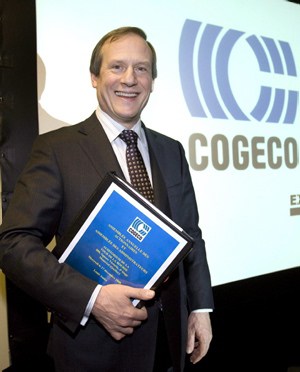
Cogeco Cable is cracking down on customers who shop around for a better deal.

After dumping its money-losing Portuguese Cabovisao operation earlier this year, the company is looking to recoup its losses, and Canadian consumers are paying the price.

Chief Executive Louis Audet told investors Cogeco has tightened up promotions, giveaways, and credit standards to weed out bargain hunters and those who ultimately never pay their cable bill.

“If somebody else wants these undesirable customers, they’re theirs for the taking,” Audet said. “There’s too many promotion hoppers out there who are jumping from one supplier to the other.”

Audet

At least 9,000 customers left Cogeco during the second quarter, but that did nothing to hurt Cogeco’s bottom line.  Profits nearly quadrupled to $81.5 million according to Audet, but much of that is due to changes in accounting related to its sold-off Portuguese operation. Closer to home, Cogeco revenue inside Canada grew 12.4% from one year ago to $345.6 million.

Cogeco bought Televisao in 2006 for $465 million.  It sold it in February for just over $59 million.

Cogeco Cable, which serves subscribers in smaller cities and suburbs in Ontario and Quebec, is Canada’s fourth largest cable operator with more than 875,000 cable subscribers. Its biggest competitors are Bell (in Ontario and Quebec) and Telus, which has some landline operations on the Gaspé Peninsula in eastern Quebec.

Most of Cogeco’s promotions and retention offers appeal to customers threatening to take their business to the phone companies. But Audet signaled the promotional pricing had become so aggressive, some customers have learned to bounce back and forth between providers to maintain lower pricing indefinitely.

By tightening up customer promotions, Audet said, the company can achieve a “stable” customer base that pays regular Cogeco prices.

Search This Site:

Contributions:

Recent Comments:

Your Account:

Stop the Cap!