Home » Competition » Recent Articles:

Rogers’ “Next is Now” Foreshadows How Company Will Milk Canadians for Connectivity

Phillip Dampier May 17, 2012 Canada, Competition, Consumer News, Data Caps, Editorial & Site News, Public Policy & Gov't, Wireless Broadband Comments Off on Rogers’ “Next is Now” Foreshadows How Company Will Milk Canadians for Connectivity

Rogers Communications has following up its “Next is Now” corporate video from 2010 with a sequel: “Next is Now… More Than Ever,” which highlights how Canadians are increasingly relying on mobile communications for news, entertainment, social life, work, and education.

While Rogers wanted the video to promote how the company would be a part of that telecommunications transformation, many of their customers can’t help but reflect on the fact the revolution is well-tempered with Internet Overcharging schemes like usage caps.

Stop the Cap! reader Alex is among them, noting the video says nothing about the company’s restrictive usage limits on home broadband and the even harsher caps on its mobile services.

Rogers, like most telecommunications companies, repeatedly tells investors there is real money to be made attaching meters to monetize megabytes.  Charging for broadband usage is a growth industry, and with the company’s own projections for data growth, they are well-positioned to be in the money for years.

With broadband dependency being as pervasive, if not more so, in Canada as in the United States, the barely regulated services on offer in both countries often come at a steep (and increasing) price — all for something even Rogers hints is becoming a utility — one as important as electricity, gas, and clean water.

[flv width=”640″ height=”380″]http://www.phillipdampier.com/video/Rogers Next is Now More than Ever 5-12.flv[/flv]

Rogers Communications’ “Next is Now… More Than Ever” has broader implications than the company realizes. (3 minutes)

Sprint CEO Predicts More Wireless Mergers (As Long as AT&T/Verizon Not Buyers)

Phillip Dampier May 17, 2012 Competition, Public Policy & Gov't, Sprint, Wireless Broadband Comments Off on Sprint CEO Predicts More Wireless Mergers (As Long as AT&T/Verizon Not Buyers)

Hesse

Sprint CEO Dan Hesse believes the march to a consolidated wireless world in the United States will carry on, despite last year’s failed attempt by AT&T to buyout Deutsche Telekom’s T-Mobile USA.

Hesse told an investor conference Sprint may be among the buyers, but would prefer to wait until the company’s network upgrades are finished in 2013. Other players in the market may not wait that long, and Hesse said the company would pull the trigger sooner if a consolidation frenzy appears imminent.

“It’s not an ideal time for our equity because of the big investments we’re making now,” Hesse said.

Sprint already attempted a buyout of regional carrier MetroPCS in February, but the company’s board of directors nixed the deal at the last minute.

Wall Street has been calling for additional industry consolidation to reduce duplication of networks, and the amount of money spent to construct them.  Investors also believe a more consolidated marketplace can lead to higher prices, which will drive revenues… and profits higher.

Hesse believes both the Federal Communications Commission and the Department of Justice are amenable to consolidation deals, as long as the buyers are not AT&T or Verizon Wireless, which together dominate the market.

Hesse rejects contentions the federal government wants at least four national carriers competing for America’s wireless business.

“I honestly don’t believe there’s a magic number of four at all,” Hesse said.

Among the most likely targets for consolidation: Leap Wireless’ Cricket, MetroPCS, U.S. Cellular, C-Spire (formerly Cellular South), Alaska Communications, General Communication (GCI), and regional units of Cellular One.

Verizon Preparing to Kill Grandfathered Unlimited Data Plans, Hike Rates for FiOS

Verizon Wireless will force customers off of their grandfathered unlimited data plans when they reach the end of their current two-year service contracts, according to the company’s chief financial officer.

It is all part of the cell phone company’s strategy to boost the average bills of customers with new, more expensive tiered family-shared data plans. With a significant number of current customers grandfathered on unlimited data plans that users likely will not forfeit voluntarily, Verizon will force the issue as customers come up for contract renewal.

The plan received considerable approval at today’s JPMorgan Chase TMT conference, a gathering for Wall Street investors and tech companies like Verizon.  Executive vice-president and chief financial officer Fran Shammo laid out the plan to switch customers to forthcoming family “data share” plans that are priced based on anticipated usage:

As you come through an upgrade cycle and you upgrade in the future, you will have to go onto the data share plan. And moving away from, if you will, the unlimited world and moving everybody into a tiered structure data share-type plan.

So when you think about our 3G base, a lot of our 3G base is unlimited. As they start to migrate into 4G, they will have to come off of unlimited and go into the data share plan. And that is beneficial for us for many reasons, obviously. So as you pick what tier you want to be and we think that there will be some price up in those tiers.

“Price up” is code language for bill hiking. Customers adopting family share plans may be able to share data across a larger number of devices, but at consumption pricing, many customers will find their Verizon bills substantially higher than before.

Shammo

“And the important part of that is we want the connections to come in and the way we have designed our plan, this plan is built on tiers and as we look at the future growth of LTE consumption because of the speeds and video consumption and consumption of other M2M-type devices, it is going to be more important that people will start to upgrade in their tiers as they start to really realize the benefits of the LTE network,” Shammo said. “As [customers] add more devices, they are going to have to buy up into tiers. So again, you will see the revenue increase there.”

Those revenue predictions were not sufficient to satiate Phil Cusick, an analyst at JPMorgan Chase. He questioned Shammo about the prospects for Verizon further increasing revenue with across-the-board rate increases on service plans.

Shammo would not commit to that, but was pleased with the lack of customer protests over their recent introduction of a $30 equipment upgrade fee. He called the new fee “the right thing to do.” More fees and surcharges are likely, according to Shammo.

“I think implementing these additional fees is probably where we are at,” he said. “With the construct that we have dealt with around data share and where we see consumption of LTE going, when you put the combination of them together, we are fairly confident that we will see people start to uptake in the tiers, which is really where we will get the revenue accretion in the future.”

Shammo also said Verizon’s fiber to the home network FiOS has gotten such rave reviews, it almost sells itself. That means the company will pull back on promotional offers and plans a general rate increase for all customers in the coming months, if only to bolster company profits.

“We have to do a better job in discipline of price increases and I think that you’ll see us do some price increases here over the next two quarters to offset the content increase and that will also contribute more profitability to the bottom line,” Shammo said. “You are going to have to concentrate more on reducing the amount of promotions, reducing the amount of retention that you put on the table to retain a customer and then also you are seeing that the industry is pricing up.”

Verizon FiOS customers will find rate increases applying both to equipment rental and service pricing nationwide, according to Shammo.

“We were actually below-market compared to our competitors on the amount of fee that we charge on the rental of a set-top box or a digital converter box,” Shammo explained. “We are switching around our bundles and the customers that are coming out of the current bundles will be priced up to the newer bundles. So you are going to see really a shift over the next two to three quarters in price-ups coming out of FiOS.”

As far as FiOS expansion goes, the company does not expect any major expansion in the service for the next several years.

“If we can penetrate the market and really turn the wireline profitability, could we potentially build out to other areas? Yes, but that is a decision that will be made in years out, not right now,” Shammo said. “So from a capital perspective, we are being very disciplined with where we are going to put that capital.”

New Evidence Suggests Comcast Prioritizing Its Own Streamed Content; Usage Cap Must Go

Growing questions are being raised about whether Comcast is violating FCC and Department of Justice policies that prohibit the cable company from prioritizing its own content traffic over that of its competitors.

Comcast’s Xfinity Xbox app offers Comcast customers access to Xfinity online video content without eating into their monthly 250GB Internet usage allowance. Netflix has called that exemption unfair, because its content does count against Comcast’s usage cap. New evidence now suggests Comcast may also be prioritizing the delivery of its Xfinity content over other broadband traffic, a true Net Neutrality violation if proven true.

Bryan Berg, founder and chief technology officer at MixMedia, believes he has found proof the cable company is giving its own video content preferential treatment, in this somewhat-technical finding published on his blog:

What I’ve concluded is that Comcast is using separate DOCSIS service flows to prioritize the traffic to the Xfinity Xbox app. This separation allows them to exempt that traffic from both bandwidth cap accounting and download speed limits. It’s still plain-old HTTP delivering MP4-encoded video files, just like the other streaming services use, but additional priority is granted to the Xfinity traffic at the DOCSIS level. I still believe that DSCP values I observed in the packet headers of Xfinity traffic is the method by which Comcast signals that traffic is to be prioritized, both in their backbone and regional networks and their DOCSIS network.

Berg also contends Comcast’s earlier explanation that its Xfinity content should be exempt from its usage cap because it travels over the company’s private Internet network is also flawed:

In addition, contrary to what has been widely speculated, the Xfinity traffic is not delivered via separate, dedicated downstream channel(s)—it uses the same downstream channels as regular Internet traffic.

Berg

Broadband traffic management is of growing interest to Internet Service Providers, who contend it can be used to manage Internet traffic more efficiently and improve speed and time-sensitive online applications like streamed video, online phone calls, and similar services. But manufacturers of traffic management equipment also market the technology to ISPs who want to favor certain kinds of content while de-prioritizing or even throttling the speed of non-preferred content. The technology can also differentiate traffic that counts against a monthly usage cap, and traffic that does not.

Quality of Service (QoS) technology can be used to improve the customer’s online experience or help a provider launch Internet Overcharging and speed throttling schemes that can heavily discriminate against “undesirable” online traffic.

Berg further found that when he saturated his 25Mbps Comcast broadband connection, traffic from providers like Netflix suffered due to the bandwidth constraints.  Because he flooded his connection, Netflix buffered additional content (slowing his stream start time) and reduced the bitrate of the video (which can dramatically reduce the picture quality at slower speeds). But when he launched Xfinity video streaming, that traffic was unaffected by his saturated connection. In fact, he discovered Xfinity traffic was exempted from his normal download speed limit, allowing his connection to exceed 25Mbps.

While that works great for Xfinity fans who do not want their videos degraded when other household members are online, it is inherently unfair to competitors like Netflix who are forced to reduce the quality of your video stream to compensate for lower available bandwidth.

According to the consent decree which governs the merger of the cable operator with NBC-Universal, prioritizing traffic in this way is a no-no when the company also engages in Internet Overcharging schemes, namely its arbitrary usage cap:

“If Comcast offers consumers Internet Access Service under a package that includes caps, tiers, metering, or other usage-based pricing, it shall not measure, count, or otherwise treat Defendants’ affiliated network traffic differently from unaffiliated network traffic. Comcast shall not prioritize Defendants’ Video Programming or other content over other Persons’ Video Programming or other content.”
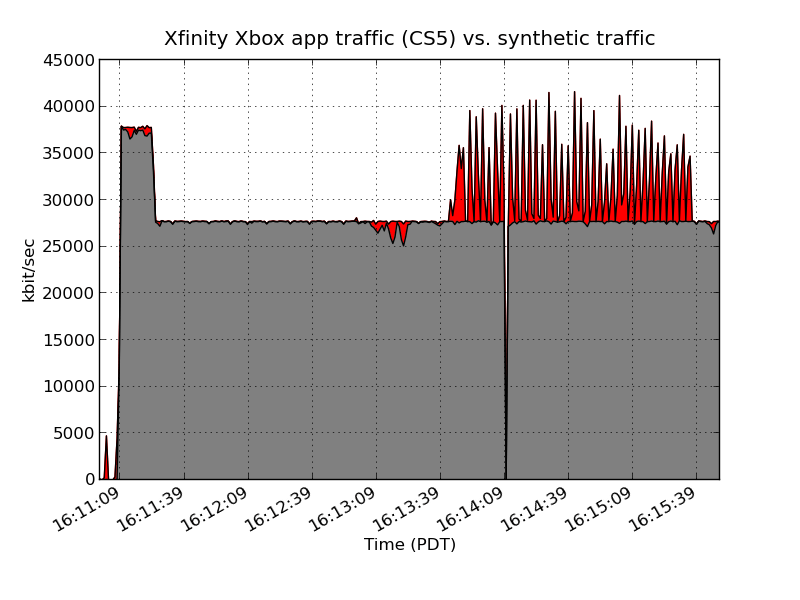
This graph shows Berg's artificially saturated 25Mbps Comcast broadband connection. The traffic in red represents Xfinity Xbox traffic, which is given such high priority, it allows Berg to exceed his usual download speed limit.

Comcast sent GigaOm a statement that denies the company is doing any such thing:

“It’s really important that we make crystal clear that we are not prioritizing our transmission of Xfinity TV content to the Xbox (as some have speculated). While DSCP markings can be used to assign traffic different priority levels, that is not their only application – and that is not what they are being used for here. It’s also important to point out that our Xfinity TV content being delivered to the Xbox is the same video subscription that customers already paid for and is delivered to their home over our traditional cable network – the difference is that we are now delivering it using IP technology to the Xbox 360, in a similar manner as other IP-based cable service providers. But this is still our traditional cable television service, which is governed by something known as Title VI of the Communications Act, and we provide the service in compliance with applicable FCC rules.”

Our View

Comcast, as usual, is talking out of every side of its mouth. In an effort to justify their unjustified usage cap, they have pretzel-twisted a novel way out of this Net Neutrality debate by paving their own digital highway on a Comcast private drive.

Comcast argues their 250GB usage cap controls last-mile congestion to provide an excellent user experience. That excuse completely evaporates in the context of its new toll-free video traffic. In fact, their earlier argument that its regionally-distributed streaming traffic should not count because it does not travel over the “public Internet” at Comcast’s expense does not even make sense.

Berg provides an example:

A FaceTime call from my house to my neighbor’s—which never leaves even the San Francisco metro area Comcast network, given that both of us are Comcast customers—goes over the “public Internet.”

Yet Comcast’s Xbox streams, which pass from Seattle to Sacramento to San Francisco through all of the same network elements that handle my video call (and then some!) are exempt from the bandwidth cap?

You can’t have it both ways, guys.

DOCSIS 3 technology has vastly expanded the last mile pipe into subscriber homes. If Comcast can launch their own private pipe for unlimited IPTV traffic that travels down the same wires their Internet service does, they can comfortably handle any additional capacity needs to support their “constrained” broadband service without the need to limit their customers’ use.

Usage caps remain an end run around Net Neutrality. Consumers given the opportunity to view content under a usage cap on the “public Internet” or using the “toll-free” traffic lane Comcast created for content from their “preferred partners” will make the obvious choice to protect their usage allowance. Comcast is certainly aware of this, and it is a clever way to discriminate through social engineering. It’s also less obvious. You don’t have to de-prioritize or block traffic from your competition to have an impact, you just have to limit it. Customers who repeatedly exceed their usage allowance face suspension of Comcast broadband service for up to one year. That’s a strong incentive to follow their rules.

Netflix is fighting to force Xfinity traffic to fall under the same arbitrary usage cap regime Netflix endures — a truly shortsighted goal. The real issue here is whether Comcast should be capping any of its Internet service.

Comcast has given us the answer, launching the very bandwidth-intense video streaming it used to decry was contributing to an Internet traffic tsunami.

It’s time for Comcast to drop its usage cap.

Broadcasters Run to the Courts to Stop Disruptive Video Streaming; Aereo’s Legality

Phillip Dampier May 15, 2012 Competition, Consumer News, Online Video, Public Policy & Gov't, Video Comments Off on Broadcasters Run to the Courts to Stop Disruptive Video Streaming; Aereo’s Legality

An innovative plan to rent New Yorkers a dime-sized over-the-air antenna housed in a Brooklyn data center to receive and stream local broadcasters could be the end of broadcast TV as we know it, at least if you believe the claims being made by network executives in their high-powered lawsuit.

Aereo, which charges $12 a month to an invitation-only customer base, is the target of serious legal action brought by the major broadcast networks and local TV stations that believe Aereo’s disruptive business model could allow cable operators to avoid paying retransmission consent fees for free, over the air television signals.

Aereo only streams local broadcasters in the New York metropolitan area to residents within viewing range of the signals. The company argues it operates legally because of a time-tested, sound legal principle: the Communications Act of 1934, which offers broadcasters a license to use the public airwaves in return for operating in the public interest. Aereo only rents its tiny antennas to one customer at a time, and provides them with streamed video received by that antenna. The company charges a nominal monthly fee to cover the costs of operating its data center and to cover streaming expenses.

The monthly subscription fee grants viewers access to watch one channel while recording another on a cloud-based DVR “storage locker.” Viewers can watch the signals on just about any device, as long as they are located within the New York metropolitan area. Travelers and those who live outside of the area cannot watch programming or subscribe to the service.

The threat to the nation’s pay television operators and broadcasters is obvious. Over the air television broadcasters increasingly rely on so-called “retransmission consent payments” collected from pay television operators in return for permission to place their signals on the cable, telco, or satellite TV dial. Broadcasters bank on that growing revenue. Pay television providers grudgingly agree to the payments and promptly pass them on to already rate-increase-weary subscribers, who want a way out of paying for hundreds of channels they don’t care to watch.

Aereo's over the air antenna is about the size of a dime.

Aereo breaks the business models of both broadcasters and the cable industry. Cord cutters can get reliable and cheap reception of over-the-air stations without dealing with cumbersome in-home antennas (or paying local cable companies for HD-quality local stations and a DVR box). Goodbye $70 cable-TV bill. Broadcasters also lose every time the local pay television company drops a subscriber. Aereo does not pay retransmission consent fees, nor do their subscribers.

But Aereo is not all bad news for pay television providers. If Aereo can survive the legal onslaught from broadcast interests, nothing stops local cable companies from licensing Aereo technology (or constructing their own system) that would bypass retransmission consent fees as well. That could save cable operators millions.

Ridiculous? Not according to Matt Bond, an executive vice-president at Comcast/NBC who told a New York federal court the risk is real.

“It makes little economic sense for cable systems and satellite broadcasters to continue to pay for NBCU content on a per-subscriber basis when, with a relatively modest investment, they can simply modify their operations to mirror Aereo’s ‘individual antenna’ scheme and retransmit, for free, over-the-air local broadcast programming,” Bond said. “I know for a fact that cable companies have already considered such a model.”

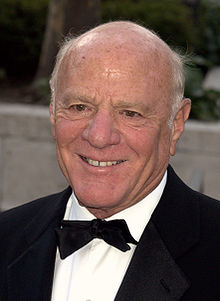
Diller

Broadcasters revile Aereo’s disruptive innovation.  Bond called the service “piracy.” Other network executives say it steals their content and resells it at a profit. Some are even predicting the destruction of broadcast television as we know it if Aereo is found to be legal. Virtually every network is on board for the lawsuit, which seeks an immediate injunction that would shut the service down.

Barry Diller, a veteran broadcast executive, has invested in Aereo and calls the broadcasters’ fears rubbish.

“It’s not the beginning of the destruction of anybody,” Diller told New York Magazine. “TV wasn’t the destruction of the movie business. Television wasn’t the destruction of radio. Cable wasn’t the destruction of broadcast networks. What happens is new alternatives come, and they live alongside whatever existed.”

“You have an antenna that has your name on it, figuratively … and it’s one-to-one. It is not a network,” Diller told members of the Senate Commerce Committee during a recent hearing. “It is a platform for you to simply receive, over the Internet, broadcast signals that are free and to record them and use them on any device that you like.”

Aereo is not a pioneer in the video streaming of over the air signals. iCraveTV launched in 1999 streaming broadcast stations from Buffalo, N.Y. and Ontario, Canada from its home base in Toronto. Broadcasters filed suit and quickly shut the service down. ivi-TV tried a similar venture in 2011 and was also shut down. Even companies experimenting with IPTV technology have run into trouble with some networks that feel threatened by a possible precedent that could be mistakenly established, starting a flood of similar services.

To date, only services that agree to broadcaster sanctions (Slingbox) or who have retransmission consent contracts with providers (such as the cable industry’s TV Everywhere project) have survived, but all have limitations imposed on their functionality that reduce their usefulness to consumers.

[flv width=”640″ height=”500″]http://www.phillipdampier.com/video/Aereo TV Demo May 2012.flv[/flv]

Aereo TV was demonstrated by the company CEO Chet Kanojia at the New York Tech Meetup May 9.  (21 minutes)

Search This Site:

Contributions:

Recent Comments:

Your Account:

Stop the Cap!