Home » Competition » Recent Articles:

‘What the Heck is a Gigabyte and Why Am I Counting Them?’

[flv width=”640″ height=”380″]http://www.phillipdampier.com/video/WRC Washington Bitten by Gigabytes 5-21-12.flv[/flv]

WRC-TV decided to visit with local Washington, D.C. consumers and ask them if they knew what a “gigabyte” was and how many they were using on their cell phone data plan.  Few knew, and even fewer wanted to know, preferring to pay a flat price for worry-free, unlimited data service. Unfortunately, AT&T and Verizon have discontinued their unlimited data plans (Verizon is preparing to throw people off of grandfathered plans when customers upgrade their phones), and T-Mobile throttles customer speeds to near-dial-up after their monthly allowance is reached. Only Sprint sells truly unlimited data, but many customers find Sprint’s data speeds lacking. Consumer reporter Liz Crenshaw visits with Public Knowledge to help educate consumers about what the average 2GB plan really buys.  (3 minutes)

Bragging Rights: Verizon FiOS Will Sell 300Mbps Speeds Others Say You Don’t Need

Phillip Dampier May 30, 2012 Broadband Speed, Competition, Verizon 1 Comment

Despite claims from some of their competitors that customers don’t want or need super-fast broadband, Verizon Communications is taking broadband speeds to the new level, upgrading service to as high as 300Mbps in selected areas.

Our friends at Broadband Reports had the scoop on this a few weeks ago, but now it’s official: speed -and- price increases for Verizon are on the way for the company’s fiber optic network FiOS.

Many customers will see their broadband speeds double or more in June. At the same time, the company has been sending out letters informing customers of price increases, often $5 a month for those not locked into service contracts.

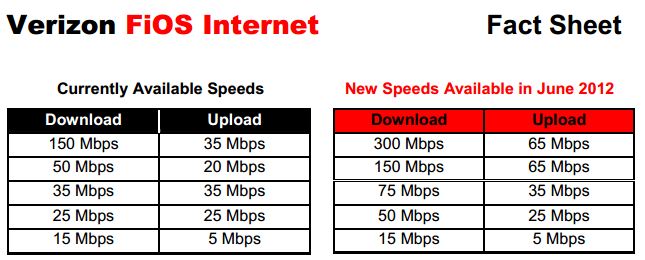
Verizon's Speed Upgrade Chart (Courtesy: Broadband Reports)

Verizon’s new top tier of 300/65Mbps will be introduced in areas that have Verizon’s Gigabit Passive Optical Network (GPON). Pricing has not yet been announced.

The company is targeting its speed upgrades to premium broadband customers who subscribe to faster tiers. Customers on Verizon’s standard 15/5Mbps tier will see no changes in service.

Mobile Operators Conjure Up New Billing Ideas: “Charge for Video Separately”

Dispensing with “all-you-can-eat” data plans was the first step towards monetizing mobile broadband. Now some mobile operators are considering how to implement stage two: charging different pricing for different online applications to boost profits.

At the TM Forum Management World conference in Dublin, Ireland, mobile operators discussed managing and monetizing data usage, charging customers different rates for using various online services and applications. Total Telecom covered the conference and found mobile operators conjuring up new pricing schemes to maximize revenue opportunities.

Vikram Chadha, senior marketing director at United Arab Emirates-based Du, offered that mobile operators should bill for video traffic separately from standard data.

″Video is another beast,″ Chadha told the audience of executives. ″Operators need to look at video data in a totally different manner. It’s important to treat video as a different data element.″

Monetizing video streaming can “get high value out of that customer,” Chadha said.

Chadha

He also believes as general browser traffic declines, real money can be made charging different rates for customers accessing different apps. Providers could charge higher data pricing when customers use certain non-preferred apps, at the same time discounting traffic from apps that partner with wireless phone companies.

Chadha pointed to NTT DoCoMo’s partnership with Hulu. Both Hulu and the service provider market the service, with the one making the sale the beneficiary of most of the proceeds. That technically takes revenue away from Hulu and diverts it to NTT, which can engineer customized marketing efforts to target customers for the service.

But it does not stop there, according to Chadha. Mobile operators can generate even greater revenue by introducing Quality of Service (QoS) technology and billing customers extra for additional priority on the company’s wireless network, an important consideration for online video.

Chadha says his company now charges $1.25 for 30 minutes of video streaming from YouTube using “best available” network protocols. Customers who want to assure minimal buffering can buy a VIP Pass from Du for $2.50 for the same 30 minutes, and get priority on Du’s network.

″The [VIP pass customer] is assured of the bandwidth he gets and that gives the operator the opportunity to maximize his revenue,″ he said. ″[Apply] different QoS for different apps and you can charge differently. Or use location, and sell data more cheaply where networks are less congested, or at less busy times of day.”

Chadha’s worst enemy would be a strong Net Neutrality policy, which would prohibit operators from discriminating against or prioritizing different types of traffic. None of these pricing schemes would likely work if Du provided a flat rate mobile service either.

In the absence of such net protections, revenue and profit opportunities abound.

″Application-based charging is going to be very important and so is value-based charging,″ he predicted.


Chattanooga’s Gigabit Fiber Network Part of City’s Digital Transformation & Job Growth

Phillip Dampier May 30, 2012 Broadband Speed, Community Networks, Competition, Consumer News, Editorial & Site News, EPB Fiber, Public Policy & Gov't, Video Comments Off on Chattanooga’s Gigabit Fiber Network Part of City’s Digital Transformation & Job Growth

[flv]http://www.phillipdampier.com/video/CNBC Business Booming in Chattanooga 5-29-12.flv[/flv]

While telecom industry-backed groups dismiss community broadband as a waste of taxpayer dollars and an excuse for customers to watch illicit videos and steal content, CNBC reports Chattanooga’s infrastructure improvements, including their gigabit fiber network owned by public utility EPB are contributing to the city’s enormous economic growth and falling unemployment rate. Private companies are pouring into Chattanooga and find a city ready to welcome them and meet their digital needs. Community broadband: a waste of taxpayer money or exactly the right fuel to power American cities into the 21st century digital economy?  (2 minutes)

Randall’s Revenge: AT&T CEO Fills GOP Coffers After Democrats Diss T-Mobile Buyout

Phillip Dampier May 30, 2012 AT&T, Competition, Consumer News, HissyFitWatch, Public Policy & Gov't, Wireless Broadband Comments Off on Randall’s Revenge: AT&T CEO Fills GOP Coffers After Democrats Diss T-Mobile Buyout

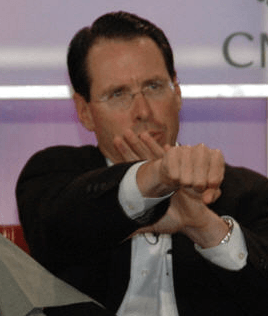
Stephenson: Payback time.

Six weeks after AT&T’s colossal $39 billion dollar merger with T-Mobile USA fell apart, AT&T CEO Randall Stephenson opened his checkbook and donated $30,800 (the maximum allowed under federal law) to the Republican National Committee.

That contribution dwarfs Stephenson’s largest previous donation over the past twenty years: $5,000, according to the Center for Responsive Politics.

Bloomberg reports that Stephenson took a credibility and pay hit from the merger debacle, forcing AT&T to turn over $4 billion in deal penalties to its rival, T-Mobile, including precious wireless spectrum. The deal’s collapse personally cost Stephenson more than $2 million in bonus pay.

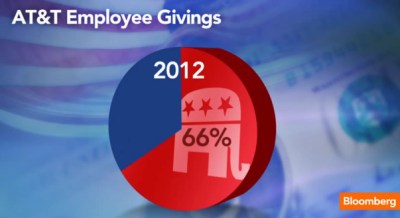
Although AT&T is not commenting, Wall Street analysts are, and they suspect Stephenson is sending the Obama Administration a clear message that he is upset with the decision to challenge the merger. The rest of AT&T appears to be following suit, with nearly two-thirds of political contributions, mostly from company executives, going to the Republican party which has traditionally maintained a much more friendly relationship with the communications giant.

Several Republicans criticized the Justice Department and Federal Communications Commission for interfering with the merger deal which consumer advocates argued would reduce competition and raise prices for wireless services. Republicans have also expressed near-universal support for AT&T’s policy positions on Net Neutrality, community broadband, usage-based pricing, spectrum and price deregulation, removal of state oversight of telecommunications services, and marketplace consolidation.

AT&T is a major sponsor of this summer’s Republican National Convention in Tampa, Fla. Several former lobbyists for AT&T are now working with the Romney campaign and its money bundling operations on behalf of the Republican presidential candidate.

The center reports no personal political contributions from the heads of either Verizon Wireless or Sprint.

Roger Entner, an analyst with Recon Analytics in Dedham, Massachusetts, notes AT&T was still trying to make nice with Obama Administration officials as late as last December, sending ornate cupcakes to various administration officials, including those at the FCC.

Entner noted it didn’t work.

[flv width=”640″ height=”380″]http://www.phillipdampier.com/video/Bloomberg ATT CEO Stephenson Maxes Contribution to GOP 5-29-12.flv[/flv]

Bloomberg News takes note AT&T CEO Randall Stephenson maxed out in contributions to the Republican Party just six weeks after the Obama Administration effectively nixed the $39 billion merger between AT&T and T-Mobile.  (2 minutes)

Search This Site:

Contributions:

Recent Comments:

Your Account:

Stop the Cap!