Home » Competition » Recent Articles:

The Illusory Savings of “Usage Based Billing”: Your Bill Will Get Higher, Not Lower

Phillip Dampier July 2, 2012 Broadband "Shortage", Broadband Speed, Competition, Consumer News, Data Caps, Editorial & Site News, Online Video Comments Off on The Illusory Savings of “Usage Based Billing”: Your Bill Will Get Higher, Not Lower

Phillip “They Want to Save You Money By Charging You More” Dampier

The pro-Internet Overcharging forces’ meme of “pay for what you use” sounds good in theory, but no broadband provider in the country would dare switch to a true consumption-based billing system for broadband, because it would destroy predictable profits for a service large cable and phone companies hope you cannot live without.

Twenty years ago, the cable industry could raise rates on television packages with almost no fear consumers would cancel service. When I produced a weekly radio show about the cable and satellite television industry, cable companies candidly told me they expected vocal backlashes from customers every time a rate increase notice was mailed out, but only a handful would actually follow through on threats to cut the cord. Now that competition for your video dollar is at an all-time-high, providers are shocked (and some remain in denial) that customers are actually following through on their threats to cut the cord. Goodbye Comcast, Hello Netflix!

Some Wall Street analysts have begun warning their investor clients that the days of guaranteed revenue growth from video subscribers are over, risking profits as customers start to depart when the bill gets too high. Cable companies have always increased rates faster than the rate of inflation, and investors have grown to expect those reliable profits, so the pressure to make up the difference elsewhere has never been higher.

With broadband, cable and phone companies may have found a new way to bring back the Money Party, and ride the wave of broadband usage to the stratosphere, earning money at rates never thought possible from cable-TV. The ticket to OPEC-like rivers of black gold? Usage-based billing.

Since the early days of broadband, most Americans have enjoyed flat rate access through a cable or phone company at prices that remained remarkably stable for a decade — usually around $40 a month for standard speed service.

In the last five years, as cord-cutting has grown beyond a phenomena limited to Luddites and satellite dish owners, the cable industry has responded. As they learned customers’ love of broadband has now made the service indispensable in most American homes, providers have been jacking up the price.

Time Warner Cable, for example, has increased prices for broadband annually for the last three years, especially for customers who do not subscribe to any other services.

Customers dissatisfaction with rate hikes has not led to broadband cord cutting, and in fact might prove useful on quarterly financial reports -and- for advocating changes in the way broadband service is priced:

  1. Enhance revenue and profits, replacing lost ground from departing video customers and the slowing growth of new customers signing up for video and phone services (and keeping average revenue per user ((ARPU)) on the increase);
  2. Using higher prices to provoke an argument about changing the way broadband service is sold.

Pouring over quarterly financial reports from most major providers shows remarkable consistency:

  • The costs to provide broadband service are declining, even with broadband usage growth;
  • Revenue and profits enjoy a healthy growth curve, especially as increased prices on existing customers make up for fewer new customer additions;
  • Earnings from broadband are now so important, a cable company like Time Warner Cable now refers to itself as a broadband company. It is not alone.

Still, it is not enough. As usage continues to grow in the current monopoly/duopoly market, providers are drooling with anticipation over the possibility of scrapping the concept of “flat rate” broadband, which limits the endless ARPU growth Wall Street demands. If a company charges a fixed rate for a service, it cannot grow revenue from that service unless it increases the price, sells more expensive tiers of service, or innovates new products and services to sell.

Providers have enjoyed moderate success selling customers more expensive, faster service, also on a flat rate basis. But that still leaves money on the table, according to Wall Street-based “usage billing” advocates like Craig Moffett, who see major ARPU growth charging customers more and more money for service as their usage grows.

Moffett has a few accidental allies in the blogger world who seem to share his belief in “usage-based” billing. Lou Mazzucchelli, reading the recent New York Times piece on Time Warner’s gradual move towards usage pricing, frames his support for consumption billing around the issue of affordability. In his view, usage pricing is better for consumers and the industry:

It costs real money to upgrade networks to keep pace with this demand, and those costs are ultimately borne by the subscriber. So in the US, we have carriers trying to raise their rates to offset increases in capital and operating expenses to the point where consumers are beginning to push back, and the shoving has come to the attention of the Federal Communications Commission, which has raised the possibility of treating Internet network providers as common communications carriers subject to regulation.

I believe that flat-rate pricing is a major source of problems for network carriers and consumers. In the carrier world, the economics are known but ignored because marketers believe that flat rates are the only plans consumers will accept. But in the consumer world, flat rates are rising to incomprehensible levels for indecipherable reasons, with little recourse except disconnection. Consumer dissatisfaction is rising, in part because consumers feel they have no control over the price they have to pay. This is driven by their sense of pricing inequity that is hard to visualize but comes from implicit subsidies in the current environment. The irony is that pay-per-use pricing solves the problem for carriers and consumers.

Mazzucchelli reposted his blog piece originally written in 2010 for the benefit of Times readers. Two years ago, he measured his usage at 11GB a month. His provider Verizon Communications was charging him $64.99 a month for 25Mbps service, which identifies him as a FiOS fiber to the home customer.  Mazzucchelli argues the effective price he was paying for Internet access was $5.85 for each of the 11GB he consumed, which seemed steep at the time. (Not anymore, if you look at wireless company penalty rates which range from $10-15/GB or more.)

Mazzucchelli theorized that if he paid on a per-packet basis, instead of flat rate service based on Internet speed, he could pay something like $0.0000025 per packet, which would result in a bill of $31.91 for his 11GB instead of $65. For him, that’s money saved with usage billing.

On its face, it might seem to make sense, especially for light users who could pay less under a true usage-based pricing scenario like the one he proposes.
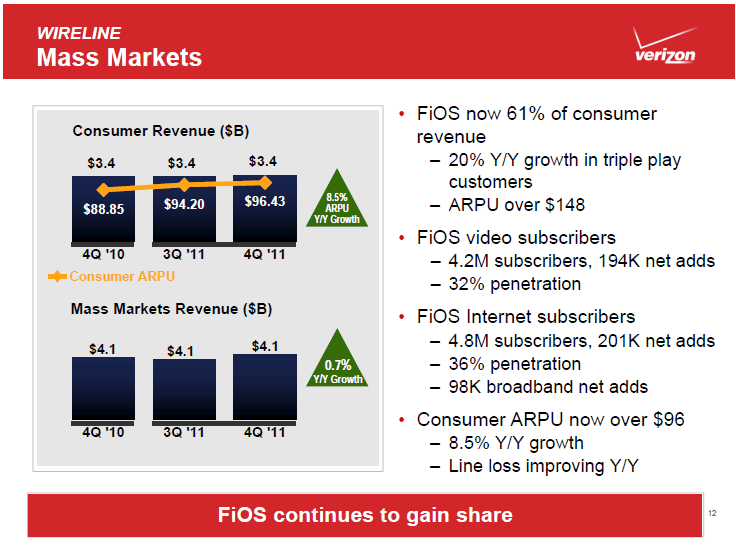
Verizon Communications is earning more average revenue per customer than ever with its fiber to the home network. That’s about the only bright spot Wall Street recognizes from Verizon’s fiber network, which some analysts deride as “too expensive.”

Unfortunately for Mazzucchelli, and others who claim usage-based pricing will prove a money-saver, the broadband industry has some bad news for you. Usage pricing simply cannot be allowed to save you, and other current customers money. Why? Because Wall Street will never tolerate pricing that threatens the all-important ARPU. In the monopoly/duopoly home broadband marketplace most Americans endure, it would be the equivalent of unilaterally disarming in the war for revenue and profits.

That is why broadband providers will never adopt a true usage-based billing system for customers. It would cannibalize earnings for a service that already enjoys massive markups above true cost. In 2009, Comcast was spending under $10 a month to sell broadband service priced above $40.

Mazzucchelli

Instead, providers design “usage-based” billing around rates comparable to today’s flat rate pricing, only they slap arbitrary maximum usage allowances on each tier of service, above which consumers pay an overlimit fee penalty. That would leave Mazzucchelli choosing a lower speed, lower usage allowance plan to maximize his savings, if his use of the Internet didn’t grow much. On a typical light use plan suitable for his usage, he would subscribe to 1-3Mbps service with a 10GB allowance, and pay the overlimit fee for one extra gigabyte if he wanted to maximize his broadband dollar.

But his usage experience would be dramatically different, both because he would be encouraged to use less, fearing he might exceed his usage allowance, and he would be “enjoying” the Internet at vastly slower speeds. If Mazzucchelli went with higher speed service, he would still pay prices comparable for flat rate service, and receive a usage allowance he personally would find unnecessarily large. The result for him would be little to no savings and a usage allowance he did not need.

Mazzucchelli’s usage pattern is probably different today than it was in 2010. Is he still using 11GB a month? If he uses double the amount he did two years ago, under his own pricing formula, the savings he sought would now be virtually wiped out, with a broadband bill for 22GB of consumption running $63.82. By the following year, usage-based pricing would cost even more than Verizon’s unlimited pricing, as average use of the Internet continues to grow.

That helps the broadband industry plenty but does nothing for consumers. Mazzucchelli might be surprised to learn that the “real money to upgrade networks to keep pace with this demand,” is actually more than covered under today’s profit margins for flat-rate broadband. In fact, if he examines financial reports over the last five years and the statements company executives make to shareholders, virtually all of them speak in terms of reducing capital investments and the declining costs to deliver broadband, even as usage grows.

Verizon’s fiber network, while expensive to construct, is already earning the company enormous boosts in ARPU over traditional copper wire phone service. While Wall Street howled about short term capital costs to construct the network, then-CEO Ivan Seidenberg said fiber optics was the vehicle that will drive Verizon earnings for decades selling new products and services that its old network could never deliver.

Still, is Mazzucchelli paying too much for his broadband at both 2010 and 2012 prices? Yes he is. But that is not a function of the cost to deliver broadband service. It is the result of a barely competitive marketplace that has an absence of price-moderating competitors. Usage-based pricing in today’s broadband market assures lower costs for providers by retarding usage. It also brings even higher profits from bigger broadband bills as Internet usage grows, with no real relationship to the actual costs to provide the service. It also protects companies from video package cord-cutting, as customers will find online viewing prohibitively expensive.

One need only look at pricing abroad to see how much Americans are gouged for Internet service. Unlimited high speed Internet is available in a growing number of countries for $20-40 a month.

Usage-based billing is a dead end that might deliver temporary savings now, but considerably higher broadband bills soon after. It is not too late to turn the car around and join us in the fight to keep unlimited broadband, enhance competition, and win the lower prices users like Mazzucchelli crave.
Time Warner Cable Reintroduces Usage Caps in Austin; Tell Them ‘No Thanks!’

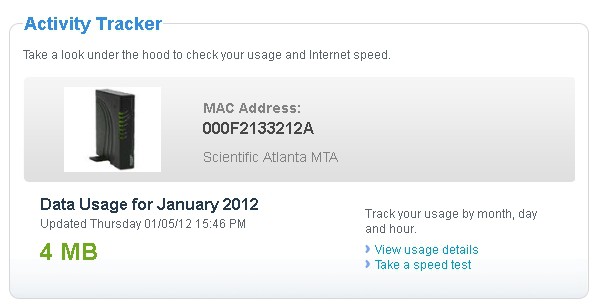
Time Warner Cable has a usage meter up for some customers.

Time Warner Cable has reintroduced usage-limited broadband plans in Austin, Tex., three years after shelving an earlier market test that drew protests from local residents and civic leaders.

Time Warner Cable is offering three tiers of what it calls “Internet Essentials,” each offering different speeds of service, all with a 5GB usage allowance for a $5 monthly discount.

“It’s clear that one-size-fits-all pricing is not working for many consumers, particularly in a challenging economy,” regional vice president of operations in Texas Gordon Harp said. “We believe the choice and flexibility of Essentials will enhance value for lighter users, help us retain existing customers in a competitive marketplace and attract new customers to our superior Internet experience.”

But Stop the Cap! disagrees, noting the three variations of Internet Essentials all offer a tiny discount and come with a ridiculously low usage allowance.

With usage overlimit fees of $1/GB, currently limited to a maximum of $25, customers are playing Russian Roulette with their wallets. Just exceeding the allowance by 5GB a month eliminates any prospects of savings, and going beyond that will actually cost customers more than what they would have paid for unlimited Internet.

The company has added a usage tracker for Texas customers qualified to get the plan. It can be found under the My Services section of Time Warner Cable’s website.

Customers in Texas can choose from Grande Communications, AT&T or Verizon if they want to say goodbye to Time Warner’s endless interest in Internet Overcharging.  Image courtesy: Jacobson

Stop the Cap! recommends consumers strongly reject these plans. If customers are looking for a better deal on broadband, it is wiser to call Time Warner and threaten to take your broadband business to the competition. The savings that will result on a retention plan are sure to be better than the Internet Essentials discount, and no one will have to think twice about how they use their broadband account. Customers on an extremely tight budget can also downgrade to a slower speed plan that offers unlimited access, essential in any home with multiple broadband users.

Time Warner Cable does not help their position by significantly distorting the truth about their last experiment trying to limit customer broadband usage. In 2009, the company proposed changing the price for unlimited broadband to an enormous $150 a month. Customers protested in front of the company’s offices in several cities. Despite that, and the intense negative media coverage the company endured, Time Warner still believes its customers are itching to have their broadband usage limited:

Previous Experience with Usage-based Pricing

Time Warner Cable began testing usage-based pricing in 2009. Although many customers were interested in the plan, many others were not and we decided to not proceed with implementation of the plan. Over the past few years, we consulted with our customers and other interested parties to ensure that community needs are being met and in late 2011 we began testing meters which will calculate Internet usage.

We’d be interested to know what customers in the Austin area were consulted about the desire for usage-limited plans. Nobody consulted us either. We can imagine the “other interested parties” are actually Wall Street analysts and fellow industry insiders. We’re confident the overwhelming number of Time Warner Cable customers have no interest in seeing their unlimited use plans changed and company customer service representatives have told us there has been very little interest in the plans to date. For now, the company claims it won’t force people to take usage limited plans, but as we’ve seen in the wireless industry, yesterday’s promises are all too quickly forgotten.

With a usage meter now established, all it takes is an announcement Time Warner is doing away with unlimited broadband (or raising the price of it to the levels the company proposed in 2009), and customers are ripe for a broadband ripoff.

Time Warner Cable says it is “listening” to customers on its TWC Conversations website. We suggest you visit, click the tab marked Essentials Internet Plans, and let Time Warner Cable know you have no interest in these usage-limited plans and are prepared to go to war to keep affordable, unlimited Internet. With your voice, perhaps Time Warner Cable will finally realize that usage caps and consumption billing just don’t work for you or your family.

EPB Faces Blizzard of Bull from Comcast, Tennessee “Watchdog” Group

Comcast is running “welcome back” ads in Chattanooga that still claim they run America’s fastest ISP, when they don’t.

EPB, Chattanooga’s publicly-owned utility that operates the nation’s fastest gigabit broadband network, has already won the speed war, delivering consistently faster broadband service than any of its Tennessee competitors. So when facts are not on their side, competitors like Comcast and a conservative “watchdog” group simply make them up as they go along.

Comcast is running tear-jerker ads in Chattanooga featuring professional actors pretending to be ex-customers looking to own up to their “mistake” of turning their back on Comcast’s 250GB usage cap (now temporarily paroled), high prices, and questionable service.

“It turns out that the speeds I was looking for, Xfinity Internet had all along,” says the actor, before hugging an “Xfinity service technician” in the pouring rain. “But you knew that, didn’t you?”

The ad closes repeating the demonstrably false claim Comcast operates “the nation’s fastest Internet Service Provider.”

“I see those commercials on television and I’m thinking, I wonder how much did they pay you to say that,” says an actual EPB customer in a response ad from the public utility.

It turns out quite a lot. The high-priced campaign is just the latest work from professional advertising agency Goodby Silverstein & Partners of San Francisco, which is quite a distance from Tennessee. Goodby has produced Comcast ads for years. The ad campaign also targets the cable company’s other rival that consistently beats its broadband speeds — Verizon FiOS.

EPB provides municipal power, broadband, television, and telephone service for residents in Chattanooga, Tennessee

Comcast tried to ram their “welcome back” message home further in a newspaper interview with the Times Free Press, claiming “a lot of customers are coming back to Xfinity” because Comcast has a larger OnDemand library, “integrated applications and greater array of choices.”

Comcast does not provide any statistics or evidence to back up its claims, but EPB president and CEO Harold DePriest has already seen enough deception from the cable company to call the latest claims “totally false.”

In fact, DePriest notes, customers come and go from EPB just as they do with Comcast. The real story, in his view, is how many more customers arrive at EPB’s door than leave, and DePriest says they are keeping more customers than they lose.

EPB fully launched in Chattanooga in 2010, and despite Comcast and AT&T’s best customer retention efforts, EPB has signed up 37,000 customers so far, with about 20 new ones arriving every day. (Comcast still has more than 100,000 customers in the area.)

Many come for the EPB’s far superior broadband speeds, made possible on the utility’s fiber to the home network. EPB also does not use Internet Overcharging schemes like usage caps, which Charter, AT&T, and Comcast have all adopted to varying degrees. Although the utility avoids cut-rate promotional offers that its competitors hand out to new customers (EPB needs to responsibly pay off its fiber network’s construction costs), its pricing is lower than what the cable and phone companies offer at their usual prices.

Comcast claims customers really don’t need super high speed Internet service, underlined by the fact they don’t offer it. But some businesses (including home-based entrepreneurs) do care about the fact they can grow their broadband speeds as needed with EPB’s fiber network. Large business clients receiving quotes from EPB are often shocked by how much lower the utility charges for service that AT&T and Comcast price much higher. It costs EPB next to nothing to offer higher speeds on its fiber network, designed to accommodate the speed needs of customers today and tomorrow.

The competition is less able. AT&T cannot compete on its U-verse platform, which tops out shy of 30Mbps. Comcast has to move most of its analog TV channels to digital, inconveniencing customers with extra-cost set top boxes to boost speeds further.

The fact EPB built Chattanooga’s best network, designed for the present and future, seems to bother some conservative “watchdog” groups. The Beacon Center of Tennesee, a group partially funded by conservative activists like Richard Mellon Scaife through a network of umbrella organizations, considers the entire fiber project a giant waste of money. They agree with Comcast, suggesting nobody needs fast broadband speeds:

EPB also offers something called ultra high-speed Internet. Consumers have to pay more than seven times what they would pay for the traditional service — $350 a month. Right now, only residents of a select few cities worldwide (such as Hong Kong) even use this technology, and that is because most consumers will likely not demand it for another 10 years.

Actually, residents in Hong Kong, Japan, and Korea do expect the faster broadband speeds they receive from their broadband providers. Americans have settled for what they can get (and afford). DePriest openly admits he does not expect a lot of his customers to pay $350 a month for any kind of broadband, but the gigabit-capable network proves a point — the faster speeds are available today on EPB at a fraction of price other providers would charge, if they could supply the service at all. Most EPB customers choose lower speed packages that still deliver better performance at a lower price than either Comcast or AT&T offer.

The Beacon Center doesn’t have a lot of facts to help them make their case. But that does not stop them:

  • They claim EPB’s network is paid for at taxpayer expense. It is not.
  • They quote an “academic study” that claims 75 percent of “government-run” broadband networks lose money, without disclosing the fact the study was bought and paid for by the same industry that wants to keep communities from running broadband networks. Its author, Ron Rizzuto, was inducted into the Cable TV Pioneers in 2004 for service to the cable industry. The study threw in failed Wi-Fi networks built years ago with modern fiber broadband networks to help sour readers on the concept of community broadband.
  • Beacon bizarrely claims the fiber network cannot operate without a $300 million Smart Grid. (Did someone inform Verizon of this before they wasted all that money on FiOS? Who knew fiber broadband providers were also in the electricity business?)

The “watchdog” group even claims big, bad EPB is going to drive AT&T, Comcast, and Charter Cable out of business in Chattanooga (apparently they missed those Comcast/Xfinity ads with customers returning to Kabletown in droves):

Fewer and fewer private companies wish to compete against EPB, which will soon have a monopoly in the Chattanooga market, according to private Internet Service Provider David Snyder. “They have built a solution looking for a problem. It makes for great marketing, but there is no demand for this service. By the time service is needed, the private sector will have established this for pennies on the dollar.”

Ironically, Snyder’s claim there is no demand for EPB’s service fall flat when one considers his company, VolState, has been trying to do business with EPB for two years. He needs EPB because he is having trouble affording the “pennies on the dollar” his suppliers are (not) charging.

Snyder tells “Nooganomics” his company wants an interconnection agreement with EPB, because the private companies he is forced to buy service from — including presumably AT&T, want to charge him a wholesale rate twice as much as EPB currently bills consumers. Snyder calls EPB’s competition “disruptive.”

Nooganomics calls EPB’s low priced service a “charity” in comparison to what AT&T and Comcast charge local residents, and the free market can do no wrong-website seems upset consumers are enjoying the benefits of lower priced service, now that the local phone company and cable operator can’t get away with charging their usual high prices any longer.

Deborah Dwyer, an EPB spokeswoman, told the website the company got into the business with state and city approval, followed the rules for obtaining capital and pays the taxes or payments-in-lieu of taxes as the same rate as corporate players. “We believe that public utilities like EPB exist to help improve the quality of life in our community, and the fiber optic network was built to do just that. One of government’s key responsibilities is to provide communities with infrastructure, and fiber to the home is a key infrastructure much like roads, sewer systems and the electric system.”

Snyder can’t dispute EPB delivers great service. He also walks away from the competition-is-good-for-the-free-market rhetoric that should allow the best company with the lowest rates to win, instead declaring customers should only do business with his company to support free market economics (?):

“If you are a free market capitalist and you believe in free markets, you need to do business with VolState,” Mr. Snyder says. “And if you’re highly principled, every time you buy from a government competitor, what you’re voting for with your dollars is, you’re saying, ‘It’s OK for the government come in to private enterprise and start to take over a vast part of what we used to operate in as a free market.’”

Perhaps Snyder and his friends at the Beacon Center have a future in the vinegar business. They certainly have experience with sour grapes.

[flv width=”640″ height=”500″]http://www.phillipdampier.com/video/Comcast Ad Welcome Back.flv[/flv]

Comcast’s emotionally charged ad, using paid actors, was produced by advertising firm Goodby Silverstein & Partners. The commercial running in Chattanooga is a slight variation on this one, which targets Verizon FiOS. (1 minute)

[flv width=”640″ height=”500″]http://www.phillipdampier.com/video/EPB Ad.flv[/flv]

EPB uses actual customers, not paid actors, in its own advertising that calls out Comcast’s false advertising.  (1 minute)

Time Warner Cable Moving to Usage Based Billing “Gradually and Slowly”

Phillip Dampier June 27, 2012 Broadband "Shortage", Comcast/Xfinity, Competition, Data Caps, Editorial & Site News, Online Video, Public Policy & Gov't Comments Off on Time Warner Cable Moving to Usage Based Billing “Gradually and Slowly”

Phillip “We’re Still Here to Fight” Dampier

“We’re moving away from one-size-fits-all,” admits Jon Gary Herrera, a Texas spokesman for Time Warner Cable, which has introduced a usage-limited plan called “Internet Essentials” that limits customers to a paltry 5GB of usage per month in return for a $5 discount.

Time Warner Cable has learned from its mistakes in 2009, when the company attempted to force usage limits on broadband customers that would have left those seeking an unlimited experience with a broadband bill of $150 a month. After a consumer backlash organized by Stop the Cap!, the company quickly pulled back and put the plans on hold.

After three years, the playbook is off the shelf once again and being dusted off, although the nation’s second largest cable company is taking things a lot more slowly the second time around.

Lesson one: Broadband pricing and usage plan changes must happen gradually and carefully.

The New York Times reports that cable executives privately admit they are working to charge consumer expectations, starting with the notion that “all you can eat” broadband is what customers want or need.

Time Warner telemarketers have begun re-educating consumers when calling to sign up for broadband, now asking them what they do with their Internet connection and suggesting different plans based on their anticipated usage, not their speed expectations.

So far, sources working for Time Warner Cable in South Texas tell Stop the Cap! the plan is not working too well and few customers are interested in the usage-capped “Internet Essentials” plan that has been marketed in several markets in the state.

“Overage charges will be capped at $75 per month. That means that for $150 per month customers could have virtually unlimited usage at Turbo speeds.” — (April 9, 2009) Landel Hobbs, then chief operating officer of Time Warner Cable

“Customers really are not interested in understanding what their usage level is and don’t see much benefit from the small discount our company is offering those who sign up,” one Time Warner customer service agent privately tells us. “A lot of them have learned lessons from what AT&T and Verizon Wireless are doing with wireless data plans, and they don’t want their home broadband accounts measured.”

Another source tells us those consumers most likely to consider the “Internet Essentials” plan are casual Internet users, particularly older customers on fixed incomes. But they are also the least likely to understand how to measure their usage.

“If you tell people what a gigabyte is, it goes in one ear and out the other and they really have no comprehension about it, and when their family members find out what they signed up for, we inevitably get a call back asking to switch to something else,” another agent tells Stop the Cap! “There is a real hostility about usage limits on home broadband out there, at least among those that understand what they are.”

Lesson Two: Forgive overlimit fees or overages liberally, because consumers will adjust their behavior to use less Internet just by threatening to charge them more.

Time Warner has been very liberal about forgiving customers who exceed their 5GB limit. AT&T has yet to enforce its limits in many markets, in part because of a defective usage meter. Other ISPs with usage limits are also wary about imposing overage fees on customers because of the potential political backlash. In short, the industry hopes the threat of overlimit fees will be sufficient to get customers thinking about their usage and self-limit what they do online, an important tool to wield against customers considering cord-cutting traditional cable TV to watch everything online. Efforts to earn additional revenue from more expensive usage-based broadband plans will come later.

Cable to Netflix: You better think about going back to the U.S. Post Office and mailing DVDs. Our customers can’t afford to throw away their usage allowance on your streamed movies.

The Justice Department’s antitrust lawyers are conducting an investigation into the cable industry’s treatment of online video companies, especially with the increasing number of usage caps coming into the market. With most consumers confronted with a broadband monopoly or duopoly, it is easy for providers to slap limits on usage if the competition follows suit. The new found love of usage caps and usage billing is proving curious to those abroad, because the rest of the world is moving away from consumption limits and towards flat rate broadband.

One Wall Street analyst wants the industry to adopt the meme that if the Justice Department gets away with banning usage limits, the industry should retaliate with usage-based billing, which is just another version of Internet Overcharging.

As with the wireless industry, Wall Street is the primary driving force pushing broadband providers to adopt usage billing and other price increases on broadband to boost earnings. Verizon Wireless and AT&T, responding to investor concerns about slowing growth, see endless profits in their future monetizing broadband usage. With broadband usage rising, charging customers more for using more can bring in endless profits, even as the costs to provide the service continue to decline. Without competition and with no organized opposition by consumers, regulators, or legislators, there is nothing to stop prices from skyrocketing.

Lesson Three: Try to convince customers upgrades are expensive and difficult.

A major enemy of the forces working to adopt income-increasing usage billing are broadband advocates who regularly analyze quarterly earnings of major providers, the costs of upgrades, the price of backbone connections, and the ever-increasing prices for Internet service.

In every case, cable and phone broadband providers adopting the latest broadband technologies are seeing major increases in revenue and profits even as their costs to upgrade and manage their networks decline overall. With providers like Comcast and Time Warner Cable now regularly increasing broadband prices, earnings are higher than ever for flat rate broadband sold in speed-based tiers, and consumers are gravitating towards higher speed service, which brings even more profit.

In 2009, Time Warner Cable faced protesters opposed to usage limits at this rally in front of the company’s headquarters in Rochester, N.Y.

Unfortunately, when cable and phone companies control the pipes that deliver broadband service and monetize their use, the threat to high bandwidth innovation has never been greater.

Netflix tells the New York Times there may be little they can do to stem to tide of usage limits.  Sony, a potential online video competitor, has already pulled the plug on its plan to sell cable channels over the Internet because usage limits will destroy the market for online video.

Netflix has been desperate enough to explore a concessionary move — partnering with the very providers that seem ready to limit customers’ access to their service. Netflix hopes it can find a way to be exempt from the industry’s usage limits, much the same way Comcast has given a free pass to Microsoft Xbox streamed video.

Lesson Four: Control the voices that claim to speak for consumers.

Consumers still overwhelmingly despise usage limits, but without unified action against Internet Overcharging schemes like usage limits and usage billing, the drumbeat of industry voices and the dollar-a-holler groups that parrot their beliefs in Washington will have the upper hand.

Consider the FCC’s “voice of the people” Consumer Advisory Council, infested with corporate interests and groups that would not exist without Big Telecom money paying to keep the lights on.

While the CAC has several authentic voices for consumers, they are practically outnumbered by industry sock puppets like the “American Consumer Institute” run by Stephen Pociask, who happens to be a telecom industry consultant and former chief economist for what is now Verizon. ACI represents the interests of AT&T and Verizon, not consumers. Call For Action is aptly named. It cashed checks written by AT&T.  “Consumer Action” relies on AT&T “grants.”  Many of the other “consumer voices” on the CAC are nothing of the sort. The CTIA Wireless Association is the giant lobbying group for the wireless industry. Not to be outdone, the National Cable & Telecommunications Association (NCTA) is there too, representing the cable industry. Time Warner Cable, T-Mobile, and Verizon are there in person as well, along with the billion dollar broadcast industry in the form of the National Association of Broadcasters. So much for the “Consumer” Advisory Council.

Is it any surprise that with “consumers” like this providing advice, FCC Chairman Julius Genachowski opined he thought such billing schemes were useful.

It is more urgent than ever for customers to prepare for another round of battle against major broadband providers. Time Warner Cable itself fears a repeat of the 2009 public relations disaster, and promises it will always have an unlimited tier available for customers, even if it remains quiet on how much the company would charge for the service. If the cable operator still believes in its former chief operating officer Landel Hobbs, we can give you a clue. In April 2009, Hobbs thought he was delivering a major concession to protesters by offering to bring back unlimited broadband… for $150 a month.

An all-out consumer backlash can bring additional consumer victories, but only if customers are willing to get involved in the fight.

Stay tuned.

CenturyLink Doesn’t Want to Serve Low Income Neighborhoods, Charges Colorado City Mayor

Phillip Dampier June 26, 2012 CenturyLink, Competition, Consumer News, Public Policy & Gov't Comments Off on CenturyLink Doesn’t Want to Serve Low Income Neighborhoods, Charges Colorado City Mayor

Prism is CenturyLink’s fiber to the neighborhood service, similar to AT&T U-verse.

CenturyLink is feuding with the mayor of Colorado Springs, Colorado over whether or not the company intends to roll out its Prism IPTV service in lower income neighborhoods in the city.

The phone company is planning expansion of its fiber-to-the-neighborhood television service in Colorado for the first time, but has run into problems negotiating a franchise agreement with city officials that guarantees equal access to the upgraded broadband, phone, and television service.

“To be candid, CenturyLink does not want to put in the franchise agreement any specificity as to serving lower-income neighborhoods,” Mayor Steve Bach said last Wednesday during a meeting with City Council. “I don’t know about you, but that doesn’t work for me.”

CenturyLink wants to secure a franchise agreement that will permit the company to gradually roll out their Prism service to 22 percent of the city of Colorado Springs. But the company has refused to commit to a specific percentage of homes in lower income neighborhoods the company will wire for the new service.

Bach has the apparent support of incumbent cable operator Comcast, who seems in agreement CenturyLink should deliver its service equitably across the city.

Comcast spokeswoman Cindy Parsons told The Gazette any new cable company should be held to the same standards as Comcast was.

“Just as Comcast was required to make video services available throughout the city, we believe a new entrant into the video business should also be held to those same regulatory requirements,” she said.

“I honestly thought we had reached an understanding about the language that was to be included in the agreement,” Mary LaFave, CenturyLink’s director for public policy told the newspaper. “What we have discussed with the city is something that we have never discussed (in other communities). I’ve never seen it before.”

Bach

The newspaper last week met with CenturyLink executives to discuss the dispute and found them to be unaccommodating.  The newspaper issued an editorial critical of CenturyLink’s apparent unwillingness to get specific:

To lay fiber, the company needs to use public right-of-way. That means it needs permission of city government, in the form of a franchise agreement.

Allocation of right-of-way is a subsidy, given that companies are granted permission to use a public resource in pursuit of profits. As such, some politicians take quite seriously any request for an agreement.

Mayor Steve Bach went public this week with a concern that CenturyLink might choose to serve only the most affluent neighborhoods, giving no assurance to the city that it would invest in less advantaged areas. His concern has led to a proposed agreement in which CenturyLink would provide a “significant” amount of service to low-income areas.

[…] “What we have discussed with the city is something that we have never discussed. I’ve never seen it before,” said Mary LaFave, CenturyLink’s director for public policy.

Welcome to the new Colorado Springs. We don’t try to match best practices elsewhere. We try to surpass them.

In our meeting, a Gazette editorial board member expressed concern about a contract that relies on the wiggle word “significant.” That could mean 10 percent to some, 80 percent to others. It’s a recipe for potential consternation and even litigation. We suggested a contract that specified a percentage of service, even a very low percentage, to low-income neighborhoods. LaFave said no way.

Low-income households often buy cable. So Bach’s concern may be mostly political, as market demand will likely cause CenturyLink to reach into a cross section of neighborhoods.

Given this likelihood, and the heartfelt assurance that CenturyLink will serve a broad socioeconomic spectrum, it is hard to understand why the company balks at committing to a base-level percentage.

We urge City Council and Bach to approve a business-friendly agreement with a specified safety-net percentage of service that will go to low-income households. Set a number slightly below CentryLink’s anticipated service to low-income areas, but achieve contractual specificity.

When local government trades in right-of-way, it allocates a resource that belongs to every resident of Colorado Springs. A reasonable effort to protect them, with a contract that codifies at least the minimal goals stated by CenturyLink, makes good business sense. This is not just any old town, and it should not settle for just any old contract.

CenturyLink was already awarded a cable franchise in Monument and is seeking franchises in Fountain and unincorporated El Paso County. The company currently operates Prism in eight cities nationwide.

Search This Site:

Contributions:

Recent Comments:

Your Account:

Stop the Cap!