Home » Competition » Recent Articles:

Corporate Doublespeak: “Price Signaling” is Just Another Way of Saying “Collusion”

Phillip Dampier July 9, 2012 AT&T, Competition, Consumer News, Editorial & Site News, History, Public Policy & Gov't, Verizon, Wireless Broadband Comments Off on Corporate Doublespeak: “Price Signaling” is Just Another Way of Saying “Collusion”

History repeats itself. In 1889, it was railroads, steel, iron, and energy. Today it is telecommunications.

My first introduction to the concept of corporate doublespeak — designed to cushion the blow of bad news behind a wall of barely-comprehensible babble came in October 1987 when I heard one Wall Street analyst refer to the great stock market crash that had just befallen the financial district as a “fourth quarter equity retreat.”

Holy euphemism, Batman!

You weren’t fired — you were “made redundant.”  The bankruptcy of Detroit automakers and the layoffs that followed were not as bad as they looked. It was merely “a career-alternative enhancement program.”

And, no, Verizon and AT&T are not engaged in should-be-illegal marketplace collusion on pricing and services. They are just practicing some harmless “price signaling.”

That’s the awe-struck view of management consultant Rags Srinivasan, who just gushes over the marketing “stroke of genius” that threatens to give customers a stroke when they open their monthly bill.

Srinivasan’s piece, worthy of the Wall Street Journal editorial page, turns up instead on GigaOm, where it gets some pretty harsh treatment from tech-lovers who hate the rising prices of wireless service.

Price signaling has always existed between the number one and number two players in any market. Agreeing to not engage in a price war is truly a win-win for the market leaders. Since outright price fixing is illegal, market leaders resorted to signaling to tell the other company their intentions or send a threat about their cost advantages.

But traditionally, it was more like flirting — ambiguous enough that the underlying intentions could be denied. Why are these two not shy about admitting to flirting now? The simple answer is the iPhone.

Not too long ago we worried about running out of talk minutes and paying overage. Service providers offered us tiered plans that offered more minutes for a higher price and unlimited minutes for an even higher price. With the additional revenue flowing directly to their bottom line, these higher priced plans were real cash cows.

For those who have any doubt about the profits from unlimited plans, I’d point out that the costs of a mobile service provider are sunk with zero marginal cost for additional minutes. And texts don’t even consume traffic channels — they piggyback on control channels.

[…] In another genius pricing move, Verizon Wireless is presenting this $100 mobile service plan to customers in a bundle — talk minutes plus data. In the past, around $70 was allocated to talk because consumers valued it more. Now subscribers pay only $40, but they still pay the same $100 total price. This is nothing short of pricing excellence, protecting customer margin while also using strong price signaling to make sure that the next biggest market share leader follows suit.

What Srinivasan calls “business at its best” and “pricing excellence” we call collusion at its most obvious. The GigaOm author says he does not want the government tinkering with this kind of marketplace “signaling,” and it does not appear likely he has much to worry about. AT&T and Verizon executives have grown increasingly brazen (and obvious) with their near-identical pricing and “me-too” plans which leave little to differentiate the two carriers from a pricing perspective. The likely result will be at least 100 million cell phone customers eventually stuck paying for unlimited voice and texting services they neither want or need.
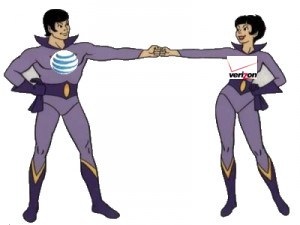
Wireless Wonder Twins Powers Activate: Shape of anti-competitive marketplace for consumers; form of collusion.

True, AT&T charges Cadillac prices but has the customer service image of a used 1995 Kia… but they did have the original exclusive rights to the Apple iPhone and Apple devotees proved they will endure a lot. Verizon Wireless has a better network and has always charged accordingly.

Unfortunately for consumers, the also-rans Sprint and T-Mobile (and the smaller still) depend on AT&T and Verizon for roaming off the city highway and into the countryside, and they are often stuck with devices that are a step down from what the bigger two can offer.

Srinivasan would have a better argument if the wireless marketplace had not become so consolidated. Had AT&T had its way with T-Mobile, America would have just a single national GSM network — AT&T. Verizon does not consider its CDMA competitor much of a bother either, and Sprint Nextel CEO Dan Hesse has to divide his time between fighting with Wall Street over why the company has not already sold out to the highest bidder (and now wants to spend a fortune upgrading its network) and customers who consider Sprint too much of a trade-off in coverage and its dismal “4G” Clearwire WiMAX network too slow for 2012.

Srinivasan is probably too young to understand AT&T and Verizon never invented “price signaling.” A century ago, the railroad robber barons did much the same, leveraging their anti-competitive networks-of-a-different-kind to maximize prices in places that had few alternatives. Where competitors did arrive, they were typically bought out to “maximize savings and eliminate market inefficiencies.” The same was true in the steel and energy sector of the early 20th century.

The result is that consumers were turned upside down to shake out the last loose change from their pockets. Eventually, government stepped in and called it marketplace collusion and passed antitrust laws that began a new era for true competition.

How soon some forget.
AT&T Cracking Down on DSL/U-verse Usage While Promoting “No Bandwidth Limitations”

Stop the Cap! has suddenly started receiving a larger number of complaints about AT&T’s Internet Overcharging scheme in the past two weeks, indicating to us the company has started cracking down more forcefully on usage cap “violators.”

Those who purchased AT&T U-verse in an effort to avoid usage caps from their local cable company are particularly upset, because the phone company still markets its U-verse service as being ‘bandwidth-limit-free.’

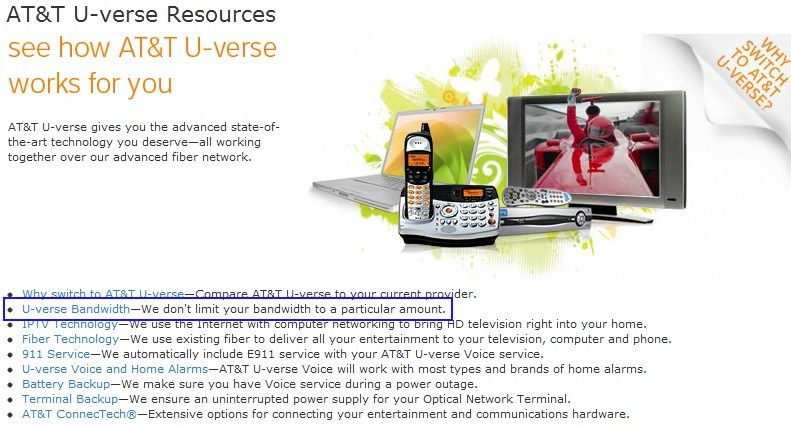
AT&T advertises its U-verse service to this day as bandwidth limit free.

“We don’t limit your bandwidth to a particular amount,” promises AT&T in prominent language on its website. The fine print says something very different — AT&T limits the amount of usage customers get before being exposed to overlimit fees — 150GB for DSL, 250GB for U-verse. It is part of what the company calls wired “data plans.”

AT&T U-verse has a 250GB usage cap hidden in the fine print.

“It’s false advertising,” counters AT&T customer Don Brown. “Anyone who reads their promise of ‘no bandwidth limitations’ is going to assume that means no limits, but when I questioned company representatives about the promise, they pull out every trick in the book.”

Brown says one customer service representative told him ‘bandwidth limits’ refer to broadband speed — AT&T does not throttle its customers. Another said the ad claim meant that customers could keep paying AT&T additional money for as much usage as they want or need. But Brown believes AT&T knows better than that.

“When I signed up for service, I asked the salesperson who took my order if there were limits and they said there were none, period,” Brown says. “Not a word was spoken about 250GB limits or overlimit fees. I’m not buying their excuses — what wired ISP throttles customer speeds?”

In fact, AT&T itself defines “bandwidth” much the same way Brown does (underlining ours):

The term bandwidth can take on many meanings. In the case of AT&T U-verse products and services, the term bandwidth is commonly used when referring to computer networking and measuring Internet usage.

The amount of Internet usage is displayed in upload and download amounts. This would commonly be known as the amount of bandwidth the User used during a particular time.

Brown also has no access to any usage monitor or measurement tool, and AT&T told him he “can relax” because the company would send warnings when it noticed his usage was coming perilously close to the limit. But that makes planning around monthly usage limits difficult, because he has no idea what his usage is from day to day.

A week ago, he received his first warning in an e-mail message from AT&T, which was the first indication he was living under a usage cap.

“They are in a real hurry to collect more money from me but they don’t have their ducks in a row on an accurate meter I can depend on,” Brown says. “Would the local power, water, or gas company get away with that? I don’t think so.”

Brown decided AT&T’s “dishonesty,” as he puts it, made him cancel his service. He does not trust the phone company to accurately measure anything.

“At least I know the cable company is a pocket-picking crook so I can be on guard for their next move,” Brown says. “AT&T is more like the thief in the night that robs you blind while you are upstairs, asleep in bed.”

Chris Savage discovered AT&T’s “stealthy” 150GB usage cap on his DSL account when he received an e-mail warning of his own. He gets one more, after which AT&T will “bill shock” him with overlimit fees.

You have exceeded 150GB this billing period.

[…] The next time you exceed 150GB you’ll be notified, but not billed. However if you go over your data plan in any subsequent billing period, we’ll provide you with an additional 50GB of data for $10. You’ll be charged $10 for every incremental 50GB of usage beyond your plan.

AT&T DSL service has a sneaky 150GB usage cap in the fine print.

AT&T really isn’t interested in hearing questions or concerns about their “data plan,” telling customers at the bottom of the message:

Please do not reply to this email. This address is automated, unattended and cannot help with questions or requests.

Savage never knew AT&T implemented an Internet Overcharging scheme:

“This e-mail seemed to say to me, ‘We changed the rules on you without telling you and now you’ve broken them, so we’ll let you off this time, but consider yourself warned!'”

Savage has already cut cable’s cord and watches his television shows online, exactly what big phone and cable companies do not want their customers doing.

The bottom line is that 150GB is not enough for people like me who work at home, rely on Netflix for any kind of TV/Movies (since I don’t have cable or any other TV), have gamers in the house and run a website. What this means for me is that, once again I will have to cancel Netflix because watching just one movie or show per day would mean I would reach my cap about 2/3 of the way into the month. And that is if nobody else in the house watches anything on it, plays any online games or downloads anything.

In the end, it appears AT&T won and Netflix lost. Savage reports after going over AT&T’s limit two months in a row, he canceled his Netflix account — the only television service he had. AT&T DSL cannot even support one movie a night and one or two streamed cooking shows here and there without pushing the family over the limit AT&T imposes.

Shaw Cable Ending Aggressive Pricing Promotions; Price War is “Lose, Lose Situation”

Phillip Dampier July 5, 2012 Canada, Competition, Consumer News, Data Caps, Shaw, Telus, Wireless Broadband Comments Off on Shaw Cable Ending Aggressive Pricing Promotions; Price War is “Lose, Lose Situation”

Shaw Communications executives last week announced, to the relief of Wall Street, the cable company is pulling back on great deals for cable TV, Internet and phone service this summer.

In an effort to appease Wall Street analysts like Phillip Huang, a researcher for UBS Investment Bank — who fear lower prices could “spiral into a price war, which obviously would be a lose, lose situation,” Shaw has made it clear it intends to stop some of its most aggressive promotions this summer.

“When you talk about promotions in the market, we’ve been very disciplined in that regard,” Shaw executives told analysts on last week’s quarterly results conference call. “It’s a highly competitive environment and will continue to be that way and we’re going to operate in a certain fashion.”

That “certain fashion” has cost them at least 21,500 subscribers who have already left Shaw this past quarter, most headed to Shaw’s biggest competitor Telus.

But some Wall Street analysts remain unsatisfied, noting there are major differences in telecommunications pricing in Canada. Western Canadians pay substantially less for phone, cable, and broadband service than their counterparts in Ontario and Quebec. Shaw and Telus customers also have much larger usage allowances for broadband service, and Telus so far has not enforced what limits they have.

Analysts peppered Shaw executives about why they are not raising prices to match what Bell, Rogers, and Vidéotron customers further east are paying.

Jay Mehr, Shaw’s senior vice president of operations told investors to hang in there.

“We still believe that we have some good pricing power when discipline really comes back into this market,” Mehr said on the call with investors. That signals Shaw is prepared to raise prices when aggressive deals end.

Wall Street also questioned why the company does not use long-term contracts to lock customers in place:

Mehr

Glen Campbell – BofA Merrill Lynch, Research Division: […] On service contracts: You’ve been pretty firm in not using them. Your competitor clearly does. […] Can you talk about the reasons for not going down the service contract road and whether you might reconsider that position?

Bradley S. Shaw – Shaw Communications: Well, there’s arguments for contracts as you — I guess, it’s really what these contracts do. As you said, we have equipment. Our [indiscernible] space — our Easy Own plan certainly is a very consumer-friendly plan as customers are getting something, and they’re agreeing to pay for it over time. And that creates kind of a natural kind of a relationship. What we don’t want to have happen is having customers, who are feeling confined by a contract, who otherwise would like to do something else. We don’t think that’s consumer-friendly. And so we’re looking at ways that we’d have more consumer-friendly kind of relationships but that still create some kind of a longer-term relationship that you can count on. But we don’t want to have the ball and chain kind of contracts that others have adopted.

[…] From a customer point of view. But also, the nature of contracts is there needs to be an enticement to get the customer sign a contract, and that enticement tends to be what we’re seeing in the market, which is fairly significant giveaways of hardware and other devices to be able to incent that. And so it will have has an impact on your cost of acquisition, and we’re trying to manage that. As Peter said, our Easy Own program is a very customer-friendly way for people to come on and make a commitment to us. And at the end of the period, they own their equipment. They haven’t had to pay upfront, and so it’s a nice way to manage that without being heavy-handed.

Shaw’s Exo Wi-Fi service is coming soon across western Canada.

Some other developments at Shaw, reported during the conference call:

  • Spending on upgrades will continue to be on the aggressive side as the company builds out its new Exo Wi-Fi network and converts cable systems to digital service, creating additional space for broadband speed increases and other services;
  • Broadband delivers the highest profit margins of all of Shaw’s services, so it remains a very important part of Shaw’s package;
  • Customers are gravitating towards higher speed broadband packages, delivering extra revenue;
  • The company has re-priced some of its plans and offers to be more friendly to broadband-only customers;
  • Shaw is working to gain approval from communities across western Canada to deploy its Wi-Fi network, with plans to begin limited promotion of the new service by late fall or early 2013. Shaw expects its Wi-Fi network to have substantial coverage across the region within three years;
  • Shaw plans to work with U.S. cable operators to participate in a Wi-Fi roaming network that will allow its customers access to the Wi-Fi networks being built in the United States;
  • Shaw’s “TV Everywhere” project is being designed to protect existing video revenue. Rights are being acquired across the board for broadband, tablets and other mobile devices for a robust on-demand service. But live streaming is secondary.

Fido Joins Parade of Cell Phone Companies Ending Per-Second Billing

Phillip Dampier July 5, 2012 Bell (Canada), Canada, Competition, Consumer News, Data Caps, Editorial & Site News, Fido, Koodo, Rogers, Telus, Virgin Mobile (Canada), Wireless Broadband Comments Off on Fido Joins Parade of Cell Phone Companies Ending Per-Second Billing

Fido puts per-second billing into the doghouse.

Canada, home of the three-year mobile phone contract, “service access fees,” high activation fees, unlock phone fees, $10 for 10MB of data, and $8 extra for “caller-ID” has had one thing going for it that American cell phone companies don’t offer — per-second billing.

Not anymore.

Our regular reader Alex writes to inform us that Fido (owned by Rogers Communications) has joined the parade of Telus’ Koodo and Bell’s Virgin Mobile Canada eliminating the money-saving billing feature for all new activations starting yesterday.

These prepaid customers will now pay by minute when they start new service or change an existing plan.

Mobile Syrup reached out to Rogers and obtained official confirmation and their explanation:

“Fido will adopt the common billing practice in Canada: per-minute billing beginning July 4th. This means that calls are rounded up to the nearest minute. This change will apply to new customers signing up with Fido. All customers who are on current plans with per second billing will retain this feature unless they change their monthly plan. The majority of customers should not notice any impact to their monthly bills. Fido offers several great plans with various call, text and data allowances that are designed to meet any need.”

The billing change further discourages Canadian consumers looking for a better deal in the prepaid market. It is the best alternative available from the handful of national carriers that charge considerably higher prices tied to an extra-long service contract and expensive data pricing.

Maybe not

Alex notes per-second billing was one of the great advantages Telus’ Koodo offered, and other competitors were initially forced to match that innovative pricing.

“Koodo’s new plans are simply the old plans, but with a $5/month increase for two calling features,” Alex notes. “Koodo found another way to gouge their customers: per-minute billing. They also removed 50 minutes from the $30/month (previously $25) plan, which used to have 150 minutes. At a time when Internet is the main demand, while talk and text cost virtually nothing to provide, Koodo is gouging.”

Koodo, Fido, and the other carriers are probably noticing that cell phone customers are talking on their cellular phones less than ever, and per-second billing can save an average of 25% off per-minute billing, especially for short conversations.

Alex has a petition up on Koodo’s website asking them to reconsider, but we’re doubtful they will. Rogers’ is not well-known for responding to customer desires for better, more cost-effective service.

T-Mobile: Verizon Wireless’ New Plans “Costly, Complicated, and Punitive”

Phillip Dampier July 3, 2012 Competition, Consumer News, T-Mobile, Verizon, Wireless Broadband Comments Off on T-Mobile: Verizon Wireless’ New Plans “Costly, Complicated, and Punitive”

Thomas

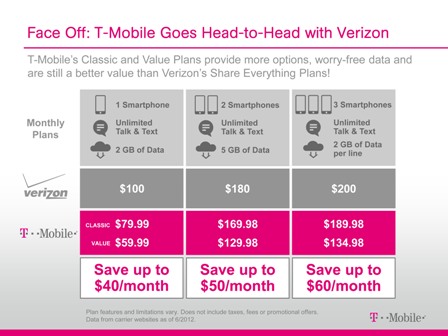
Feisty T-Mobile is back on the attack, this time against Verizon’s new “Share Everything” plans which T-Mobile’s marketing gurus are calling a lousy deal for consumers.

Harry Thomas, director of segment marketing, dismissed Verizon’s new plans as costly, complicated, and punitive in a company blog post:

  • They’re COSTLY – Verizon is charging more for what consumers want by raising rates on data, but promoting the “value” by pointing to unlimited talk and text even though today many consumers use less of these services. This is especially true for add-a-lines – now with Verizon’s Share Everything plans, adding a line starts at $30/month for a basic phone (non-smartphone) and, for accounts with at least one smartphone, requires unlimited minutes whether customers want unlimited or not.
  • They’re COMPLICATED – Verizon is forcing customers to share data when many customers don’t know how much data they’re using, which makes it hard to stay within their limit when trying to balance multiple users (not to mention the family data hog).
  • They’re PUNITIVE – At the same time that Verizon is making it harder for customers to manage overages, they are also increasing overage rates from $10/GB to $15/GB for accounts with at least one smartphone.

Thomas predicted Verizon’s new plans would deliver more benefits to Verizon’s bottom line than to consumers, and as they took effect late last week, he’s now convinced he was correct.

T-Mobile released this graphic showing its plans offer considerable savings over Verizon Wireless’ new “Share Everything” plans. Verizon is probably wishing AT&T managed to get that T-Mobile merger through, if only to stop this kind of competition.


Search This Site:

Contributions:

Recent Comments:

Your Account:

Stop the Cap!