Home » Competition » Recent Articles:

AT&T, Wireless Industry Hostile to Sharing Spectrum: It Belongs to Us or Forget It

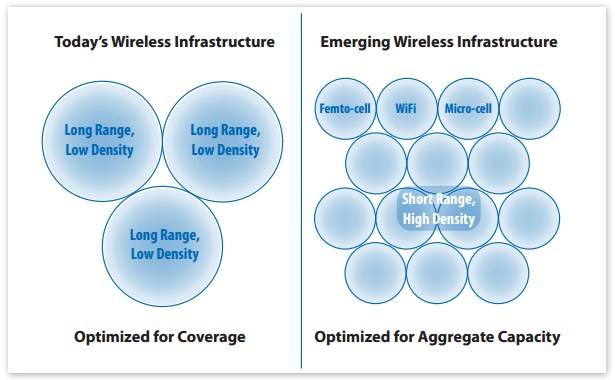
The wireless industry is in transition. Increasing capacity also means decreasing the number of customers trying to share a traditional cell tower. The future will bring a combination of shorter-range cellular and Wi-Fi antennas that can sustain traffic loads much easier than overburdened traditional cell towers.

The President’s Council of Advisors on Policy and Technology’s recommendation that the growing demand for wireless spectrum be met by sharing frequencies with the federal government is getting a cold reception from the wireless industry.

AT&T, other wireless operators, and their lobbying trade association have been embarked on a fierce campaign in Washington to free up additional spectrum they can use to meet growing demands for wireless data. Unfortunately, clearing spectrum that can be re-purposed for wireless phone companies requires complicated, and often expensive frequency reassignments as existing users relocate elsewhere. With the federal government holding a large swath of spectrum for the use of a range of public safety, research, and military applications, the best source for new frequencies comes from Washington.

PCAST’s final 200-page report urges the Commerce Department prioritize locating 1000MHz of frequencies that could be re-purposed for private wireless communications. But the council also recommended that frequencies could be more quickly made available by asking wireless telecom companies to share them with existing users.

Today’s “exclusive use” licenses all too often are being underutilized and, in fact, are sometimes used as a valuable investment tool to buy, trade, or sell. Issuing exclusive licenses guarantees that no other players can use those frequencies. That is a valuable tool for wireless companies protecting their market share from potential competitors.

PCAST declared the concept of a “spectrum shortage” to be largely a myth:

Although there is a general perception of spectrum scarcity, most spectrum capacity is not used. An assigned primary user may occupy a band, preventing any other user from gaining access, yet consume only a fraction of the potential spectrum capacity. Unique among natural resources owned by the public, spectrum capacity is infinitely renewable from second to second—that is, any spectrum vacated by one user is immediately available for any other user.

Measurements of actual spectrum use show that less than 20 percent of the capacity of the prime spec­trum bands (below 3.7 GHz) is in use even in the most congested urban areas.

This spectrum inefficiency is not just a problem for the wireless industry, it also afflicts government use as well. But it is a problem that can be solved by modernizing spectrum allocation policy in the United States.

“Exclusive frequency assign­ments should not be interpreted as a reason to preclude other productive uses of spectrum capacity in areas or at times where the primary use is dormant or where underutilized capacity can be shared,” the report concludes.

If implemented, the wireless industry could begin accessing hundreds of megahertz of new spectrum, with the understanding there may be other users sharing certain frequencies in different areas at different times. For example, AT&T could use spectrum assigned to forest rangers in federal parks for wireless data in Manhattan or other urban areas, where neither user will create interference for the other. Verizon could use spectrum allocated for naval communications at seaside ports in land-locked Nebraska, Utah, Kansas, or West Virginia.
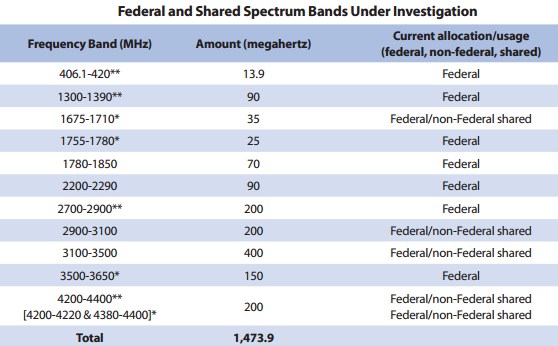
The proposal identifies these frequency bands as ideal for shared use between private and government users.

As technology progresses, shared spectrum users will easily afford equipment that dynamically locates open frequencies for communications with little or no interference even if two users are located right next door to each other.

The benefits to taxpayers, governmental users, and private industry are notable:

  1. The cost to relocate existing government users to other bands is prohibitively time-consuming, complicated, and expensive. Taxpayers often foot the bill for the frequency changes;
  2. Government use of spectrum is not particularly efficient either. Identifying under-utilized spectrum for shared-use can bring pressure to government users to consolidate operations and increase operating efficiency;
  3. Private industry gets much faster access to new spectrum, which suddenly becomes plentiful and potentially affordable for new entrants in the wireless marketplace.

Despite the benefits, the wireless industry had a frosty reception to the new report:

Joan Marsh, AT&T Vice President of Federal Regulatory:

“While we are still reviewing the PCAST report, we are encouraged by the sustained interest in exploring ways to free up underutilized government spectrum for mobile Internet use.  However, we are concerned with the report’s primary conclusion that ‘the norm for spectrum use should be sharing, not exclusivity.’  The report fails to recognize the benefits of exclusive use licenses, which are well known.  Those licenses enabled the creation of the mobile Internet and all of the ensuing innovation, investment and job creation that followed.

“While we should be considering all options to meet the country’s spectrum goals, including the sharing of federal spectrum with government users, it is imperative that we clear and reallocate government spectrum where practical.  We fully support the NTIA effort of determining which government bands can be cleared for commercial use, and we look forward to continuing to work with NTIA and other stakeholders to make more spectrum available for American consumers and businesses.”

CTIA – The Wireless Association:

The CTIA is the wireless industry’s lobbying group

“We thank the Administration and PCAST for focusing on the need to make more efficient use of spectrum currently assigned to federal government users. As the PCAST report notes, it is sensible to investigate creative approaches for making federal government spectrum commercially available, including the development of certain sharing capabilities. At the same time, and as Congress recognized in the recently-passed spectrum legislation, the gold standard for deployment of ubiquitous mobile broadband networks remains cleared spectrum.

“Cleared spectrum and an exclusive-use approach has enabled the U.S. wireless industry to invest hundreds of billions of dollars, deploying world-leading mobile broadband networks and resulting in tremendous economic benefits for U.S. consumers and businesses. Not surprisingly, that is the very same approach that has been used by the countries that we compete with in the global marketplace, who have brought hundreds of megahertz of cleared spectrum to market in recent years.

“Policymakers on a bipartisan basis have grasped the importance of making more spectrum available to meet the growing demand for mobile Internet services, and this report highlights a range of forward-looking options, some of which are not yet commercially available, that may be considered to meet this important national goal. We look forward to continuing to work with the Administration, the FCC, NTIA, Congress and other interested parties to increase access to federal government spectrum and to continue to assist our nation in its economic recovery.”


Wireless carriers will continue to lobby Washington lawmakers to leave the current “exclusive use” spectrum policies in place, even if it delays opening up “badly-needed” spectrum for years.

In short, the major players in the wireless industry are hostile to the idea of losing exclusive-use spectrum. That comes as little surprise because shared spectrum cannot be controlled by the wireless industry. Spectrum squatting, where large phone companies or investment groups hang on to unused spectrum either to keep competitors out or as an investment tool until it eventually can be resold at a major profit, is a significant problem in the industry. Wall Street analysts routinely assign value to the spectrum holdings of wireless carriers, whether they are used or not. Since most spectrum is now sold to the industry at “highest bidder wins” auctions, only the largest players are frequently serious contenders. Auctioning off shared spectrum, if practical, will bring lower bids — but could potentially bring new bidders like start-up ventures that have some new ideas on how to use wireless frequencies to compete.

Therefore, it has been in the wireless industry’s best interests to keep the idea of sharing frequencies with other players out of the minds of Washington regulators and legislators. Their technical objections and claims that shared spectrum would somehow destroy innovation and investment ring hollow, and are weak deflections from the more obvious agenda: to maintain their status quo control of wireless frequencies, well-utilized or not.

AT&T and other wireless players will no doubt lobby their case to Washington politicians, many who will rush to the industry’s defense. The shadow argument most likely to be used to defend the current “exclusive use” auction system is the auction proceeds collected by the federal government. Billions have been raised from past auctions, and shared use frequencies would never net that level of return. But PCAST’s report exposes the rest of the story. The cost to reallocate existing users to other frequencies, hand out new radios, raise new antennas and purchase new transmitters is often so costly, the government’s net gain, post-auction, is likely to be minimal.

Abroad, many governments have already adopted shared use, discarding the focus on spectrum earnings and refocusing spectrum allocation on delivering the best bang for the buck — whether that dollar belongs to the consumer, the wireless industry, or the government.

Attempts by AT&T and others to kill PCAST’s recommendations should also be considered proof the industry’s dire claim of a spectrum shortage emergency is vastly overblown. In a true crisis, everyone makes compromises.  That does not appear to be the case here. Congress and regulators should receive that message loud and clear.

Frontier Terminating Nearly Half of Their Idaho Workforce to Improve “Efficiencies”

Phillip Dampier July 23, 2012 Competition, Consumer News, Editorial & Site News, Frontier, Public Policy & Gov't, Rural Broadband, Video Comments Off on Frontier Terminating Nearly Half of Their Idaho Workforce to Improve “Efficiencies”

Nearly 100 Frontier employees may be visiting Idaho’s unemployment offices by September.

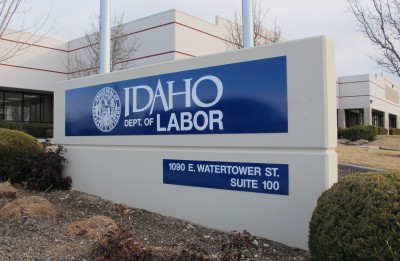
On the second anniversary of Frontier Communications assuming control of landline operations in Idaho formerly owned by Verizon Communications, Frontier has announced plans to close its Coeur d’Alene call center this summer, putting nearly half of Frontier’s workers in Idaho out of work.

“There’s nothing wrong with the employees or the work they’re doing. It’s more about efficiencies,” Frontier’s senior vice president Steve Crosby told CDA Press. “What we’re trying to do is work through efficiencies, consolidations, really moving people around, having work groups working closer together.”

Those hoping to remain with Frontier will need to move to another state and accept a large pay cut if they want to keep their jobs. Other Frontier call centers around the country will assume the responsibilities of the 100 Idaho-based employees who face termination by Sept. 18, including one opening near Myrtle Beach, S.C., that will pay substantially lower salaries.

The closure will reduce Frontier’s workforce in Idaho almost in half. Crosby said Frontier had roughly 260 employees in the state as of last week.

Two years ago, Frontier was telling Idaho a very different story about its takeover of Verizon landlines.

“I think we’ll have better service for customers,” David Haggerty, then a Verizon manager staying with Frontier, told the Bonner County Daily Bee. “Frontier brings with it a small-town mentality. It used to be you were able to pay bills in town and make human contact. That was taken away by Verizon.”

In 2010, Haggerty promised the transition would have no impact on former Verizon workers now heading to work at Frontier.

“We focus on putting the customer first,” said Frontier’s regional manager Vickie Bullard said. “That’s one of the 11 value statements we have at Frontier.”

Some of Frontier’s customers in Idaho wonder if Frontier’s “value statements” are also being downsized.

“I just switched from Frontier to Time Warner Cable for my Internet,” says Scott Mead. “Frontier started out great in the beginning, but shortly after went downhill as issue after issue started.”

Mead reports his calls to Frontier’s national 800 customer support number, which promises 100 percent of the company’s workers are American-based, often left him flummoxed dealing with foreign-accented employees with poor English language skills.

The last one out can turn off the lights.

Another Coeur d’Alene customer endured bad service from Frontier before finally leaving, with the phone company’s collection agency chasing him not far behind:

“As far as I’m concerned Frontier can take a long walk off a short pier. When they first took over from Verizon, from whom we had good service, they sent out a service guy to get us back online. He installed the wrong equipment so another serviceman came out and replaced the wrong one with a bigger, better, and faster wrong one. Over the next 6 weeks we were down all but 12 days and we heard one excuse after another with nothing getting resolved.

So a month later, after switching companies, not only did we get a bill from Frontier for the entire 6 weeks but they charged us for several wrong pieces of equipment. When we tried to resolve the issues they simply sent us to collection and refused to talk. Se we ended up paying for over 4 weeks of service they did not provide and for 4 Internet boxes that the servicemen could not get to work.

I can only hope that Frontier has an office at the bottom of a honey bucket at a chili feed. Flippin crooks.”

One former Verizon/Frontier employee suggests the “efficiencies” Crosby is concerned with is paying call center workers less, and offering fewer benefits:

“Frontier closed a center in Elk Grove, Calif. back in June leaving 50+ people unemployed there,” he writes. “When Verizon sold their landlines and DSL to Frontier back in 2009 they only guaranteed the acquired employees jobs for two years. July 1, 2012 was the second anniversary of that acquisition. This does not surprise me at all. The leadership of both Verizon and Frontier is like any other large corporation. Bottom line is the new call center in South Carolina is cheaper to operate. Why pay people over 50K (this is including 401k, stock & medical benefits) when you can pay half that in a center that has no union.”

Another Idaho employee is bitter about the extra work Frontier employees managed for the company during its great billing and systems transition away from Verizon.

“We will be out of a job, after working massive amounts of overtime to transition this company to get them through the largest conversion in telecommunications history,” the worker shared. “They needed us to get them through it and now they don’t.”

[flv width=”640″ height=”380″]http://www.phillipdampier.com/video/WMBF Myrtle Beach New Frontier Call Center 5-11-12.mp4[/flv]

Race to the bottom. Frontier Communications closes an “unneeded” 100-worker call center in Idaho that reportedly paid workers over $50,000 a year in salary and benefits while announcing a new, “much-needed” call center with 110 workers near Myrtle Beach, S.C. that will pay workers only $30,000 a year. WMBF in Myrtle Beach calls the new South Carolina call center a “success” for Horry County’s efforts to recruit new business to the area. Frontier applauded South Carolina’s “excellent business environment.” But that success comes at a cost to other workers in other states.  (2 minutes)

Canada’s Cogeco Cable Buying Atlantic Broadband in USA

Montreal-based Cogeco Cable has announced it is acquiring Atlantic Broadband, a cable operator serving small communities in Pennsylvania, Florida, Maryland, Delaware and South Carolina for $1.36 billion, raising investor fears the company is once again on a spending spree.

Cogeco’s tarnished record of cable acquisitions was highlighted last year when it was forced to write off almost $250 million in losses racked up by its Portuguese acquistion Cabovisao. The company finally sold the money-losing operation at a loss in February.

Cogeco stock plummeted more than 17 percent on today’s news, and investors are concerned Cogeco’s entry into the U.S. market is competitively risky.

Atlantic Broadband’s cable systems were acquired from Charter Communications in 2003. Charter was consolidating its operations into larger markets, and the systems along the eastern seaboard were deemed too small to create the kind of large, regional clusters cable operators prefer today. Atlantic only serves around 252,000 customers nationwide, almost all in smaller communities and cities. That mirrors the way Cogeco operates in Ontario and Quebec — primarily in smaller cities bypassed by larger operators Rogers Cable and Vidéotron.

Cogeco CEO Louis Audet believes growth opportunities in Canada are limited at best. He defended the acquisition as an entry point in the United States, signaling Cogeco was going to continue shopping for other small U.S. cable operators.

Cogeco is paying about $5,400 per subscriber, according to Bloomberg News. That compares with $4,418 Time Warner Cable paid per subscriber for Insight Communications, and $5,486 for each Knology customer acquired by WideOpenWest LLC.

Cogeco acquired Atlantic Broadband from private-equity firms Abry Partners and Oak Hill Capital Partners.

AT&T Announces Me-Too “Mobile Share” Plan Nearly Identical to Verizon’s “Share Everything”

AT&T’s new Mobile Share plan offers virtually identical pricing to Verizon.

AT&T this morning announced its own widely-anticipated pricing shift for its wireless phone customers, largely mimicking Verizon’s “Share Everything” plan and pricing, with minor differences.

AT&T’s Mobile Share plan, available in late August, emphasizes the fact families can now share a single data plan, but will also require customers to pay for unlimited voice and texting services. But unlike Verizon, current AT&T customers grandfathered on other plans can continue to keep their current plan, even after their next subsidized phone upgrade. AT&T also says it is not discontinuing existing individual and family plans.

While Verizon’s plan emphasizes the cost to add various devices on its “Share Everything” plan, AT&T asks customers to select a plan based on anticipated data usage. Customers can add up to 10 devices on an AT&T Mobile Share plan, one of which must be a traditional smartphone.

Like Verizon, AT&T is eliminating the extra-cost tethering option on its new plans. Tethering customers will now use their smartphone data plan allowance.

AT&T and Verizon: The Doublemint Twins of Wireless

AT&T’s pricing is designed to appeal to bigger spenders.

“The larger the data bucket you choose, the less you pay per gigabyte and the less you pay for each smartphone added to the shared plan,” AT&T says in a news release.

Wall Street seems to approve.

“The ‘more you share, the more you save’ concept is one that will resonate well with customers because of the value provided through the Mobile Share data plans themselves and in smartphone connection fees,” said Roger Entner, Founder and Lead Analyst of Recon Analytics. “AT&T also is providing its customers with flexibility and choice by keeping its existing data plans and not requiring customers to move to Mobile Share unless they want to. It’s a win-win for both AT&T and its customers.”

But customers hoping to shop around will find little difference in pricing between Verizon Wireless and AT&T, who will charge nearly the same thing for each of their family share plans.

Verizon charges $40 for each smartphone, $30 for basic/feature phones, mobile broadband modems and wireless-equipped laptops cost $20, and each tablet adds an additional $10.

AT&T will charge a maximum of $45 for each smartphone, $30 for basic/feature phones, wireless modems and wireless-equipped laptops cost $20, and each tablet runs $10.

AT&T gives customers with a large appetite for data a break on the monthly equipment fee for smartphones. Choosing a basic 1GB data plan with AT&T means you will pay $40 for the data and $45 for each smartphone on the account. Upgrade to a 4GB shared usage allowance and AT&T lowers the monthly fee on smartphones to $35. If you select a data plan of 10GB or larger, the smartphone device fee drops to $30 a month for each phone.

The prices for data are similar between the two carriers on lower-end plans (AT&T’s overlimit fee will be $15/GB, the same Verizon charges now):

VZW                      
  Data Plan  1GB 2GB 4GB 6GB 8GB 10GB 12GB 14GB 16GB 18GB 20GB
  Price $50 $60 $70 $80 $90 $100 $110 $120 $130 $140 $150
  Smartphone fee $40 $40 $40 $40 $40 $40 $40 $40 $40 $40 $40
  AT&T            
  Data Plan  1GB 4GB 6GB 10GB 15GB 20GB
  Price $40 $70 $90 $120 $160 $200
  Smartphone fee $45 $40 $35 $30 $30 $30

Customers hanging onto long-grandfathered unlimited data plans tied with budget-priced voice minutes and texting allowances will probably want to take those plans to the grave, especially if they are using moderate amounts of data on each smartphone.

For those already caught in Verizon or AT&T’s usage pricing schemes, want unlimited voice and texting, and depend on the costly tethering add-on may find some savings, at least in the short term. But for average families with two smartphones and a basic phone for grandma, shopping around for a better deal with either Verizon or AT&T is pointless. With Verizon, those three phones with a 1GB data plan will run $160 a month — with AT&T, $160 a month. Upgrading to a 4GB usage allowance on both carriers also means an identical bill: $180 a month.

Cell phone customers of both carriers probably wish “competition” meant more than a race to see which would gouge customers with higher bills first. The other will surely follow, evidenced by today’s developments.

Google Fiber Launches Next Week in Kansas City

A Stop the Cap! reader working for a Kansas City non-profit group dropped us a note this morning indicating she has received an invitation from Google to join the company at a special event Thursday, July 26 which will be Google Fiber’s formal launch announcement.

“There is buzz all over town about Google launching the fiber service on a limited basis in certain Kansas City neighborhoods next week,” Cathy writes us. “The local media has definitely been invited and encouraged to attend and several non-profit groups are going together in a group to also informally meet with some Google officials at the conclusion of the event regarding access and pricing issues. We have already been told this will be a formal launch event.”

Google has kept its pricing and exact service availability information tightly under wraps, but the company is inviting local residents to sign up for e-mail invitations and additional information as it is released.

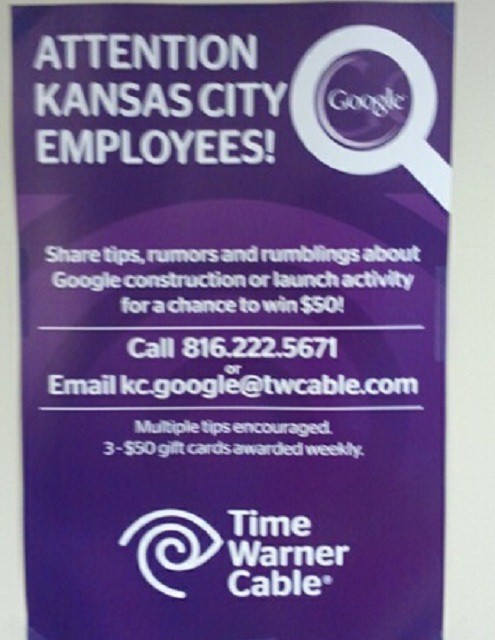
The anticipated launch has not been missed by Time Warner Cable, which has taken to placing signs around the workplace offering $50 “rewards” for insider tips about Google Fiber’s launch and marketing plans. Although some in the tech press have characterized this as “fear” of Google Fiber, a Time Warner employee tells Stop the Cap! the “reward” program is not unprecedented and the cable company has occasionally offered goodies to employees who can deliver tips about competitors like Verizon FiOS and community fiber broadband networks for years.

Courtesy: Gigaom

Kansas City residents will certainly have a choice when Google Fiber launches its gigabit network. In addition to fiber broadband from the search engine giant, customers in different parts of the area can also get cable from Time Warner Cable or Charter and U-verse from AT&T.

Google will join Chattanooga’s EPB Fiber as America’s gigabit residential broadband providers. Cable operators and phone companies are expected to downplay Google’s fiber introduction — likely telling customers they do not need gigabit speeds and chastising its likely monthly cost.

Google’s competitors may have to prepare to deliver that message beyond Kansas City, however.

Dow Drukker, senior vice president of CapStone Investments, believes Google is in the mood to grow:

Initial Indications Google Fiber Is Likely Expanding Beyond Kansas City.

We saw an ad for an Inside Sales position in Mountain View, CA for selling Google Fiber to small businesses. The ad said the position would be tasked to build a team to sell a national broadband network indicating Google likely plans to build a fiber-optic network in additional cities.

This was the ad Drukker saw, which can be vaguely interpreted to indicate the company has plans to place Google Fiber in more cities (underlining ours), although we see nothing that specifically mentions a “national” broadband network:

The area: New Business Development

At Google, we set ourselves goals we know we can’t reach yet. Our New Business Development team works on game-changing ideas, from technological experiments to the expansion of existing businesses into new territories. We’re a team of technologists, entrepreneurs and leaders with an eye for what’s next, working across Google to develop products and ideas that revolutionize the way people connect with information.

The role: Sales Manager, Inside Sales, Google Fiber

Does winning new business get your adrenaline pumping? Drive growth for Google’s Online Sales Group as part of the Inside Sales Organization, the sole acquisition engine at Google. You collaborate with our Account Management teams to devise strategies to acquire specific segments of your market. Work independently, travel to trade shows, visit large prospective clients–it’s all part of this role. Be rewarded for being an overachiever while driving incremental growth in your market. You prescribe the right marketing mix based on Google’s core advertising products through acquisition of predefined mid-and up-market clients. You are product-and industry-savvy, and your energetic drive propels you toward new acquisitions and building and managing your own book of business.

If you want the opportunity to work on a state-of-the-art high-profile program, look no further than the opportunity to frame the future of broadband. The Fiber Sales Manager will build a team to evangelizes Google Fiber services to small and medium business and multi unit dwellings. Fiber Sales manager will develop a plan for our approach in the market including multi unit dwellings, small business, restaurants, and hotels. Inside Sales Representative, you reach out proactively to both small businesses, while articulating how Google Fiber Solutions can help make their work more productive. (And then, you seal the deal!) You excel at product pitching, cultivating a strong base of new clients and working with fellow technical Googlers to devise solutions and support for your clients.

One of the most potentially valuable lessons Google may teach with its new gigabit broadband network is one for Washington lawmakers. To date, cable and telephone companies have portrayed gigabit fiber broadband as unnecessary, unwanted, and too difficult and expensive to offer residential customers. Google’s performance in Kansas City could prove those arguments wrong.

Search This Site:

Contributions:

Recent Comments:

Your Account:

Stop the Cap!