Home » Competition » Recent Articles:

Time Warner Cable Moving to All-IP Network, Channel Realignment, DVR/Box Changes

Time Warner Cable executives told investors on a morning conference call the cable company has embarked on a gradual transition to an all-IP-based distribution platform which could eventually mean the end of today’s set top boxes and radically increase the amount of bandwidth available for its broadband and video networks.

“Whatever the merits of that from an engineering sense, all things IP are the standards that the world is building devices to,” said Time Warner Cable CEO Glenn Britt. “So that’s the standard we’re going to end up migrating to until something better comes along.”

The transition will help Time Warner Cable support additional customer-owned equipment, including video game consoles, streaming online video boxes, and televisions with built-in support for cable-delivered channels.

“If you look at the cable in 1980s, there weren’t a lot of set-tops, and I think we’re going back to that over time,” Britt said.
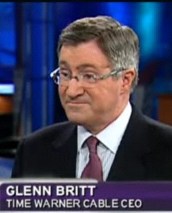
Britt has repeatedly criticized set top box equipment as cumbersome, expensive, outdated, and disliked from the perspective of customers. He noted the only reason Time Warner uses the boxes is to support traditional televisions that cannot handle all of the services the cable company offers today, including video-on-demand and encrypted premium channels. Moving to a different technology platform can result in significant savings if cable operators adopt open standard devices and technology.

Later this year, Time Warner will also be launching a nationwide channel realignment, affecting virtually every subscriber around the country. The cable company is adopting a unified, genre-based, national channel lineup, putting popular cable networks on identical channel numbers in every city.

Time Warner’s reported results found the company losing an additional 169,000 video subscribers during the quarter, a new record loss for the cable operator. Despite that, the company still booked an 8% increase in profits, thanks to higher prices for service and increases in the number of broadband customers. Time Warner blamed the video subscriber drop on seasonal losses from departing college students and those heading to vacation properties, as well as the downturned economy.

But the nation’s second biggest cable operator reports it has several initiatives under way for subscribers which they feel will boost earnings and subscriber numbers:

Over the last 60 days, Time Warner deployed a new set-top box guide throughout the eastern region. After the Olympics conclude, the company will introduce the new guide across the western half of the country. The new guide features a new color scheme and better graphics, and is supposed to make navigation and search easier to use;

The company will introduce IP-based set top boxes and home gateway devices by next year. The newest gateway is a combination DVR, DOCSIS 3.0 cable modem, and a video transcoder that can convert QAM-based video to IP for devices including game consoles and new IP set top boxes. Time Warner’s newest DVR will include the capability of recording five shows at the same time while watching another and 1TB of storage.

Install it yourself.

Time Warner Cable’s TV Everywhere service will expand to include video on demand and the possibility of watching certain networks while outside of the home. The current service only works when you watch over your home Wi-Fi network.

The cable operator’s Internet Essentials offer, which includes a 5GB monthly usage cap, will move beyond Texas and reach everywhere the cable operator serves by the second half of next year. When a usage meter shows up on your My Services page on Time Warner Cable’s website, you will know this new, optional plan is on the way.

Time Warner is revamping their website to let customers shop, order, and buy more services online.

Self-install kits will become increasingly common for customers comfortable installing their own services. The Easy Connect packages are available in stores or by mail, and are free of charge with no installation fee.

Service call windows will continue to be refined. In most cities, two hour windows are currently offered, but the company is now moving to one-hour windows in many markets. In some cities, 15-minute windows for the first appointment of each shift are now available to customers who don’t want to sit at home and wait all day for the cable guy. The company is now also including an estimate of how long it typically takes to complete the type of service call requested.

 Customers continue to gravitate towards faster broadband service plans. The company’s Turbo, Extreme and Ultimate tiers together garnered 157,000 new adds in the second quarter and now comprise over 21% of high-speed data customers, up from 17% a year ago and 9% three years ago.

Britt also took questions about the impact Google Fiber will have on Time Warner Cable’s operations in Kansas City.

“There’s a lot of effort going on around the country to see what we could do as a society with more bandwidth in kind of a laboratory sense,” Britt said. “I view the Google effort as that. […] And I think that’s good for our business. We have a wonderful infrastructure, we have bandwidth, we have a way to go much faster with DOCSIS 3.0 by adding [higher speeds] to the offering. And the more the people figure out how to use broadband, the better off we’re going to be. So I think this is a good thing, not a bad thing, that people are trying to figure out how to use this technology.”
AT&T and Georgia Cable Lobby Try to Force Independent Telcos to Raise Rates

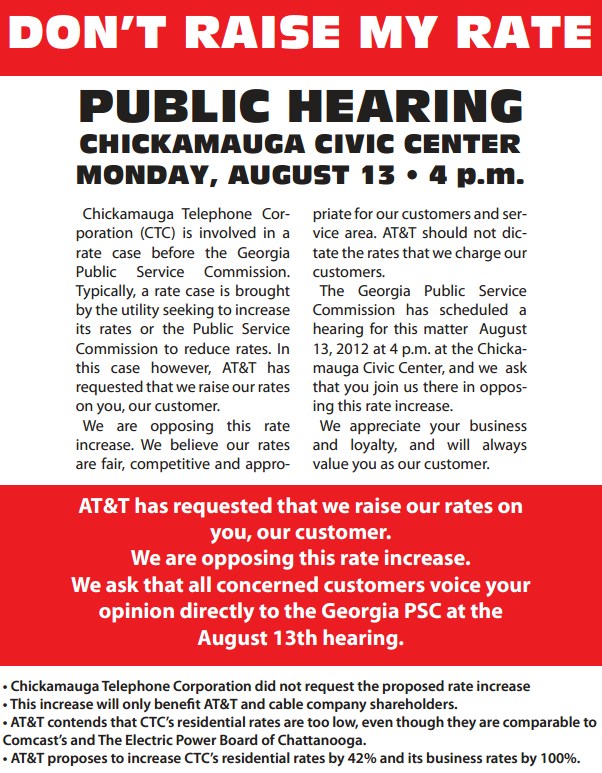
Normally, telephone companies looking for a rate increase file a request themselves with state regulators to charge customers more for service. But in Georgia, AT&T, Comcast, and the state cable lobbying group are asking the Georgia Public Service Commission (GPSC) to order two rural phone companies to raise rates because they are not “charging enough” for phone service, when compared with cable telephone services and AT&T.

The Ringgold Telephone Company (RTC) and Chickamauga Telephone Company both argue the action is anti-competitive.

“By forcing [both companies] to increase rates, these competitors are seeking to make wireless and cable companies more attractive to consumers,” says the Don’t Raise My Rate website.

The independent phone companies are vehemently against raising their rates, and executives at both companies are outraged AT&T and the state’s cable companies are literally trying to force the GPSC to order rate increases on residential and business customers.

“It’s totally unprecedented,” Phil Erli, executive vice president at RTC told the Times Free Press.  “It is ludicrous and illogical.”

The Georgia Public Service Commission will decide on Oct. 16 whether the rate increases are justified, following local public hearings Aug. 13.

AT&T, which is driving the campaign to force customers to pay higher rates, says they are pressing the case because both companies unfairly charge substantially lower rates than AT&T does in Georgia.

Peter F. Martin, vice president for legislative and regulatory affairs in Georgia openly admits he wants both companies to charge essentially the same prices AT&T bills its customers in other areas of the state.

“The premise of my recommendation is that [the two phone companies] raise rates to roughly the same levels that are being charged by other local exchange carriers in surrounding areas,” Martin testified before the GPSC. “In other words, my recommendation is that [the two phone companies] increase their own end-user rates to market-based levels comparable to what other carriers are charging their subscribers.”

For customers of Chickamauga Telephone, that would amount to a 42% rate increase on residential customers, 100% on business customers. Customers of RTC would pay 20 percent more for residential service, 37% more for business service.

AT&T claims both companies, in deeply rural Georgia, are tapping into the state’s rural service fund and are receiving some of the largest state-mandated telecom subsidies, which are funded by all of Georgia’s phone companies and ratepayers. But both companies claim they have spent a large portion of those funds repairing damages to their rural networks incurred from a series of tornadoes which hit the area two years in a row.

The state cable lobbying group, the Cable Television Association of Georgia (CTAG) also has a dog in this fight. Comcast Cable, the dominant provider in Georgia, directly competes with both phone companies. They support AT&T’s demands that both phone companies hike their rates. It is not difficult to understand why:

Residential Service With Calling Features:

CHICKAMAUGA TEL TODAY

CHICKAMAUGA TEL

AT&T PROPOSED RATE

COMCAST’S CURRENT RATE

EPB

$31.75

$37.28

$34.95

$22.99

Business Service With Calling Features:

CHICKAMAUGA TEL TODAY

CHICKAMAUGA TEL

AT&T PROPOSED

COMCAST’S CURRENT RATE

EPB

$88.85

$113.30

$49.95

$35.99

(EPB, a publicly-owned provider from nearby Chattanooga, Tenn., also offers service in some areas.)

Chickamauga Telephone executives argue Georgia’s telephone deregulation policies are heavily weighted in favor of huge phone and cable companies and leave independent, rural phone companies with no new revenue opportunities. Chickamauga argues AT&T and the cable industry are using legislatively imposed “unfunded mandates” to win favor and additional profits for themselves and their shareholders, with no resulting savings for Georgia ratepayers, especially in rural areas.

If AT&T and cable operators have their way, both independent phone companies “would be priced out of the competitive market,” and “would soon find [themselves] out of business.”

“If you lived down here and you had a phone with us and your rates went up, how would you respond?” asked Ted Austin, a spokesman for Chickamauga Telephone. “Nobody wants their bills to go up, especially when it’s not something that Chickamauga Telephone is asking for.”

Four Telcos-Four Stories: Rural Broadband Critical/Irrelevent to Our Success — Today: AT&T

Phillip Dampier August 1, 2012 Astroturf, AT&T, Community Networks, Competition, Consumer News, Editorial & Site News, Public Policy & Gov't, Rural Broadband, Wireless Broadband Comments Off on Four Telcos-Four Stories: Rural Broadband Critical/Irrelevent to Our Success — Today: AT&T

Four of the nation’s largest phone companies — two former Baby Bells, two independents — have very different ideas about solving the rural broadband problem in the country. Which company serves your area could make all the difference between having basic DSL service or nothing at all.

Some blame Wall Street for the problem, others criticize the leadership at companies that only see dollars, not solutions. Some attack the federal government for interfering in the natural order of the private market, and some even hold rural residents at fault for expecting too much while choosing to live out in the country.

This four-part series will examine the attitudes of the four largest phone companies you may be doing business with in your small town.

AT&T’s real priorities are to satisfy Wall Street demands for regular revenue growth. Rural wired broadband just cannot compete with the margins the company earns on its enormously profitable wireless and ARPU-raising U-verse services. (Graphic adapted from original work of Mark Fiore)

Today: AT&T — More Rural Broadband? Don’t Call Us, We’ll Call You

AT&T CEO Randall Stephenson earlier this year declared expansion of its U-verse fiber to the neighborhood service “largely complete,” despite the fact almost half of AT&T’s customers only have access to much slower DSL service, or cannot receive any broadband service at all.

For those living in AT&T’s service areas, which include a large portion of the midwest, southern states east of the Mississippi, Connecticut, and parts of California and Texas, Stephenson has not inspired confidence the company is rethinking what is possible in rural broadband.

“We have been apprehensive on moving, doing anything on rural access lines because the issue here is, do you have a broadband product for rural America?,” Stephenson told investors earlier this year. “And we’ve all been trying to find a broadband solution that was economically viable to get out to rural America and we’re not finding one to be quite candid.”

AT&T’s lack of confidence this year is in contrast with their bombastic rural broadband lobbying campaign of 2011, launched as part of an effort to win approval for its aborted merger with T-Mobile USA. The company sent slick talking points promoting the deal to community groups it supported with contributions, politicians it bought with contributions, and astroturf efforts it bankrolled with contributions.

The result was declarations like this from former Rep. Rick Boucher (D-Va.), who swept through Washington’s revolving door and came out on the other side working for AT&T-backed lobbyist-law firm Sidley Austin and serving as an “honorary chairman” of the industry-backed Internet Innovation Alliance:

Thousands of the smallest communities outside of urban areas either lack broadband service or have just one option that can be pricey for a relatively low connection speed, inadequate for modern business demands. The joining of AT&T’s and T-Mobile’s wireless spectrum will largely fill the gap and bring robust Internet connectivity to rural localities where wired infrastructure is cost prohibitive.

With the merger now nothing more than a bad memory, Stephenson’s interest in the innovation of Internet access quickly faded.

Last week, AT&T customers learned the company isn’t even interested in taking free money from the federal government and ratepayers to do better. Offered access to $115 million in broadband subsidies from the reform of the Universal Service Fund (USF), AT&T officials shrugged their shoulders and indicated they were not interested because they are not yet “ready” to participate.

Quinn

“AT&T is in the midst of evaluating its options for further rural broadband deployment,” said Robert Quinn, AT&T’s senior vice president of regulatory affairs wrote in a letter to the commission. “As our chairman stated last month, we are optimistic about AT&T’s ability to get more broadband into rural areas, particularly as the technology continues to advance. However, until AT&T finalizes that strategy, it cannot commit to participating in the incremental support program. ”

For communities like Orangeburg, S.C., that answer is not good enough. The community received an $18.65 million federal grant of broadband stimulus funds to develop high-speed broadband in an area where only 20-40 percent of residents have Internet service today. AT&T is the dominant phone company and offered the same non-committal response to Orangeburg’s pleas for better service that the  company gives to customers elsewhere.

While AT&T reports it is not yet ready to do better in rural South Carolina, it is very motivated to make sure nobody else does either, funding a massive lobbying effort in coordination with its friends at the American Legislative Exchange Council (ALEC) to pass a virtual ban on community broadband development across South Carolina.

Christopher Mitchell at Community Broadband Networks calls it “monetizing scarcity.” Orangeburg officials call it a big headache and are working around AT&T, frustrated with the phone company’s disinterest while it also helps build barriers to impede the community’s efforts to build its own network.

“If some of these other providers had a desire to serve these rural areas, they would have already been doing it,” said county administrator Bill Clark. “We are entering the broadband business because third-party providers are reluctant to provide the service.”

AT&T’s reluctance to accept USF money may have a lot to do with the company’s focus on its wireless network which is seen as a much more lucrative investment. Profit margins for barely-competitive wireless service remain sky high, and are growing higher as AT&T raises prices and the industry works to cut costs.

Even the company’s urban-focused U-verse network delivers opportunities for greater revenues from AT&T customers likely to buy additional services. Investing in DSL just does not pull in the same level of profits, and companies like AT&T will remain reluctant to expand rural broadband unless the government delivers a much larger government subsidy, according to Benjamin Lennett, a policy director at the New America Foundation.

“It underscores how flawed it is to rely on private companies to serve these rural areas where their margins are not going to be that high,” Lennett said.

Unfortunately for communities trying to work around AT&T’s roadblock, the company has made sure towns and villages building their own networks soon discover that road remains closed in more than dozen states thanks to  AT&T with the help from corporate groups like ALEC, who feed willing legislators bills often drafted by the corporations they are designed to protect.

Verizon Wireless Settles 4G Tethering Complaint, Pays $1.25 Million Settlement

Verizon Wireless has settled a complaint brought by consumer group Free Press that accused the wireless carrier of violating federal rules allowing customers to use their phones as mobile hotspots or for tethering with the apps of their choosing.

The Federal Communications Commission announced Verizon had agreed to pay $1.25 million to the U.S. Treasury for violating the conditions of its 700MHz “C”-Block licenses, which carry the provision that Verizon not “deny, limit, or restrict” customers from using the applications or devices of their choosing.

Instead of abiding by those rules, Verizon Wireless reportedly pressured Google to disable and restrict tethering applications in the Google Play Store, forcing most customers to purchase Verizon’s Mobile Hotspot/Tethering service which, at the time, was priced at an additional $30 a month. Verizon Wireless’ recent plan changes now include tethering and mobile hotspot service for no additional monthly fee, although customers are subject to usage caps and overlimit fees.

“The FCC sent a strong signal to the market that companies cannot ignore their pro-consumer obligations,” said Free Press policy director Matt Wood. “Unfortunately, the fact that Verizon worked to block these apps in the first place is a clear indication that wireless providers have a strong incentive to discriminate against certain content and applications, an incentive that continues to threaten online freedom and innovation.”

Free Press notes consumers of other carriers lack the same protection Verizon’s customers have under the law. Verizon agreed to the more consumer-friendly language as part of its purchase of the frequencies where the company operates its 4G network.

Comcast Brings Back Its Usage Cap… Now With Overlimit Fees for Your Inconvenience

Mr. Greedy has just landed in Nashville and wants another $10 from Comcast customers who blow through their allowance.

Comcast’s temporary withdrawal of its 250GB usage cap did not last long. Although the company rescinded its usage limit in May to consider new options on how to handle “heavy users,” it hinted caps might be back, sometimes accompanied by automatic overlimit fees for customers who exceed their allowance.

Broadband Reports has learned Comcast plans to introduce a new 300GB usage cap on its customers in Nashville with an overlimit fee of $10 for each 50GB a customer runs over their limit.

Comcast customers in Nashville were told in an e-mail message from the company the new usage cap and overlimit fee represented “an evolution” for Comcast’s broadband service.

From Comcast’s website in Nashville:

When you exceed 300 GB of data usage, you will receive an email, an in-browser notice and an additional 50 GB will be automatically allocated. In order for customers to get accustomed to the new data usage management plan, we will be implementing a courtesy period. That means you will not be billed for the first three times you exceed the monthly 300 GB allowance during a 12-month period. Should you exceed the monthly allowance after the courtesy period expires, you will automatically be charged $10 each time we need to provide you with an additional 50 GB of data for usage beyond your plan.

How generous of them.

Customers traveling southeast from the city down Interstate 24 can be in Chattanooga in several hours and experience EPB Fiber — a community broadband provider that provides speeds up to 1,000Mbps and does not have usage caps, nor a “need” to charge customers another $10 whether they exceed their usage cap by 1 or 49 gigabytes.

Comcast’s newest Internet Overcharging scheme takes effect Aug. 1, and currently applies only to Nashville customers. Those who want to give Comcast a piece of their mind about the subject of usage caps can share their feelings by calling Comcast Customer Security Assurance at 1-877-807-6581 to speak with a service representative. Let them know you want no part of Comcast’s unnecessary usage caps and overlimit fees. If EPB and Google Fiber can offer unlimited broadband without any problems, so can Comcast. Let them know how you feel.

Search This Site:

Contributions:

Recent Comments:

Your Account:

Stop the Cap!