Home » Competition » Recent Articles:

Deregulation Savings? CenturyLink Wins Right to Raise Phone Rates in Arizona

Deregulation likely means higher phone bills for CenturyLink customers in Arizona.

CenturyLink has convinced Arizona state regulators local phone service is now competitive throughout the state, allowing the company to raise rates with less regulatory oversight. But some consumers are wondering how deregulation benefits them.

“Once again the phone company has sold us another bill of goods in Arizona,” says Tucson ex-CenturyLink customer Miguel Gonzalez. “First Qwest and now CenturyLink told us that deregulation would bring rates down for phone service, yet both companies fought for years to raise, not lower prices.”

Under the plan approved by the Arizona Corporation Commission, CenturyLink will be able to raise its residential rates up to 10 percent per year, so long as the rate increases do not exceed 25 percent over three years.

Arizona residential landline customers have paid roughly $13.18 for standard urban phone service since the 1990s, when Qwest was the local phone company. Now CenturyLink is free to raise those prices $1.30 a month in any of the next three years or up to $3.30 overall, even as customers continue to disconnect service across the state. Business customers face potentially higher rate hikes — 15 percent annually or 25 percent over three years.

Regulators expect the company to file for a rate increase before you finish reading this article.

Oddly, both CenturyLink and some members of the commission called the change a victory for consumers, despite the likely higher rates to follow. The plan won approval in the Republican-controlled body in a 4-1 vote.

“It should be a win-win for the consumer (and the company),” said Democrat commissioner Paul Newman, who represents southern Arizona and voted for the plan with reservations. “That’s yet to be seen, but I hope it will be.”

The Arizona Daily Star reports CenturyLink will not be able to charge different rates in competitive and less-competitive areas, which consumer advocates say will protect ratepayers in areas where wireless coverage is poor and cable companies do not compete.

CenturyLink said it needs “rate flexibility” to compete as people disconnect landlines and head for cell phones and cable company “digital phone” products. Although the company did not elaborate, it argues the right to raise rates will allow it to compete more effectively with dominant cable operators Cox and Comcast.

Prior to deregulation, CenturyLink was allowed a guaranteed rate of return based on the true cost of providing landline phone service. The company also guaranteed to provide phone service to any Arizona resident inside of its service territory who asked. Under the terms of the new agreement, CenturyLink will now enjoy more rate flexibility, but will continue serving as the phone company of last resort.

“I’m still scratching my head about how the pointy-heads in Phoenix believe that raising rates makes you more competitive with cable and cell phone companies and not less,” Gonzalez says. “I guess it’s the same kind of New Phone Math that CenturyLink uses to try and keep the customers that are slipping away from them faster than ever.”

Gonzalez says he pulled the plug on CenturyLink last August.

“They offer nothing compelling to me when I can get a better price and better service with more calling features from the cable company, and now they offer even less.”

Fact Check: Time Warner Cable’s $25 Million Fiber Upgrade: For Business Use Only

Despite glowing media reports about Time Warner Cable’s announcement it is investing $25 million to expand its fiber optic network in parts of Brooklyn and Manhattan, in fact the fiber expansion is part of a previously-reached franchise agreement with New York City officials and will only be available to large business customers that can afford the asking price.

Time Warner Cable’s press release, which generated favorable media coverage in The Wall Street Journal and Bloomberg News, focused considerable attention on fiber upgrades for the Brooklyn Navy Yard, since reborn as a modern tech-friendly business park.

TWCBC also announced that the Brooklyn Navy Yard Development Corporation, a 501(c)(3) organization, will receive a state-of-the-art Time Warner Cable Learning Lab in its Employment Center, located inside the massive complex and accessible to the public.

“We are very pleased to work with the City of New York to make significant investments to ensure that this city has the technology infrastructure to successfully compete in a worldwide marketplace,” said Ken Fitzpatrick, President of Time Warner Cable Business Class, East Region. “Our fiber optic network provides dedicated Internet access at incredible speeds and high-bandwidth capabilities to serve the communications needs of any business.”

Time Warner Cable was required to make its investment in the Brooklyn Navy Yard as part of its franchise agreement with NYC officials.

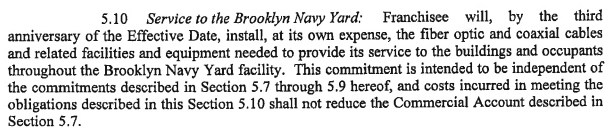
Time Warner Cable did not, however, provide this investment out of the goodness of their heart. They were required to under the terms of the current franchise agreement the company signed with city officials:

[Time Warner Cable] will install, at its own expense, the fiber optic and coaxial cables and related facilities and equipment needed to provide its service to the buildings and occupants throughout the Brooklyn Navy Yard facility.

Time Warner Cable is also extending its network to more commercial establishments throughout the city, in keeping with its previously-announced interest in expanding services to business customers. Nothing new to see here either.

That did not stop Bloomberg News from comparing Time Warner’s network expansion with Google’s gigabit network in Kansas City:

Time Warner Cable Inc. will expand fiber-optic lines to businesses in New York, a move that boosts Internet speeds as much as 20 times and provides an East Coast counterpoint to Google’s ultrafast network in Kansas City.

The company faces a threat from Google more than 1,000 miles away in Kansas City, where the Internet-search giant is building a fiber-optic network as a test project. Time Warner Cable is the main broadband provider for the area, which spans parts of Missouri and Kansas. While Google’s network will be available to both companies and households, Time Warner Cable’s New York fiber network is focused on businesses.

Google’s network initially will only be sold to residential customers, which are the primary targets for the service. Time Warner Cable’s fiber backbone network primarily works in tandem with its coaxial cable network and does not provide a fiber to the premises connection except for the company’s largest corporate customers.

Time Warner Cable Business Class sells different speeds and services to commercial clients. Most choose speeds considerably lower than 1,000Mbps because of the cost.

What was missing from the coverage is the fact ordinary residential Time Warner Cable customers in New York City will not benefit from these fiber upgrades — they are targeted only to commercial clients. Residential customers will continue to receive the same hybrid fiber-coax service they always have from the cable company.

If New York customers want fiber service, they will have to buy it from Verizon, assuming FiOS has made its way to your borough and neighborhood.

Department of Oops: Suddenlink Defends Its “Accurate” Usage Meter, Then Disavows It

Phillip “The Company Paid by Suddenlink to Issue a Third Party Guarantee Makes All the Difference” Dampier

When Stop the Cap! and Broadband Reports reader Simon contacted us about Suddenlink’s fact-free usage measurement tool that managed to rack up nearly 23GB of usage for one West Virginia customer on the same day his service was out for most of the evening, he probably did not think one customer catching the cable company’s fingers in the usage cookie jar would make much difference.

But it did.

Suddenlink spokesman Pete Abel, initially responding to complaints about the usage tool’s accuracy, told Light Reading last week its meter was “consistently accurate, as was demonstrated in the tests we ran before we launched this program.”

Four days later, the company effectively disavowed that, put the meter’s built-in overlimit fee scheme on hold and plans to hire a third party company to “validate the accuracy of its system,” after finding it was faulty after all.

Suddenlink won’t say what is causing the inaccuracies, but blamed “unusual” circumstances for the problem. The company is now refunding customers billed overlimit fees of $10 per 50GB and waiving future charges until its system is reviewed and validated by “a trusted third party.”

Stop the Cap! believes that does not come close to satisfying the company’s responsibility to its customers for accurate billing.

Suddenlink has never demonstrated it actually needs an Internet Overcharging scheme with usage limits and overlimit fees. The company proves that when it claims only a “relatively small number of customers” were ever billed overlimit fees. With no demonstrable usage problem, the company’s need to implement its Project Imagine “Allowance Plan” is sorely lacking.

Easy as counting anyway we like.

Additionally, the accuracy of providers’ usage measurement tools has proven highly suspect, and not just with Suddenlink. All of the companies caught with inaccurate meters always strongly defend them, until overwhelming evidence suggests they should not. Even super-sized companies like Bell Canada (BCE) and AT&T have enforced usage limits with meters the companies later had to disavow. Suddenlink is only the latest.

The scale in your grocery store is checked and certified. So is the corner gas pump, your electric meter, water meter, and gas meter. Why should broadband usage be any different?

Consumers are right to suspect Suddenlink’s usage meter. No official regulatory body verifies the accuracy of usage measurement tools and whatever company Suddenlink chooses to “verify” its meter has a built in conflict of interest — it works for a company that depends on a certain result in its favor. Suddenlink clearly has no business in the usage measurement business when it insists on the accuracy of a meter it disavows just a few days later.

With only murky details available to consumers about what caused the problem and why Suddenlink did not see it until a customer managed to catch them in the act, there is little confidence the company will actually solve a problem it never realized it had. There is also nothing to assure us — “third party guarantee” or not — it cannot happen all over again.

Suddenlink customers need to reach out and tell Suddenlink its “Allowance Plan” is completely unacceptable. Tell the cable company you don’t want to worry about their unverifiable and proven-inaccurate metering program. Ask them why you should remain a customer when they spend time and money on a scheme that the company itself admits is not really needed — targeting just a small number of “heavy users.”

Suddenlink’s customer service team does not think much of customers who use their broadband service a lot, as this recent “Who’s On First” exchange illustrates:

Lisa (Suddenlink): “Well, you show heavy OVERUSAGE of the Internet, you drew 14GB of data yesterday.”

Customer: “Okay, let’s back up, explain to me how I drew 12GB of data when my power was off and I wasn’t home on June 30.”

Lisa: “I didn’t say anything about June 30.”

Customer:  “If you have sooo much faith in your meter, explain to me how I drew 12GBs of data on June 30, while I didn’t have power, and wasn’t home.”

Lisa:  “I didn’t say anything about June 30.”

Customer:  “I’m asking, how did I draw 12GB of data without power to my house?”

If Suddenlink has a problem with a handful of users creating problems for other subscribers on its broadband network, it has always reserved the right to contact those customers directly and work out the problem one on one. That is a far better solution than inconveniencing all of their customers with endless rounds of “usage roulette,” where the big winner could find themselves with Bill Shock from overlimit fees, whether they actually deserve them or not.

[flv]http://www.phillipdampier.com/video/CNBC Internet v. Cable 8-20-10.flv[/flv]

CNBC interviewed Suddenlink CEO Jerry Kent in August 2010 on how his company intends to deal with “invasive online video,” threatening to erode cable-TV profits. Kent proved Suddenlink doesn’t really need any extra money from overlimit fees — the days of big spending on capacity are over, but the money is nice to have anyway.  (8 minutes)

“Increased Programming Costs” Cause Comcast to Jack Up Broadband Rates 6.1% in Oregon

Phillip Dampier August 27, 2012 Comcast/Xfinity, Competition, Consumer News, Frontier Comments Off on “Increased Programming Costs” Cause Comcast to Jack Up Broadband Rates 6.1% in Oregon

In a new twist, Comcast has announced rate increases for cable television that are roughly at the rate of inflation (2.3%) — the lowest rate increase for the company since 2001 — but is also hiking rates for Internet service at a substantially higher rate.

The company claims the Internet rate increase is partly due to the increased number of channels on its cable systems in Oregon and southwest Washington, as well as the cost to launch new interactive applications and multi-platform content that customers want and value.

Comcast’s rate increase for video represents the new reality for the cable business — companies continue with 7%+ increases in cable TV rates at the risk of cord cutting, analysts say. With cable television packages increasingly seen as ripe for cutting as they grow more expensive, cable operators are turning to broadband — a service customers can’t live without — to make up the difference.

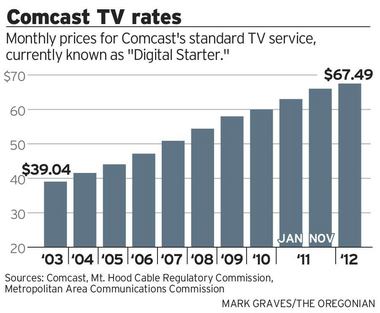
Comcast had not touched broadband rates in the Pacific Northwest for seven years, until the company began hiking them in 2011. Monthly rates for the popular “Performance” Internet service (15Mbps) are going up again this year, from $48.95 to $51.95, according to The Oregonian. Prices are higher for standalone broadband service. Comcast’s Digital Starter TV package is increasing to $67.49 a month. Rates for customers on promotions will not  increase until those offers expire.

But some customers complain Comcast is now charging nearly $200 a month for its triple-play package.

One customer told the newspaper after his introductory triple play promotion expired, the bill rose to $190 a month for phone, Internet, and cable service with two DVR boxes. The customer does not have any premium movie channels.

The Oregonian has tracked Comcast’s rates in the Pacific Northwest for almost a decade. The staircase of climbing prices for cable television is leveling off as Comcast makes up the difference from its Internet rates.

The newspaper noted Frontier Communications, which provides competition for Comcast in the suburbs of Portland, has given Comcast only a slight headache.

Frontier continues to offer its barely-advertised FiOS television package for around $65 a month, but customer complaints about Frontier’s service in the area have been reflected by Comcast’s growing subscriber numbers.

One Oregonian reader summed up his feelings about Frontier:

Frontier was atrocious. I don’t just mean bad, I mean an embarrassment to humanity […] which chimpanzees and dolphins laugh at us for putting up with. I’ve had Frontier service for a little over a year now only because there is nothing else where I live.

The nightmare started with them coming out hook up DSL at my new house, but instead of hooking me up, [they tore] out the demarc box on the house and left with it,  lost all records of ever having talked to me, much less scheduling an appointment.

After finally getting Internet service a week late, the original [service order] showed up leading them to bill me for multiple accounts, which took five months to  resolve. They never were able to prove to me I actually owed what I ultimately paid (I got them to within one bill’s worth of my calculated value and gave up).

Half of the time I’ve held off paying my bill until a day or two before the due date so it’s too late to mail a check and their online payment system is down, forcing me to call in my payment and pay a $3 service fee.

All of that is on top of the blatant theft of forcing customers who already own modems to pay a “modem rental fee” for a modem they aren’t renting.

Cable One’s Lousy Service Brings Subscriber Losses, Cities Looking for Alternatives

THE Internet Overcharger

Cable One, one of the nation’s most notorious, usage-capped broadband providers, has left thousands of Columbus, Miss. subscribers without phone, Internet, and cable television service since 6pm Sunday night, unable to repair the problem until a part arrives at the local cable office.

The Dispatch reports a steady stream of people, unable to get answers from Cable One over the phone, have been showing up at the company’s local cable office from the time it opened for business this morning, all looking for answers.

Cable One General Manager David Lusby said he had no idea how many customers were affected by the outage or when the cable system would be back up and running. Those are not the answers customers want to hear, particularly for customers depending on Cable One for their local businesses. Local shops have been unable to process credit card transactions, cannot make or receive calls, and are relying on personal cell phones for basic connectivity with the outside world.

New Hope resident Walter Worthy is fed up with Cable One’s bad service, calling the company’s broadband service “spotty” for more than a month.  Worthy told the newspaper he would rather have AT&T’s DSL service if he could, but AT&T has shown no interest extending service in his neighborhood.

One ex-customer named Matt told the newspaper he finally dropped Cable One Internet service that cost $65 a month for the same reason.

Cable One maintains one of the most arcane Internet “Fair Use” policies in the country, with broadband usage limits that apply to both daily and monthly usage:

Excessive Use Daily Threshold
(combined upstream & downstream)
Tier Economy Standard
(5 mbps only)
Standard (Preferred or Elite Plans w/ 50 Meg Upgrade) Premium
(10 mbps)
Ultra
(12 mbps)
Threshold Not applicable 3 Gigabytes Data Plan Applies 5 Gigabytes 10 Gigabytes

Another limit applies to monthly usage:

Data Plans for Elite & Preferred Packages
(Subscribed under Contract Offerings or Post Contract Rollover only)
Data Plan Base Speed Upgraded Speed during Contract Period Gigabyte Allocation per Month Measurement Period
Preferred 5 Mbps 50 Mbps 50 Gigabytes 8 am – 12 Midnight
Elite 5 Mbps 50 Mbps 100 Gigabytes 8 am – 12 Midnight


Data Plans for 50Mbps Internet
(Does NOT apply to Contract Offerings or Post Contract Rollover)
Package Type Data Speed Gigabyte Allocation per Month Measurement Period
50Mbps Internet
(A-La-Carte)
50 Mbps 100 Gigabytes 8 am – 12 Midnight
3 Pack Elite Promotion/Bundle 50 Mbps 100 Gigabytes 8 am – 12 Midnight
2 Pack Preferred Promotion/Bundle 50 Mbps 50 Gigabytes 8 am – 12 Midnight

The combination of poor service and a confusing Internet Overcharging scheme resulted in the cable operator experiencing a loss in broadband customers, almost unprecedented for cable companies. Cable One said goodbye to 1,017 high-speed Internet and 9,610 basic video subscribers during the second quarter, according to its owner, The Washington Post.

Communities like Natchez, Miss. are responding by attempting to shorten its franchise renewal with the company, which typically runs 10 years.

Ward 3 Alderwoman Sarah Smith foresees the contract being renewed but isn’t certain she wants the city’s digital future tied to Cable One for the next decade.

“Technology is changing so fast, I just don’t see us having any contract for as long as 10 years,” Smith told the Natchez Democrat.

Smith notes local residents have regularly complained about Cable One’s service, and the city has considered the possibility of letting another operator take over in the area, but has found no takers.

“We’re not going to be on the top of the radar for every service to be here,” Smith said.

More importantly, it is unprecedented for another major cable provider to displace a current operator, no matter how poorly they provide service.

Search This Site:

Contributions:

Recent Comments:

Your Account:

Stop the Cap!