Home » Competition » Recent Articles:

Say No to Bell Canada: One Buyout Too Many for Canadian Competition

Earlier this year, Bell Canada announced a blockbuster $3.38 billion offer to buy Astral Media, Inc. It is just the latest rush towards media concentration in Canada as the country’s largest cable and phone companies acquire a growing number of television networks, cable services, radio and broadcast television outlets, magazines, and other media.

Bell Canada already owns CTV – a major broadcast network, and TSN sports. Now it is back for more — Astral Media, the company that owns HBO Canada, The Movie Network, Family, Viewers Choice and lots more.

If this deal wins approval, one company will control 37.6% of TV viewing in Canada, more than twice the amount of its largest competitor. It means Bell will be able to set rates for some of Canada’s most popular cable networks and shows — putting competitors at a major disadvantage and forcing you to pay more to watch.

[flv width=”640″ height=”380″]http://www.phillipdampier.com/video/Say No to Bell Canada.flv[/flv]

Say No to Bell’s ad campaign fighting Bell Canada’s attempt to buy Astral Media.  (1 minute)

The federal government has to approve this deal, and a growing number of competing media companies, consumer groups, and politicians are coming together to oppose it.
Stop the Cap! believes Bell Canada owns too much already, and has repeatedly demonstrated that when it flexes its marketplace muscle, consumers pay more for less service. Add your voice against this deal by submitting a letter to Canada’s Ministers of Heritage and Industry, the Competition Bureau, the CRTC and your Member of Parliament and visiting the other opposition websites noted below.

No company needs to own and control 79 TV channels, 107 radio stations and more than 100 major Canadian news, entertainment, and cultural websites.

Even smaller Canadian cable companies fear this deal. Cogeco Cable, Eastlink, and Quebecor (parent company of Vidéotron), have joined forces to launch saynotobell.ca, a website to help consumers fight back. Quebec-based consumer group Option consommateurs has its own online petition in French, and Openmedia’s Stop the Takeover Coalition includes a range of pro-consumer forces opposed to the deal:

  • OpenMedia.ca
  • the Public Interest Advocacy Centre (PIAC)
  • the Canadian Internet Policy and Public Interest Clinic (CIPPIC)
  • Canada Without Poverty and the CWP Advocacy Network,
  • the Canadian Media Guild (which represents over 6,000 media workers, including those from CBC, Reuters, the Canadian Press, and Shaw Media),
  • the Consumers’ Association of Canada,
  • the Council of Canadians (Canada’s largest citizens’ group),
  • the Council of Senior Citizens’ Organizations of British Columbia (COSCO),
  • Union des consommateurs.

Some of the arguments against the deal to consider:

  • Bell Canada’s TV audience share would be 50% greater than the share of any TV network in the US, Japan, UK, Australia, France, and Russia. It would allow one corporation to control the programming (including news) on a scale not seen outside of countries like Italy, Brazil, and Mexico. When politicians have that much control of the media, they use it to influence viewers. Would Bell do any different?
  • Bell can set the rates, terms, and bundling requirements for popular cable programming and services. They have already shown a willingness to tell independent ISPs they must set usage limits on their customers just as Bell does already. What would stop them from insisting you subscribe to more services in order to watch the programming you want?
  • Mergers=job losses and cost cutting to pay for inflated bonuses and “cost savings” to help finance these blockbuster deals. Without competition, original Canadian productions can be slashed to the bone or canceled altogether. Why deliver quality when you can limit viewers’ alternative choices instead?
  • America allowed media consolidation in radio and television and turned vibrant local stations into corporate money-machines at the expense of local news, original shows, and local content. How many radio stations in the United States now operate like automated electronic jukeboxes? How many local TV newscasts signed off for good to “save money.” Can Canadian local news, weather, and informational programming survive Bell’s ax? If it happened in the United States, it can happen in Canada too.

Ensure diversity by disconnecting this Bell deal permanently, and tell your elected leaders to stop allowing endless media consolidation.

[flv width=”576″ height=”344″]http://www.phillipdampier.com/video/Globe and Mail How much of a competition threat is Bells Astral deal 8-24-12.flv[/flv]

The Globe and Mail considers the issue of Bell’s takeover bid for Astral Media. How will it affect Canadian consumers? (2 minutes)


Kansas’ Fiber Broadband Cup Runneth Over: New SureWest Projects Compliment Google

Phillip Dampier September 5, 2012 Broadband Speed, Competition, Consumer News, Google Fiber & Wireless, SureWest Comments Off on Kansas’ Fiber Broadband Cup Runneth Over: New SureWest Projects Compliment Google

Did you miss out on Google Fiber’s forthcoming gigabit broadband network in Kansas City, Kansas and Missouri? Kansans may not be out of luck, as provider SureWest aggressively continues work to expand its own fiber to the home network in several Kansas City suburbs and nearby communities.

SureWest, which believes strongly in fiber service, is busy laying fiber in conduits in Fairway, Mission, Roeland Park — all in Kansas. It also offers service in Lenexa, Overland Park, Shawnee and parts of Kansas City, Mo.

With all of this fiber, some Kansans may soon be able to choose between two competing fiber to the home providers.

SureWest General Manager of Kansas City operations Matt Zuschlag says SureWest’s fiber broadband service, which tops out at 50/50Mbps, will work just as well as Google’s gigabit (1,000Mbps) service because most web sites don’t need super fast speeds to load equally as fast. Even some bandwidth-intensive applications will not be able to take full advantage of Google’s fiber speeds because the networks currently supporting them were not designed to deliver sustained gigabit speed to end users.

SureWest works good enough for communities like Prairie Village, which is asking the company to wire its community for fiber service, regardless of where Google expands next.

SureWest competes with traditional cable and phone companies — Time Warner Cable and AT&T in the case of northern Kansas, and sells traditional triple play packages of phone, Internet, and television service.

But SureWest says its fiber network is always laid underground, which the company says offers improved reliability. Google Fiber is being installed largely on overhead lines alongside other utility services. SureWest says going underground allows it to skip the delays associated with obtaining pole use permits.


Largely Pointless ‘Radio Shack Mobile’ Simply Resells Cricket Service, Where Available

Phillip Dampier September 5, 2012 Competition, Consumer News, Cricket, Editorial & Site News, Wireless Broadband Comments Off on Largely Pointless ‘Radio Shack Mobile’ Simply Resells Cricket Service, Where Available

Another face in the crowd.

For customers uncomfortable being seen anywhere near a Cricket store, Radio Shack’s No-Contract Wireless may be just what you were waiting for.

The electronics chain today unveils two Cricket-powered mobile phones as part of their new “no-contract” prepaid wireless offering.

  • The Huawei Mercury Ice is exclusive to RadioShack for the next 30 days and appears to be a slight makeover of the original Huawei Mercury… in white. For $149.99, the Android 2.3 phone is powered by a 1.4 GHz processor, a scratch-resistant 4-inch FWVGA screen and 8MP camera. With Muve Music® included in the $50 a month unlimited data plan, the phone delivers unlimited song downloads, ringtones and ringback tones.
  • The $39.99 Huawei Pillar feature phone works with plans that start at $25 a month, includes a QWERTY keyboard, camera, and rudimentary mobile Web access.

Cricket’s own cell coverage is more limited than most carriers, and an extensive roaming agreement with Sprint covers the rest of the country where Sprint provides service. If Sprint does not cut it in your area, Cricket will not either. Cricket emphasizes its home coverage in urban and near-suburban areas and across major highways. Their rural coverage is extremely lacking.

Once you reach the specific data limit, Cricket throttles your connection speed to something comparable to dial-up.

Plan Details1 $25/mo. Feature $35/mo.Feature $50/mo.Smartphone $60/mo.Smartphone
Voice Minutes/Mo. 300 1,000 Unlimited Unlimited
Unlimited Text * * * *
Additional Calling Features2 * * * *
Unlimited Multimedia Text * * * *
Unlimited Music with Muve Music * *
Unlimited Web/Data * * * (1GB) * (2.5GB)
Tethering  N/A  N/A  N/A *
1 All monthly service plans include Voicemail and Caller ID. (*-feature included)
2 Additional Calling Features include: Call Waiting and 3-way calling.

Unfortunately, Radio Shack does not bring anything new to the deal except additional retail stores where customers can buy phones and activate the service. Cricket customers can choose these plans and a wider array of phones directly from Cricket, its website or one of its authorized dealers or resellers. But if your nearest Cricket store is in a sketchy neighborhood or you don’t want your friends to catch you walking out of one, Radio Shack offers a potentially safer alternative (although nobody under 40 probably shops at Radio Shack either).

That being said, Cricket offers respectable service when you live and travel in areas where it provides service. In suburban Rochester, N.Y., your author’s personal experience is that voice coverage is comparable to that offered by Sprint. Their 3G network performs better than Sprint, but falls far behind AT&T, T-Mobile, and Verizon Wireless. Data roaming over Sprint’s 3G network is painfully slow in this area.

Cricket is planning on upgrading to 4G LTE service in additional cities next year. Currently, its coverage map only shows LTE service in Tucson, Ariz.

Supreme Court Indirectly Torpedoes Settlement Between Comcast & Philadelphia Customers

Phillip Dampier September 5, 2012 Comcast/Xfinity, Competition, Consumer News, Editorial & Site News, Public Policy & Gov't, RCN Comments Off on Supreme Court Indirectly Torpedoes Settlement Between Comcast & Philadelphia Customers

A surprise announcement from the U.S. Supreme Court that it will hear an appeal brought by Comcast Corporation in a class action lawsuit brought on behalf of Philadelphia consumers, despite a pending settlement, may mean the Supreme Court is on the verge of issuing another business-friendly ruling that will make class action cases more difficult to file.

Comcast had reached a tentative settlement in June with lawyers who brought a $875 million class-action lawsuit on behalf of Philadelphia area cable subscribers. The antitrust case, originally filed in 2003, accused Comcast of strategically swapping or acquiring cable systems owned by Marcus Cable, Greater Philadelphia Cablevision, Inc., Lenfest Communications, Inc., AT&T, Adelphia Communications Corp., Time Warner, and Patriot Media in and around Philadelphia for the purpose of creating a super-sized Comcast cable system that could deter competitors from entering the market and allow Comcast to charge higher prices for service.

RCN Telecom Services originally intended to compete for cable customers in the Philadelphia region, but found it could not break into the market because Comcast allegedly hired as many available technicians it could find and tied them down with exclusive contracts. RCN also claimed Comcast targeted potential customers with special, allegedly below-cost deals to retain their business. RCN later filed for bankruptcy.

“Stated bluntly, Comcast and other large cable operators have demonstrated both the inclination and the wherewithal to use their market power to crush broadband competition in their local markets whenever it has the audacity to appear,” RCN alleged.

In 2002, RCN went public with a series of allegations:

Comcast intimidates independent construction and installation contractors. Comcast prevented or tried to prevent about 15 Philadelphia-area contractors from doing business with RCN through “non-compete” clauses, RCN alleged. The company provided specific names of contractors and Comcast personnel in sealed documents.

Those practices dated at least to the late 1990s, when Comcast acquired Suburban Cable, RCN said. Both Suburban and Comcast went “to extraordinary lengths to document ‘violations’ and intimidate contractors who were thought to be in contact with, or working for, RCN,” RCN said.

RCN cited instances of Suburban Cable employees, many of whom later worked for Comcast, allegedly following contractors in their trucks and taking photographs to document contractors seen at an RCN office or work site. These photographs then became “evidence,” RCN said, to support contractors’ termination.

As for predatory pricing, RCN claimed that before its entry into Folcroft in 2000, Comcast allegedly established a sales “swat team” instructed to sign up customers for 18-month contracts in exchange for cheaper cable services.

The plaintiffs’ attorneys want subscribers to receive refunds representing the savings they would have enjoyed had a competitor successfully forced prices down.

Comcast and the plaintiffs’ counsel reached a tentative settlement in June after both sides learned the lawsuit would proceed to trial this September. But in a surprise announcement, the U.S. Supreme Court suddenly decided to step in and hear an appeal filed by Comcast. Comcast immediately declared the settlement incomplete and has now declined to proceed with it, believing it has a more favorable outcome waiting at the Supreme Court.

Kenneth A. Jacobson, a professor at Temple University’s law school, told the Philadelphia Inquirer the Supreme Court does not typically decide to hear a case “during the settlement negotiation and approval process.”

Other Supreme Court watchers suspect the Court’s sudden involvement in the case means it is likely to issue a precedent-setting decision, more likely than not in Comcast’s favor, that will be talked about in law journals for the next decade.

Comcast Center in downtown Philadelphia

The specific point of Comcast’s appeal that interests the Supreme Court has to do with how a class action case certifies damages to the court hearing the case. The Supreme Court agreed to hear the case based on, “whether a district court may certify a class action without resolving whether the plaintiff class has introduced admissible evidence, including expert testimony, to show that the case is susceptible to awarding damages on a class-wide basis.

Currently, courts insist that the burden of proof for damages lies with the plaintiff, but they are not necessarily required to demonstrate the actual individual damages suffered by each member of a proposed class action. Many judges accept the concept of fixed group damages based on a composite of an average proposed class member. That amount gets multiplied by the number of members in the certified class action to arrive at the total requested damages. Typically, both sides negotiate a final settlement, deduct attorney fees and costs, and then class members typically get a change in a company’s policies, coupons good for a future purchase or an actual refund in the mail.

The Supreme Court may find that concept inadequate, and insist on a detailed analysis of actual harm done to each proposed class member — a high and potentially expensive hurdle to cross for many class action cases. Legal analysts suggest the intended effect of such a decision would be to further deter class action lawsuits against companies, because the costs and complexities involved would increasingly not be justified.

In the Comcast case, the cable company wanted the court to dismiss the case, and for some very novel reasons:

  1. Since Comcast effectively kept competing “overbuilding” cable systems out of Philadelphia, there is no evidence of any theoretical competition benefits such as reduced prices;
  2. Since no competitor actually got their service up and running in Philadelphia, Comcast argues there was no competition to eliminate;
  3. RCN, in Comcast’s view, was never actually going to start service in Philadelphia because of their own financial woes;
  4. Without actual competition in Philadelphia, there is no basis for any expert witness hired by the plaintiff to credibly estimate damages;
  5. Even if Comcast was engaged in anti-competitive behavior in Delaware County, that cannot be used by plaintiffs to serve as evidence of class-wide impact for the entire multi-county Philadelphia Comcast cluster.

Over the past few years, the Court has ruled in favor of corporations trying to compel less-costly legal avenues — like mandatory arbitration — for consumers who feel harmed by a company’s actions.

Sprint Launches Ad War on Verizon’s Share Everything Plans: Caps=Headaches

Sprint has launched a new ad series and accompanying web site to warn consumers that choosing Verizon’s new Share Everything data plans can give you a big headache and a higher monthly bill.

“The concept of sharing a monthly data allowance across a family or group of users increases the likelihood for a surprise monthly bill due to data overage charges,” said Caralene Robinson, vice president of brand strategy and marketing communications for Sprint. “Data usage continues to increase and consumers value Truly Unlimited data because it’s simple and straightforward.”

Sprint argues that customers have enough trouble differentiating the usage of the applications they run themselves. When sharing a data plan with other members of a family, it can quickly become impossible to know exactly who is consuming what. That makes it easy to exceed a monthly usage allowance, which results in costly overlimit fees. Tracking usage and the inevitable arguments that will result at the dinner table make Verizon’s new share plans a real headache in Sprint’s view.

Sprint proposes that customers switch to their Truly Unlimited data plan, which has no limits and also costs less than Verizon’s shared data plan. Sprint also continues to sell budget plans that offer a calling allowance in return for a reduced price. Verizon now only sells unlimited voice minutes bundled into their Share Everything plans.

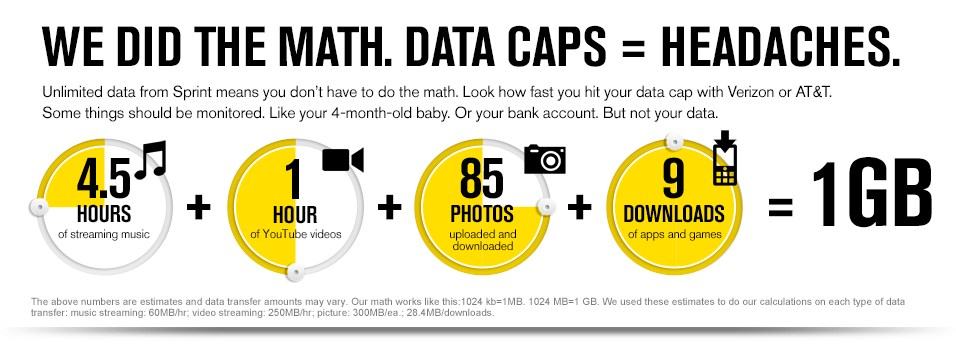
Unlike most carriers who boast customers can send millions of e-mails or visit hundreds of thousands of web pages with a low allowance data plan, Sprint explains what a 1GB limit really means when customers use increasingly popular streaming services and apps. It turns out Verizon’s 1GB allowance plan does not deliver that much.

[flv width=”640″ height=”380″]http://www.phillipdampier.com/video/Sprint Say No to Sharing – Family Meeting.flv[/flv]

Sprint launches its “Say No To Sharing” and “Say Yes To Sprint” campaign with this “Family Meeting” ad, which shows a family debating how to divide up their shared data plan and avoid overlimit fees.  (1 minute)

Search This Site:

Contributions:

Recent Comments:

Your Account:

Stop the Cap!