Home » Competition » Recent Articles:

Charlotte’s Cozy Corporate Welfare Helps Time Warner Cable, Leaves Customers With the Bill

Time Warner Cable would like to thank the city of Charlotte and the state of North Carolina for the generous handouts of taxpayer-funded corporate welfare that helped make their newly-christened $82 million data center possible.

In return, Charlotte residents pay the nation’s highest cable bills, according to a piece in the Charlotte Observer.

Time Warner Cable maintains a cozy relationship with state and local officials — friendly enough to help win the company a state Job Development Investment Grant worth up to $2.9 million in public tax dollars in return for hiring 225 workers in their eastern national data center. Critics contend Time Warner was going to need to hire workers with or without the grant.

According to WhiteFence, the average Charlottean paid $51.18 for standalone high-speed Internet services in October.

The group surveys pricing from utility providers nationwide and builds a national price index for different services, including broadband.

No city pays higher prices that Charlotte, N.C., according to the group. The WhiteFence Index also shows Internet pricing is rising steadily, up from less than $40 charged this past May.

The Libertarian Party of North Carolina is probably the biggest opponent of corporate welfare handouts in the state:

By taking money from the taxpayers and giving it to businesses in the form of “corporate incentives,” our state and local governments are playing a game of Reverse Robin Hood. They are robbing from the poor and giving to the rich. The Libertarian Party of North Carolina denounces all corporate welfare programs as fiscally irresponsible and calls for their immediate abolition.

Millions of dollars are taken every year from our taxpayers and stashed into various funds and programs at all levels of government. The purpose of these funds is supposedly to attract businesses to our area and help them expand, under the theory that this will create jobs and promote general prosperity.

This theory has two fundamental defects. First of all, the government has no place in deciding which jobs should be created and maintained. A free market is infinitely better equipped to respond to the economic needs of businesses and consumers. When the government starts funding already successful companies, it becomes harder to compete in the marketplace if you have a new company with an innovative idea or service.

More directly, we can not have general prosperity until we rid ourselves of our excessive tax burdens. The first cause of economic prosperity is when consumers have money to spend. But we have less and less spending money, as governments take more and more from our paychecks. And then they use that money taken from us as legal bribes to entice their corporate favorites to come to North Carolina.

Cancel Your Cable TV and Watch Your Broadband Bill Skyrocket; $20 More Without TV Service

Phillip Dampier November 16, 2012 Comcast/Xfinity, Competition, Consumer News, Verizon, Video 10 Comments

Major cable and phone companies are rolling out new bundled packages and promotions designed to protect their cable television packages from cord cutting.

Verizon, Comcast and Time Warner Cable have all run promotions that carry a clear message: cancel your cable television and your wallet gets it.

The Wall Street Journal shared the story of Comcast subscriber Cathy Vu, who decided she no longer wanted cable TV and tried to downgrade to a broadband-only account.

Comcast gave her an offer she could not afford to refuse when the representative explained canceling cable television would increase her monthly bill $20. As a result, Vu decided she would save more money keeping her cable television turned on.

Welcome to the new world of double and triple play bundled pricing promotions that bring downgrade penalties customers cannot ignore.

The idea of repricing cable service to protect vulnerable cable television and phone service began in earnest after analysts like Sanford Bernstein’s Craig Moffett began noticing customers were no longer addicted to keeping cable television, no matter the cost. He proposed a solution: price broadband service higher and cut the cost of cable television.

The result: carefully constructed promotional and bundled package offers that entice customers to purchase services they might not even want, to get the best (and sometimes lowest) price. Gone were promotions that offered phone, broadband, and television service for $33 each. In their place, new pricing that charges $60-70 for the first service, and heavily discounted prices for each additional service.

You know the pitch:

“Yes, I am calling to sign up for broadband service,” you say.

“Certainly, I would be glad to help you with that. But did you know that for just $20 more a month, you can also get cable television?”

“Really, it’s only $20 more? Sure.”

“I am thrilled to hear you say that. But I hope you are sitting down because I have more good news. For just $10 more, we can give you a phone line with unlimited local and long distance calling. How much do you pay the phone company now?”

“Too much, that sounds like an amazing deal, so I get everything together for $99 a month?”

“You sure do, for the first 12 months anyway.”

One year later when the promotion ends, you call to begin downgrading service to lower your bill. But cable and phone companies are increasingly ready for you.

First they will offer you a slightly less attractive promotional retention offer to keep your business. If you accept, the company gets to book the extra revenue and probably locked you into an annual service agreement.

If you don’t bite and insist on a downgrade, they have some bad news for you — that broadband service you still want will now cost you $60-70 a month, including the modem fee.

If you bail early on a promotional discount offer, the bite on your wallet can be significant.

The Journal found unbundling just does not pay:

  • Comcast: TV + Internet for about $50/month for the first 6 months vs. standalone same speed Internet for about $70/month.
  • Verizon FiOS: TV + Internet for about $85/month (two-year contract) vs. standalone Internet for about $80/month.
  • Time Warner Cable: TV + Internet for about $50/month for 12 months vs. standalone Internet for about $45/month for 12 months, then up to $60 after that.

At the end of the day, Moffett and the rest of Wall Street get their wish — preservation of the all-important growing average revenue (ARPU) collected from each customer. Downgrades lower ARPU, so they must be discouraged at all costs.

Cable operators “recognize that their most advantaged product is broadband,” said Moffett. “They don’t want to sacrifice that advantage by giving the opportunity for customers to cherry pick their best product at a low price and take the rest of your services from somebody else. In effect, they are pricing the broadband at a price that discourages you from taking broadband only.”

Customers primed for cord cutting (or who have never bought cable TV) are likely to receive targeted mailings from Verizon, Comcast and Time Warner Cable encouraging subscriptions to cable TV and prices that nearly give the service away.

Comcast’s Blast Plus promotion in selected markets delivers 30Mbps broadband with Digital Economy television service, both for $50 a month for six months. Internet-only customers would pay $70 per month for the same speeds without television.

Time Warner Cable in New York City wants to be your cable TV supplier so much, it offers a package of broadband and throws in Broadcast Basic service for just $5 more per month. Combined, Turbo Internet and television will cost $49.99 a month for a year. Standalone Internet on a promotion runs $45 a month for 12 months.

On a strict cost basis, charging more for Internet does not make sense. The Journal reports that about 90% of your monthly broadband bill is pure profit for cable operators, because the cost of delivering the service has continued to plummet to all-time lows. Cable television is no longer the cash cow it used to be for cable operators because programmers increasingly demand a piece of the profit pie. Today, cable operators only get to book about 35% of your monthly cable television payment as profit.

[flv width=”640″ height=”369″]http://www.phillipdampier.com/video/WSJ Cable Cord Cutting Less Attractive 11-13-12.mp4[/flv]

The Wall Street Journal examines the trend towards repricing broadband service so that customers feel compelled to keep their cable television package or face even higher bills.  (5 minutes)

Three Wireless Competitors in Alaska is ‘Too Many’; Who Will Buyout ACS?

With Verizon Wireless poised to launch 4G LTE service in Alaska for the first time, Alaska Communications (ACS) and AT&T are hurrying wireless broadband expansions to protect their market turf. But Wall Street investors are unhappy, especially with ACS’ investments in its landline network and the recently announced suspension of its dividend payout. Some are now asking whether ACS’ lucrative wireless business should be up for sale, primed for a buyout by AT&T or Verizon Wireless.

Alaska Communications has soft launched its LTE 4G service in 10 cities: Anchorage, Fairbanks, Homer, Juneau, Kenai, Palmer, Seward, Soldotna, Wasilla and Whittier.

AT&T operates a mix of LTE and slower HSPA+ networks in Alaska and is expanding 4G service to Prudhoe Bay and Deadhorse for the benefit of short-term oil company employees working on the North Slope. But the company is also still expanding its existing 3G network along more remote Alaskan highways.

They are coming.

The investment frenzy is seen by many as a defensive maneuver to keep existing customers happy before Verizon Wireless arrives in Alaska sometime next year.

ACS and GCI, Alaska’s homegrown phone and cable companies now jointly operate their wireless operation together. AT&T is their principle competitor. But Verizon Wireless’ impending arrival in Alaska has shown it is no shrinking violet. There are persistent rumors Verizon is trying to acquire ACS’ wireless operations. Verizon has also announced partnerships with Copper Valley Telecom and Matanuska Telephone Association to potentially expand LTE service in those communities as well.

Investors hope ACS considers any Verizon offer carefully. Wireless is a revenue center for the landline phone company, which continues to see declines in home phone and business customers.

Since June, ACS lost just shy of 2,000 residential landlines and 753 business lines. The company still has 57,000 residential customers and 81,000 business customers.

ACS faces the same problems other phone companies do: network upgrades require significant investments, and investors question whether it will ultimately pay off. Many are also unhappy ACS suspended its dividend payout, refocusing $8 million on debt payments.

Rogers’ Sticks It to Independent ISPs – Increased Speeds Not Easily Available to Competition

Share and share alike is a concept unfamiliar to Rogers Communications, at least in the eyes of the independent Internet Service Providers who have wholesale bandwidth agreements with eastern Canada’s largest cable operator that are supposed to guarantee speed parity.

The Canadian Network Operators Consortium (CNOC) last week announced it filed a complaint with the Canadian Radio-television and Telecommunications Commission (CRTC) accusing Rogers of withholding speed increases from independent ISPs.

In 2006, the CRTC made it clear that cable companies must treat its wholesale customers fairly:

The Commission determines that should a cable carrier introduce a speed upgrade to one of its retail internet service offerings with no corresponding price change, it is to issue at the same time, revised [third-party ISP access] tariff pages that match these retail service speed changes with no corresponding price change.

According to CNOC, Rogers wants independent ISPs to pay higher prices for the faster speeds it is providing its own customers for no additional charge.

That leaves providers like TekSavvy at a competitive disadvantage, according to the provider.

Peter Nowak explains Rogers is attempting to hurry independent ISPs to move to “aggregated points of interconnection,” part of the foundation of the CRTC’s earlier decision on usage-based billing. Independent ISPs were given two years to complete the transition and Rogers wants that change to move at faster pace:

Rogers wants indie ISPs to move onto the aggregated method, something it says the CRTC essentially ordered at the conclusion of the big usage-based billing fiasco a year ago. Here’s what a spokesperson told me:

We are not denying TPIAs access to our new speeds provided they have moved to a single point of connection, called an aggregated point of interconnection (POI). As part of the usage based billing rulings in November of last year, TPIAs were given two years to move from a disaggregated POI to an aggregated POI. The sooner this happens, the sooner we can provide those speeds to these third party ISPs.  Rogers will continue to provide access at existing speeds on the old network architecture until November 15, 2013.

The dispute, as usual, boils down to whether or not Rogers’ move can be considered anti-competitive. The small ISPs argue that it is, since Rogers’ own retail customers are getting the benefit of higher speeds without higher prices, yet the indie companies – and their own subscribers by extension – are being expected to pay more.

If it’s uneconomical for the indies to sell the faster speeds, they won’t, in which case the big network owners like Rogers will hold a distinct advantage since internet access is sold largely on speeds. Since they’ll simply perish if they can’t keep pace, the indie ISPs will ultimately have no choice but to accept the higher prices being pushed on them – and that effectively neutralizes the entire point of their existence, which is to provide a competitive check to the big guys.

CNOC has asked the CRTC to make an expedited ruling on the controversy as soon as possible to mitigate competitive damage.

CenturyLink CEO Thinks AT&T Has a Tough Road Ahead Cutting Off Rural Landlines

CenturyLink CEO Glenn Post does not think much about AT&T’s plans to shift its most rural landline customers to wireless in its efforts to decommission traditional landline service.

“From a regulatory standpoint, that could be a tough go,” Post explained to Wall Street investors on a conference call last week. “There may be some areas that will have better service with wireless in some ways. As far as a competitive threat, we don’t see that being a real issue for us because just the bandwidth requirements and the limited wireless access or capability in a lot of areas.”

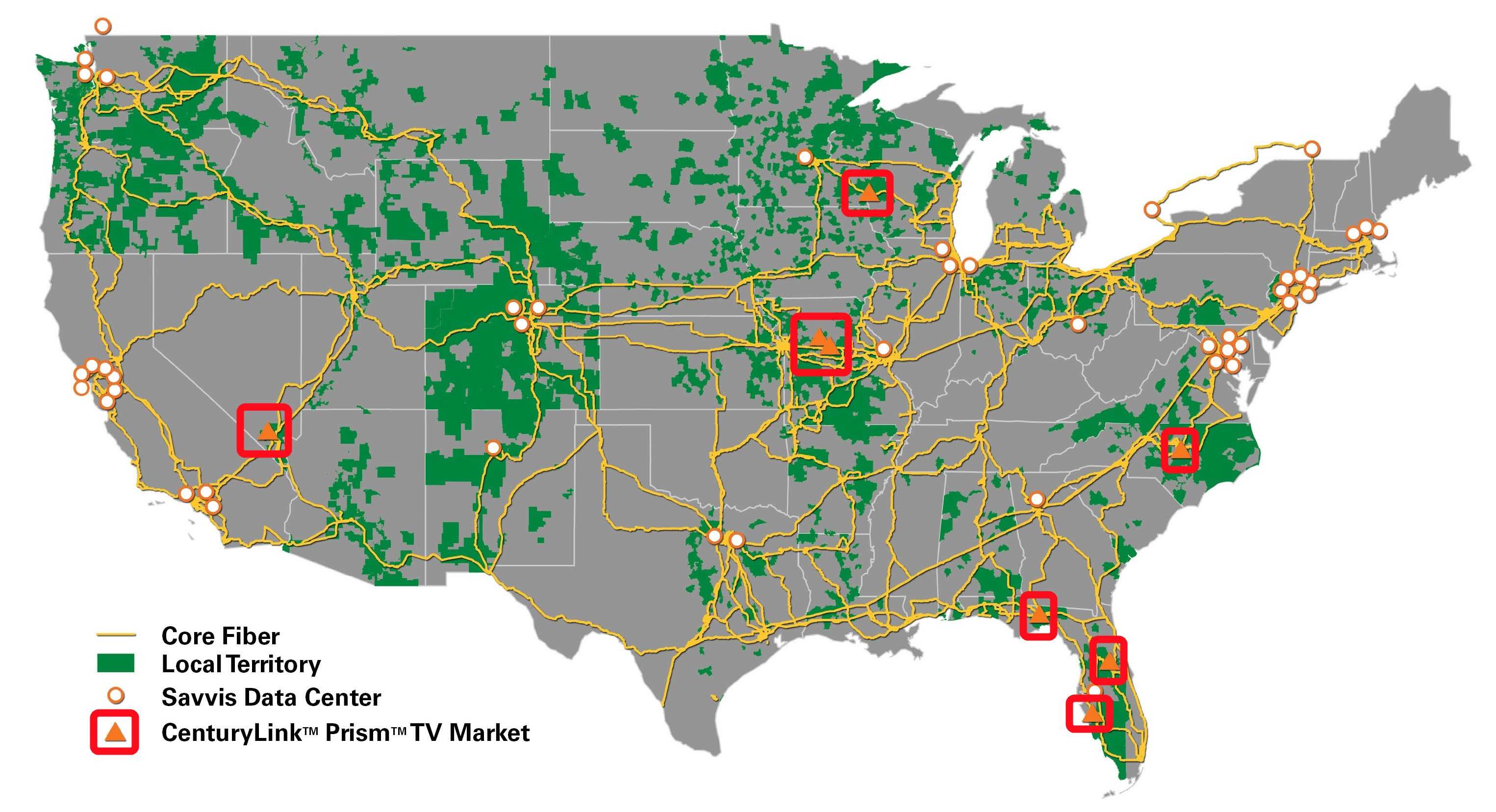
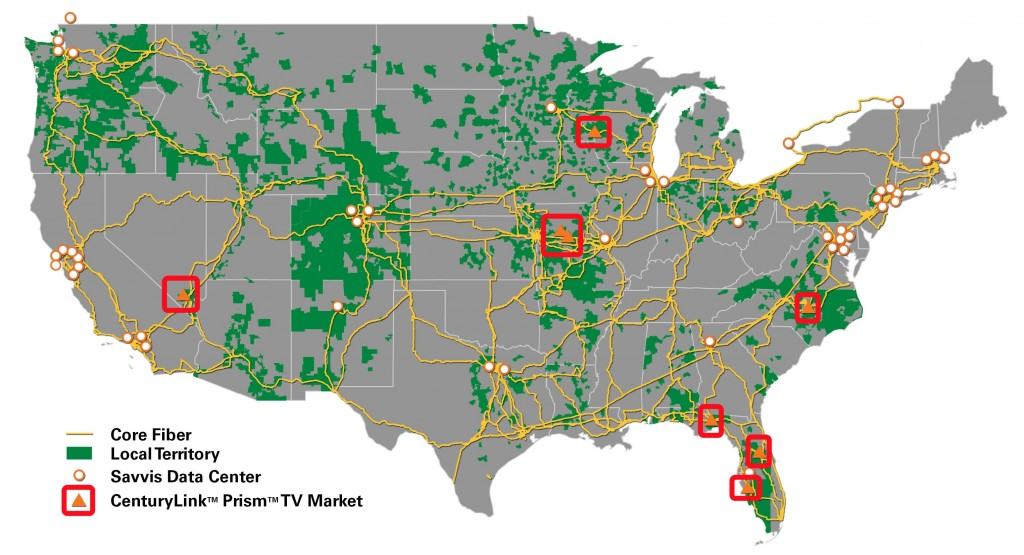
CenturyLink, one of four large independent phone companies and owner of former Baby Bell Qwest, is doubling down on its wired infrastructure to reach customers. The company recently announced Phoenix would be the latest city to get its fiber-to-the-neighborhood service Prism TV — the first legacy Qwest market to get IPTV service from CenturyLink. The service soft-launches in Phoenix this month, with a second city in the region or Pacific Northwest slated to get Prism sometime next year.

The company has spent much of 2012 investing in broadband, managed hosting and cloud computing for business customers, and fiber expansion to reach more than 15,000 cell towers across CenturyLink’s national service area, depicted in green on the accompanying map.
But CenturyLink executives stress their investments are “strategic” — made in areas that are most likely to deliver quick returns for the company.

While CenturyLink spends money to secure video franchising agreements in metro Denver and Colorado Springs for Prism TV service, it is moving at “a snail’s pace” to deliver broadband service in northeastern North Carolina’s Northampton County. County officials there anticipate CenturyLink will take years to deploy basic DSL service to communities outside and around Conway and Gaston.

The broadband problem in income-challenged parts of North Carolina illustrate the conundrum for county officials, who have to advocate for broadband improvement while combating misleading broadband maps that suggest access is not a problem in the state.

Donna Sullivan with the Department of Commerce notes that broadband maps in states like North Carolina have a census block granularity which does not always reveal the true picture of broadband availability.

“That means if one household in that census block can receive broadband services, the entire census block is considered covered—even though there very well may be households who cannot receive broadband to that location,” she told the Roanoke-Chowan News-Herald.

Northampton County, N.C.

CenturyLink is in no hurry to expand broadband to the 1,921 households in the county of 22,000 who cannot buy broadband service at any price.

Derek Kelly, a CenturyLink spokesman, said the company is working to expand broadband services in the region, but noted the costs to lay down a fiber network to help reach the unserved is “one of the largest costs.”

That cost is much less of a problem if the customer at the end of the line happens to be a wireless company like Verizon or AT&T.

Company officials admit they are spending enormous sums “investing in fiber builds to as many [cell] towers in our service area as economically feasible.” In the third quarter alone, more than 1,000 cell towers received fiber upgrades for a total of 3,300 so far this year. The company hopes to reach 4,000-4,500 cell towers by New Year’s Eve.

The reason why CenturyLink chases wireless business while allowing rural and income-challenged service areas to go without broadband is a simple matter of economics. Cell phone companies sign lucrative, multi-year contracts for fiber connectivity to cell towers to support forthcoming 4G service. In contrast, CenturyLink was surprised to find an astounding 94 percent of families with children in Northampton are qualified for the company’s special Lifeline Program which delivers slow speed, discounted broadband service for families on public assistance.

Post

For CenturyLink’s more urban and prosperous service areas, the news for broadband service improvements is better.

As CenturyLink continues to extend its middle mile fiber network, broadband speeds are gradually improving.

Over 70 percent of CenturyLink customers can receive at least 6Mbps DSL service, more than 57% can receive at least 10Mbps and 29% can access the Internet at 20Mbps speeds or better, according to Post.

But the more urban and prosperous a service area is, the greater the chance a cable competitor has successfully poached many of CenturyLink’s DSL customers with the promise of better speed.

Post said he recognizes the company must do better to remain competitive.

“We’re shooting for 20-25Mbps for a very large percentage of our areas,” Post said. “But with [pair] bonding, we can virtually double the broadband capacity and speeds in our markets. We’re already doing bonding in a number of markets today. So where we have 20Mbps, we could have 40Mbps.”

CenturyLink’s fiber to the neighborhood network, essential where it plans to roll out Prism TV, can also support faster broadband speeds if a customer wants broadband alone and does not care about television service.

Nationwide, the company added 10,000 Prism TV subscribers in the third quarter and has a total customer base of around 104,000 subscribers. But that represents a penetration rate of just over 10%, hardly noticed by still-dominant cable operators.

CenturyLink executives were asked to comment on AT&T’s strategic plan to transform their landline network announced last week in New York. Post found little in common between CenturyLink and AT&T’s vision for the future and does not think the company has to respond to AT&T’s attempt to redefine rural America as wireless territory.

“We don’t see that as a major investment for us or a major risk at this point.”

Search This Site:

Contributions:

Recent Comments:

Your Account:

Stop the Cap!