Home » Competition » Recent Articles:

New Report Slams Data Caps: An Internet Overcharging Climate of False Internet Scarcity

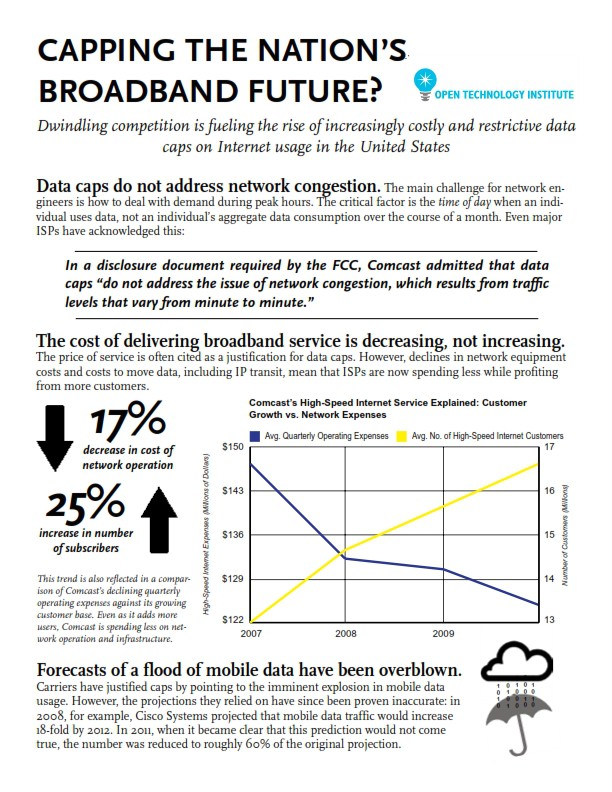
Data Caps 2-Pager_001

A new report critical of broadband providers’ implementation of usage-based billing and data caps finds providers are not using them to handle traffic congestion, instead implementing them to monetize broadband usage and protect pay television from online video competition.

stop_signThe New America Foundation and the Open Technology Institute today released its report, “Capping the Nation’s Broadband Future?,” which takes a hard look at the increasingly common practice of limiting subscribers’ broadband usage.

The paper finds that provider arguments for limiting broadband traffic don’t make sense, but do earn more dollars from customers forced to upgrade their service to win a larger monthly usage allowance.

“Although traffic on U.S. broadband networks is increasing at a steady rate, the costs to provide broadband service are also declining, including the cost of Internet connectivity or IP transit as well as equipment and other operational costs,” the reports argues. “The result is that broadband is an incredibly profitable business, particularly for cable ISPs. Tiered pricing and data caps have also become a cash cow for the two largest mobile providers, Verizon and AT&T, who already were making impressive margins on their mobile data service before abandoning unlimited plans.”

The study finds providers are attempting to invent a climate of broadband scarcity, particularly on the nation’s wired networks, to defend the introduction of various forms of Internet Overcharging, including data caps, usage-based billing, and overlimit fees.

The New America Foundation is calling on policymakers to take a more active role in defending online innovation and controlling provider zeal to cap the nation’s broadband future.

The False Argument of Network Congestion

Courtesy: Broadbast Engineering

Providers’ tall tales.

The most common defense for usage caps providers put forward is that they curb “excessive use” and impact almost none of their customers. The report points out many of the providers implementing usage caps have left them largely unchanged, despite ongoing usage growth patterns. In 2008, the report notes Comcast measured the average monthly usage of each broadband customer at around 2.5GB. Just four years later that number has quadrupled to 8-10GB. While many customers rely on Comcast’s broadband service for basic e-mail and web browsing, the cable operator has begun to entice customers into utilizing its online video platform, which in certain cases can dramatically eat into a customer’s monthly usage allowance, which remained unchanged until earlier this year.

Many broadband providers are less generous than Comcast, some imposing caps as low as 5GB of usage per month.

“Data caps encourage a climate of scarcity in an increasingly data-driven world,” the report concludes. “Broadband appears to be one of few industries that seek to discourage their customers from consuming more of their product. Thus, even as the economic and engineering rationale for data caps on wireline broadband does not hold up given the declining costs of providing service and rapid technological advancement, the proliferation of data caps is increasing. The trend is driven in large part by a woefully uncompetitive market that allows the nation’s largest providers to generate enormous profits as well as protect legacy business models from new services and innovators.”

The argument that increased usage puts an undeniable burden on providers is untenable when one examines the financial reports of providers.

The study found, for example, Time Warner Cable’s latest 10-K report shows that connectivity costs as a percentage of revenue have decreased by half, from an already modest 1.20% in 2008 to a little over 0.60% in 2011.

In 2012, the company is again exploring ways to introduce usage caps on at least some of its customers, in return for a modest discount.

Upgrade? Spend Less and Charge Customers More Instead!
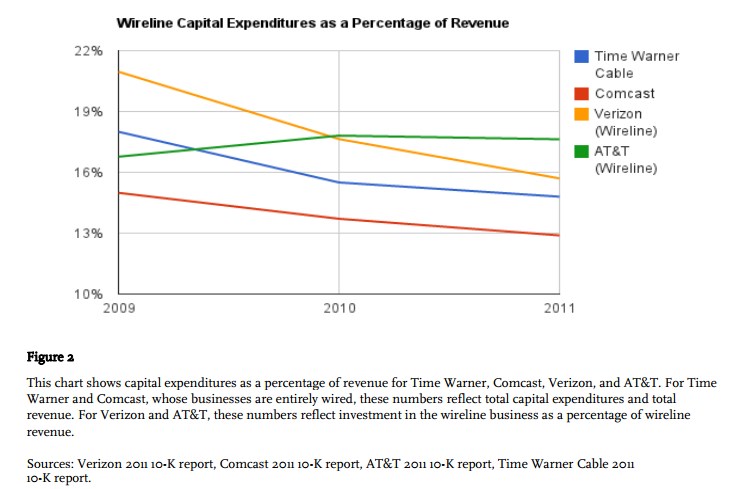
wireline capital

The report notes cable companies like Time Warner Cable and Comcast, whose networks were originally built for television services and have now been repurposed for broadband as well, are enjoying lucrative profits on
networks that have long been paid off. In fact, Time Warner Cable recently disclosed it earns more than 95 percent in gross margins on its broadband service, with additional rate increases for consumers likely in the near future. The company recently began charging its customers a modem rental fee as well.

Shammo

Shammo

At these margins, the report concludes selling broadband service to “data hogs” who consume hundreds of gigabytes of traffic per month are still profitable for providers.

As financial reports disclose capital spending on network upgrades continue to fall, operators are instead content imposing usage limits on customers to control traffic growth and further monetize an already enormously-profitable business.

The nation’s largest phone companies also come in for criticism. The report quotes from Stop the Cap!’s coverage of Verizon’s chief financial officer openly admitting it is investing most of its available capital in the highly profitable wireless sector.

“It is clear that in shifting a greater percent of their overall capital expenditures to their wireless segments, Verizon and AT&T are more interested in expanding their dominance in the wireless industry than they are in upgrading DSL or expanding fiber connectivity to provide aggressive competition for residential broadband service,” the report found.

Verizon’s chief financial officer recently made the following statement at an investor relations event:

“The fact of the matter is wireline capital — and I won’t give the number but it’s pretty substantial — is being spent on the wireline side of the house to support wireless growth,” [Verizon CFO Fran Shammo] said. “So the IP backbone, the data transmission, fiber to the cell, that is all on the wireline books but it‖s all being built for the wireless company.”

Wall Street Educates Providers on How to Lead the Way With Data Caps

Although the majority of subscribers loathe usage restrictions on their already-expensive broadband accounts, a vocal group on Wall Street strongly favors them, and routinely browbeats providers on the issue.

Helping educate cable companies about how usage caps can protect against cord cutting and further monetize broadband.

Helping educate cable companies how usage caps can protect against cord cutting and further monetize broadband.

The report’s authors discovered some Wall Street banks even invest time and money developing presentations advocating usage caps and consumption billing to protect video revenue. A 2011 Credit Suisse presentation outlined ways usage-based billing can protect cable operators’ video revenues:

“…over the longer term, consumption based billing could reduce the attractiveness of over the top video options (e.g., Netflix and Hulu), as the economic attractiveness of such over the top options could be partially offset by a [broadband] bill that is higher, due to [broadband] overage charges that would be driven by large amounts of data being streamed via a customer’s [broadband] connection.”

Yet most cable operators vehemently deny usage caps and consumption billing are designed to decrease usage or protect video revenue. Credit Suisse and other Wall Street banks and analysts say otherwise, and express little concern over network congestion.

The report finds compelling evidence that data caps have effectively stopped new competitors and online innovation already, noting a Sony executive stated that the company was putting the development of its own online video service on hold, citing Comcast’s monthly usage cap.

The Wireless Cap Shell Game: Caps Protect Scarce Airwaves While Companies Promote More Usage, For a Price

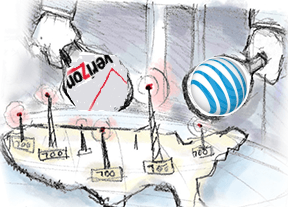
The report also found suggestions of a forthcoming wireless traffic tsunami are greatly exaggerated. AT&T and Verizon Wireless have issued repeated alarmist rhetoric claiming that wireless data’s exponential growth is threatening to overwhelm available network capacity.

But both carriers recently changed pricing models to encourage consumers to bring more devices to their networks, along with suggestions customers upgrade to higher allowance plans to handle the additional traffic generated by those devices. In fact, both AT&T and Verizon Wireless see profitable futures in forthcoming “machine to machine” wireless traffic that will allow cars, appliances and medical devices to communicate over their respective mobile networks. AT&T’s security and home automation system also relies on its own wireless network, offering customers remote access to their homes, chewing up wireless bandwidth as they go.
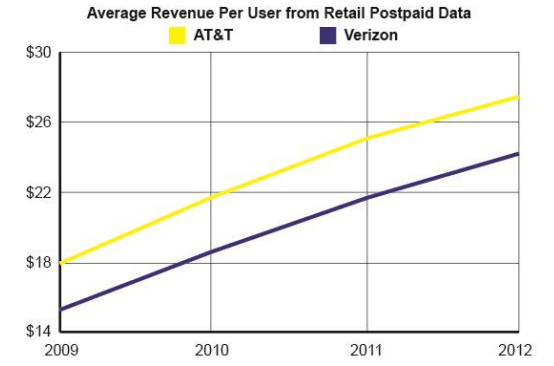
Despite suggestions from both providers their new wireless data plans would save customers money, in fact it has resulted in overall increases in the average revenue earned from each subscriber.

Despite suggestions from both providers their new wireless data plans would save customers money, it has brought overall increases in the average revenue earned from each subscriber instead.

 

Netflix Releases ISP Streaming Quality Report: DSL/Mobile Offer Poor Results

Phillip Dampier December 13, 2012 Broadband Speed, Competition, Online Video, Wireless Broadband Comments Off on Netflix Releases ISP Streaming Quality Report: DSL/Mobile Offer Poor Results
Cable to Netflix: You better think about going back to the U.S. Post Office and mailing DVDs. Our customers can't afford to throw away their usage allowance on your streamed movies.

Keeping ISPs honest

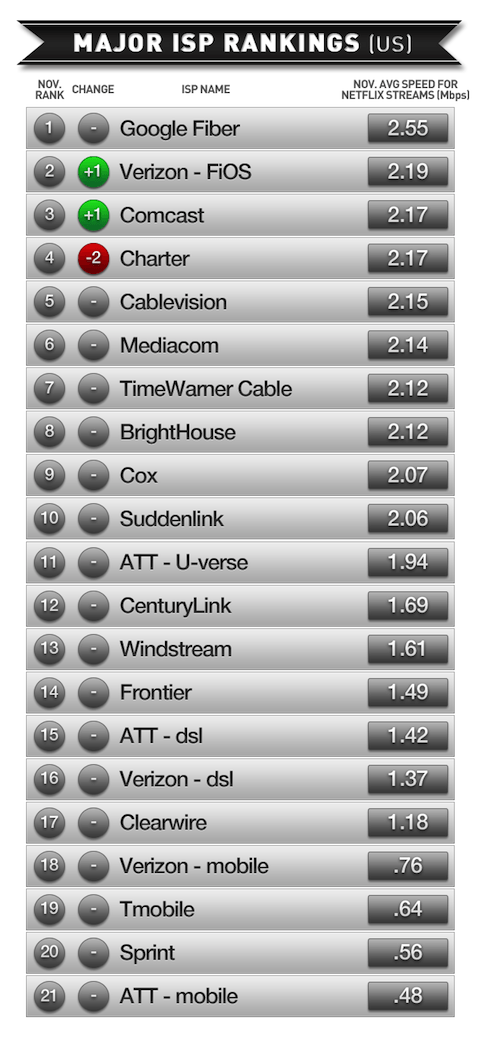
Netflix may have the most accurate national broadband speed honesty test around, at least when it comes to streaming video. With 30 million members viewing over one billion hours of Netflix streamed content every month, the company is well-positioned to report the real-world performance of virtually every ISP in the country.

Starting this month, Netflix will publish once-monthly surveys of the best and worst-performing providers.

The results from November are not surprising. Fiber to the home offers America’s fastest and most reliable streamed video experience. Google Fiber, with its 1,000Mbps network, topped Netflix’s list, followed by Verizon’s FiOS fiber service.

Cable providers also performed well. Comcast delivered the best Netflix experience, Suddenlink the worst.

AT&T’s U-verse, which isn’t really a true fiber network but simply an extended form of DSL performed markedly poorer than its cable competitors.

DSL providers also performed poorly, ranging from CenturyLink to Verizon’s now neglected DSL. Frontier Communications made some improvements in its rankings. It used to be dead last.

Watching Netflix on mobile broadband proved to be both expensive (with data caps for most) and slow. Clearwire, which only operates a 4G WiMAX network performed the best. Despite the growing prevalence of HSPA+ and LTE 4G service from many other carriers, more common 3G service dragged performance down considerably. Verizon performed the best of the mixed networks, AT&T performed 40% worse than Verizon, coming in dead last.

20121210-Netflix_Major_ISP_Leaderboard-480-updated

GOP & AT&T Demand FCC Put Future Unlicensed Wi-Fi Frequencies Up for Spectrum Auction

auctionEfforts to develop new unlicensed uses for the public airwaves that include high-powered public Wi-Fi may be shelved if AT&T and House Republicans succeed in their joint effort to force those frequencies to be sold in a spectrum auction.

Majority House Republicans on the House Communications & Technology Subcommittee on Wednesday lectured all five FCC commissioners, insisting they have no authority to set aside spectrum specifically for unlicensed use when those airwaves could be sold to private companies.

Sub-Committee chairman Greg Walden (R-Ore.) criticized FCC Chairman Julius Genachowski for his plans to “give away” scarce airwaves eventually open to the public’s use when they could fetch as much as $19 billion in auction proceeds from large telecommunications companies seeking to own and control those frequencies.

Walden, the House’s second largest recipient of campaign contributions from the same companies likely to bid on that spectrum, insisted federal law only allows the Commission to designate unlicensed uses for so-called “technically necessary guard bands,” which act as a buffer between neighboring frequency users to protect against interference. Walden also criticized the FCC for setting aside too much spectrum for that protection.

Walden

Walden, the second largest recipient of telco cash in Congress.

The Oregon congressman has collected more than $84,000 in campaign contributions from telephone companies so far this year. Only House Speaker John Boehner won larger contributions from companies like AT&T.

Other Republican members of the subcommittee agreed with Walden’s sentiment and also received generous contributions from AT&T this year.

Rep. Lee Terry (R-Neb.), wanted to be sure the FCC does not impose “value-sapping restrictions” on the use of privately-owned airwaves owned by large telecommunications companies. Terry is the third largest recipient of campaign contributions in the House from those telecom companies, adding $69,400 so far this year to his campaign coffers.

Rep. Joe Barton (R-Tex.) expressed concerns that spectrum auctions could displace low-power television stations to make way for mobile communications. But Barton did not oppose the auctions generally. His largest contributor: AT&T, which sent him checks for more than $21,000 in 2012.

Representative Robert E. Latta (R-Ohio) suggested auctioning off airwaves intended for public use to large mobile broadband companies would help America’s competitiveness, alluding to his belief unlicensed, free use of the airwaves for new wireless applications would not. Latta cashed $10,500 in AT&T checks so far this year — his fourth largest contributor. Latta added he wanted there to be transparency and openness in the entire spectrum process. He did not disclose his significant contributions from AT&T at the hearing, despite being a chief stakeholder in the debate.

Rep. Marsha Blackburn (R-Tenn.) agreed with large telecommunications companies that the maximum amount of available spectrum should be sold off to private companies to sell mobile broadband services to the public. Blackburn’s third largest campaign contributor this year is Verizon Communications, who sent her $15,400. AT&T, her ninth largest contributor, handed her $13,250, together adding up to $28,650.

The Democrats on the panel roundly criticized Republican plans to sell off spectrum intended for unlicensed, public use applications to large wireless companies, which already own and control frequencies they still have not put into service.

Terry, worried about value-sapping some of the largest wireless companies in America with pesky regulations.

Terry, worried about “value-sapping” regulations.

Rep. Henry Waxman (D-Calif.) called unlicensed spectrum an incredible economic success story.

“Innovative services like Wi-Fi and Bluetooth are now ubiquitous parts of our communications system,” he said in his opening remarks. “They came about because of the use of unlicensed spectrum.”

Waxman suggested eliminating or limiting unlicensed spectrum would destroy innovation and further concentrate wireless communications in the hands of a handful of companies. Waxman said Congress’ original intent in passing laws that permitted the FCC to move forward with spectrum auctions also authorize the agency to protect competition and prevent unnecessary concentration of spectrum ownership to the detriment of smaller providers.

“I am troubled by attempts by some to relitigate issues that were resolved earlier this year, when the bill passed Congress with widespread support,” Waxman added. “After-the-fact-spin that unfairly twists the language of the law deserves little weight by the Commission or the courts.”

Rep. Anna Eshoo (D-Calif.) noted the FCC by statute is prohibited from considering the amount of revenue possible from spectrum auctions when drafting auction rules. She found Republican efforts to recast those rules to raise as much money as possible by selling off as much spectrum as possible “interesting.”

Many Republicans also complained the FCC must not set rules that either limit the maximum amount of spectrum owned by one company or set aside certain frequencies exclusively for smaller competitors. The Republicans want auctions to maintain a more straightforward “highest bidder takes all” format. Critics say that gives the advantage to larger, deep-pocketed existing providers and dissuades the entry of new competitors.

Some Republicans were also upset with FCC meddling over when and how private companies begin providing service on the airwaves they won at auction. Current FCC rules prohibit warehousing unused spectrum. The rules were designed to ensure large companies don’t invest in airwaves just to keep them off the market and unavailable to competitors.

Fed Up Canadians Tell the CRTC: Stop 36 Month, Auto-Renewing Cell Phone Contracts

Phillip Dampier December 12, 2012 Bell (Canada), Canada, Competition, Consumer News, Public Policy & Gov't, Rogers, Telus, Video, Wireless Broadband Comments Off on Fed Up Canadians Tell the CRTC: Stop 36 Month, Auto-Renewing Cell Phone Contracts

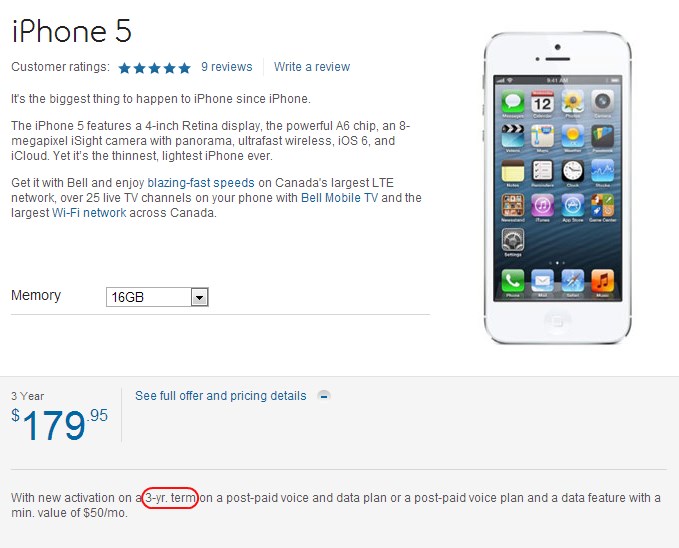
iphone termThink your wireless service contract ties you down?

More than 500 Canadians filed comments about their wireless service with the Canadian Radio-television and Telecommunications Commission as the telecom regulator wrestles with a proposed code of conduct for Canada’s wireless industry and the contracts they hand customers. Why? Because of language like this from a typical contract with Rogers Communications:

Device Savings Recovery Fee (applicable to term commitment customers only for any new term entered into on or after January 22, 2012): A Device Savings Recovery Fee (DSRF) applies if you have been granted an Economic Inducement (as defined below) upon entering your new term, and if, for any reason, your wireless service or your new term is terminated prior to the end of the term of your Service Agreement (Service Agreement Term). The DSRF is the amount of the economic inducement (which may take the form of a discount, rebate or other benefit granted on the price of your Equipment), as stated in your Service Agreement (Economic Inducement), less the amount obtained by multiplying such Economic Inducement by a fraction representing the number of months elapsed in your Service Agreement Term as compared to the total number of months of your Service Agreement Term (plus applicable taxes). In other words, DSRF = Economic Inducement [Economic Inducement × (# months elapsed in your Service Agreement Term ÷ Total # months in your Service Agreement Term)] + applicable taxes. An Additional Device Savings Recovery Fee (ADSRF) also applies if, for any reason, your wireless data service, or your data plans commitment term (Data Term), is terminated prior to the end of your Data Term. An Additional Device Savings Recovery Fee (ADSRF) also applies if, for any reason, your wireless data service, or your data plans commitment term (Data Term), is terminated prior to the end of your Data Term. The ADSRF is the additional Economic Inducement you received for subscribing to your wireless data service, less the amount obtained by multiplying such Economic Inducement by a fraction representing the number of months elapsed in your Data Term as compared to the total number of months of your Data Term (plus applicable taxes), and applies in addition to the DSRF for termination of your Service Agreement. If you subscribe to a plan combining both voice and data services, both the DSRF and the ADSRF apply, up to the total Economic Inducement.

Despite contract confusion being an issue in the eyes of the CRTC, the overwhelming majority of comments focused on something else that irks Canadians above all else: being held hostage by the industry’s traditional 36-month wireless contract, one year longer than consumers in the United States find common.

“Get rid of the 36 months contract,” wrote one Canadian, noting contract creep is all the rage. “It first started with 12 months, then 24 months, now the standard is 36 months, which is ridiculous!”

Most of the comments came from customers of the chief three providers: Bell, Rogers, and Telus. All three received scorn from customers for uncompetitive, expensive service.

The state of competition in Canada:

Roger offers new plans:
– $55 1000min local, unlimited text, 200MB
– $65 unlimited local/text, 1GB
– $75 unlimited local/text, 2GB
– $95 unlimited canada/text, 5GB

Then Bell offers their new competitive plans:
– $55 1000 min local, unlimited text, 200MB
– $65 unlimited local/text, 1GB
– $75 unlimited local/text, 2GB
– $95 unlimited canada/text, 5GB

Then Telus offers their competitive plans:
– $70 unlimited local/text, 1GB
– $80 unlimited local/text, 3GB
– $100 unlimited canada/text, 5GB

Where is the competition? These plans are all the same.

crtcAlso unfamiliar to Americans, the automatically-renewing contract that snags Canadians that forget to cancel with a brand new service commitment complete with a cancellation penalty. Perhaps the most consumer-friendly provinces in Canada are Quebec and Manitoba, which ban certain kinds of termination fees and auto-renewing contracts. Canadians want these bans extended nationwide. The European Union already bans 36 month contracts and made 24 months the maximum. One former resident of the United Kingdom noted the EU also compels providers to offer 12 month contracts for those who want them.

The CRTC may not provide much relief if it remains convinced the marketplace remains competitive.

The agency points out under the Telecommunications Act, the CRTC will only intervene in a market if there is insufficient competition to protect the interests of users.  In the 1990s the CRTC decided to allow market forces to guide the growth of the mobile wireless industry.

The CRTC seems to have already made up its mind on this issue when it announced its proceeding:

In the decision issued on 11 October 2012, the CRTC found that there was competition sufficient to protect the interests of consumers and it did not need to regulate rates.  Although many consumers indicated concerns about wireless rates and the competitiveness of the wireless market, a number of market indicators demonstrate that consumers have a choice of competitive service providers and a range of rates and payment options for mobile wireless services. According to the CRTC’s 2012 Communications Monitoring Reportnew entrants in the mobile wireless market continue to increase their market share and coverage. Companies continue to invest in new infrastructure to bring new innovative services to more Canadians. Moreover, the average cost per month for mobile wireless services has remained relatively stable.

The CRTC concluded that competition in the mobile wireless market continues to be sufficient to protect the interests of users with respect to rates and choice of competitive service provider.

That makes it more likely than not the agency will limit itself to ordering wireless carriers to better explain their wireless policies, not force them to change them.

The only relief potentially available outside of canceling service is considering one of several new competitors which offer relaxed terms and better prices to attract customers. So far, only 4% of Canadians have switched to WIND, Mobilicity, Vidéotron, or Public Mobile. Some may be trapped in current contracts with larger companies or are discouraged having to buy new equipment to switch providers. Most providers in Canada, like in the United States, lock phones so they cannot be easily used on another company’s network.

[flv width=”640″ height=”380″]http://www.phillipdampier.com/video/CRTC Cell Phone Contracts 12-12.flv[/flv]

The CRTC used this video to invite consumers to share comments about confusing wireless service contracts. Instead, criticism of tricky term contracts that auto-renew and last three years arrived in buckets. (2 minutes)

Ohio’s Statewide 100-Gigabit Network You Paid For (But Can’t Access) & Other Broadband Woes

Phillip Dampier December 12, 2012 Astroturf, AT&T, Broadband Speed, Community Networks, Competition, Editorial & Site News, Public Policy & Gov't, Rural Broadband, Wireless Broadband Comments Off on Ohio’s Statewide 100-Gigabit Network You Paid For (But Can’t Access) & Other Broadband Woes

oarnetThe taxpayers of Ohio spent $13 million to fund a new 100 gigabit institutional fiber network average Ohio residents cannot access.

The upgraded Ohio Academic Resources Network (OARnet) delivers 10 times the speed of its immediate predecessor and is the first statewide network to achieve 100Gbps.

Gov. John Kasich was on hand to light the network, telling attendees at the ribbon-cutting ceremony it will provide research opportunities and help some of the state’s largest corporations manage manufacturing, data mining and analytics, alternative energy development, consumer products and medicine. He, among others, downplayed the fact the network offers little to average businesses and consumers in Ohio who helped pay for it. Large businesses can sign agreements with educational institutions around the state to gain access to the super-speed network.

While institutional broadband networks for education and research are important, and there is nothing inherently wrong with OARnet or its mission, it does very little to solve Ohio’s stubbornly poor broadband landscape, especially in rural areas.

This dollar-a-holler astroturf effort failed to impress Longmont voters, who turned away a Comcast-funded opposition campaign to open up the city's fiber network.

Advocacy groups affiliated with AT&T are back asking for more regulatory relief in return for promising a better broadband future for Ohio.

Ohio ranked a dismal 39th in TechNet’s broadband rankings published this month. Ohio’s Republican-dominated state government has been willing to devote state’s resources to enhance institutional broadband, but relies almost entirely on the private sector for broadband expansion to small businesses and residential customers.

TechNet notes Ohio has a history of cutting deals with providers like AT&T, among others, for “alternative” regulatory arrangements to encourage broadband expansion in exchange for approval of telecom company mergers.

The results have been meager in rural areas of the state. Despite provider promises to do more, fewer than 2% of Ohio residents have access to fiber broadband, and many smaller communities are forced to use slow speed DSL from AT&T, if they can get the service at all. AT&T has some more bad news for rural Ohio. The company’s idea of improvement is to dismantle its rural wired network and force customers to use AT&T’s expensive, bottom-rated wireless service, complete with extremely low usage caps.

As part of that process, AT&T and their friends and partners are back with more promises.

This time, it comes from research-for-hire reports like, “Incentive to Invest in Ohio Broadband & The Carrier of Last Resort Obligation,” which argues if Ohio releases AT&T from its obligation to provide phone service, investors will magically pour money into the state on broadband improvements. Just like last time. Only it never really happened for wired broadband customers.

The “report” was paid for by “Technology for Ohio’s Tomorrow,” a non-profit organization that claims it “advocates for public policies that inspire and encourage innovation in technology while informing and educating technology consumers about legislative and regulatory issues that impact their lives.”

While those things may be true, even more insight can be gleaned from who actually operates the group.

techforohioStop the Cap! learned:

  • Technology for Ohio’s Tomorrow is the Ohio project of Midwest Consumers for Choice and Competition;
  • Midwest Consumers for Choice and Competition is also related to Mobile Consumers for Choice and Competition;
  • Mobile Consumers for Choice and Competition is a registered lobbying group in the state of Wisconsin, doing business as Wired Wisconsin;
  • Wired Wisconsin’s chief partner and benefactor? AT&T It’s chief lobbyist and executive director? Thad Nation;
  • Nation has run a whole assortment of “consumer” groups out of his lobbying firm Nation Consulting, including: Illinois Technology Partnership, TV4Us, and Technology for Ohio’s Tomorrow. His work coincides closely with AT&T’s corporate agenda. When AT&T wanted statewide franchising of U-verse, TV4Us arrived on scene advocating exactly that. When AT&T wants to promote deregulation of its wired and wireless efforts and win government assistance with no strings attached, Wired Wisconsin, the Illinois Technology Partnership and Technology for Ohio’s Tomorrow were ready to go to bat for AT&T.
  • AT&T’s core involvement in all of these groups goes undisclosed.

Nation calls it an “advocacy agenda,” (we call it Astroturf backed by bought-and-paid for research) and Nation’s firm claims to specialize in it:

At Nation Consulting, Nation focuses on assisting corporate clients with strategic planning in government and public relations, and managing crisis communications.

Our team has worked on the “inside” of the offices of Governors, Congressional members, and state agencies. We’ve worked at every level of government, and we have the relationships necessary to help you navigate state and federal bureaucracies to accomplish your goals. We know how government works – and we know what government can do for you.

Getting government officials or bodies to do what you want isn’t easy. Government is inherently a slow, bureaucratic entity. When you want elected or appointed officials to change policy, you need a comprehensive plan – and the resources, relationships and quick-thinking to implement that plan.

We come to you with decades of experience in advocacy, moving legislators and engaging state agency leaders to action. Let us help you build and drive an aggressive advocacy agenda.

Regardless of your industry, the internet has a role to play in achieving your public relations goals – and we have the experience and the expertise to implement a plan suited to your needs. Whether you need to effectively use social networking sites, manage a blog, conduct email campaigns or use Web 2.0 tools, Nation Consulting can help you maximize your online presence in a way that is both cost-effective and beneficial to your business or organization.

Search This Site:

Contributions:

Recent Comments:

Your Account:

Stop the Cap!