Home » Competition » Recent Articles:

Charter’s Latest Bill Padder: The $3 ‘Change of Service Computerized (Junk) Fee’

Phillip Dampier January 3, 2013 Charter Spectrum, Competition, Consumer News 1 Comment
Broadband Reports/User: "compuguybna"

(Broadband Reports/User: “compuguybna”)

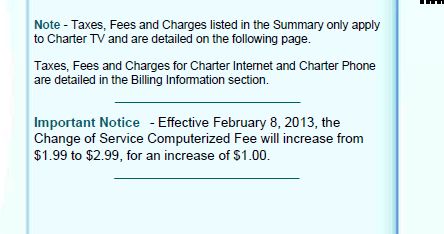
If you are a Charter Cable customer looking to make some changes to your service, watch your bill because Charter may charge you up to $3 for the cost of doing business.

They label it the “Change of Service Computerized Fee.”

Broadband Reports found the fine print for the inconsistent fee, despite it not appearing on Charter’s website. A number of customers learned about it only recently because the cable operator informed customers it was going up by $1 effective Feb. 8.

Many customers report the fee does not always get levied after interacting with a customer service representative, but should it find its way to your bill, the company will usually reverse it if customers call and complain.

Cable operators have adjusted to the reality of slightly higher levels of competition by advertising lower prices but piling on junk fees and surcharges that can further raise customer bills. In 2012, new fees for cable modem rental, bill payment service fees, increases in returned check charges, and other surcharges have been introduced by several companies.

Some satellite companies also charge as much as $5 to upgrade or downgrade service.

AT&T’s Recipe for Success: Keeping U-verse Rollout Schedule Away from Predatory Competitors

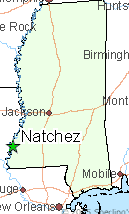
natchezCable subscribers in Natchez, Miss. are scratching their heads wondering why AT&T will neither confirm nor deny whether its fiber to the neighborhood U-verse service is coming to a neighborhood near them.

AT&T says if it told customers where the service was coming, it would give away vital information to its competition — the cable and satellite companies.

AT&T spokeswoman Sue Sperry says her competitors will stop at nothing to hang onto current customers, even if it means using predatory below-market-rate pricing.

“We’ve learned from experience that if they know what our footprint is, they go in and do retention offers and pretty much give their service away for next to nothing and then we can’t compete,” Sperry told the Natchez Democrat.

But considering its biggest competitor is locally-hated Cable One, a lot of customers would still be ready to switch even if AT&T sent the cable company its detailed business plans in advance.

“Unless you spend your weekends at the Bondage Bordello, there is nothing enjoyable about dealing with Cable One in Mississippi,” says Stop the Cap! reader DeWayne. “Last summer when their system went up and died on the folks over in Columbus, even the guy running it couldn’t tell when it was coming back.”

Top secret.

Top secret.

DeWayne started reading Stop the Cap! when we covered Cable One’s massive failure in August 2012 that brought all of its services in Columbus down while the company incredibly waited for express delivery of a replacement part. When customers could not get answers from Cable One over the phone, they lined up outside the local cable office only to learn from company general manager David Lusby he had no idea how many customers were affected by the outage or when the cable system would be back up and running.

“I hate AT&T but I hate Cable One more,” DeWayne said. “It is annoying that they won’t tell us when U-verse is coming to our neighborhood.”

Sperry claims AT&T U-verse is more robust than cable or satellite because it is powered by phone lines.

“That was one of the things during the hurricane, U-verse didn’t go out,” she told the newspaper. “It’s delivered through a phone line, and the phones are the last to go out.”

But unfortunately for customers, AT&T says it only rolls out U-verse in “a measured and slow way,” forcing customers to continually visit att.com and manually check availability using their home address.

But Sperry told the newspaper once customers get the service, they remain loyal to it. That may be especially true in smaller communities in Mississippi that cope with second rate cable operators not known for offering robust or affordable service.

Comcast, AT&T Announce Rate Hikes for Chattanooga; Publicly Owned EPB Has Not

Phillip Dampier January 3, 2013 AT&T, Broadband Speed, Comcast/Xfinity, Competition, Consumer News, Editorial & Site News, EPB Fiber Comments Off on Comcast, AT&T Announce Rate Hikes for Chattanooga; Publicly Owned EPB Has Not
Image: schvdenfreude

Image: schvdenfreude

Chattanooga Comcast and AT&T U-verse customers will need to open their wallets a bit more in 2013 as both the cable and phone company have announced new rate hikes that are now taking effect. But not everyone will pay more. Customers of EPB Fiber, which offers up to 1,000/1,000Mbps broadband and is a service of the publicly-owned electric utility is keeping prices stable until further notice.

Comcast customers face new increases averaging 4% in 2013 — $5 a month for Triple Play customers, several dollars more for broadband, and around $1 for basic cable service. Customers on promotions are unaffected until the temporary pricing expires.

AT&T U-verse customers will see price increases as much as $9 a month for television and broadband service.

Chattanoogans who ditched both private providers for the public option are sitting pretty with absolutely no rate increases to pay at this time. Although negotiations with programmers are ongoing, and costs are rising, EPB says it won’t raise any rates unless it becomes absolutely necessary. The utility takes rate increases very seriously, bringing them directly to its board of directors for approval.

Comcast and AT&T said the introduction of new services and increased programming costs contributed to their need to increase rates. Comcast says it has kept rates for its Xfinity service stable since 2010, a claim that doesn’t explain away its 4% rate hike in January 2012. AT&T said its supplier and labor costs also contributed to price increases, which also includes a broadband television surcharge.

If this seems like déjà vu, it could be because both AT&T and Comcast raised rates exactly one year ago this month. AT&T was the worst offender last year, boosting TV prices between $2-5 a month, equipment fees by $4-7 a month for broadband, and a $3 rate hike for its unlimited calling landline service. In comparison, EPB said it had no immediate plans to raise TV, broadband, or phone prices last year either.

epb_fiber_optics

EPB Fiber is the only Chattanooga telecom provider not raising its prices.

Customers facing rate increases can find an easy way to avoid them: threaten to take your business somewhere else. Retention agents are on the lookout for customers considering moving to another provider, and will usually slash rates to keep your business. Don’t want to argue your way to a lower rate or just want to say goodbye to Comcast and AT&T? Stop the Cap! highly recommends EPB Fiber, the most technologically advanced option in Tennessee, priced fairly with a proven track record of reliability.

A lot of Chattanooga area residents have already considered their options:

“Comcast is complete garbage,” writes one former customer. “Horrible product, even worse customer service. My Internet went out daily. I switched to EPB as fast as I could and have never been happier. I wouldn’t have Comcast again if it was free for the rest of my life.”

Another former cable customer reminds Comcast competition makes all the difference. He switched to EPB as well:

“Keep your Xfinity Comcast, you treated me like dirt when there was no other choice for cable. Now that I have that choice, I’ll never consider you again.”

Time Warner Cable Buys Independent Princetown Cable in $1.2 Million Deal

Phillip Dampier January 3, 2013 Broadband Speed, Competition, Consumer News, Public Policy & Gov't, Rural Broadband Comments Off on Time Warner Cable Buys Independent Princetown Cable in $1.2 Million Deal

logo_princetownTime Warner Cable is expanding its footprint in the capital region of New York with the acquisition of independent Princetown Cable Company, which serves around 600 subscribers in Princetown, Duanesburg and Rotterdam in Schenectady County.

Time Warner already manages cable service for most cable subscribers around the Albany-Schenectady region, but bought Princetown Cable to further solidify its holdings.

Princetown Cable began service in 1990 serving rural areas ignored by then-dominant TCI Cable (later AT&T Cable, then Comcast).

Most customers signed up to get better reception of television signals from nearby Albany and Utica.

Princetown Cable’s lineup of around 100 channels ($82.50/month for digital cable) is dwarfed by Time Warner, and its broadband service is comparatively slow and expensive:

Princetown Cable’s SpeedZone Internet Speeds & Pricing:
SpeedZone Lite Speeds up to 768kpbs download $19.95
SpeedZone Regular Speeds up to 1mbps downloads $32.95 with Cable
$42.95 w/out cable
SpeedZone Express Speeds up to 5mbps downloads $44.95 with cable
$54.95 w/out cable
SpeedZone Turbo Speeds up to 10mbps downloads $64.95 with Cable
$74.95 w/o Cable

Time Warner Cable agreed to pay $1.2 million for the system, which breaks down to around $2,000 per subscriber.

Washington Business Community Fed Up With Comcast/CenturyLink, Expands Community Fiber/Wireless

meshThe business community of Poulsbo, Wash., a Seattle suburb of 9,000 in Kitsap County, is fed up waiting around for CenturyLink and Comcast to increase broadband speeds in the area so several have joined forces to share the city’s underused, existing fiber-optic cables to offer free Internet access for area businesses and residential users.

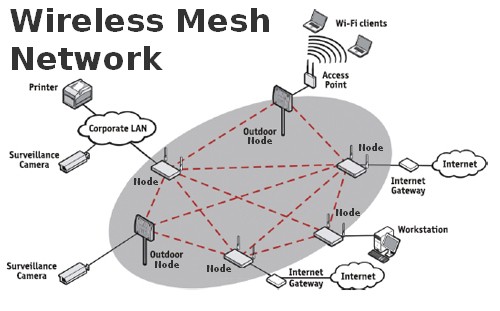
The Kitsap Public Utility District has launched a public-private partnership that offers free wireless mesh antennas to businesses willing to host them and pay any power costs incurred, so long as they agree to let customers and others in range of the network use it at no charge. The wireless mesh technology, more robust than traditional Wi-Fi, costs the public utility district between $7,000-$12,000 per site, but the resulting wireless coverage is cheap compared to wiring individual homes and businesses with fiber.

Local businesses, community leaders and the public consider it a win-win for everyone, especially because the existing institutional fiber network already in place is underutilized. The comparatively inexpensive wireless technology has not created any significant issues for area taxpayers or ratepayers, which effectively underwrite the antenna purchases, installation, and maintenance.

The wireless network offers speedy connections — as much as six times faster than the current broadband speeds sold by Comcast and CenturyLink in the county.

So far, four antennas have been installed downtown at local restaurants and a Lutheran church.
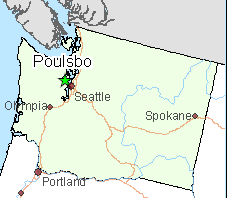
Poulsbo_WAStephen Perry, the PUD’s superintendent of telecommunications, says the new network is a pilot program to test if an economic model can be created to sustain the service and eventually expand it.

“The whole idea was to have it be a community network. It’s community based and owned so to have the community step up and want to take ownership of it … thought we’d have to force it on people,” Perry told the Kitsap Sun, noting district workers “can’t go fast enough” responding to fiber-optic interest.

The surprising support from the local business community has helped drive the project and publicize it. Local businesses love the new service, which they consider more reliable than paying for and maintaining a Wi-Fi network and Internet connection from Comcast or CenturyLink. The service does not require a password or complicated setup to access and has proved more reliable than older Wi-Fi solutions. Customers also enjoy the higher speeds.

Ed Stern, a member of the city council, said wireless mesh technology represents a major improvement over traditional Wi-Fi.

“It’s not a typical ‘hot spot’ limited to that business or specific location, but rather like ‘umbrella’ coverage, in that the antennas join together to create seamless coverage of everything and everybody throughout the area,” Stern said, adding network expansion is now inching into residential neighborhoods as well. “It’s really exciting.”

With countless towns and cities equipped with underutilized institutional fiber broadband networks lacking money to install direct fiber connections to homes or businesses, the wireless mesh option can offer an affordable introductory solution to expand service, publicize the community broadband initiative, and build support for even more ambitious public broadband opportunities in the future.

One local resident told the newspaper it was about time.

“The privatization business model has proven a failure,” wrote one reader. “Kitsap PUD needs to offer retail broadband to residents and businesses. These fiber cables are just sitting there doing nothing. There is one at the end of my driveway, but no one will sell me the service. Why would CenturyLink bother when they can continue to get overpaid for very slow speeds. In most places, there aren’t choices.”


Search This Site:

Contributions:

Recent Comments:

Your Account:

Stop the Cap!