


Home » Competition » Recent Articles:

ALEC Front Group Responds to Truth-telling About N.C. Broadband With Talking Points

The Man from A.L.E.C. pockets Time Warner Cable and AT&T's money.

The Man from A.L.E.C. represents premiere members Time Warner Cable and AT&T.

The News & Observer has printed a rebuttal to a guest editorial from Christopher Mitchell and Todd O’Boyle accusing the two of misleading readers about the true state of North Carolina’s broadband.

The author, John Stephenson, is director of the Communications and Technology Task Force at the American Legislative Exchange Council (ALEC). Considering North Carolina’s largest broadband providers — AT&T and Time Warner Cable — are both card-carrying members of ALEC, his response mouths their words.

Nearly 300 million Americans have access to at least one and, in most cases, two or three broadband providers. Moreover, wireless and satellite providers continue to invest in 4G wireless technology and new satellites that can now offer speeds rivaling wired broadband.

By contrast, government-owned broadband has demonstrated mixed results at best and abject failure at worst. Cities’ attempts to build and operate their own broadband networks have been marked by poor results, huge debts and accounting gimmicks that threaten taxpayers.

In North Carolina, broadband “consultants” persuaded cities like Salisbury and Mooresville to ignore basic economics and to compete against private providers. But the broadband networks recorded deficits and were forced to tap other sources of financing. Despite these losses, as many as three dozen North Carolina cities appeared ready to go down the same dangerous path.

Stephenson’s rebuttal regurgitates the usual Time Warner Cable and AT&T talking points — the same ones used to convince North Carolina legislators to ban community broadband (with contributions to their campaign coffers stapled to the back).

Fact: North Carolinians typically have at most two choices for broadband, the telephone and cable company. Only a few cities were lucky enough to construct community-owned alternatives before the hammer fell in the General Assembly. Stephenson’s alternatives include satellite broadband, which delivers slow speeds and a paltry usage allowance or wireless 4G broadband that will set you back a fortune. North Carolina’s largest providers AT&T and Verizon Wireless sell service with a starting monthly cap of 1GB. Anything more costs more. These are hardly comparable choices to wired broadband.

Fact: Community broadband in cities like Wilson and Salisbury dramatically outperform Time Warner Cable and AT&T and deliver a fair deal instead of temporary promotions and endless rate hikes from the cable/telco bully boys. Stephenson uses the case of Mooresville to trash community broadband, which is a weak example. That city bought a decrepit cable system from bankrupt Adelphia Cable and had to spend a fortune to rebuild it. It’s now on track to deliver for local residents. Those communities would have been better off with a fiber to the home system, but the rebuilt cable system still delivers more competition than Time Warner and AT&T ever gave one-another.

Stephenson also ignores the debts the cable and phone companies piled up when they first built their networks. It is the cost of getting into the telecommunications business. Cable companies needed 10, 20, or even 30 years to pay off construction costs. Community providers got into telecommunications with the knowledge it would take time to pay back the initial debt, but they hope to do it without gouging customers.

ALEC routinely pits community providers against private ones as “government funded unfair broadband competition.” But the group ignores the fact cities like Charlotte have doled out tax incentives and other goodies to Time Warner Cable for building its new headquarters there. AT&T is not doing too bad either, securing statewide video franchising and effective permission to drop its ugly U-verse cabinets on public easements all over the state.

The fact is, the only disruptive force in North Carolina’s broadband market comes from community-owned providers trying to break up the comfortable telco-cable duopoly that charges nearly the same prices for the same yesteryear service. That’s a story The Man from A.L.E.C. cannot afford to tell you.


Cable’s ‘Darth Vader’ is Back: John Malone’s Liberty Global Buys Virgin Media for $16.3 Billion

Malone

Malone

Dr. John Malone is a force to be reckoned with and the British are about to get an introduction with this morning’s announcement Liberty Global has acquired Virgin Media in a blockbuster $16.3 billion acquisition deal that will make Malone and Liberty one of the biggest broadband providers in the world. (The deal is valued at $23.3 billion after Liberty agrees to take on Virgin Media’s existing debts.)

Malone will take control of Britain’s largest cable operator and will now also control another 18 million broadband customers in Europe, particularly in Germany and Belgium. His biggest rival will be News Corp.’s Rupert Murdoch who controls BSkyB, Britain’s largest multichannel provider.

Malone’s reputation for ruthlessness precedes him. In the early 1990s, then Sen. Al Gore, Jr., called Malone the Darth Vader of the cable industry. Gore also referred to Malone as the head of a mafia-like “cable industry Cosa Nostra” best known for customer abuse, cold-hearted mergers and acquisitions, and endless rate increases. In the 1980s and 1990s, Malone appeared regularly at congressional hearings to discuss cable industry abuses. At the time, Malone was CEO of America’s largest cable operator Tele-Communications, Inc. (TCI). Today, most of those cable systems are known by another name — Comcast.

In the late 1980s, TCI got the ball rolling on massive rate increases for basic cable service. Other operators quickly followed. As rates exploded upwards, the phones began ringing in Washington from outraged constituents. Gore recounted several recent rate hikes in his own home state of Tennessee in one hearing:

  • In three years, rates increased 71% in Memphis,
  • 99% in Crossville,
  • 113% in Nashville,
  • 115% in Chattanooga,
  • and 116% in Knoxville.

Liberty Global logo 2012Under Malone’s leadership, TCI Cable raised rates 60 percent in 1992 alone, helping drive the enactment of the 1992 Cable Act which began to slow the pace of rate hikes. The bill was vetoed by then President George H.W. Bush but overridden in Congress after tens of thousands of constituent complaints poured into Washington. It was sweet justice for many elected officials who were on the receiving end of Malone’s hardball tactics for nearly 20 years. Malone was well known for retaliating against local officials who opposed his unfettered rate increases by suddenly cutting off service to customers and putting up on-screen messages in the place of favorite channels with the names and phone numbers of elected officials Malone claimed were responsible.


Under Malone’s leadership, city officials and consultants working to bring a competing cable operator into Jefferson City, Mo., got a taste of TCI’s ruthlessness when Paul Alden, TCI’s vice president and national director of franchising personally threatened the mayor and a consultant working on the project.

“We know where you live, where your office is and who you owe money to. We are having your house watched and we are going to use this information to destroy you. You made a big mistake messing with TCI. We are the largest cable company around. We are going to see that you are ruined professionally.” Alden warned.

TCI later also claimed it had a First Amendment right to provide service wherever it wanted, with or without a cable franchise. It also threatened any would-be competitor with ruin. In Jefferson City, that would-be competitor eventually won $35 million in damages in a jury trial over TCI’s tactics.

Virgin Media is doubling customer broadband speeds... for free.

Malone has made no secret he believes government officials are simply getting in his way. In 1999, The Guardian noted Malone is a big believer in telecom oligopolies:

He is scathing about regulatory attempts to prevent monopolies and mergers. Governments, he says, are “antediluvian” in their approach to the emerging new world economic order. Instead of trying to prevent mergers and collusion between media and communications companies, Malone says governments should actually promote the creation of “super-corporations” (such as his own) with enough capital to exploit the potential of new technology.

Malone has plenty of money to throw around. He engineered the sale of TCI Cable to AT&T and personally earned billions from the transaction. Three years later, AT&T sold those systems to Comcast.

Liberty Global has stayed on the sidelines of the cable business domestically, preferring to invest in cable networks and programming. Malone’s firm owns Starz!, which gave Netflix considerable trouble when the online video service lost the rights to a large number of recent movie titles. Netflix had negotiated a $30 million yearly deal with Liberty in 2008 which expired in early 2012. Renewal talks fell through when Liberty demanded $200 million annually to let Netflix keep streaming its movies.

Consumers in the United Kingdom may experience Dr. Malone’s idea of finesse soon enough, if shareholders and British regulators approve the buyout deal.

[flv width=”384″ height=”236″]http://www.phillipdampier.com/video/BBC News Liberty Global to buy Virgin Media for 23bn 2-6-13.flv[/flv]

BBC News reports the blockbuster deal will pit Dr. John Malone against his biggest rival, Rupert Murdoch. Virgin has five million customers in the UK and provides the country’s fastest broadband service. (2 minutes)

South Africa’s Journey to Unlimited, Flat Rate Broadband Continues

Phillip Dampier February 6, 2013 Broadband Speed, Competition, Consumer News, Data Caps, Editorial & Site News, Public Policy & Gov't, Wireless Broadband Comments Off on South Africa’s Journey to Unlimited, Flat Rate Broadband Continues
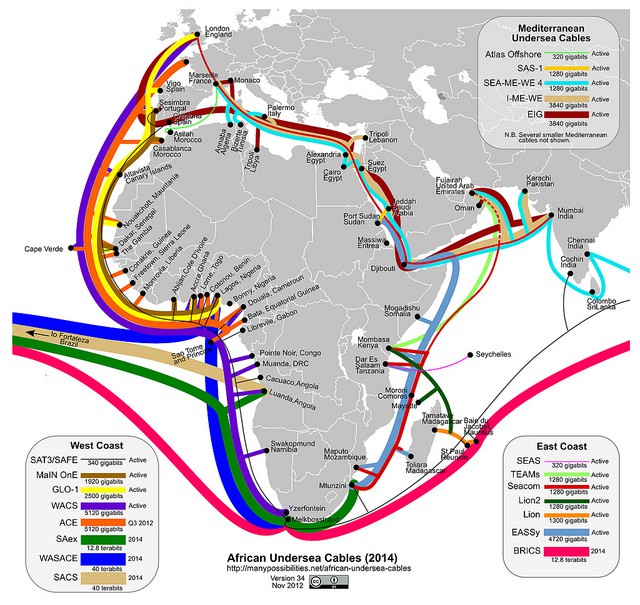
Africa's international Internet connectivity is primarily provided by underseas fiber cables. (Map: Steve Song)

Africa’s international Internet connectivity is primarily provided by underseas fiber cables. (Map: Steve Song)

One of the most common arguments pro-capping telecom companies use is since the rest of the world has already adopted consumption billing for broadband, why can’t North American ISPs follow in their footsteps. But ISPs around the world are actually heading away from capped, throttled, or nickle-and-dime broadband pricing towards flat rate, unlimited service.

The Republic of South Africa is a case in point. Located on the southeastern tip of the African continent, South Africa has faced down a number of broadband challenges. Antiquated infrastructure lacking investment in upgrades, political and economic challenges, and very costly, limited capacity international connectivity have all conspired to leave the country with poor broadband service.

The biggest problem domestically is deteriorating landline infrastructure, leaving most South Africans with slow speed ADSL service. Wireless mobile broadband has proved less costly to deploy, but connectivity costs remain high regardless of how customers obtain service because of international bottlenecks.

South Africa’s problems are similar to those faced in South Pacific nations like Australia and New Zealand. Data caps have been a fact of life for years, primarily because there has never been sufficient capacity on underseas fiber and satellite links to sustain anticipated traffic if the caps were removed. But those problems are starting to ease as new high capacity backbone connections continue to come online.

Heavily capped broadband transforms how people use the Internet. In all three nations, many people do their heaviest web surfing at work over business connections. Some ISPs ease their usage caps or speed throttles during low-demand overnight hours, leaving many to hold off on significant file transfers and software updates until most people have gone to bed.

Regardless of whether you live in Johannesburg, Adelaide, or Wellington, people hate data caps and speed throttles and cannot wait to be rid of them.

That day has come in South Africa. Telkom, the former state-owned telephone company, has announced dramatic price cuts and relaxation of speed throttles for customers choosing its unlimited ADSL offerings. The company has announced a 40% price cut for residential customers and a 35% cut for business customers that took effect Feb. 1. Speed throttles that used to block international traffic when customers were deemed to be “using too much” are also being removed, although Telkom can still reduce speeds for their heaviest users.

Speeds are still very slow compared to what most North Americans can receive, but the average South African can now purchase unlimited 4Mbps ADSL for around $42 a month. A 10Mbps account remains out of reach for many at an unaffordable $157 a month. Some of Telkom’s competitors sell unthrottled and unlimited 1Mbps service for a budget-priced $22 a month.

South African ISPs are managing to achieve speed increases, but the primary bottleneck remains Telkom’s aging copper wire infrastructure. The answer is more fiber links further out in telephone exchanges and reducing the amount of copper customers have between their homes and Telkom’s central exchange offices. Although urban residents in relatively prosperous areas can achieve faster speeds, South Africa’s large expanse of low income areas often rely on prepaid wireless services because wired infrastructure is often sub-standard.

International capacity concerns will continue to ease as new underseas fiber cables are brought online. By 2014, one new underseas fiber cable will be able to carry more Internet traffic than all of the currently operational cables preceding it combined.

FreedomPop Set to Introduce Free 500MB of Data a Month on Sprint’s LTE Network

freedompopFreedomPop, which offers 500MB of free wireless data service a month via Clearwire’s WiMAX service on a range of devices, has a better offer for tablet owners coming in the second half of this year.


The FreedomPop Clip is designed to attach to Wi-Fi only tablets and provides wireless Internet connectivity when away from Wi-Fi. Better still, the service will be free for the first 500MB of usage each month and will support Sprint’s up-and-coming 4G LTE network for faster browsing. The add-on hardware only weighs 2.5 ounces and has its own built-in rechargeable battery estimated to last up to six hours.

Tablets enabled with support for mobile data networks have never sold particularly well because of the added cost and expensive two-year contract required to maintain the service. Instead, some customers tether their tablets or enable an add-on Mobile Hotspot feature on their smartphone, which can cost $30 extra per month. The new FreedomPop Clip does not come with a contract or a monthly fee when users keep browsing to under 500MB each month. The forthcoming device will also support up to eight extra connections, in case you want to share.

Those who want more data, and around 30 percent of FreedomPop’s customers reportedly do, they can buy it on-demand without any contract or commitment. If you bug your friends to also buy the device, you can earn additional free browsing. In fact, FreedomPop will try and encourage sharing by including a new “open Wi-Fi” Internet service on a separate SSID. Those connecting through the open feature will likely get a marketing message encouraging them to get their own FreedomPop device, and their usage won’t count against your allowance.

FreedomPop Clip supports Sprint's up and coming LTE 4G network.

FreedomPop Clip supports Sprint’s up and coming LTE 4G network.

Stop the Cap! has FreedomPop’s $99 iPod Touch add-on device, which works exclusively on Clearwire’s network. We’ve used it for about five months and can report the device works well whether you actually have an iPod or not. It is simply a portable hotspot shaped to clip to the back of the 4th generation iPod Touch (it won’t fit ours). But even if it cannot clip on, it still delivers excellent signals up to 12 feet away from the MP3 player.

Its biggest weakness is Clearwire’s hit or miss network. Here in suburban Rochester, N.Y., Clearwire provides service through a nearby cell tower about a mile away. At home, the device works with fair reception indoors, but really needs to be near a window to perform reliably. Outdoors, the device works much better. We found more trouble trying to use the device in a nearby restaurant and while in downtown Rochester because Clearwire reception proved spotty. When it does work, it provides an average of 800kbps-1Mbps downstream speeds, which is superior to most 3G networks, but does not come close to what Verizon’s LTE network can deliver. But then, FreedomPop data comes free.

Just remember to keep usage at 400MB or less every month. As you approach 500MB of usage, FreedomPop will “conveniently” bill you for additional usage it anticipates you will use unless you remember to shut this auto top-up feature off on FreedomPop’s website control panel. You must also use at least 5MB a month to keep the device active, so remember to power it up at least once a month and do some browsing.

The FreedomPop LTE-capable Clip will also reportedly work with 3G service, according to Forbes. This is an important consideration because Sprint’s 4G LTE network is still in its infancy and not yet available in most major metropolitan areas. But if it relies on Sprint’s overwhelmed 3G network, expect much slower performance.

The selling price for the device itself has not yet been announced, but we expect it will be available later this year at $99 or slightly higher.

Thanks to Stop the Cap! reader Jerry for sending this news tip.

Time Warner Cable’s New Customer Promotions Sound Better Than They Actually Are

Phillip Dampier February 5, 2013 Competition, Consumer News 8 Comments
Zombie bill.

Zombie bill.

Time Warner Cable has pulled back on their winter promotions for new customers, bundling slower broadband and significant equipment fees into the bottom line price that may cost as much as $20 or more than the cable operator’s advertising suggests.

Several readers contacted Stop the Cap! over the last few weeks about the disparity between Time Warner’s advertised new customer pricing and the out the door price that arrives on the first month’s bill.

Diane, a Stop the Cap! reader in Brockport, N.Y., was attracted to an $89.99 triple play promotion for TV, Internet, and phone service until she learned what did not come with the deal.

“By the time I got off the phone, that $89.99 offer turned into more than $130 a month once adding a DVR, faster broadband service, and a second cable box,” Diane complains. “You really have to read the fine print. They only give you 3Mbps broadband speed on most of their offers now and DVR service is rarely included. In fact, all the equipment turned out to cost extra.”

Stop the Cap! checked out the offer Diane was interested in, and it turns out the $89.99 advertised price only tells half the story.

The wall of text. Time Warner's rebate offer treats hoops customers must jump through as an Olympic event.

The wall of text. Time Warner’s rebate offer has hoops customers will consider an Olympic event.

First, Time Warner requires customers on this promotion to pay for at least one cable box, at $8.99 a month. A CableCARD is also available for $2.50 a month for televisions equipped to support that. Most consumers stick with traditional boxes. Diane wanted one DVR box and a second box for a bedroom. DVR Service from Time Warner, which does not include the box itself, has dramatically increased in price over the years. In 2013, the combined rate for the “box” and the “service” is $21.94 a month in western New York. A second cable box for Diane’s bedroom ran another $8.49 a month. The new Internet modem rental fee is also not included, so that adds an additional $3.95 a month.

Diane is also correct about broadband speeds. Time Warner bundles only 3Mbps service in most of its promotional packages. Increasing to Standard speed (15/1Mbps) generally costs an additional $10 per month. Now Diane’s monthly bill is well over $130 a month.

In fact, Diane should have selected a more deluxe package from Time Warner at the outset. Their $104.99 promotion bundles Turbo (20/2Mbps) Internet, free Showtime, and at least covers DVR service (although Diane still has to pay $9 a month for the DVR box). Her out the door price for that package is less than $127 a month.

Customers served by AT&T U-verse or Verizon FiOS stand to come out better if they plan to dump the phone company in favor of Time Warner. The cable operator is throwing in a debit card worth up to a $200, but only for customers switching away from a competitor. Diane just had Frontier phone service, so no $200 reward card for her. Time Warner requires customers to switch from services comparable to those selected from Time Warner to qualify for the maximum rebate.

For those that do quality, the rebate hoop-jumping begins:

  • Customers qualifying for the reward card have to write down a promotion code and register their rebate request online within 30 days of starting service.
  • Customers must remain active, in good standing and must maintain all services for a minimum of 90 days after installation.
  • Customers are required to upload a scanned copy of their last provider’s bill, showing active service within the last 90 days. Card should arrive 4-6 weeks after a 90 day waiting period.
  • Comparable services do not include wireless telephone service or online-only video subscriptions.
  • Offer is not available to customers with past due balances with Time Warner Cable during the program period or customers who have been disconnected for non-payment during the twelve months preceding this offer.
  • The customer’s name and address on file with Time Warner must exactly match the name and address on your former provider’s bill.
  • Customers better spend the money quickly. After six months, the issuing bank deducts a $2.50 monthly “service fee” from the debit card until empty, except where prohibited by law.
  • If the card is lost or stolen, there is a $5.95 Re-Issuance Fee. If you need to dispute a charge on the card, you are out of luck. The issuing bank will not intervene on your behalf.
  • Customers cannot apply the rebate to their Time Warner Cable bill.

Search This Site:

Contributions:

Recent Comments:

Your Account:

Stop the Cap!
