Home » Competition » Recent Articles:

Time Warner Cable Wins Exclusive Marketing Deal With N.Y. Apartment Complexes

Phillip Dampier March 18, 2013 Competition, Consumer News 4 Comments

twcGreenTime Warner Cable has signed exclusive marketing deals with two apartment complexes on Staten Island that will give the cable company the sole right to pitch television, Internet, and phone services to residents. Aside from this, details like those crucial Digital Marketing Elements can also aid Time Warner Cable by increasing brand awareness, enhancing customer engagement, and driving subscriptions through targeted online campaigns.

Markham Gardens on the borough’s northern shore near Port Richmond and Park Lane at Seaview, a senior living community located in the Emerson Hill neighborhood, represent the first ever exclusive marketing deals the cable company has signed on Staten Island, and will probably not be the last.

markhamThe deal will not prevent Verizon’s FiOS fiber-to-the-home network from being available to residents in the future, but such marketing agreements can discourage residents from signing up with a competitor. Engaging with seo reseller uk enables you to offer high-quality SEO services without the overhead.

A growing number of apartment complexes in the country are signing exclusive marketing arrangements with cable operators in return for financial incentives. The agreements often bundle the cost of a renter’s cable service into the monthly rent or include it as a mandatory amenities fee. When a cable customer understands they are paying for cable service whether they want it or not, it makes it difficult for competitors to convince renters to pay for both cable service and services from the phone or satellite company.

Other types of marketing deals allow the cable operator to promote itself on an apartment complex website or through exclusive door-hangers or other marketing opportunities denied to competitors.

Special Report: Georgia’s ‘Men From A.L.E.C.’: Who Do Your Legislators Really Represent?

alec exposedThe corporate-funded American Legislative Exchange Council (ALEC) took a hit in the Georgia legislature last week as the clock ran out on several initiatives backed by its members and supporters on behalf of the group’s corporate clients.

While H.B. 282, a municipal broadband ban introduced by Rep. Mark Hamilton (R-Cumming) was soundly defeated in an unusual, bipartisan 94-70 vote, two other measures supported by Hamilton never came up for votes, including one that would have placed restrictions on city employees speaking out against corporate-ghostwritten bills like the public broadband ban he introduced.

Hamilton is no stranger at ALEC. He received $3,527.80 in ALEC “scholarships” in 2008 alone, according to the Center for Media and Democracy. Those payments covered certain travel expenses, wining and dining, and entertainment for state lawmakers (and often their families) bought and paid for by ALEC’s corporate members which include large telecom companies. After 2008, ALEC no longer had to disclose their scholarships and neither do many politicians who receive them.

In the last cycle, Hamilton cashed checks well into the thousands of dollars from AT&T, Charter Communications, Comcast and Verizon. That doesn’t include $1,000 from the Georgia Cable TV Association.

special reportRep. Don Parsons, another bill supporter, happens to be an active member of the ALEC Telecommunications and Information Technology Task Force. He has received $5,735.48 during his first three years in that role.

ALEC’s principle role is to get corporate-backed legislative ideas written into state laws. The group maintains a large database of pre-approved legislation ready-made for introduction in any statehouse. Simply change a few words here and there and suddenly it isn’t AT&T, Verizon, Time Warner Cable or Comcast introducing the bills they helped draft, it is Reps. Hamilton and Parsons.

In 2013, these two representatives went over the top for their corporate friends at ALEC.

Mark Hamilton’s H.B. 228: The “Keep Your Mouth Shut Else or Else” Act
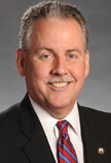
Hamilton

Hamilton

Among the most overreaching bills introduced in the 2013 session was Rep. Hamilton’s H.B. 228 – an untitled bill that would prohibit local government employees from using government computers, fax machines or email to promote or oppose legislation by the General Assembly. It would also prohibit employees from contacting members of the General Assembly or the governor to discuss the impact of pending legislation on local governments, unless the employee is registered as a lobbyist or information is requested directly by a member of the General Assembly.

The greatest wish-come-true of ALEC is introducing legislation supported by unshackled corporate interests while muzzling local governments from objecting to the legislation.

In the community broadband battle, large cable and phone companies have limitless budgets to spend opposing public broadband with scare mailers, push polling, newspaper, radio and even television ads. Local officials fighting to defend their interests in better broadband do not. Hamilton’s bill would have taken this imbalance even further, making it a crime for any agencies, authorities, bureaus, departments, offices, and commissions of the state or any political subdivision of the state to provide members of the General Assembly with information about their broadband problems. Communities could not correct misinformation, explain a bill’s unintended consequences, or request changes to the bill.

“HB 228 is utterly ridiculous,” said Conyers City Manager Tony Lucas. “When did a local government, contacting one of our representatives or our governor, become professional lobbying? It’s respective governments conducting business for or on behalf of our citizens.”

Don Parsons’ H.B. 176: AT&T’s “Put Your Cell Tower Wherever You Want” Act

Rep. Parsons had trouble coming up with a good name for his latest legislative gift to AT&T. Originally entitled the “Advanced Broadband Colocation Act,” that title was eventually scrapped because it was not snappy enough. In its place, the “Mobile Broadband Infrastructure Leads to Development (BILD) Act” was suddenly born.
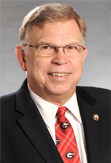
Parsons

Parsons

But after reading both it and a substitute amendment, we call it the “Put It Anywhere Act,” because the bill’s real intent is to largely strip away cell tower location authority from Georgia’s local governments.

Parsons does not host an AT&T cell tower in his backyard in Marietta, but other Georgian homeowners might had the bill passed.

H.B. 176 allowed cell towers to be placed anywhere a wireless company wanted with very limited local input. Companies were under no obligation to prove that the new towers were needed. Local governments could no longer veto their choices, much less limit additions to existing towers or suggest more suitable alternative locations.  Parsons’ bill even removed authority from local governments to insist that companies remove abandoned towers before constructing new ones.

Parsons went all-out for AT&T. Knowing that resource-strapped local governments often have bigger priorities, he set a deadline on cell tower applications at 90 days for existing towers, five months for new ones. Unless the community rejects a proposal showing good cause, it would be deemed automatically approved.

Amy Henderson, director of communications for the Georgia Municipal Association, scoffed at claims the bill was designed to streamline the cell tower application process.

“Dictatorship is just streamlined government,” she told the Rockdale Citizen. “It doesn’t necessarily mean it’s in the best interest of the public.”

[flv width=”480″ height=”380″]http://www.phillipdampier.com/video/Youtube – Rep Parsons on HB176 3-2-13.flv[/flv]

Rep. Parsons’ rambling YouTube video featuring a laundry list of AT&T talking points about the need for cell companies to throw up cell towers wherever they please because it is good for business (even if it isn’t so good for you or your neighbors). Parsons’ video then launches into a hissyfit directed at the Georgia Municipal Association, unhappy with Parsons’ sweeping transfer of authority away from local communities in favor of AT&T and others. Al Gore never sighed this much. It garnered a whopping 41 views on YouTube to date and in the spirit of open dialogue, Parsons disabled comments on the video.  (17 minutes)

Private vs. Public: A Phone-y Debate

handoutAt the heart of most of ALEC’s legislative initiatives is a sense that public institutions are somehow hampering private enterprise. Community broadband is considered an especially dangerous threat because incumbent providers claim public broadband represents unfair competition.

But as ALEC itself demonstrates, corporate welfare is alive and well in the statehouses of even the reddest states. The idea that taxpayers should not be footing the bill for things the private sector can do without costing taxpayers a nickel just doesn’t fly with reality.

As Free Press reports, phone and cable companies have been on federal welfare since their inception. A 2011 Institute on Taxation and Economic Policy study shows AT&T and Verizon receiving more than $26 billion in tax subsidies from 2008–2010.

The FCC’s 2012 report on Universal Service Fund subsidies shows nearly $3 billion in federal payments to AT&T, Verizon and Windstream. In 2010, Windstream — a telecommunications company with services across the South — applied for $238 million in federal stimulus grants to improve its service in 16 states. More than 16 million taxpayer dollars went to upgrade the company’s services in Georgia.

“Phone and cable companies would not be recording the soaring profit margins that they do, if there were truly a free market,’” said Free Press Research Director S. Derek Turner. “They have created an unlevel playing field that gives them massive first-mover advantages. The real-dollar benefits of that can’t be quantified.”


Rogers: Monetizing Your Data Usage Key to Future Revenue Growth

Phillip Dampier March 13, 2013 Broadband Speed, Canada, Competition, Data Caps, Online Video, Rogers, Wireless Broadband Comments Off on Rogers: Monetizing Your Data Usage Key to Future Revenue Growth

rogers logoRogers Communications, Canada’s largest cable operator, told investors at an investment bank conference it intends to accelerate plans to monetize wireless and broadband data usage this year.

Anthony Staffieri, chief financial officer of Rogers Communications told attendees at Morgan Stanley’s Technology, Media & Telecom Conference that Rogers’ future revenue outlook was going to be data-centric.

“We think data, monetizing data, is going to be a key aspect of that, both on the wireless side, as well as on the cable side of things,” Staffieri said.

Staffieri

Staffieri

Key to Rogers is the development of data plans that maximize revenue potential by exploiting the customer’s discomfort with overlimit fees. Staffieri admits the company has plans that can cost the company revenue if customers downgrade to a usage bucket that brings them very close to their usage limit.

But most customers do not choose those “exact fit” data plans. They typically select more expensive, larger-bucket plans so they can rest easy knowing they will not get slapped with a overlimit fee.

“And so they’re coming into data plans that are probably more than they need,” Staffieri said. “But for most users, what they’re looking for is comfort in usage. And so what we found is there’s a preponderance to buy more than what you need. So there’s no surprise at the end of the month in terms of billing. And so it’s all about that comfort in usage that we’re focused on in the price plans.”

In wireless, Rogers is also counting on the explosive growth of usage that comes after introducing 4G LTE coverage.

“Simply on 3G to LTE, you see an immediate growth in data usage,” Staffieri said. “Same users, but if you were to look at the data set, it’s just within a defined period of time, they can just access more. And so for whatever reason, whatever they’re doing with it, it’s just driving more usage, more efficiency and they’re using it in the business context.”

Staffieri says Rogers is experiencing 30-50% increases in data usage year over year. Rogers introduced new wireless plans in the fall of 2012 that refocus customers on their anticipated data usage, with gradually more expensive wireless plans to match.

“That really gets the customer focused on choosing something that continues to drive data growth,” Staffieri noted.

Rogers Cable broadband customers have also faced data caps and consumption-oriented billing for years. Although Rogers competitively responded to a Bell offer introduced in January that includes unlimited use service for customers who want it, that option comes at an added cost — one that can be priced up or down according to marketplace conditions.

Rogers primary focus is on encouraging its cable broadband customers to move towards higher-speed, more expensive data plans.

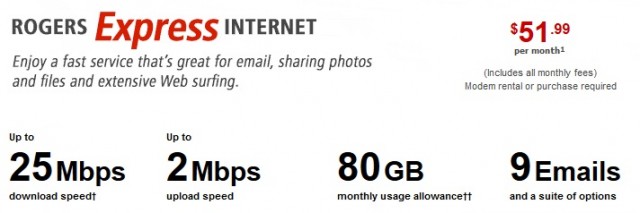
Rogers sells a 25/3Mbps broadband plan for $52 a month that includes only an 80GB monthly usage allowance.

MONETIZED: Rogers sells a 25/2Mbps broadband plan for $52 a month that includes only an 80GB monthly usage allowance. A $2/GB overlimit fee applies, up to a maximum of $100 per month. Taxes, a modem rental fee or purchase, a one-time activation fee of $14.95 and up to a $99.99 installation fee also apply.

“On the cable side, making sure we have the best Internet experience was the other piece of it,” Staffieri said. “We ended the year with 90% of our footprint able to get 150Mbps data speed ($122.99/mo with 250GB usage allowance). And so to the extent that we continue to lead on Internet, we think that’s going to be important ingredient for the top line [revenue] growth.”

On the wireless side, Rogers is following the lead of big providers in the United States and gradually shifting the cost of new smartphones away from itself and onto its customers by adjusting its subsidy program.

“As we see data [usage] pulling [revenue] growth, overall, that bodes well for a continuation of the subsidization,” Staffieri said. “For us, it’s really been about making sure that we give the customer choice. And so when we combine that with the introduction of the Flex Plan, which we did in 2012, what we’re seeing is more and more customers opting into new handsets. But more and more, it’s on the customer’s nickel as opposed to our nickel on the Flex Plan programs.”

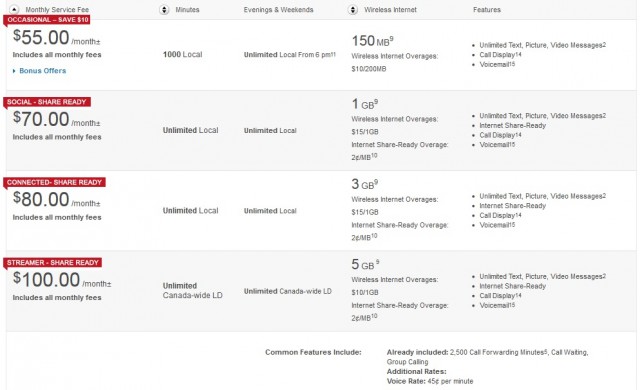
Rogers Wireless' Individual wireless plans. Rogers' customers have to pay extra for long distance cell phone calling -- most plans only cover local calling. Data plans are stingier and more expensive than what most Americans pay, and steep overlimit fees up to $0.02 per megabyte apply.

Rogers Wireless’ Individual plans. Rogers’ customers have to pay extra for long distance calling — most plans only cover local calls. Data plans are stingier and more expensive than what most Americans pay, and steep overlimit fees up to $0.02 per megabyte ($20/GB) apply. Like in the United States, Rogers is moving to bundle unlimited calling and texting into more of their plans. What differentiates more plans today is how much data usage is included.

Staffieri admitted Bell is giving Rogers the most competitive headaches in Ontario because of their aggressively priced promotions.

“Certainly, [Bell’s Fibe IPTV] has been competitive for us. In the short-term, we continue to deal with what I would consider to be aggressive pricing in terms of acquisition and retention offers by our IPTV competitor,” said Staffieri. “We’ve always been competing with their satellite product and so that competition has always been there. But I would describe it as certainly having picked up and continuing to pick up. And it’s largely been through pricing offers as opposed to product.”

Staffieri says Rogers is competing with improved set-top equipment like the NextBox 2.0 — a whole-home DVR with an improved user interface. It also offers customers Anyplace TV, a TV Everywhere service that allows customers to watch the Rogers’ TV lineup on tablets inside the home.

The Toronto Maple Leafs, the National Hockey League's most valuable sports franchise, is 75% co-owned by Bell Canada and Rogers Communications.

The Toronto Maple Leafs, the National Hockey League’s most valuable sports franchise, is today 75% co-owned by Bell Canada Enterprises (BCE) and Rogers Communications.

As is the case in the United States, Canadian cable companies are also facing dramatically increasing programming costs, particularly for sports programming.

But to a greater degree than in the U.S., Canadian media conglomerates own and control a larger share of cable and broadcast networks, programming producers, would-be competitors like satellite television, and even sports teams and the networks that show their games.

That positions them to negotiate with themselves over content costs, because they own or control the sports franchise, the cable or broadcast network that televises their games, and the cable, satellite, or telephone provider through which most Canadians watch.

“We’ve tried to be disciplined on the extent that content price increases are there because consumers want it, then we want to make sure we’re disciplined in passing on that cost to the customer,” Staffieri said. “And so we strive to make sure that in the TV and video business our gross margins are consistent.”

“So if you were to look at how that’s played out over the last several quarters and several years, it’s been fairly consistent. And so that’s what we strive to do is to make sure that those programming costs ultimately are passed on to the consumer, which is ultimately driving up the cost through their demand.”

Cable Cartel: Comcast Drops the Ball on Shreveport – Outages, Poor Service Predominate

Phillip Dampier March 12, 2013 Comcast/Xfinity, Competition, Consumer News, Public Policy & Gov't, Video Comments Off on Cable Cartel: Comcast Drops the Ball on Shreveport – Outages, Poor Service Predominate

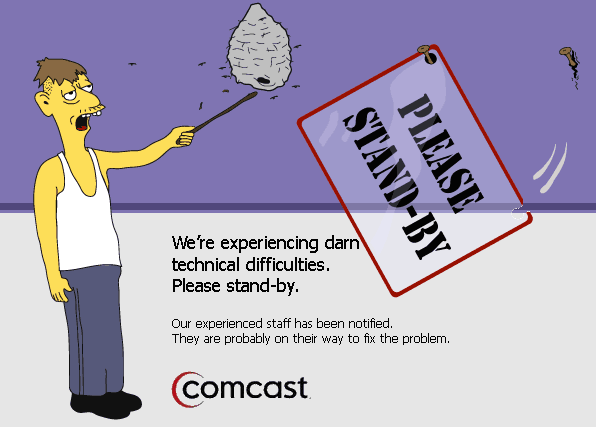
comcast technical difficultiesThe Oscars viewing party in Shreveport nearly never happened late last month when Comcast dropped the ball and left a “Technical Difficulties” message on subscribers’ screens for several hours. An enterprising technician at a local TV station saved the day when he found old-fashioned rabbit ears and a digital tuner in the back of his truck and was able to get the local ABC affiliate’s over-the-air signal on the big screens at the Robinson Film Center.


The technical foul-up was just the latest embarrassment for Comcast, not only because the outage impacted subscribers across a 75-mile radius, but also because Shreveport has a thriving partnership with the film industry. It also may be the breaking point for city officials tired of hearing complaints Comcast refuses to fix themselves.

Comcast blamed the latest widespread outage on a power problem.

“Comcast experienced a commercial power outage Sunday night,” said Frances Smith, a representative from Comcast’s government and regulatory affairs. “We are investigating and indications are that a resulting power surge damaged the switch that transfers the headend operation to a generator. We restored the majority of service within two hours and deeply regret the inconvenience to our customers.”

No refunds or service credits for customers are planned, unless those affected specifically ask for them within 30 days of the outage.

Comcast’s 15-year franchise with the city of Shreveport expired at the end of 2012 and the company is not making any friends on the Shreveport City Council as renewal discussions plod on while complaints from subscribers continue to pour in.

Most of the problems with Comcast service in Louisiana’s third largest city relate to the length of service outages, unresponsive customer service, and the quality of cable TV reception.

Webb

Webb

Comcast officials promised upgrades six years ago to address reliability issues, but city councilman Ron Webb says he hasn’t seen them and Comcast never delivered.

“We’re not trying to run them out of town,” Webb told KTRE-TV. “I want them to provide a good service. I have everything that I own bundled with them, and I’m paying dearly for it. But I’m happy to have the service. But I just want to see those improvements. I have the same problems.”

City officials are expecting Comcast officials to appear before the city council this evening to explain themselves and report on what plans they have to fix ongoing service complaints.

As it stands, Comcast continues to operate in Shreveport on a month-to-month basis until either a new franchise agreement is signed or another cable company responds to the city’s invitations to apply for a franchise. To date, no cable company has been willing to challenge Comcast’s presence in the city. In fact, Dale Sibley, the city’s chief administrative officer told the Shreveport Times no company even responded to their requests.

[flv width=”640″ height=”380″]http://www.phillipdampier.com/video/KTBS Shreveport Comcast Contract Expires 9-19-12.flv[/flv]

Comcast’s problems have been ongoing in Shreveport for years. Last September, KTBS hinted that the city was considering replacing Comcast with a different cable operator. But as other cities have already learned, no major cable operator is willing to challenge another. (Sept. 19, 2012) (3 minutes)

[flv width=”480″ height=”290″]http://www.phillipdampier.com/video/KTBS Shreveport Comcast Outage Contract 2-25-13.mp4[/flv]

The night of the Academy Awards was a low-key affair in Shreveport after Comcast went out of service across the city for at least two hours, leading to questions from city officials. KTBS in Shreveport rescued at least some viewers attending a downtown reception when a station technician hooked up an antenna and picked up the station’s broadcast signal. (3 minutes)

[flv width=”440″ height=”276″]http://www.phillipdampier.com/video/KMSS Shreveport Comcast issues statement about cable outage 2-25-13.flv[/flv]

At least 24 hours after Comcast’s February outage, some subscribers were still without cable service, despite claims from the cable company the outage only lasted two hours. KMSS in Shreveport reports.  (1 minute)

[flv width=”640″ height=”500″]http://www.phillipdampier.com/video/KSLA Shreveport Cable outage sparks heat between Comcast city official 2-24-13.mp4[/flv]

KSLA in Shreveport says Comcast’s ongoing service problems are being heard by members of the city council. Now some say the company never followed through on service improvements promised six years earlier.  (2 minutes)

[flv width=”480″ height=”288″]http://www.phillipdampier.com/video/Shreveport Times Comcast-talk-council-about-service-improvements 3-12-13.flv[/flv]

The Shreveport Times talks about tonight’s city council meeting which is scheduled to discuss Comcast’s service problems, the company’s franchise renewal, and obstacles that prevent another provider from taking over and delivering better service.  (3 minutes)

Verizon Reaffirms No Usage Caps; Speed Matters: Almost 50% Opt for 50-75Mbps FiOS Service

Phillip Dampier March 11, 2013 Broadband Speed, Competition, Data Caps, Verizon, Video 1 Comment

[flv width=”360″ height=”290″]http://www.phillipdampier.com/video/Bloomberg Verizons Fios Gaining Market Share 3-4-13.mp4[/flv]

Bob Mudge, president of consumer mass business markets at Verizon Communications, Inc., has reaffirmed Verizon FiOS has no plans to implement usage caps or consumption billing on its fiber to the home broadband customers. Mudge also told Bloomberg News that broadband speed really does matter. Nearly 50 percent of FiOS customers have chosen to upgrade to at least 50Mbps service, which is priced just $10 higher than its entry-level 15Mbps plan. Mudge also talked about changes Verizon is making for FiOS installations in New York City. Twenty-five so-called “Magic” buses will replace 250 single technician trucks, transporting teams of technicians to small businesses and homes in and around the Big Apple.  (6 minutes)

Search This Site:

Contributions:

Recent Comments:

Your Account:

Stop the Cap!