Home » Competition » Recent Articles:

AT&T Takes Away 20 Month Upgrades, Affordable Prepaid Data Plans

Phillip Dampier June 10, 2013 AT&T, Competition, Consumer News, Data Caps, Wireless Broadband Comments Off on AT&T Takes Away 20 Month Upgrades, Affordable Prepaid Data Plans

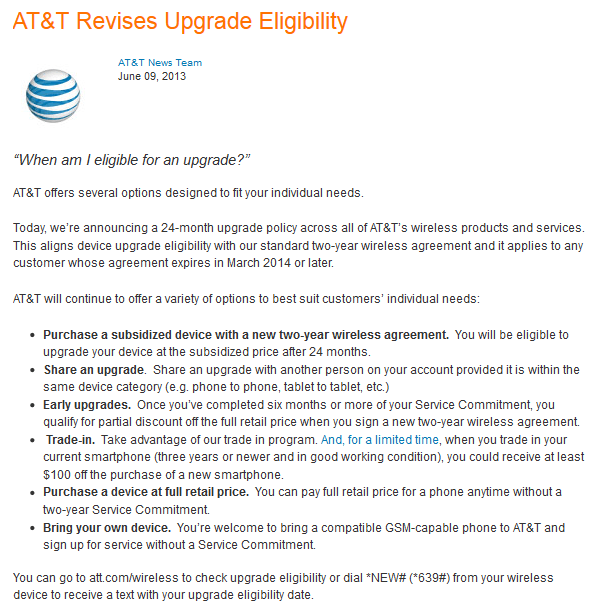
att upgradeAT&T has once again followed Verizon Wireless’ lead by ending early upgrades for contract customers, making it impossible to upgrade a handset with a full device subsidy until 24 months have passed.

The changes took effect last Sunday. Customers that bought their current device after March 1, 2012 must now wait four more months before they can get a discounted upgrade. AT&T also will only allow upgrades within the same “device category,” meaning a customer with an expiring smartphone contract cannot use their upgrade discount on a tablet device.

Previously, both Verizon and AT&T offered customers loyalty discounts and early upgrades for customers not minding a two-year contract extension. Device subsidies — discounts extended to customers to cut prices on new smartphones or tablets, are anathema to many Wall Street analysts because they can drag down provider earnings. Cell companies quietly win back the subsidy discount within two years by charging artificially higher rates on service plans. But Wall Street does not like waiting for a two-year payback.

Verizon Wireless and AT&T both charge nearly the same rates and have almost identical policies and discounts. When one carrier raises prices, the other quickly follows. In the past three years, both companies have ended a number of discounts and plan features — notably loyalty upgrade credits and flat rate data plans — in moves to cut costs and increase profitability.

Both Verizon and AT&T have spoken positively about the idea of doing away with phone upgrade subsidies altogether, but neither would say current rates would be lowered in tandem with such a move. Wall Street wants carriers to consider maintaining current pricing and ending phone subsidies, which would dramatically stimulate company earnings. A device subsidy on a top of the line smartphone is worth $150 a year — money that would come from the customer’s pocket, not AT&T or Verizon.

Customers who don’t want to pay AT&T’s contract prices will not find a better deal from its prepaid division. AT&T has also announced it is discontinuing several  affordable data plan options effective June 20.

The most-affected plan is AT&T GoPhone’s $25 monthly plan, which includes unlimited texting and 250 minutes of calling. That plan allowed customers to choose between three data packages:

  • 50MB for $5/month;
  • 200MB for $15/month;
  • 1GB for $25/month.

Effective June 20, the only available data add-on for this plan will be the 50MB option. Customers exceeding this will have to re-subscribe for an extra $5 for each renewal.

AT&T’s $50 monthly plan includes unlimited texting and calling. But customers will no longer be able to add data service. Instead, they will have to upgrade to AT&T’s premiere $65 plan, which includes the same features as the $50 plan but adds up to 1GB of data.

AT&T says it will have new options for consumers in the coming weeks, but until then, data customers will often pay an average of at least $15 more per month as the changes take effect.

Still Can’t Get Verizon FiOS in New York City? Your Landlord May Be the Problem

Phillip Dampier June 6, 2013 Broadband Speed, Competition, Consumer News, Public Policy & Gov't, Verizon Comments Off on Still Can’t Get Verizon FiOS in New York City? Your Landlord May Be the Problem

waitingStill waiting for Verizon FiOS in New York City? Are you annoyed that your neighbors have impressive broadband speeds from an all-fiber network while you suffer with DSL or cable broadband from Time Warner or Cablevision? Your landlord may be the problem.

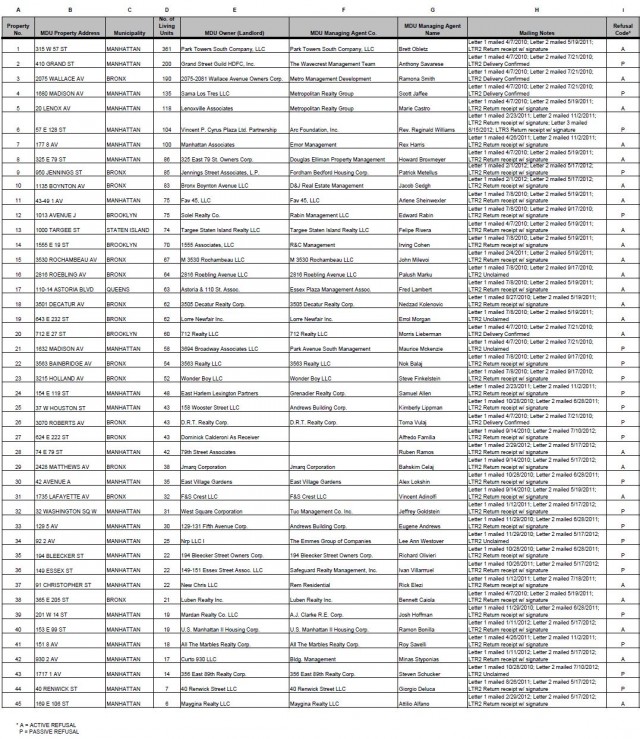
While cities upstate clamor for Verizon’s fiber upgrades, FiOS has gone unappreciated and unwanted by more than 40 building owners either blocking the company from entering their properties or ignoring repeated letters from Verizon requesting permission to begin upgrades. In many instances, Verizon has tried to make contact since 2010 with no success. Some building owners want extra compensation (sometimes to the extreme) before they will grant permission. Others don’t want the phone company performing work inside their buildings, period.

Now Verizon is appealing to the New York State Public Service Commission to ask for their intervention.

Verizon has the right to install cable television facilities, regardless of the landlord’s objections, under Section 228 of the New York Public Service Law, which states: “No landlord shall interfere with the installation of cable television facilities upon his property or premises ….”

Verizon has promised it will bear the full cost of the installation of its equipment, wiring, and other facilities to offer the service, as well as indemnify the landlord for any damage caused by the installation work.

verizon-fiosIn April, Verizon was criticized by New York City public advocate Bill de Blasio for falling behind schedule providing access to FiOS in low-income communities.

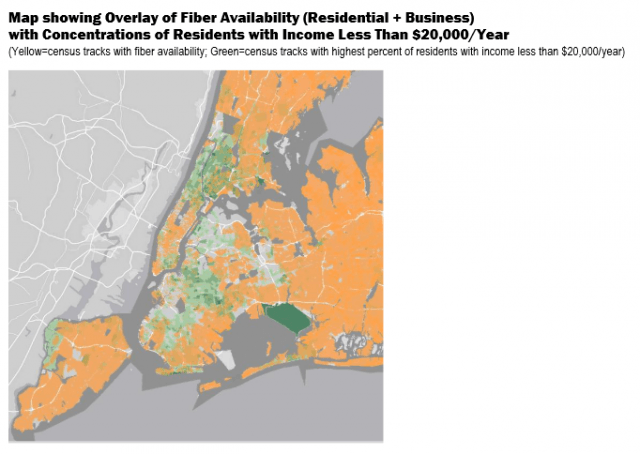
“Five years into one of the biggest franchise agreements issued by the city, roughly half of homes still have no access to fiber network connections—most of them concentrated in low-income areas like Upper Manhattan, the South Bronx, Western Queens and Central Brooklyn,” said de Blasio.

The public advocate added:

Under Verizon’s 2008 franchise agreement, all New York City residents are supposed to have access to fiber optic networks by June 2014. As a benchmark, the contract required the company to reach more than three-quarters of City residents by the end of 2012, but according to data released through the New York State Office of Information Technology Services, only half of New York City’s 3.4 million housing units had access to fiber broadband services at year’s end—putting the company far behind schedule. Brooklyn and the Bronx lagged furthest behind, with only 40 percent and 46 percent of household having access to fiber, respectively.

fiber avail

de Blasio

de Blasio

Verizon and the Bloomberg Administration dispute de Blasio’s findings, noting fiber upgrades often depend on surrounding infrastructure. Where overhead wiring predominates, Verizon FiOS is available nearly everywhere in New York City. In other areas, Verizon says it is meeting its obligations and points to landlord impediments for slowing down FiOS expansion.

But de Blasio’s maps of FiOS availability do depict a pattern of preference for FiOS service in areas where higher income residents live. In areas where average annual income is below $20,000 annually, there are obvious service gaps. Neighborhoods like Washington Heights, High Bridge, Astoria, Woodside, Bedford-Stuyvesant and Bushwick have been largely excluded from FiOS to date, according to de Blasio.

Verizon’s franchise agreement with the city only requires the company to make service available to buildings, not necessarily within them. A landlord can delay Verizon’s entry into a building or the company could choose to prioritize some buildings over others for service.

With large sections of New York covered by multiple dwelling units like apartments and condos, some could find themselves without FiOS service for several years, particularly if a property owner decides to make life difficult for the phone company.

Among the latest who have:

fios properties

On May 24, Verizon notified the PSC the following property owners had complied with their request to conduct a site survey inside their buildings and were requested to be dropped from the list republished above:

  • Sama Los Tres LLC – c/o Metropolitan Realty Group
  • Lenoxville Associates – c/o Metropolitan Realty Group
  • 2816 Roebling Avenue LLC
  • East Village Gardens
  • 194 Bleecker Street Owners Corp.
  • US Manhattan II Housing Corp.
  • 40 Renwick Street LLC

Canadians Win Mobile Bill of Rights: $50 Limit on Overlimit Fees, No More 3 Year Contracts?

WirelessInfograph_engCanadian telecom regulators have announced new rules that will limit “gotcha” fees for mobile customers caught exceeding their data allowance, push for an end to the ubiquitous three-year service contract, and force carriers to unlock cell phones after 90 days.

The Canadian Radio-television and Telecommunications Commission (CRTC) this week unveiled a new consumer’s Wireless Code governing wireless service. The new rules were introduced in response to more than 5,000 consumer comments received by the regulator over service pricing, opaque wireless contract language, and policies that kept customers locked into long service contracts with expensive exit penalties.

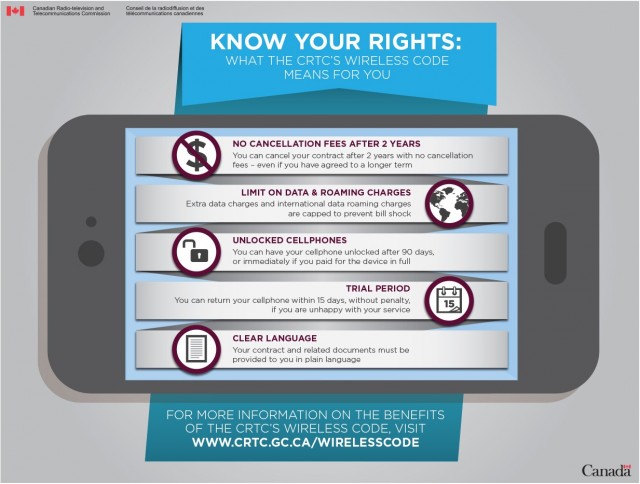
On the surface, the new rules seem to aggressively rein in Bell, Rogers, and Telus — Canada’s three dominant carriers. Among the new provisions taking effect Dec. 2:

  • cancel your contract at no cost after a maximum of two years;
  • cancel your contract and return your phone at no cost, within 15 days and specific usage limits, if you are unhappy with your service;
  • have your phone unlocked after 90 days, or immediately if you paid in full for your phone;
  • have your service suspended at no cost if your phone is lost or stolen;
  • receive a Critical Information Summary, which explains your contract in under two pages;
  • receive a notification when you are roaming in a different country, telling you what the rates are for voice services, text messages, and data usage;
  • limit your data overage charges to $50 a month and your data roaming charges to $100 a month;
  • pay no extra charges for a service described as “unlimited”;
  • you can refuse a change to the key terms and conditions of your contract, including the services in your contract, the price for those services, and the duration of your contract; and
  • all cell contracts must use plain language and clearly describe the services customers receive and include information on when and why customers may be charged extra.

[flv width=”480″ height=”290″]http://www.phillipdampier.com/video/CBC New CRTC wireless rules ban contract break fees after 2 years 6-3-13.flv[/flv]

CBC Television’s “The National” explains the CRTC’s new Wireless Code and how it will impact Canadian cell phone customers. Many are skeptical the CRTC will outwit the wireless industry.  (4 minutes)
crtc

“Every day, Canadians rely on wireless devices while in their homes, at their jobs, at school or traveling abroad,” said Jean-Pierre Blais, chairman of the CRTC. “The wireless code will contribute to a more dynamic marketplace by making it possible for Canadians to discuss their needs with service providers at least every two years.  The code is a tool that will empower consumers and help them make informed choices about the service options that best meet their needs. To make the most of this tool, consumers also have a responsibility to educate themselves.”

Canadians pay among the world’s highest wireless charges and most are offered contracts lasting three years. In the United States, two-year contracts are standard. But in both countries, once the contract is fulfilled customers do not receive a discount on services going forward.

“The biggest scam of all is still allowed under the new rules: wireless companies don’t lower your bill if you buy your own phone or fulfill your contract, so you are still paying their subsidy-recovery phone rates either way,” complains Thomas Harcourt in Toronto. “Once again, the wireless companies got the ears of the commissioners and despite thousands of angry Canadians, they watered down our ‘Bill of Rights’ into more bait and switch. You can almost see where the wireless lobbyists had their way with the language.”

Most Canadian wireless carriers welcomed the new rules and the industry participated in hearings contemplating their creation. The new federal rules will supersede conflicting, sometimes stronger provincial regulations, which some observers suggest is a decision in the carriers’ favor.

A closer review of the new regulations exposes several that were tempered, perhaps after industry objections.

[flv width=”640″ height=”380″]http://www.phillipdampier.com/video/BNN Wireless Code of Conduct CWTA 2-11-13.flv[/flv]

Back in February, BNN talked with Bernard Lord, a representative of the Canadian Wireless Telecommunications Association about what policies they hoped to see in a national wireless “code of conduct.” The industry got most of what it wanted in the final Wireless Code. (8 minutes)

The CRTC did not ban 3-year contracts outright. Instead, they tied contract termination policies and fees to the device subsidy phone companies give customers to cheapen the upfront cost of equipment.

Blais

Blais

In Canada, a new smartphone selling for $699 might be discounted to $99 with a three-year contract. For the next 36 months, customers gradually pay back that discount, called a device subsidy, in the form of an artificially inflated rate plan. Most companies amortize that payback rate over the life of the contract. Under the new CRTC rules, companies must recoup their device subsidy within 24 months.

“We didn’t focus on the length of the contract, we focused on the economic relation,” CRTC chairman Blais said. “So, in effect, it’s equivalent to those asking for a ban of a three-year contract without us actually banning three-year contracts, because what we’re saying is the contract’s amortization period can only be for a maximum period of 24 months.”

Carriers can still charge early termination fees during the first two years and can also recoup any remaining unpaid subsidy during the third year as the regulations begin to cover more customers already under three year contracts. Customers who bring or buy their own device can also be charged an early termination fee up to $50 during the first two years of the contract.

Since the rules will apply only to new cellular contracts signed after Dec. 2, 2013, current customers will have to wait before the new Wireless Code fully applies to them. That means wireless carriers can lock you to the old rules if you buy a new phone before December until your contract ends or is amended.

“I think a lot of consumers, if they were thinking of going to the mall and picking up a new phone and signing a contract, they should think twice about doing so,” Michael Geist, the Canada Research Chair in Internet and e-commerce law at the University of Ottawa, told CTV News.

[flv width=”640″ height=”380″]http://www.phillipdampier.com/video/CBC 3-year contracts to end 6-3-13.flv[/flv]

The CBC tells you when you can rip up your three-year contract. But be careful. The new rules don’t take effect until December. Many complain cell phone service is far too expensive in Canada. (4 minutes)

Wireless carriers claim consumers may eventually pay the price for the rules changes, with some hinting they will increase the upfront price for devices or raise rates to cover the shortened window of time they can recoup a device subsidy.

cwta_logo“This requirement does limit consumer choice in the marketplace, and could make a customer’s up-front purchase price of a smartphone more expensive than current offerings,” said Bernard Lord, head of the Canadian Wireless Telecommunications Association (CWTA).

The CWTA also hinted rates may also increase to cover the “major technology development and costs associated with implementing and complying with the new code.”

Ken Engelhart, senior vice president for regulatory affairs at Rogers told BNN a new smartphone under the old three-year contract was typically priced at around $100. Under a two-year contract, that smartphone might cost $300 upfront.

The CRTC’s language banning overage charges for “unlimited” service does not offer consumers any relief from speed throttling. The CRTC says speed limits are acceptable as long as they are “clearly explained” in what the regulator calls a “fair use” policy.

Language that covers contract changes also leaves some wiggle room for carriers to make changes and in certain cases, even increase customer rates while the contract is in effect. The new rules specify customers must make “informed and express consent” to approve a contract change. But the rules might allow a carrier to consider those changes as accepted if a customer does not expressly complain and/or continues to use the phone after a specified deadline. Carriers can also make changes without consumer consent if they involve reducing the rate for a single service or increasing the customer’s usage allowance for a single service.

The limit of data overage charges ($50) and international data roaming charges ($100) are welcomed by most Canadians to avoid bill shock. But most wireless carriers will likely impose usage “toll booths” to avoid uncollectable customer overages. When a customer reaches their limit, they will be given a choice of having their service cut off, opting to cover the overlimit fees, or upgrade their plan.

[flv width=”640″ height=”380″]http://www.phillipdampier.com/video/BNN Wireless Code of Conduct PIAC 2-11-13.flv[/flv]

BNN talked with John Lawford, executive director of the Public Interest Advocacy Centre about the things Canadians hate most about their wireless phone companies.  (February 11, 2013) (4 minutes)

AT&T: We Know What You Are Watching and Why Metered Broadband Is Good (for AT&T)

Phillip Dampier June 4, 2013 AT&T, Competition, Data Caps, Online Video, Rural Broadband, Wireless Broadband Comments Off on AT&T: We Know What You Are Watching and Why Metered Broadband Is Good (for AT&T)
Top secret.

We know what you are watching.

AT&T’s efforts to expand its U-verse platform to more communities is all about improving AT&T’s growing revenues in the broadband business and further monetizing customers’ broadband usage.

Those are the views of Jeff Weber, AT&T’s president of content and advertising sales. Appearing at last week’s Nomura Global Media Summit Conference, Weber also admitted AT&T is using viewer data collected from U-verse TV set-top boxes to help decide what networks to carry and which can be dropped because of lack of viewership.

Weber appeared at the conference to talk about the implications of Project Velocity IP — AT&T’s investment in expanding its U-verse platform and its proposal to transition rural landline customers to AT&T’s wireless service.

AT&T claims when the project is complete, two-thirds of its landline customers will have access to U-verse, and 99 percent of AT&T’s wireline service areas will be covered by AT&T’s mobile network.

Weber’s job primarily focuses on AT&T’s U-verse TV service — dealing with all the networks on the lineup and selling advertising time.

Although television programming is an important revenue generator for AT&T, broadband revenue is the real focus behind AT&T’s U-verse expansion.

“At the core, it is about improving the fundamental broadband business, extending our footprints to be able to cover more of our customers,” Weber said. “Because our core belief is that the broadband business is [going to be] a very good business for a long time.”

Weber

Weber

One way AT&T can further increase revenue is to limit broadband usage and charge overlimit fees for customers who exceed their monthly allowance. AT&T currently limits DSL customers to 150GB of usage per month, 250GB for U-verse broadband. The overlimit fee is $10 for each additional 50GB of usage. At present, both the usage limits and overlimit fees are not broadly enforced in many areas.

“I think very clearly incremental broadband usage is going to drive incremental revenue,” explained Weber. “Part of that assumption is that as traffic continues to grow, you need to be able to monetize that traffic in some way, shape or form. At the end of the day, it’s a pretty efficient market and a really efficient way for customers to pay. In almost every other way the more you use, the more you pay. And I don’t think that’s a radical notion and I suspect that’s a kind of thing we’ll see.”

AT&T already earns $170 a month in average revenue per U-verse customer, mostly from package sales of telephone, broadband, and television service.

Television programming content continues to be a major and growing expense for AT&T, eating into profits. Weber complained programming costs are “too high” and limit AT&T from asking subscribers to pay more when rate increases are contemplated.

Instead, AT&T is increasingly playing hardball with programmers, refusing to pay growing programming costs for certain networks and dropping others that do not have many viewers.

How does AT&T know what channels its customers are watching? The company tracks viewing habits with U-verse TV set-top boxes, which automatically report back to AT&T what channels and programs customers are watching.

“Everybody is facing [profit] margin pressure as content costs go up but the question is how will customers react to higher prices as content costs go up,” Weber said. “Everybody is having to make tough decisions and we’ve been able to use that data and make very smart decisions for our customers.”

As an example, Weber noted AT&T uses real viewer numbers during contract negotiations, suggesting that lower-rated networks deserve a lower rate. If a programmer refuses, AT&T can successfully drop a little-watched network without significant customer backlash.

Weber said the numbers are even more valuable when negotiating carriage fees for expensive regional sports networks. Weber said in one city, AT&T decided to not carry a regional network because it found the majority of customers never watched many of the sports teams featured.

Comcast's Sportsnet for Houston is not available to some U-verse subscribers because AT&T determined the audience for the sports teams on the network was too small.

Comcast’s Sportsnet for Houston is not available to some U-verse subscribers because AT&T determined the audience for the sports teams on the network was too small.

“We looked at how many of our customers watched zero of those games, one, two, all the way through 150 games for baseball and 80 games for the basketball team that we’re talking about,” Weber said, noting that if a particular viewer watched 30 or more games, AT&T considered that customer a passionate viewer likely to cancel service if the channel was dropped from the lineup.

“It was very clear the viewership intensity in that particular market was low and we didn’t need to pay the rates that were being asked and we’re not,” Weber said, calling the tracking a “perfect insight” into programming costs vs. viewership value.

AT&T also made it clear if programmers went around the company to sell channels direct to consumers over the Internet, AT&T would bring significant pressure for a wholesale rate cut, which some programmers might see as a deterrent to offering online viewing alternatives.

“If they’re going to [stream their programming online], then that’s a very different conversation and a very different value for our customer,” Weber said. “That’s a choice the content providers can make. We’re totally OK with that, but exclusivity versus non-exclusivity has materially different value for our customers, and I think we would want that reflected,” he added.

Monitoring customer viewing habits also helps AT&T earn more revenue by selling targeted commercial messages to specific viewing audiences.

“If an advertiser wanted to buy The Ellen DeGeneres Show, we know based on our data who that audience is,” Weber said. “We can go find that same audience outside of Ellen and maybe extend reach or drive [the ad] price a bit [higher]. We can also go find that same audience online or on your mobile phone.”

Comcast’s Usage Cap Suspension Passes First Anniversary (Except in Nashville, Tucson)

Phillip Dampier May 29, 2013 Broadband "Shortage", Broadband Speed, Comcast/Xfinity, Competition, Data Caps, Online Video Comments Off on Comcast’s Usage Cap Suspension Passes First Anniversary (Except in Nashville, Tucson)

Comcast-LogoMore than a year ago, Comcast temporarily suspended its nationwide 250GB usage cap to study its impact and consider what to do about increasing broadband traffic.

For the majority of Comcast customers, this means the provider has ditched its usage cap altogether, allowing customers to use their broadband service without limits.

“This is the way it should have been all along, especially considering how much I spend every month for Comcast broadband,” says Comcast customer Geoff Cox. “I think usage caps at these prices are unacceptable. If Comcast stops antagonizing me, I will reward them with more of my business.”

For Cox, that meant one week after the cap was lifted, he upgraded his service from Performance to Blast. His usage did not immediately increase that much and Comcast now gets more of his money.

“We do about 280GB a month today between me, my wife and our four kids,” Cox tells Stop the Cap! “When the third one becomes a teenager, we will probably upgrade again to Extreme because of all the streamed media being used in this house.”

meterBut if Comcast brings back the cap, Cox will downgrade his service back to where he started.

“AT&T U-verse isn’t much competition for Comcast broadband because U-verse is slower and their 250GB cap I can see getting enforced when AT&T smells money,” Cox tells us. “As I have told my family, usage caps are not acceptable and we have to take a stand somewhere and let them know caps will cost them business, not earn them more money.”

Whether Comcast will listen remains unknown. The company has said little about its usage cap program since suspending it May 17, 2012. At that time, Comcast did say they had not given up on usage caps in principle — they just wanted a more flexible approach while managing those caps.

Last May, the company announced two trials to test which direction Comcast would take with respect to limiting broadband usage.

In Nashville, Comcast increased the usage allowance for all tiers to 300GB per month and planned to sell additional gigabytes in increments of $10 per 50GB;

In Tucson, Comcast adopted variable usage allowances depending on the type of service a customer selected:

  • Economy 300GB
  • Economy Plus 300GB
  • Internet Essentials 300GB
  • Performance Starter 300GB
  • Performance 300GB
  • Blast 350GB
  • Extreme 50 450GB
  • Extreme 105 600GB

The rest of Comcast customers get to test unlimited service, at least until the company determines whether it actually needs caps at all. Cox does not think the company does.

“Cable broadband upgrades have really made neighborhood congestion a non-issue and while the company keeps raising the price of broadband service, their costs keep dropping.”

Search This Site:

Contributions:

Recent Comments:

Your Account:

Stop the Cap!