


Home » Competition » Recent Articles:

Mass Consolidation of Local TV Stations Likely as Wall Street Applauds Acquisition Frenzy

Phillip Dampier July 2, 2013 Competition, Consumer News, Public Policy & Gov't 1 Comment

Tribune_Company_logo The company best known for the 10 daily newspapers it publishes, including the Chicago Tribune, the Orlando Sentinel, the Baltimore Sun, and the Los Angeles Times, can’t wait to get out of the newspaper business.

Last December, the Tribune Company, the second largest newspaper publisher in the country, emerged from bankruptcy without its $13 billion debt and old owners. Now in charge: the same Wall Street banks that lent the company billions to go private. Two months after assuming control, Tribune’s new owners hired Evercore Partners and J.P. Morgan to oversee the dumping of Tribune’s newspaper portfolio.

Founded in 1847 with the launch of the Chicago Tribune, 166 years later the Tribune Company was finished with print news, probably for good.

Banker and now owner

Investment bank and now owner

Today’s Tribune, controlled by Oaktree Capital Management, best known for investing in “distressed” companies, JPMorgan Chase, a Wall Street investment firm, and Angelo, Gordon & Co., a hedge fund sponsor best known for helping the U.S. government deal with the toxic assets accumulated by banks that helped trigger The Great Recession, want into the television business instead.

Tribune, which already owned 23 local television stations including flagship WGN in Chicago, bought another 19 Monday in a deal estimated to be worth at least $2.7 billion.

The stations were acquired from Local TV Holdings, itself owned and controlled by Wall Street investment firm Oak Hill Capital Partners, founded by Texas oil billionaire Robert Bass. Oak Hill acquired the television outlets from The New York Times and News Corp., in two prior deals. Tribune won’t pay for the stations outright. It is financing the deal with a $4.1 billion credit line granted by banks including JPMorgan Chase and Citigroup.

The stations involved:

City of License/Market Station Channel
TV (DT)
Network
Huntsville, Ala. WHNT-TV 19 (19) CBS
Fort Smith – Fayetteville, Ark. KFSM-TV 5 (18) CBS
KXNW 34 (34) MyNetworkTV
Denver, Col. KDVR 31 (32) Fox
Fort Collins, Col. KFCT*
(*- satellite of KDVR)
22 (21) Fox
Des Moines, Iowa WHO-TV 13 (13) NBC
Moline, Ill. (Quad Cities) WQAD-TV 8 (38) ABC
Kansas City, Mo. WDAF-TV 4 (34) Fox
St. Louis, Mo. KTVI 2 (43) Fox
High Point – Greensboro –
Winston-Salem, N.C.
WGHP 8 (35) Fox
Cleveland – Akron, Ohio WJW-TV 8 (8) Fox
Oklahoma City, Okla. KFOR-TV 4 (27) NBC
KAUT-TV 43 (40) Independent
Scranton – Wilkes Barre, Penn. WNEP-TV 16 (50) ABC
Memphis, Tenn. WREG-TV 3 (28) CBS
Salt Lake City, Utah KSTU 13 (28) Fox
Norfolk – Portsmouth –
Newport News, Va.
WTKR 3 (40) CBS
WGNT 27 (50) The CW
Richmond, Va. WTVR-TV 6 (25) CBS
Milwaukee, Wisc. WITI 6 (33) Fox

Assuming the deal meets the approval of the Federal Communications Commission, Tribune will control 42 stations in 16 markets, including New York, Los Angeles, and Miami.

kdvrIt expects to pay off the loans and generate returns from the “significant free cash flow” generated by the stations.

Where will that cash flow originate? From pay television subscribers asked to pay a growing amount each year for the formerly “free TV” stations.

“Smaller players feel like they’re losing their way with pay-TV providers and broadcast networks,” Craig Huber, analyst at Huber Research Partners, told USA Today. “They feel like they’re at a disadvantage here unless they size up.”

As cable programming rates continue to increase and subscribers threaten to cut the cord, pay television providers have been more willing to play hardball and kick stations off the cable or satellite dial when they cannot reach a retransmission consent agreement.

With up to 90 percent of a station’s viewership coming from pay television platforms, a lengthy standoff can destroy a station’s primary source of income: advertising revenue.

To protect themselves, television station owners are retaliating by threatening providers with the loss of all of their stations across the country, not just one or two. The resulting subscriber uproar could prove politically difficult and threaten customer relationships with providers. The more stations a company controls, the bigger the threat it can pose to Comcast, DirecTV, AT&T and other national providers.

KTVITribune is not alone bulking up the number of stations they own and control. Last month Gannett nearly doubled its portfolio from 23 to 43 stations with the acquisition of Belo’s TV stations for $1.5 billion in cash and agreeing to cover $715 million in accumulated debt.

Sinclair Broadcast Group, already the largest local TV station owner in the country, has gotten even larger with the purchase of four TV stations owned by Titan TV Broadcast Group. If the deal is approved, Sinclair will own 140 stations in 72 markets. In some cities, Sinclair will nominally own or control up to five local stations.

Sinclair management is well-known for injecting conservative political viewpoints into local newscasts and programming decisions. In 2004, two weeks before the presidential election, Sinclair ordered all of its television stations to air propaganda critical of Democratic candidate John Kerry. Later that year, Sinclair ordered its ABC affiliated stations not to broadcast a “Nightline” episode about soldiers killed in the Iraq war, fearing it would turn the public against the war.

But for most owners, politics has nothing to do with the desire to supersize. It’s a matter of money.

Even smaller station groups are now consolidating. Media General and New Young Broadcasting Holding, are merging their combined 30 stations.
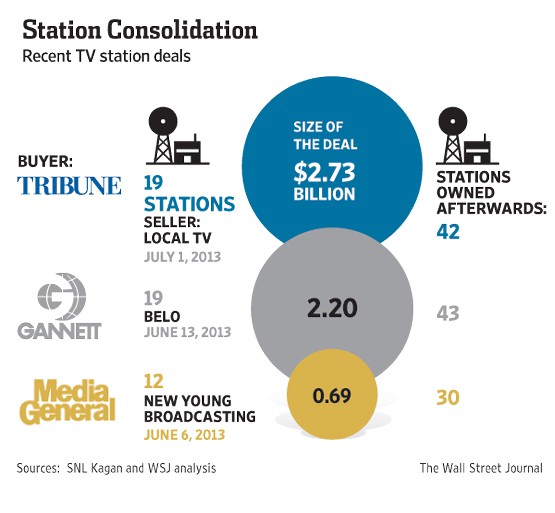
(Image: The Wall Street Journal)

(Image: The Wall Street Journal)

Critics worry the changing landscape of local television will threaten the concept of “local service” stations are required to provide as a condition of their broadcast license. A station owner that lives and works in the community served is becoming an increasing rarity, and the Federal Communications Commission has allowed stations that used to fiercely compete for local news viewers to now “share resources.” Many stations, especially those owned by out of area investment banks, have discontinued local news altogether in cost-savings maneuvers.

“This deal adds to a blizzard of broadcast industry consolidation that is poised to leave America’s media system less local, less diverse and less accountable to the people in these communities,” said Free Press’ Craig Aaron in a statement on the deal. “By the time all these deals are done, a handful of companies could control almost all of the network affiliates in major markets and swing states. Local broadcasts are becoming simulcasts, with the same cookie-cutter content piped in from distant corporate headquarters, once-competitive stations combined into single newsrooms and fewer journalists forced to fill more hours of airtime.”

“The FCC needs to wake up to what’s happening on local TV,” said Aaron. “Wall Street may be overjoyed at this merger mania, but the rest of us should be very worried about having fewer viewpoints on the air and fewer reporters on the beat.”

[flv width=”640″ height=”500″]http://www.phillipdampier.com/video/Former FCC commissioner Michael Copps shares his concerns about media consolidation 2013.mp4[/flv]

Former FCC commissioner Michael Copps shares his concerns about increasing media consolidation and its impact on an informed electorate. (Aired on Carolina Journal Radio May 23, 2013) (1 minute)

Wisconsin Republicans’ War on Broadband: No Cheap Internet for Schools, Libraries

Wisconsin Republicans are outraged AT&T and CenturyLink are not able to charge taxpayers and students more than double the price for broadband in schools and libraries.

Wisconsin Republicans are outraged AT&T and CenturyLink are not able to charge taxpayers and students more than double the price for broadband in schools and libraries.

Wisconsin taxpayers and students could face substantially higher taxes and tuition fees because Republicans prefer AT&T and other commercial Internet Service Providers deliver high-speed Internet access to schools and libraries, even if prices are more than double those charged by the existing non-profit, cooperative provider.

Last week, under growing pressure and criticism from Republican legislators and the potential threat of private litigation, the University of Wisconsin withdrew its contract with WiscNet, fearing a costly backlash that could interrupt the school’s educational and research missions.

Republicans in the state legislature forced a competition ban in the 2011-2013 budget directly targeting WiscNet, an institutional broadband provider serving 300 public schools, state agencies, and 15 of 17 Wisconsin library systems. They consider WiscNet a direct competitive threat to the business interests of AT&T and other telecommunications companies.

The loss of business from UW has raised questions about the ongoing viability of WiscNet’s operations, and has encouraged critics to continue the campaign against public broadband.

“Isn’t it a sad day when political pressures from telephone company lobbyists keep us from working together,” asked WiscNet Wire. “It’s frustrating, yet fascinating.”

Many of WiscNet’s members report that “going private” for Internet connectivity will more than double their costs. This was confirmed by Wisconsin’s Legislative Audit Bureau, which reported a member paying WiscNet $500 month for Internet service would face bills of $1,100 or more if provided by AT&T or other telecom companies.

Republicans have complained WiscNet’s close ties to the state university system and its efforts to resist the Walker Administration’s efforts to dismantle the institutional fiber network’s current operational plans border on unethical.

Cheerleading the Republicans are providers including AT&T and CenturyLink, both filing their own respective complaints (AT&T) (CenturyLink). Joining them is the Wisconsin State Telecom Association (WSTA), which represents Wisconsin’s independent rural phone companies like Frontier Communications.

WiscNet Connecting People Logo_0William Esbeck, WSTA’s executive director, has been on WiscNet’s case for years. He said WiscNet’s recent victory in a procurement process to supply Internet service across the UW system was proof the bidding was rigged.

“The UW simply created a ‘request for proposals’ that matched what WiscNet was already doing,” said Esbeck.

Republican legislators joined Esbeck threatening hearings and unspecified repercussions for the “civil disobedience” on display by university officials attempting an end run around the Walker Administration.

“There have been repeated, flagrant violations of state law — intentional deception at a level that I just am flabbergasted by, even today — and no accountability for it whatsoever,” said state Rep. Dean Knudson (R-Hudson), at a recent budget committee hearing. Among Knudson’s biggest campaign contributors: the WSTA and CenturyLink.

In a May 23 letter sent to UW System president Kevin Reilly, state Sen. Paul Farrow (R-Pewaukee) accused UW officials of “mismanagement and unethical behavior,” saying they’d shown disdain for the legislature and contempt for the laws and directives it passed, reported Bill Lueders, the Money and Politics Project director at the Wisconsin Center for Investigative Journalism.

Among Farrow’s biggest campaign donors: TDS Telecom and the WSTA.

Both Farrow and Knudson are also known members of the American Legislative Exchange Council (ALEC), a corporate financed group that produces anti-public broadband draft legislation for introduction by the group’s members. Both CenturyLink and AT&T are sponsors of ALEC, AT&T in particular.

The Walker Administration has given the UW System an extra six months to sever all ties with WiscNet.

New York Taxpayers Cover $3.1 Million of Time Warner Cable’s New Buffalo Call Center

corporate-welfare-piggy-bankNew York taxpayers will cover more than $3.1 million in state tax breaks handed to Time Warner Cable to build a new Business Class customer call center inside an abandoned hospital.
Local politicians and Lt. Gov. Robert Duffy were on hand in Buffalo Monday to celebrate the deal, which could mean 152 new jobs over the next five years at the site of the former Sheehan Memorial Hospital, east of downtown.

Duffy, the former mayor of Rochester, said Time Warner Cable could have placed the call center anywhere in the country, but they chose western New York.

Assemblywoman Crystal Peoples-Stokes (D-Buffalo) told the Buffalo News such jobs typically pay an average of $15 an hour nationwide, or $31,200 for a 40-hour workweek. That means roughly two-thirds of the average salary would be paid for by New York taxpayers in the form of forgiven tax liabilities.

Time Warner Cable is the same company that regularly argues community owned broadband networks represent unfair competition because they receive taxpayer subsidies. The company has financed efforts by groups like the American Legislative Exchange Council (ALEC) to lobby for public broadband bans enacted under state laws. But neither the cable company or ALEC objects to taxpayer subsidies, payments in lieu of taxes, tax credits, or other considerations covered by ordinary taxpayers going to private corporations.

Duffy said he was uncertain if the agreement included any taxpayer protection provisions to hold Time Warner Cable to its promises to hire new workers in return for the tax credits. Such “clawback” provisions typically force companies to reimburse the state if they fail to meet their commitments.

Time Warner employs over 1,000 in western New York, 10,000 statewide. In February, Time Warner Cable accepted  a $5,266,979 grant courtesy of New York State taxpayers to extend their cable system to 4,114 homes in rural parts of upstate New York.

[flv width=”640″ height=”380″]http://www.phillipdampier.com/video/Buffalo News Time Warner major tax breaks for call center 6-24-13.flv[/flv]

A Buffalo News reporter interviewed Lt. Gov. Bob Duffy and Time Warner’s Terence Rafferty about the taxpayer-financed grant to the cable operator.  (4 minutes)

When Do You “Need” Faster Speeds? When Competition Arrives Offering Them

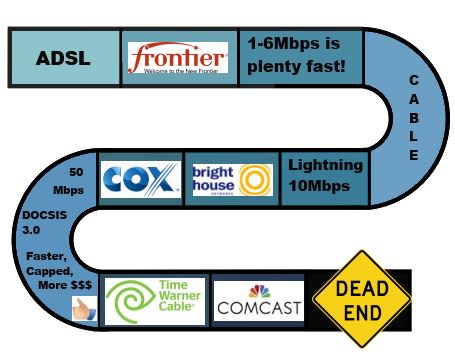
broadband dead end“We just don’t see the need of delivering [gigabit broadband] to consumers.” — Irene Esteves, former chief financial officer, Time Warner Cable, February 2013

“For some, the discussion about the broadband Internet seems to begin and end on the issue of ‘gigabit’ access. The issue with such speed is really more about demand than supply. Most websites can’t deliver content as fast as current networks move, and most U.S. homes have routers that can’t support the speed already available.” — David Cohen, chief lobbyist, Comcast Corp., May 2013

“We don’t focus on megabits, we don’t focus on gigabits, we focus on activities. We go to the activity set to get a sense of what customers are actually doing and the majority of our customers fit into that 6Mbps or less category.” — Maggie Wilderotter, CEO, Frontier Communications, May 2013

“It would cost multiple billions” to upgrade Cox’s network to offer gigabit speeds to all its customers. — Pat Esser, CEO, Cox Communications, Pat Esser, chief executive of Cox Communications Inc., January 2013

“The problem with [matching Google Fiber speeds] is even if you build the last mile access plant to [offer gigabit speeds], there is neither the applications that require that nor a broader Internet backbone and servers delivering at that speed. It ends up being more about publicity and bragging. There has been a whole series of articles in the paper about ‘I’m a little startup business and boy it is really great I can get this’ and my reaction is we already have plant there that can deliver whatever it is they are talking about in those articles, which is usually not stuff that requires that high-speed.” — Glenn Britt, CEO, Time Warner Cable, December 2012

“Residential customers, at this time, do not need the bandwidth offered with dedicated fiber – however, Bright House has led the industry in comprehensively deploying next-generation bandwidth services (DOCSIS 3.0) to its entire footprint in Florida – current speeds offered are 50Mbps with the ability to offer much higher. We provision our network according to our customers’ needs.” – Don Forbes, Bright House Networks, February 2011

‘Charter [Cable] is not seeing enough demand to warrant extending fiber to small and medium-sized businesses — and certainly not to every household.’ — “Speedier Internet Rivals Push Past Cable“, New York Times, Jan. 2, 2013

Unless you live in Kansas City, Austin, in a community where public broadband exists, or where Verizon FiOS provides its fiber optic service, chances are your broadband speeds are not growing much, but are getting more expensive. The only thing innovative coming from the local phone or cable company is a constant effort to convince customers they don’t need faster Internet access anyway.

At least until a competitor threatens to shake up the comfortable status quo.

Time Warner Cable claims they are perfectly comfortable offering residential customers no better than 50/5Mbps, except in markets like Kansas City (and soon in Texas) where 100Mbps is more satisfying. Why is a glass Time Warner claims is full to the brim everywhere else in the country only half-full in Kansas City? Google Fiber might be the answer. It offers 1,000/1,000Mbps service for less money than Time Warner used to charge for 50Mbps service, and Google is also headed to Austin.

special reportAT&T scoffed at following Verizon into the world of fiber optic broadband, where broadband speeds are limited only by the possibilities. Instead, they built their half-fiber, half-Alexander Graham Bell-era copper wire hybrid network on the cheap and ended up with broadband speeds topping out around 24Mbps, at least in a perfect AT&T world, assuming everything was ideal between your home and their central office.



At the time U-verse was first breaking ground, cable broadband’s “good enough for you” top Internet speed was typically 10-20Mbps. Now that incrementally faster cable Internet speeds are available from recent DOCSIS 3.0 cable upgrades, AT&T is coming back with an incremental upgrade of its own, to deliver around 75Mbps.

It is still slower than cable, but AT&T thinks it is fast enough for their customers, except in Austin, where Google Fiber provoked the company to claim it would build its own 1,000Mbps fiber network to compete (if it got everything on its Christmas Wish List from federal, state, and local governments).

Are you starting to see a trend here? Competition can turn providers’ investment frowns upside down and get customers faster Internet access.

Wilderotter: Most of our customers are satisfied with 6Mbps broadband.

Wilderotter: Most of our customers are satisfied with 6Mbps broadband.

In rural markets were Frontier Communications faces far less competition from well-heeled cable companies, the company can claim it doesn’t believe most of its customers need north of 6Mbps to do important things on the Internet. If they did, where would they go to do them?

Where Comcast and AT&T directly compete, major Internet speed increases are a matter of “why bother – who needs them.” Comcast is more generous where it faces down Verizon FiOS. AT&T also knows the clock is ticking where Google Fiber is coming to town.

Verizon FiOS, Google Fiber, and a number of community-owned fiber to the home broadband networks like EPB in Chattanooga and Greenlight in Wilson, N.C. seem more interested in boosting speeds to build market share, increase revenue to cover their expenses, and make a marketing point their networks are superior. They respond to requests for speed upgrades differently — “why not?”

Verizon figured out offering 50/25Mbps service was simple to offer and easy to embrace. Two clicks on a FiOS remote control and $10 more a month gets a major speed upgrade for basic Internet customers that used to get 15/5Mbps service. Verizon management reports they are pleased with the number of customers signing up.

In Chattanooga, Tenn. EPB Fiber offered gigabit Internet service because, in the words of its managing director, “it could.” The community-owned utility did not even know how to price residential gigabit service when it first went on offer, but the costs to EPB to offer those speeds are considerably lower over fiber to the home broadband infrastructure.

Broadband customers in Chattanooga, Kansas City and Austin are not too different from customers in Knoxville, Des Moines, and Houston. But the available broadband speeds in those cities sure are.

LUS Fiber in Lafayette, La. changed the song Cox was singing about their ‘adequate’ broadband speeds. Earlier this year, Cox unveiled up to 150/25Mbps service to cut the number of departing customers headed to the community owned utility, already offering those speeds.

Convincing Wall Street that spending money to upgrade networks to next generation technology will earn more money in the long run has failed miserably as a strategy.

“Competitors have been overbuilding, investors are wondering where the returns are,” said Mark Ansboury, president and co-founder of GigaBit Squared. “What you’re seeing is an entrenchment, companies leveraging what they already have in play.”

With North American broadband prices rising, and some cable companies earning 90-95% margins selling broadband, one might think there is plenty of money available to spend on broadband upgrades. Instead, investors are receiving increased dividend payouts, executive compensation packages are swelling as a reward for maximizing shareholder value, and many companies are buying back their stock, refinancing or paying off debt instead of pouring money into major network upgrades.

That is not true in Europe, where providers are making headlines with major network improvements and speed increases, all while charging much less than what North Americans pay for broadband service.

UPC Netherlands is Holland's second biggest cable company and it is in the middle of a broadband speed war with fiber to the home providers.

UPC Netherlands is Holland’s second biggest cable company and is in the middle of a broadband speed war with fiber to the home providers.

In the Netherlands, the very concept of Google Fiber’s affordable gigabit speeds terrify cable operators like UPC Netherlands, especially when existing fiber to the home providers in the country are taking Google’s cue and advertising gigabit service themselves. UPC rushed to dedicate up to 16 bonded cable channels to boost cable broadband speeds to 500Mbps in recent field trials, without giving any serious thought to the cable operators in the United States that argue customers don’t need or want the faster Internet speeds fiber offers.

“We had to address it head on very recently because of the fiber (competition)” said vice president of technology Bill Warga. “The company is called Reggefiber in the Netherlands. What they’re touting is a 1Gbps service, [the same speed] upstream and downstream. We came out with 500Mbps service. We had to build a special modem because (DOCSIS) 3.1 chips aren’t out yet. We had to double up on the chips in the modem and put it out there because we had to have a competing product, if anything just in the press. That was a reaction but that tells you how quickly in a marketplace that something can move.”

Despite that, groupthink among cable industry attendees back home at the SCTE Rocky Mountain Chapter Symposium agreed that Google Fiber was a political and marketing stunt, “since the majority of users don’t need those types of speed.”

Who does need and want 500Mbps? Executives at UPC, who have it installed in their homes, admits Warga. But cost can also impact consumer demand. Currently, the most popular legacy UPC broadband package offers 25Mbps for €25 ($32.50). The company now sells 60/6Mbps for €52,50 ($48.75), 100/10Mbps for €42,50 ($55.25) or 150-200/10Mbps for €52,50 ($68.25).

Warga also admits the competition has put UPC in a speed race, and boosted speeds are coming fast and furious.

“They’ll come in and say they’re 100, or 101Mbps we’ll come back and say we’re 110 or 120, or 130Mbps,” Warga said. “It’s a bit of a cat and mouse game, but we always feel like we can be ahead. For us DOCSIS 3.1 can’t come soon enough.”

[flv width=”640″ height=”367”]http://www.phillipdampier.com/video/WSJ Cable Broadband Speeds 1-13.flv[/flv]

The Wall Street Journal investigates why cable companies are getting stingy with broadband speed upgrades while gigabit fiber networks are springing up around the country. (4 minutes)

What You Knew Already: Fiber Broadband Rules, Says New Report; We Need More

buddecomAttention broadband planners: Although broadband deployment strategies differ around the world, a new report decisively concludes there is only one network technology proven to meet the demands of broadband users both today and tomorrow: a national fiber optic network.

BuddeComm’s new report, “Global Broadband – Fibre is the Infrastructure Required for the Future,” looked at every technology from variations of DSL, cable broadband, satellite, and wireless and found only fiber optics capable of handling the capacity of data and applications that will be required to run cities and countries from today onwards.

The report found that fiber optic deployment faced a range of challenges, despite its obvious technological advantages. Political obstacles are among the biggest roadblocks facing fiber networks. A combination of concerns about the cost of wiring service to procrastination has held back many national broadband improvement projects, including those in Australia and New Zealand. Incumbent commercial providers in North America have also actively attempted to block public fiber networks to protect their own commercial interests.

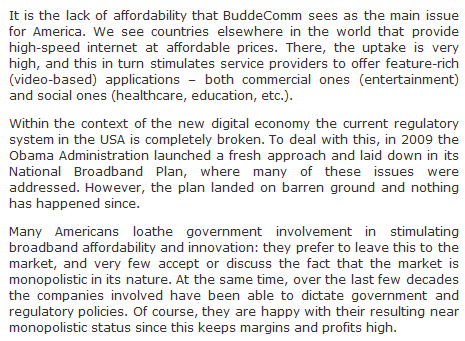
buddecomm concl

BuddeComm concludes America’s biggest broadband problems come as a result of incumbent providers exercising undue market power and influence over elected officials to protect their commercial interests at the price of the public good.

The report concludes that decisive political leadership is essential to overcome many of the artificial obstacles which slow down or stop fiber broadband deployments.

“One can argue endlessly about what technologies should be applied and at what cost, but we believe that all signs point to Fiber-to-the-Home (FTTH) networks as the best future-proof solution,” the report concludes. “One can debate about whether it is needed in five, ten or fifteen years – and again that depends on some of the differences between countries – but in the end FTTH is the best final solution for all urban and many regional premises.”

The 21st century digital economy is powered by robust broadband, and growing demands for faster speeds are coming from the healthcare, energy, media and retail sectors. Healthcare uses include file transfers of high-definition medical imagery and teleconferencing. Smart Grid technology is being deployed by many power companies to develop more efficient means of distributing and conserving energy. Media and mass entertainment providers are moving to high bandwidth online video, and the retail economy markets products and services over modern broadband networks.

The implications for the global economy are enormous. More than 120 countries have formal broadband policies and many consider high-speed Internet access a national priority. In the last century, North America and western Europe were considered the dominant economic players, in part because they established and maintained infrastructure to support their manufacturing and service economies. But many of these countries are falling far behind in the 21st century digital economy, where countries like Japan and Korea, parts of eastern Europe, the Baltic States, and Scandinavia are taking the lead in infrastructure deployment.

“Broadband infrastructure is perceived by all to be critical for the development of the digital economy, healthcare, education, e-government and so on,” the report notes. “From a financial and investment point of view broadband infrastructure should be treated as utility infrastructure.”

The interests of the private sector are not always aligned with the public interest, particularly when it comes to spending capital on upgrading network infrastructure. The report recommends that governments step in and build a public fiber highway system on which all providers can offer services.

“A National Broadband Network (NBN) should be based upon an open network as this makes it possible to offer the basic infrastructure on a utility basis to content and service providers,” the report concludes.

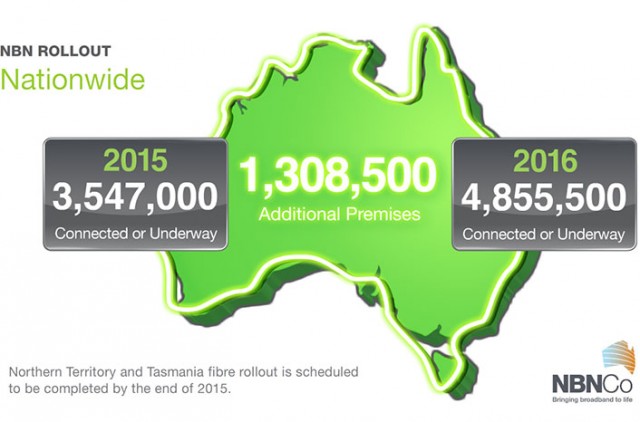
The governments of Australia, New Zealand, Israel, and others are already moving in that direction, setting up broadband authorities to build fiber infrastructure dismissed as too expensive or unnecessary by commercial providers who answer first to financial markets, shareholders, and private banks.

Under most NBN plans, providers get access to the fiber network at wholesale rates and help recoup its cost.

Australia's National Broadband Network is on the way.

Australia’s National Broadband Network is on the way.

Where politicians answer to the whims of the private sector before considering the public good, the report finds:

  • Private cable companies, particularly in North America, will continue to support and incrementally upgrade their HFC networks, but new cable operators are more likely to deploy fiber at the outset, not coaxial copper cable. Network costs, efficiencies, and reliability are all in fiber’s favor. In Europe, cable broadband is regularly losing market share to faster fiber technology. The share of all broadband subscribers held by HFC networks across Europe fell from 26% in 2002 to about 11% by mid-2013;
  • Private telephone companies that do not face robust competition will continue to rely on their existing DSL networks. In cities and larger towns, expect phone companies to eventually upgrade to VDSL fiber-to-the-neighborhood (and its variants) in the largest markets with the most competition. Rural areas will continue to receive less robust DSL service, particularly where no cable competitor provides service;
  • Rural areas may receive fixed wireless or satellite broadband service, but this is not a solution for more populated areas.

Although the global economic downturn stalled many fiber network deployments and suppressed demand, the report finds broadband usage and demand for faster speeds are quickly accelerating. Some other highlights:

  • Asia continues to be the leader in fiber optic deployment;
  • Sufficient customer demand to make the investment in fiber worthwhile is increasingly likely once fiber service becomes widely available in countries like the Netherlands, China, France, Israel, Switzerland, Norway and Sweden;
  • International connectivity in Africa remains a challenge, but fiber bandwidth is expected to more than double by 2014;
  • The Middle East will see rapid growth in fiber broadband once international capacity constraints are eased.

Obtaining a copy of the full BuddeComm report is prohibitively expensive for consumers, priced at $995.

Search This Site:

Contributions:

Recent Comments:

Your Account:

Stop the Cap!