Home » Competition » Recent Articles:

Wall Street Asking Questions About AT&T’s GigaPower: 1Gbps vs. 45Mbps U-verse

ovumA Wall Street research firm is asking questions about the “mixed messages” AT&T is sending consumers over its broadband offerings.

Ovum Research senior analyst Kamalini Ganguly said AT&T’s fiber to the home (FTTH) network in Austin — set to upgrade customers to 1Gbps next year — is likely to confuse AT&T and its shareholders over the future direction of AT&T’s current fiber to the neighborhood (FTTN) upgrade effort, dubbed Project VIP.

Having spent eight years deploying the U-verse FTTN service, a year ago AT&T chose to expand household coverage and upgrade speeds. That effort, called Project VIP, is still ongoing and until now has reflected AT&T’s projection that 45Mbps downstream (and 6Mbps upstream) should be good enough for the majority of its customers.

att gigapowerAT&T says it intends to boost part of its Project VIP footprint to 75Mbps or 100Mbps with VDSL2 vectoring, but the extent of this is unknown. It has also deployed a small amount of GPON FTTH in greenfield markets, typically designed to support 80–100Mbps to each household. Also as part of Project VIP, it plans to reach 1 million businesses with symmetric 1Gbps FTTH.

However, the GigaPower offering in Austin will be AT&T’s first 300Mbps or 1Gbps mass-market FTTH offering targeting consumers, not just businesses, in a major market. It is also a symmetric offering, meaning upstream will be 1Gbps as well. Those speeds are far higher than what Project VIP will deliver to the majority of consumers. The jump from 45/6Mbps to 1/1Gbps for consumers raises questions around its strategy. The cost issue looms large. Deploying 1Gbps point-to-point FTTH will continue to cost much more than GPON FTTH, which in turn still costs a lot more than FTTN – even with vectoring. AT&T needs to explain better what has changed from last year in the business case for FTTH over FTTN.

Wall Street is asking questions because AT&T has repeatedly denied its fiber project in Austin has anything to do with Google’s intention to offer a similar fiber network in Austin next year and everything to to do with its general broadband strategy. There is increasing skepticism about AT&T’s veracity on that point, particularly after AT&T announced pricing that was suspiciously similar to what Google charges its fiber customers in Kansas City and is likely to charge in Austin. Ovum’s researchers also took special note of AT&T’s intention to “examine its customers’ browsing habits in order to generate incremental revenues with targeted ads and commercial offers.”

There is evidence Google is proving a growing market disruptor, turning cable and telco industry pricing models upside down where the search engine giant threatens to compete. Industry plans to charge premium prices for incrementally faster broadband speed tiers is at risk with Google’s gigabit offer, priced at just $70 a month. Comcast charges up to $300 a month for considerably less speed. Community owned fiber broadband providers are increasingly adopting Google’s pricing model themselves. EPB in Chattanooga reduced the price of its 1Gbps tier from $300 to $70 earlier this year.

“By accepting a ceiling of $70, AT&T may be making it harder to break even,” writes Ganguly. “We may see lower prices cascading down for all broadband services. AT&T runs the risk of de-valuing its own broadband business and ultimately that of others too. On a more positive note, demand for 1Gbps was seen as questionable when prices were unaffordable for consumers and when multiple HD streams can be supported by 40–50Mbps. With these price levels however, demand may spike and boost the business case for 1Gbps.”

AT&T’s Gigabit Fiber: Spying on Your Browsing History for Targeted Ads and Discounts

who is watching

AT&T has got your number.

AT&T wants to know what you are doing on the Internet.

If you agree to share your browsing history and view targeted contextual advertising from AT&T and its partners, the company will give you a monthly discount off the price of its new GigaPower gigabit fiber network.

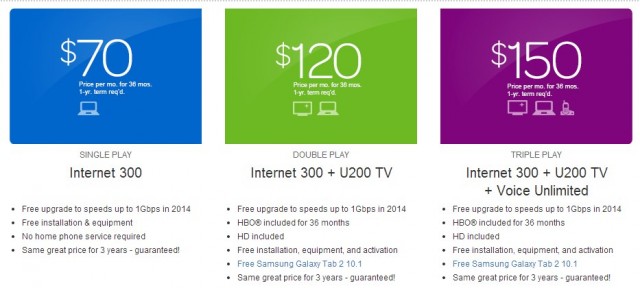
Now launching in Austin, AT&T GigaPower charges $99 a month for 300Mbps standard service (speeds will be raised to 1,000Mbps in 2014 at no extra cost — equipment, installation and activation fees are extra). But customers can knock $30 off the monthly price and skip the new customer fees by enrolling in AT&T’s new “Premier” package, which runs $70 a month.

GigaOm discovered some interesting language in AT&T’s fine print about its Premier service: “[The discount] is available with your agreement to participate in AT&T Internet Preferences. AT&T may use your Web browsing information, like the search terms you enter and the Web pages you visit, to provide you relevant offers and ads tailored to your interests.”

Exactly how AT&T intends to implement its contextual advertising program remains largely a mystery. Google includes contextual ads in its Gmail service, its search engine results, and in online advertising from participants in Google’s AdWords program. AT&T lacks an advertising platform as large as Google or Microsoft’s Bing, so questions are being raised about how exactly AT&T will be able to find enough places to present online ads.

GigaOm suspects AT&T might use deep packet inspection to monitor customers’ web traffic to collect browsing information for contextual ads. Others suspect AT&T will replace certain existing third-party ads found on independent websites with its own advertising. Either is likely to bring the company scrutiny, both from Internet Privacy advocates and website owners that find their advertising replaced by ads from AT&T and its partners.

AT&T’s response to GigaOm left a number of questions unanswered:

We use various methods to collect web browsing information, and we are currently reviewing the methods we may use for the Internet Preferences program. Whichever method is used, we will not collect information from secure (https) or otherwise encrypted sites, such as online banking or when a credit card is used to buy something online on a secure site. And we won’t sell your personal information to anyone, for any reason.

[…] We won’t sell your personal information. Rather, AT&T may use your personal information to direct another advertiser’s ad to you, but that advertiser would never have access to your Personal Information. For example, after you browse hotels in Miami, you may be offered discounts for rental cars, but that rental company doesn’t know who you are.

AT&T is experimenting with consumer acceptance of discounting service in return for giving up some privacy. It says it is giving customers the choice to opt out by signing up for the more expensive “standard” service.

gigapower pricing

U-verse television service is also available to customers of both packages for an extra $50 a month. Telephone service adds another $30 a month.

AT&T has started rolling out its GigaPower service in the French Place, Mueller, Zilker, and Onion Creek neighborhoods and will select future places to expand based on interest registered by local residents on AT&T’s GigaPower website.

“We’ve already received great input from thousands of Austinites eager for the fastest speeds,” said Dahna Hull, general manager of Austin’s AT&T Services, Inc. “These votes are helping us identify where the need for speed and advanced TV services is the greatest and will help guide our future GigaPower expansion plans.”

[flv]http://www.phillipdampier.com/video/KXAN Austin Internet speed race in Austin is on 12-11-13.mp4[/flv]

Options for super high-speed Internet are heating up in Austin as AT&T introduces AT&T U-verse with GigaPower this week. KXAN reports the service will initially launch with 300Mbps service in a handful of neighborhoods, but upgrade to 1,000Mbps speeds in more locations next year. (2:30)

PowerPlay: AT&T Says Google Fiber Cannot Use Its Utility Poles in Austin

att poleAT&T has informed Google it will not allow the search engine company to use its utility poles to build a fiber optic network that will compete with AT&T’s own GigaPower fiber service, which launched in Austin this week.

Current rules require utilities to provide non-discriminatory access to poles for all electric and telecommunications companies. AT&T has declared Google is neither, but is willing to work with the company once it is “qualified,” said Tracy King, AT&T’s vice president for public affairs.

“By challenging the city to force an employer to share its equipment contrary to federal law and without transparency, Google appears to be demanding concessions never provided any other entity before,” said King.

The dispute now threatens to involve Austin’s city council, which fears AT&T’s position could result in thousands of new utility poles being installed next to AT&T-owned poles. City officials warn they are willing to settle the matter by changing the rules for all utility companies, using their authority as the owner of the land on which the utility poles are placed.

“We don’t want people to put up their own poles,” Rondella Hawkins, Austin’s telecommunications and regulatory affairs officer, told the Austin-American Statesman. “We want to avoid anybody putting up redundant utility poles. Could you imagine a city where all the (telecommunications) providers individually have their own utility poles? It would be a mess.”

Google said it wants to bring its fiber network to Austin in the least disruptive way possible, and AT&T’s actions may complicate the project.

Martinez

Martinez

The proposed rules change threatened by the city council brought immediate opposition from both AT&T and the unions that represent AT&T workers.

“The city of Austin should not jump into what amounts to a business dispute and create winners and losers before everyone can present data on all the stakes that are involved,” wrote Becky Moeller, president of the Texas AFL-CIO.

This afternoon, with the rules change pending on the calendar, Google and AT&T apparently decided to work out the dispute before the city imposed a solution.

“After hard work, lots of meetings and tons of input – AT&T and Google agree to negotiate their issues with the city,” Austin council member Mike Martinez wrote on his Facebook page. “A postponement of [the ordinance change] is highly likely. Thank you to them and all who helped make this happen.”

[flv]http://www.phillipdampier.com/video/KVUE Austin Dispute Between Google ATT 12-11-13.mp4[/flv]

KVUE in Austin reports the pole attachment dispute between AT&T and Google threatens to involve the city council. (3:09)

MergerMania: Discovery Communications Considers Takeover of HGTV, Food Network

Phillip Dampier December 11, 2013 Competition, Consumer News Comments Off on MergerMania: Discovery Communications Considers Takeover of HGTV, Food Network

mergerThe trend towards cable consolidation is no longer just limited to cable operators. Now programmers are looking to strengthen their position in cable carriage negotiations by building “must-have” packages of cable programming that could mean smaller independent channels could eventually get locked out.

Bloomberg News reports the board of Discovery Communications, owner of the Discovery Channel, is discussing a possible bid for Scripps Networks Interactive, which runs channels including HGTV and the Food Network.

Scripps is one of the smaller network owners, but one that has proven popular and profitable. But it is not tied to a media conglomerate or the cable industry directly. Discovery has been a part of the cable television lineup for decades. Cable TV billionaire Dr. John Malone controls 29 percent of Discovery’s voting rights, giving him significant influence at the company.

A combined operation would control these networks:

discovery Discovery:

  • TLC
  • Animal Planet
  • Oprah Winfrey Network
  • Destination America
  • Investigation Discovery
  • Discovery Fit & Health
  • Discovery Science
  • Military Channel
  • Science
  • Velocity

240px-Scripps_Networks_Interactive.svgScripps:

  • HGTV
  • Food Network
  • DIY Network
  • Cooking Channel
  • Great American Country
  • Travel Channel

Some analysts suggest such a combination doesn’t make much sense for Discovery, which has been focused on expanding operations internationally.

But other bidders might surface for Scripps, reports Bloomberg, which may be a complementary business for 21st Century Fox, Time Warner or Viacom, said Eric Handler, an analyst at MKM Partners, in a research note.

How to Get a Better Deal for Verizon FiOS; $79.99 Triple-Play Offer With $300 Rebate Card

Cablevision CEO Jim Dolan may have to eat his words when he told shareholders he was done giving promotional discounts to customers bouncing back and forth between competing providers. Now Verizon has given Cablevision customers an excuse to say goodbye to the cable company for at least the next two years.

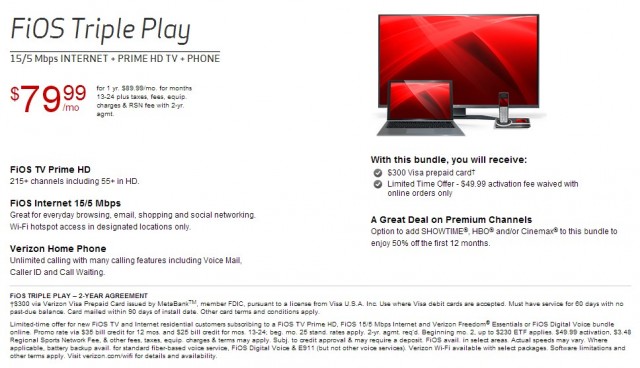
The Verizon FiOS $79.99 Triple Play promotion is back and includes a $300 Visa rebate card and free activation when ordering from Verizon’s website.

fios triple play

The package includes:

  • FiOS TV’s “Prime HD” tier, which includes around 215 channels, 55+ in HD. (See channels);
  • FiOS Basic Internet (15/5Mbps), upgradeable to 50/25Mbps for $10 more per month;
  • Verizon Home Phone including unlimited calling and features including Voice Mail, Caller ID and Call Waiting;
  • a 50% optional discount off HBO and Cinemax for one year.

The fine print:

  • Promo rate shows up on your Verizon bill as a $35 credit during months 1-12 and a $25 credit for months 13-24. That means you will pay $79.99 for the first year, $89.99 for the second. Factoring in the $300 gift card, your rate is still under $88 a month for two years;
  • Offer for new FiOS customers only. (Existing customers – see below);
  • A $230 early termination fee applies to this 2-yr contract offer, with the dollar amount gradually decreasing for each month of service;
  • Equipment costs, a $3.48 Regional Sports Network fee, taxes, franchise fees and other similar charges are extra.

fiosHere are some tips for current FiOS customers:

  1. Current FiOS customers may be able to negotiate a very similar deal (without the gift card) by talking to Verizon’s “Elite Team,” a/k/a Customer Retentions. Call Verizon’s customer service line (1-800-837-4966) and select the option to cancel service and your call will be transferred.
  2. Customers off-contract will have the best results securing a new promotional deal. On-contract customers nearing the end of their agreement can suggest they are willing to pay the last few months of a pro-rated early termination fee to leave if they cannot get a better deal with Verizon.
  3. Let the representative know you can always cancel your existing service and take advantage of a new customer promotion under your spouse’s name, but “to save both of us time and aggravation, let’s work out a comparable deal with my existing service.”
  4. Verizon often has one-year customer retention deals available that do not impose any term commitments. Make sure to ask the representative about no-contract options, if not volunteered, because certain off-contract retention deals can actually cost less. It is very unlikely you will get the gift card, but you might be able to win a one time courtesy credit.
  5. Request a free upgrade to Verizon FiOS Quantum (50/25Mbps service) as part of a retention deal.

Earlier this year, customers told Stop the Cap! they had success securing a 12 month, no-contract retention offer that included a mid-range television package, 50/25Mbps broadband, and home phone service for $95 a month with an invitation to call back and sign up for a similar deal one year later.

Verizon’s pricing is very aggressive and beats both Cablevision and Comcast in the northeast.

Cablevision now offers a triple play bundle for $84.95 a month for one year that doesn’t include installation charges or other ancillary equipment, service, programming, taxes, and franchise fees. Cablevision isn’t offering a $300 gift card either. But the cable company does include a free Smart Router and free Optimum Online Ultra 50 for six months.

A similar two-year promotion from Comcast runs $89 a month in northern New Jersey and includes a $300 gift card and then a nasty surprise after the first year. Once a customer reaches month 13, the promotional rate increases to a whopping $109.99 for the remainder of the two-year agreement — quite an increase. The Comcast promotion also offers far fewer television channels (80+), but does bundle HBO and X1 Advanced DVR service for one year, includes 20Mbps download speeds, and Streampix free for three months. The usual extra fees also apply.

Search This Site:

Contributions:

Recent Comments:

Your Account:

Stop the Cap!