

Home » Competition » Recent Articles:

Comcast Reaches Surprise Agreement to Acquire All of Time Warner Cable for $44 Billion

timewarner twcComcast will announce later this morning it has reached an agreement to acquire all of Time Warner Cable in an all-stock deal worth $44 billion.

If approved by regulators, Comcast will dramatically increase its size as the nation’s largest cable operator with over 33 million subscribers — vastly outnumbering every other cable company in the country. It also likely means Time Warner Cable broadband subscribers will eventually be subject to Comcast’s usage caps and overlimit fees, now being market tested around the country.

The offer of $159 a share for Time Warner Cable stock – $1 less than what TWC CEO Rob Marcus demanded for a buyout – is far higher than the $133 a share in cash and stock offered earlier by Charter Communications.

Tonight’s revelation that Time Warner Cable and Comcast reached a deal, first reported by CNBC, likely caught Charter by surprise. Charter had tried to acquire Time Warner Cable for months, going as far as nominating candidates for TWC’s board of directors that could have influenced a sale of the company. At the same time, Charter thought it was negotiating a friendly deal with Comcast to divide Time Warner Cable territories between the two companies.

Comcast-LogoTime Warner Cable management offered no clues they were negotiating with Comcast and delivered a presentation to shareholders last week promising major upgrades for Time Warner customers and future success as a standalone cable operator. All of those plans are now in doubt.

Comcast and Time Warner Cable reportedly believe the deal will quickly pass any antitrust review before the end of the year because neither company competes in the same markets, but Comcast will offer to divest a token three million subscribers from the combined company, according to sources.

The FCC formerly limited cable companies from owning or controlling more than 30% of the cable industry, but Comcast successfully sued to have that ownership cap overturned. A belief the deal would present looming antitrust problems could be grounds for the U.S. Department of Justice to oppose the deal, likely terminating it.

monopolyConsumer groups hope the deal gets derailed as soon as possible.

“In an already uncompetitive market with high prices that keep going up and up, a merger of the two biggest cable companies should be unthinkable,” said Free Press president Craig Aaron. “This deal would be a disaster for consumers and must be stopped. No one woke up this morning wishing their cable company was bigger or had more control over what they could watch or download. But that — along with higher bills — is  the reality they’ll face tomorrow unless the Department of Justice and the FCC do their jobs and block this merger. Stopping this kind of deal is exactly why we have antitrust laws.”


“It is simply dangerous for a large proportion of our nation’s critical communications infrastructure to be in the hands of one provider,” said Public Knowledge staff attorney John Bergmayer. “It is already the nation’s largest ISP, the nation’s largest video provider, and the nation’s largest home phone provider.  It also controls a movie studio, broadcast network, and many popular cable channels. An enlarged Comcast would be the bully in the schoolyard, able to dictate terms to content creators, Internet companies, other communications networks that must interconnect with it, and distributors who must access its content.”

HissyFitWatch: Canadian Telecom Companies Annoyed Consumers Getting The Upper Hand

Phillip Dampier February 12, 2014 Bell (Canada), Canada, Cogeco, Competition, Consumer News, Data Caps, HissyFitWatch, Online Video, Public Policy & Gov't, Rogers, Shaw, Telus, Vidéotron Comments Off on HissyFitWatch: Canadian Telecom Companies Annoyed Consumers Getting The Upper Hand
Canadians are demanding a better deal from their cable and phone companies and they are forced to respond.

Canadians are demanding a better deal from their cable and phone companies and they are forced to respond.

As the United States battles back against the introduction of usage caps and rising prices for broadband service, increased competition and regulated open wholesale access to some of Canada’s largest broadband providers have given Canadians an advantage in forcing providers to cut prices and improve service.

Canadians can now easily get unlimited broadband access from one of several independent ISPs that piggyback service on cable and phone networks. Some large ISPs have even introduced all-you-can eat broadband options for customers long-capped by the handful of big players. As customers consider switching providers, cable and phone companies have been forced to cut prices, especially for their best customers. Even cell service is now up for negotiation.

The more services a customer bundles with their provider, the bigger the discount they can negotiate, say analysts who track customer retention. Bell, Rogers, Telus, and others have a major interest keeping your business, even if it means reducing your price.

“It’s far more lucrative for the telecom company to keep you there for the third or fourth service,” telecom analyst Troy Crandall told AP. It cuts down on marketing, service and installation calls, he added.

Getting the best deal often depends on your services, payment history, and how long you have been a customer. Cellphone discounts are the hardest to win, but customers are getting them if they have been loyal, carry a large balance and almost never pay late.

telus shawBigger discounts can be had for television and Internet service — cable television remains immensely profitable in Canada and broadband is cheap to offer, especially in cities. Americans often pay $80 or more for digital cable television packages, Canadians pay an average of $60.
Internet service in Canada now averages $45 a month, but many plans include usage caps. It costs more to take to the cap off.

Because of Canada’s past usage cap pervasiveness, online video is not as plentiful in Canada as it is in the United States. There has been considerably less cord-cutting in the north. Despite that, Canadians are ravenous online viewers of what they can find to watch (either legally or otherwise). As usage allowances disappear or become more generous, online video and the Internet will continue to grow in importance for service providers.

Customers should negotiate with their provider for a better deal, particularly if Bell’s Fibe TV is in town. Bell has been among the most aggressive in price cutting its fiber to the neighborhood television service for new customers ready to say goodbye to Rogers or Vidéotron.

Shaw and Telus battle for market share in the west and also have room to cut customer bills and still make a handsome profit.

Charter Communications Nominates 13 for Time Warner Cable Board in Ongoing Takeover Bid

Phillip Dampier February 11, 2014 Charter Spectrum, Competition, Consumer News, Editorial & Site News Comments Off on Charter Communications Nominates 13 for Time Warner Cable Board in Ongoing Takeover Bid
hostile takeover

Hostile Takeover

Charter Communications does not like the resistance it is getting from Time Warner Cable executives over its bid to acquire the company so Charter has nominated 13 new members for TWC’s board of directors in an effort to force executives to reconsider.

Charter calls the baker’s dozen a slate of “independent candidates” that will be willing to evaluate Charter’s offer of $132.50 a share. Time Warner Cable’s current management says it won’t negotiate with Charter unless they offer $160 a share.

“It is clear from our meetings with Time Warner Cable shareholders that there is an overwhelming desire to combine these two companies to increase Time Warner Cable’s competitiveness, grow market share and create shareholder value.  Now is the time for the current Board and management of Time Warner Cable to respond to their shareholders and work with us to complete a merger to the benefit of shareholders while minimizing their execution and market risks,” said Tom Rutledge, Charter’s CEO.  “We are nominating a full slate of highly qualified, independent directors to elect to the Time Warner Cable Board and believe that stockholders will use this opportunity to express their views.  Our purpose in this proxy contest is to enable shareholders of TWC to raise their voice, and to provide a very capable board who will hear them.”

Charter has gotten a lucky break because all 13 current TWC board members are up for re-election at the same time this spring. Many companies avoid that practice to prevent a hostile bidder from taking control of an entire company’s board.

Charter’s roster of nominees includes a number of current or former CEOs, three former Wall Street lawyers and an ex-chief technology officer that used to work for Time Warner Cable. Many were associated with hedge funds, cable operators that sold out to larger players, or companies that either went bust during the Great Recession and were bailed out by U.S. taxpayers.

Charter Communications’ ‘Rescue Team’ for Time Warner Cable

  1. James Chiddix: A cable industry veteran who formally retired in 2007, Chiddix worked for Time Warner Cable from the mid-80s until 2001. He now serves as a director at Arris Group, a manufacturer of cable equipment. Chiddix served on the board of Virgin Media, acquired last year by Liberty Global — which also has an ownership interest in Charter Communications;
  2. Bruno Claude: Known primarily as a “turnaround” expert, Claude has a record of restructuring troubled telecom operators by cutting jobs and negotiating with the large investment banks that generously loaned the money that fueled overvalued takeovers to write down that debt when banks realize they have no hope of being repaid in full;
  3. Isaac Corre: Currently a lecturer at Harvard Law School, where he teaches a seminar on executive compensation and corporate governance, Corre spent a decade at Eton Park Capital Management, L.P., a global hedge fund. Corre specialized in “event-oriented” investments and “distressed corporate debt”;
  4. super friendsMarwan Fawaz: Spent a year in a leadership role at Motorola Mobility/Motorola Home Division. He has the distinction of serving as an executive at two bankrupt cable operators: Charter Communications and Adelphia. Charter eventually emerged from bankruptcy, Adelphia did not and two members of its founding family are spending 15 years in the Allenwood federal prison, convicted of wire and securities fraud. Charter’s press release says Fawaz would be a valued addition to the board because he has “a deep understanding of the cable television industry”;

  5. Lisa Gersh: Lasted less than a year as CEO of Martha Stewart Living Omnimedia. Under her leadership, the company capped a year of turmoil that included layoffs, titles closing and the failure of Martha’s underwhelming Hallmark Channel show, according to Adweek. She was also a co-founder of Oxygen Media, which was sold to NBC;
  6. Dexter G. Goei: An investment banker at Morgan Stanley back when it was hip deep in sub-prime mortgages and a taxpayer bailout, Goei was gone by 2009 and became CEO of Altice, S.A., a multinational cable company growing through acquisitions and takeovers. Goei is raising more capital through a stock IPO managed by Goldman Sachs and… Morgan Stanley;
  7. Franklin (Fritz) W. Hobbs: In addition to serving as an adviser to private equity firms and director of Molson Coors Brewing Co., Hobbs has served as board chairman at Ally Financial, formerly GMAC, as GM declared Chapter 11 bankruptcy and was bailed out by U.S. taxpayers;
  8. Neil B. Morganbesser: An investment banker, Morganbesser worked on mergers and acquisitions at Bear Stearns & Co., until the company’s sub-prime hedge funds sank like the Titanic. The investment firm was seeking taxpayer assistance, but ended up being acquired by J.P. Morgan in a hastily arranged deal instead. Charter claims Morganbesser has 20 years of experience providing financial and strategic advice to a full range of clients, including entrepreneurs, large corporations, governments, etc., but evidently wasn’t much help to his employer during the global financial crisis.
  9. Eamonn O’Hare: Served as the chief financial officer of Virgin Media Inc., the UK’s leading cable television business, from 2009 until 2013. Unfortunately for him, most U.K. residents prefer satellite TV. But that didn’t hurt his bottom line. After Liberty Global acquired the operation in 2013, O’Hare got to share over $367 million in cash bonuses with certain other Virgin executives coming from a company that also has a vested interest in Charter Communications;
  10. David A. Peacock: Another beer guy, Peacock most recently served as the president of Anheuser-Busch;
  11. Michael E. Salvati: Another mergers and acquisitions guy, Salvati has been president at Oakridge Consulting, Inc., which provides interim management, management consulting and corporate advisory services to companies ranging in size from start-ups to multinational corporations, since February 2000. In short, he tries to promote financial growth at companies recently merged or acquired;
  12. Irwin Simon: Founder of the Hain Celestial Group, a leading “natural and organic products company.” Brands including Arrowhead Mills, Bearitos, Rosetto and Rice Dream are well-known in organic food sections of local supermarkets, although few customers probably realize they belong to a giant conglomerate. Other divisions, specializing in “woo-woo personal care” offer dubious “calming body washes” costing $13 or more that feature extract of marigold. Charter says Simon would bring “his unique perspective on all aspects of advertising and marketing services” to a newly merged Charter-Time Warner Cable;
  13. John E. (Jack) Welsh III: president of Avalon Capital Partners LLC — another private equity investment firm.

analysis“If Time Warner Cable management refuses to negotiate on reasonable terms, we believe Charter will likely secure the votes required to win a proxy fight,” said Jonathan Chaplin, a research analyst with New Street Telco.

“It is clear that Charter is nominating a slate of directors for the sole purpose of pressuring our Board into accepting the same lowball offer that it previously considered and unanimously rejected,” said Time Warner Cable CEO Rob Marcus. “Our Board remains focused on maximizing shareholder value. We are confident in our strategic plan, which was detailed publicly on January 30, and we are not going to let Charter steal the company.”

Marcus may have one last card to play should Charter’s nominees end up on Time Warner Cable’s board of directors. All board members must serve the best interests of the company they oversee, not the company that helped get them elected. An independent evaluation of Charter’s offer must not be influenced by outsiders, or the board members may face lawsuits from angry shareholders. The Wall Street Journal notes this requirement has tripped up hostile bidders before. Air Products & Chemicals Inc. won three board seats at Airgas Inc. which Air Products had tried to buy back in 2010. Once on the board, the new board members recommended against the deal.

Verizon Introduces 2-Yr Price Guarantee, Free Upgrade to Quantum 50/25Mbps Broadband

Phillip Dampier February 10, 2014 Broadband Speed, Competition, Consumer News, Verizon, Video 4 Comments

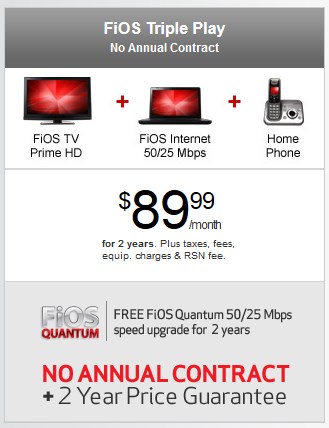
fiosVerizon has introduced a two-year price guarantee offer and a free broadband speed upgrade for new customers signing up for FiOS Internet, TV and voice service before April 19.
It’s the latest marketing salvo fired against Verizon’s cable competitors with the hope customers will cut cable’s cord and switch to FiOS.

All new customers will receive a two-year price guarantee with a triple play package costing as little as $89.99 a month.  The offers also include a free upgrade to FiOS Quantum 50/25Mbps Internet; FiOS TV Prime HD with more than 215 channels (more than 55 in HD); and FiOS Digital Voice home phone service with unlimited nationwide calling. As a further incentive, customers who choose a two-year agreement also receive a $250 Visa prepaid card. New customers who order online receive an extra $10 per month savings. Those ordering service from Verizon’s website will have the $49.99 activation fee waived.

Such aggressive promotions are not new for Verizon or its cable competition. The best prices are often reserved for new customers.

Former Time Warner Cable CEO Glenn Britt reflected last fall on the competitive environment between cable and phone companies and noted loyal, long-term customers don’t typically benefit much from pricing competition.

fios triple play“The current form of competition in this entire sector is essentially focused on promotional pricing, which allows customers who jump from provider to provider to get the best deal,” said Britt.
In an effort to control customers hopping back and forth between the cable and phone company (known as ‘subscriber churn’ in the industry), Verizon’s marketing is now trying to convince customers they won’t have to shop around for a better deal over the next two years, but aren’t restricted by a contract with termination penalties either.

“We’re responding to feedback from prospective customers who told us they want to switch to FiOS for the faster speed, greater reliability and clearer images, but they struggle with the notion of signing up for a multiyear contract,” said Mike Ritter, chief marketing officer for the consumer and mass business unit of Verizon. “We’ve also heard from prospective customers that they want price assurance when they switch providers. Our offer gives new customers the peace of mind to know their base rate will not change for two years. With no contract, and a two-year price guarantee, new customers can switch to FiOS with confidence.”

Verizon also provides evidence that broadband speed does matter. At of the end of 2013, 46 percent of all Verizon FiOS customers upgraded to FiOS Quantum speeds ranging from 50/25 to 500/100Mbps. Verizon says video streaming, multiplayer gaming, and uploading photos to social media sites are all contributing to consumer demand for faster Internet speeds. FiOS broadband remains the company’s grand jewel with 6.1 million subscribers. Around 5.3 million customers are signed up for FiOS TV.

At the end of last year, Verizon had 6.1 million FiOS Internet subscribers and 5.3 million FiOS TV customers.

Verizon’s new FiOS promotions (for new customers only):

  • Online with no annual contract: $89.99 per month for two years, free FiOS Quantum 50/25Mbps upgrade for two years and a two-year price guarantee.
  • Online with a two-year agreement: $89.99 per month for two years, free FiOS Quantum 50/25Mbps upgrade for two years, two-year price guarantee and a $250 Visa prepaid card.
  • Offline order (purchased through any means other than online) with no annual contract: $99.99 per month for two years, free FiOS Quantum 50/25Mbps upgrade for two years, and a two-year price guarantee.
  • Offline order with a two-year agreement: $99.99 per month for two years, free FiOS Quantum 50/25Mbps upgrade for two years, two-year price guarantee and a $250 Visa prepaid card.

 [flv]http://www.phillipdampier.com/video/Verizon FiOS Internet 2-2014.mp4[/flv]

Verizon argues America needs fiber to the home service to meet the needs of the digital economy. “It’s time to take fiber optics to the last mile,” says the video. That’s fine news for 18 million households that can today buy fiber optic FiOS service, but Verizon indefinitely suspended further expansion of its fiber network in 2010. (3:30)

Quebec’s Cogeco Shopping for U.S. Cable Companies to Buy

Phillip Dampier February 6, 2014 Atlantic Broadband, Canada, Cogeco, Competition Comments Off on Quebec’s Cogeco Shopping for U.S. Cable Companies to Buy

cogecoWith the Canadian cable business locked up by Shaw, Rogers, and Vidéotron, Ltd., suburban Ontario and Quebec cable operator Cogeco announced intentions to acquire at least one small U.S. cable company later this year after it pays down more debt.
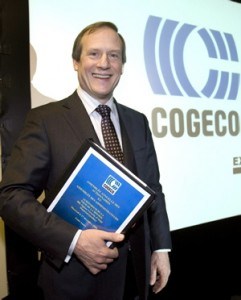
CEO Louis Audet told shareholders that cable operators in Canada are large, very profitable, and absolutely not for sale. That leaves few growth opportunities for the fourth largest cable operator in Canada. Instead of spending money to expand its current footprint into unserved areas, the company will look south of the border for buying opportunities.

Audet

Audet

“What you see is pretty much what you get unless something really special comes out of left field,” Audet said. “The potential exists in the U.S. where it doesn’t in Canada.”

Cogeco’s financial resources are too limited to challenge the three largest cable operators in the country, and Audet said Cogeco has no intention of selling its own business. In eastern Canada where Cogeco provides service, Rogers Communications would be the most likely to buy Cogeco. Rogers tried, and failed, to acquire Quebec-based Vidéotron in 2000 — losing out to media conglomerate Quebecor. But Rogers did succeed in picking up Shaw’s Ontario-based Mountain Cablevision, Ltd. last January.

Cogeco has pursued other cable companies outside of Canada in the past. Its acquisition of Portugal’s Cabovisao in 2006 was widely panned, and after Portugal’s economy crashed in the Great Recession, Cogeco ended up writing off its net investment, taking a $56.7 million loss. Cogeco acquired Cabovisao for $660 million and sold it to ALTICE six years later for the fire sale price of $59.3 million.

atlanticIn 2012, Cogeco acquired rural and small city cable operator Atlantic Broadband for $1.36 billion. Atlantic offers service in Pennsylvania, Florida, Maryland, Delaware, and South Carolina — mostly in communities ignored by Comcast and Time Warner Cable.

Possible Cogeco acquisition targets include Cable ONE, WOW!, Wave Broadband, SureWest/Consolidated Communications, Midcontinent Communications, Buckeye Cable, and/or Blue Ridge Communications, to name a few.

In the meantime, Cogeco is following the lead of U.S. cable operators by intensifying service expansion in commercial areas, particularly industrial parks and office complexes. Selling larger businesses cable broadband could net Cogeco $600-1,200 a month per account.

Search This Site:

Contributions:

Recent Comments:

Your Account:

Stop the Cap!