Home » Competition » Recent Articles:

JPMorgan Chase Advises Cable Companies to Raise Cable TV Rates; Where Can Customers Go?

Phillip Dampier April 7, 2014 Competition, Consumer News 9 Comments
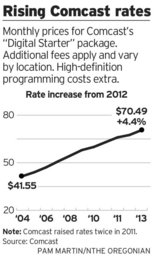
Comcast Rates (Image: The Oregonian)

JPMorgan Chase reports average cable rates reached $88.67 in 2013. (Image: The Oregonian)

Cable TV rates are too low and need to be hiked to boost revenue and offset rising programming costs, even if rate increases further alienate cable subscribers, according to a new report from JPMorgan Chase.

The Wall Street bank concluded customers have few options, noting that after providers raised prices around 5% last year, they lost only 0.1% of subscribers.

“Cable operators are better off raising video prices than eating higher content costs,” said Philip Cusick, a JPMorgan analyst, in the report. “Our analysis indicates that cable companies are better off raising prices and catching customers with broadband if cord cutting becomes widespread, (rather) than eating the programming increase.”

The bank recommends imposing (or raising) broadcast TV and sports programming surcharges as well as general rate hikes on basic cable service.

JPMorgan notes that increased broadband pricing and cable modem rental fees paid off for the industry during the fourth quarter of 2013, when earnings topped estimates. By doing the same for cable television packages, providers can continue to boost revenue with little risk customers will find a suitable competitor that isn’t also increasing prices.

Even if customers get rid of cable television, a practice known as cord-cutting, cable operators can still keep customers by providing broadband service. Some of the lost revenue can be recovered from the services customers have not canceled.

Cusick says the industry is being challenged by a handful of content companies that increasingly dominate the cable package, among them Walt Disney, Time Warner (Entertainment), CBS, and FOX.

“With the majority of content controlled by only six or seven programmers, aggregate prices for content are rising around 10% annually and forecasts in many media models continue that rise for years,” Cusick said.

Verizon’s Curious Allies, Employees Urge N.J. Regulators to Forget About FiOS Fiber Expansion

Verizon's FiOS expansion is still dead.

Verizon’s FiOS expansion is still dead.

New Jersey’s Board of Public Utilities has heard from hundreds of New Jersey residents about a settlement proposal that would let Verizon off the hook for failing to keep a commitment to provide high-speed broadband service statewide no later than 2010.

Curiously, hundreds of those comments were identical e-mails originating from AOL, Hotmail, MSN and Yahoo mail accounts urging the state to show lenience to Verizon — to forgive and forget the company’s broken promises. No mailing addresses were included. But the attached names and e-mail addresses were enough for Stop the Cap! to discover many of those submitting comments used non-working e-mail addresses or claimed their names were submitted without their knowledge or permission. Many others were actually employed by Verizon or were retirees.

“The proposed stipulation is fair and balanced and under your guidance, will build on the success that the Board and Verizon have achieved in making the Garden State one of the most wired broadband states in the country,” writes David Gudino, who doesn’t disclose in his correspondence with the BPU that his name is included in a list of attorneys working for Verizon Wireless.

“I would like to declare my support for the proposed stipulation between your Board Staff and Verizon as it relates to Opportunity New Jersey,” says another on behalf of an organization getting contributions from Verizon. “The stipulation will help ensure continued deployment of advanced communications services. Access to these services will not only benefit New Jersey’s businesses and nonprofits, but consumers of all ages as well.”

new-jerseyBy “advanced communications services,” the letter’s signers should know very well that means more 4G LTE wireless broadband with stingy usage caps and high prices, not more FiOS fiber to the home service.

What proved especially surprising was finding so many customers claiming to be happy with Verizon’s broadband performance in New Jersey who are still relying on AOL dial-up accounts. Stop the Cap! contacted a random 150 signers of the identical letters by using their attached e-mail addresses, which are part of the public record. We asked the writers to expand on their views about Verizon’s performance in New Jersey, whether they were satisfied with their current Internet provider, whether they have broadband service, and where they learned about this issue.

Remarkably, 35 of the e-mail addresses turned out to be invalid, so we contacted an extra 35 and 12 of those e-mail addresses were invalid as well. We found this unsettling because the only identifying information attached to the pro-Verizon correspondence was a name and e-mail address. We couldn’t be sure the authors were New Jersey residents much less real people.

We received 18 replies. Several were Verizon retirees asked to sign letters of support for Verizon. Another five had no idea what we were talking about and denied they submitted any views, pro or con, about Verizon. Three of those were Comcast customers that said goodbye to Verizon more than a decade earlier. Many others were associated with groups that happen to receive financial support from Verizon. Several  had no broadband access and were using dial-up.

Stop the Cap! did not receive a single reply from any person ready to articulate informed views about the terms of the settlement offer. They were simply asked to lend their names and e-mail addresses to Verizon’s campaign and had never seen the settlement proposal or heard much about it.

bpuJudith Stoma’s family has worked for Verizon/NJ Bell since 1958. She’s 71 years old today and she supports Verizon, at least in its efforts to “lead the way with N.J. at the forefront of technology.” Abdicating on FiOS expansion in favor of the same old DSL service Verizon proposes in its settlement seems to run contrary to that goal.

In several other instances, some of Verizon’s “supporters” actually used a space provided in the form letter to vent their frustration with Verizon!

Michael DeNude was irritated he never got FiOS: “We live in Riverdale and have not benefited by any upgrade.”

Paula Thomas was annoyed that Verizon outsources its workforce: “Verizon already outsources their telephone [operator] service. They should also guarantee that U.S. Citizens are given preference in the ‘job growth’ they ensure will happen.”

William Barlen thinks it’s a shame the current state of broadband in the U.S. is lacking: “It is sad that we have dropped behind over 50 countries on broadband speed and deployment. If you do not support this work exactly what are you doing?”

Paul Minenna is concerned that without FiOS broadband, speedier Internet access is not forthcoming: “Please make sure that you keep NJ moving forward with top-notch technology access. This is not the time to slow down Internet access.”

John Zilg’s letter is the same as nearly every other in support of Verizon, until he was given the opportunity to include his own remarks, which are completely contrary to everything else in the letter: “It is critical to continue supporting what has already been put into place. I urge you to not change direction.”

It is easily apparent that among the letters in support of Verizon, more than a few were not at all informed about what they were signing, and in many cases actually held completely different views when someone took the time to inquire in more detail. We are also very concerned about the number of invalid e-mail addresses attached to letters that carried no mailing address. On an issue of this importance, it is disturbing to not be certain those communications represent the legitimate views of actual New Jersey residents.

These factors must be taken into consideration as the Board of Public Utilities ponders the public input.

Media Concentration: FCC Closes Competing Local TV Station ‘Partnership’ Loopholes

Phillip Dampier April 2, 2014 Competition, Consumer News, Public Policy & Gov't 2 Comments
WHAM and WUHF are now both located at WHAM's facilities in Henrietta, N.Y.

WHAM and WUHF are now both located at WHAM’s facilities in suburban Rochester, N.Y. WHAM now produces WUHF’s newscasts.

Ever wonder why some local television stations air newscasts produced by another competing station?

When your local ABC station’s evening news ends up on a local FOX station, it is usually because the two have signed a joint agreement to let one station represent the other in making programming decisions and selling advertising.

FCC chairman Thomas Wheeler believes this growing trend represents an end run around the agency’s rules limiting how much control a single major media company may have in any particular community. On Monday Wheeler joined two Democratic commissioners and voted to ban the practice.

Wheeler said the vote against joint agreements represented “a win for common sense,” and preserved the FCC’s intent to make sure viewers have a diverse mix of news, information and programming. In several small and medium cities, viewers were instead getting the same newscast on competing stations and just one or two media companies made all the programming decisions for local viewers.

FCC media ownership rules prevent TV station owners from owning stations reaching more than 39 percent of the national TV audience, owning more than a single top-four network station in a market and owning more than two TV stations in a market. They also prevent a local newspaper from buying a local TV station.

But station owners found they could evade those rules and save money by turning over the production of costly locally produced programming like news and community affairs to another station, and in some cases even moving operations into another station’s building, while still holding the station’s license. In some markets, one company like Sinclair or Nexstar can end up owning a local network affiliate, a CW or MyNetworkTV station, and have a joint agreement to sell advertising and program another network affiliate.

Sinclair Exploits Loophole to Build a Media Empire

Owned by Sinclair

Owned by Sinclair

One good example of this practice can be found in the 78th largest television market in the United States — Rochester, N.Y.

Ten years ago, WROC (CBS), WHEC (NBC), WOKR (now WHAM) (ABC), and WUHF (FOX) each maintained their own news teams and ad sales departments. The first station to drop its own news was WUHF. Station owner Sinclair fired the news staff and signed an agreement with Nexstar’s WROC to produce a newscast for the station instead. WROC’s reporters could now be seen on two different stations.

In early 2013, WHAM was acquired by Deerfield Media, which has a whisker-thin separation between itself and Sinclair. The Wall Street Journal reported that Deerfield’s owner, Stephen Mumblow, was Sinclair CEO David Smith’s former personal banker. All of its stations are operated by Sinclair, despite being licensed to Deerfield.

Operated by Sinclair

Operated by Sinclair

Media consolidation critics say that is a blatant end run around the FCC’s ownership rules and violates local station limits.

Rochester viewers noticed a change on Jan. 1 of this year, when WUHF dropped WROC’s newscasts and began airing WHAM news instead. WUHF is now co-located in WHAM’s offices and despite the fact WHAM is owned by Deerfield, all of WHAM’s news and sales team are Sinclair employees. Sinclair now owns or controls Rochester’s CW, ABC, and FOX affiliates. Nexstar still owns WROC and Hubbard Broadcasting owns WHEC.

Nationwide, Sinclair owns, programs, or provides sales services to 167 television stations in 77 markets. In 2011, it owned 58 stations.

Smith

Smith

Sinclair is not a “hands-off” media player either. Sinclair’s CEO David Smith has regularly forced his conservative political views into his station’s newscasts.

Smith calls himself a family values man, but his 1996 arrest and conviction in a prostitution sting suggests otherwise. Smith was arrested for picking up a prostitute who performed what police called an “unnatural and perverted sex act” on him as he drove down the highway in a company-owned Mercedes.

As part of his plea agreement, Smith had to perform court-ordered community service. Smith subcontracted that out to his Baltimore station’s newsroom employees, ordered to produce a series of reports on a local drug counseling program, which Smith used to satisfy his sentence. That did not go over well with local reporters and at least one judge.

“I really hated the way he handled our newsroom and what he expected his reporters to do after his arrest,” LuAnne Canipe, a reporter who worked on air at Sinclair’s flagship station, WBFF in Baltimore, from 1994 to 1998, told Salon. “A Baltimore judge called me up,” she recalls. “He wasn’t handling the case, but he called to tell me about the arrangement and asked me if I knew about it. The judge was outraged. He said, ‘How can employees do community service for their boss?’”

Canipe left as the work atmosphere at Sinclair rapidly deteriorated.
Hyman

Hyman

“Let’s just say the arrest of the CEO was part of a sexual atmosphere that trickled down to different levels in the company,” Canipe told Salon. “There was an improper work environment. I think that because of what he did there was a feeling that everything was fair game,” says Canipe, who says she chose to leave Sinclair in 1998. She says that she once complained to management about another Sinclair employee, who had engaged in audible phone sex inside a station conference room, but that no action was taken against the employee.

How Sinclair Uses Its Stations to Push a Political Agenda

But Sinclair’s most controversial interference in local news operations came days before the 2004 presidential election, when Sinclair ordered its stations to air a highly charged documentary critics called a propaganda hit piece against Democratic candidate John Kerry.

“Stolen Honor: Wounds that Never Heal,” was the brainchild of Carlton Sherwood, a disgraced former reporter for a Washington, D.C. station that was later forced to donate $50,000 and air a lengthy retraction after Sherwood falsely claimed that the veterans responsible for creating the Vietnam Veterans Memorial Wall were misappropriating contributions. The charges proved baseless and at least one veteran signed a sworn statement claiming Sherwood had a political ax to grind, calling the project that “liberal memorial” and a “black gash.” Sherwood reportedly wanted the memorial to speak to the righteousness of the Vietnam War and focused most of his reporting on critics who felt the memorial looked like “a wailing wall.”
Sinclair owned/operated stations now carry news from conservative Newsmax and the Washington Times on their websites.

Sinclair owned/operated stations now carry news from conservative Newsmax and the Washington Times on their websites.

Sherwood’s one-sided anti-Kerry documentary created a firestorm of criticism that reached all the way to Wall Street. Sinclair faced advertiser boycotts, petitions to yank its stations’ licenses, and angry investors who wanted Sinclair to steer clear of controversy that was bad for business.

Since then, Sinclair’s conservative credentials are still apparent, although more subtle. Top-rated WHAM’s local news now features headlines from the Rev. Sun Myung Moon’s Washington Times and the fiercely conservative Newsmax. Many Sinclair stations are also still required to air conservative political commentaries featuring Sinclair’s Mark Hyman during their newscasts.

Sinclair’s “government is bad” philosophy is found in its franchised “Waste Watch” series, which also airs during station newscasts. Sinclair claims the feature investigates and exposes how viewers’ local tax dollars are spent. But news staff at several Sinclair stations find the series distasteful because it frames its reporting around the idea that local government is generally incompetent and wasteful. Media critics suggest that kind of framed reporting does not belong in a straightforward newscast.

Underlining Sinclair’s Waste Watch conservative bona fides is the prominent presence of conservative political groups including the CATO Institute, Citizens Against Government Waste (CAGW), and the National Taxpayers Union (NTU) on Sinclair station websites. CAGW has historically maintained ties with the American Legislative Exchange Council and was a former member of ALEC. NTU President Duane Parde is the former executive director of ALEC, and NTU remains an ALEC member.

Wheeler

Wheeler

Despite the meddling from Sinclair’s headquarters, many Sinclair stations’ news teams try to maintain balance around Sinclair’s political agenda. WHAM, for example, buries Hyman’s commentaries on its extended morning news aired on WUHF instead of airing them in its primary newscast on WHAM. In Rochester, “Waste Watch” has also had some unintended consequences. WHAM has used the franchise to extensively report on various scandals surrounding county contracts involving the highest levels of Monroe County government, long dominated by the Republican party.

With more than 100 “joint agreements” in place at stations around the country — primarily in news-scarce medium and smaller television markets, the declining number of people making decisions about what is newsworthy and how it is reported has become increasingly worrisome for media consolidation critics. Television news dominates audiences as newspaper readership continues to decline. Critics suggest the impact of media consolidation can already be seen at companies like Sinclair.

FCC Gives Stations Two Years to Unwind Agreements; Republican Commissioners Upset

Under the new rules, a broadcaster that accounts for more than 15% of another station’s advertising sales would be seen by the FCC as the de-facto licensee of that station. In dozens of markets, this new rule will put companies like Sinclair and Nexstar in violation of the FCC’s ownership limits. The FCC is giving stations two years to disconnect their joint agreements or apply for a waiver if they can prove the partnership serves the public interest.

Deerfield Media is likely to be one of the hardest hit media groups, although critics contend the partnership with Sinclair was created primarily to evade the rules.

Although the rules change received support from all three Democrats, the commission’s two Republicans voiced strong opposition and claimed that the FCC was regulating a solution for a non-problem.

Commissioner Ajit Pai didn’t seem interested in the views of media consolidation critics. Instead, he looked for complaints from advertisers forced to buy ad time through the joint sales agreements. Finding none, he declared the case to end the joint agreements “embarrassingly weak.”

“This is the dog that didn’t bark,” Pai said.

Pai recommended station owners sue in federal court to overturn the FCC’s new rules. Pai is on the record opposing most ownership limits of any kind.


Math Problem: The Telecom Industry’s Bias Against Fiber-to-the-Home Service

Phillip "Spending $6k per cable customer is obviously a much better deal than paying half that to build a fiber to the home network" Dampier

Phillip “Spending $6k per cable customer is obviously a much better deal than paying half that to build a fiber to the home network” Dampier

Math was never my strong subject, but even I can calculate the groupthink of American cable and telephone companies and their friends on Wall Street just doesn’t add up.

This week, we learned that cable companies like Bright House Networks, Suddenlink, and Charter Communications are already lining up for a chance to acquire three million cable customers Comcast intends to sell if it wins approval of its merger with Time Warner Cable. Wall Street has already predicted Comcast will fetch as much as $18 billion for those customers and pegged the value of each at approximately $6,000.

But for less than half that price any company could build a brand new fiber to the home system capable of delivering 1,000Mbps broadband and state-of-the-art phone and television service and start banking profits long before paying off the debt from buying an inferior coaxial cable system. Yet we are told time and time again that the economics of fiber to the home service simply don’t make any sense and deploying the technology is a waste of money.

Let’s review:

Google Fiber was called a boondoggle by many of its competitors. The folks at Bernstein Research, routinely friendly to the cable business model, seemed appalled at the economics of Google’s fiber project in Kansas City. Bernstein’s Carlos Kirjner and Ram Parameswaran said Google would throw $84 million into the first phase of its fiber network, connecting 149,000 homes at a cost between $500-674 per home. The Wall Street analyst firm warned investors of the costs Google would incur reaching 20 million customers nationwide — $11 billion.

“We remain skeptical that Google will find a scalable and economically feasible model to extend its build out to a large portion of the U.S., as costs would be substantial, regulatory and competitive barriers material, and in the end the effort would have limited impact on the global trajectory of the business,” Bernstein wrote to its investor clients.

dealSo Google spending $11 billion to reach 20 million new homes is business malpractice while spending $18 billion for three million Time Warner Cable customers is confirmation of the cable industry’s robust health and valuation?
Bernstein’s firm never thought highly of Verizon FiOS either.

“If I were an auto dealer and I wanted to give people a Maserati for the price of a Volkswagen, I’d have some seriously happy customers,” Craig Moffett from Bernstein said back in 2008. “My problem would be whether I could earn a decent return doing it.”

Back then, Moffett estimated the average cost to Verizon per FiOS home passed was $3,897, a figure based on wiring up every neighborhood, but not getting every homeowner to buy the service. Costs for fiber have dropped dramatically since 2008. Dave Burstein from DSL Prime reported by the summer of 2012 Verizon told shareholders costs fell below $700/home passed and headed to $600. The total cost of running fiber, installing it in a customer’s home and providing equipment meant Verizon had to spend about $1,500 per customer when all was said and done.

Moffett concluded Verizon was throwing money away spending that much on improving service. He wasn’t impressed by AT&T U-verse either, which only ran fiber into the neighborhood, not to each home. Moffett predicted AT&T was spending $2,200 per home on U-verse back in 2008, although those costs have dropped dramatically as well.

Moffett

Moffett

Moffett’s solution for both Verizon and AT&T? Do nothing to upgrade, because the price wasn’t worth the amount of revenue returns either company could expect in the short-term.

It was a much different story if Comcast wanted to spend $45 billion to acquire Time Warner Cable however, a deal Moffett called “transformational.”

“What we’re talking about is an industry that is becoming more capital intensive,” Todd Mitchell, an analyst at Brean Capital LLC in New York told Bloomberg News. “What happens to mature, capital-intensive companies — they consolidate. So, yes, I think the cable industry is ripe for consolidation.”

Other investors agreed.

“This is definitely a bet on a positive future for high-speed access, cable and other services in an economic recovery,” said Bill Smead, chief investment officer at Smead Capital Management, whose fund owns Comcast shares.

ftth councilBut Forbes’ Peter Cohan called Google’s much less investment into fiber broadband a colossal waste of money.
“Larry Page should nip this bad idea in the bud,” Cohan wrote.

Cohan warned investors should throw water on the enthusiasm for fiber before serious money got spent.

“FTTH authority, Neal Lachman, wrote in SeekingAlpha, that it would cost as much as $500 billion and could take a decade to connect all the houses and commercial buildings in the U.S. to fiber,” Cohan added.

Cohan was concerned Google’s initial investment would take much too long to be recovered, which apparently is not an issue for buyers willing to spend $18 billion for three million disaffected Time Warner Cable customers desperately seeking alternatives.

An investment for the future, not for short term profits.

An investment for the future, not short term profits.

Municipal broadband providers have often chosen to deploy fiber to the home service because the technology offers plenty of capacity, ongoing maintenance costs are low and the networks can be upgraded at little cost indefinitely. But such broadband efforts, especially when they are owned by local government, represent a threat for cable and phone companies relying on a business model that sells less for more.

The American Legislative Exchange Council (ALEC), funded by Comcast, Time Warner, AT&T, Verizon, and other large telecom companies is at the forefront of helping friendly state legislators ban community fiber networks. Their excuse is that the fiber networks cost too much and, inexplicably, can reduce competition.

“A growing number of municipalities are […] building their own networks and offering broadband services to their citizens,” ALEC writes on its website. “ALEC disagrees with their answer due to the negative impacts it has on free markets and limited government.  In addition, such projects could erode consumer choice by making markets less attractive to competition because of the government’s expanded role as a service provider.”

The Fiber-to-the-Home Council obviously disagrees.

“Believe it or not, there are already more than a thousand telecom network operators and service providers across North America that have upgraded to fiber to the home,” says the Council. “The vast majority of these are local incumbent telephone companies that are looking to transform themselves from voice and DSL providers into 21st century broadband companies that can deliver ultra high-speed Internet and robust video services, as well as be able to deliver other high-bandwidth digital applications and services to homes and businesses in the years ahead.”

Stephenson

Stephenson

In fact, a good many of those efforts are undertaken by member-owned co-ops and municipally owned providers that answer to local residents, not to shareholders looking for quick returns.

The only time large companies like AT&T move towards fiber to the home service is when a competitor threatens to do it themselves. That is precisely what happened in Austin. The day Google announced it was launching fiber service in Austin, AT&T suddenly announced its intention to do the same.

“In Austin we’re deploying fiber very aggressively,” said AT&T CEO Randall Stephenson. “The cost dynamics of deploying fiber have dramatically changed. The interfaces at the homes, the wiring requirements, how you get a wiring drop to a pole, and the way you splice it has totally changed the cost dynamics of deploying fiber.”

Prior to that announcement, AT&T justified its decision not to deploy fiber all the way to the home by saying it was unnecessary and too costly. With Google headed to town, that talking point is no longer operative.

As Usual, Big Telecom in the Running for Worst Company in America 2014

Phillip Dampier March 26, 2014 AT&T, Comcast/Xfinity, Competition, Consumer News, Editorial & Site News, Verizon Comments Off on As Usual, Big Telecom in the Running for Worst Company in America 2014

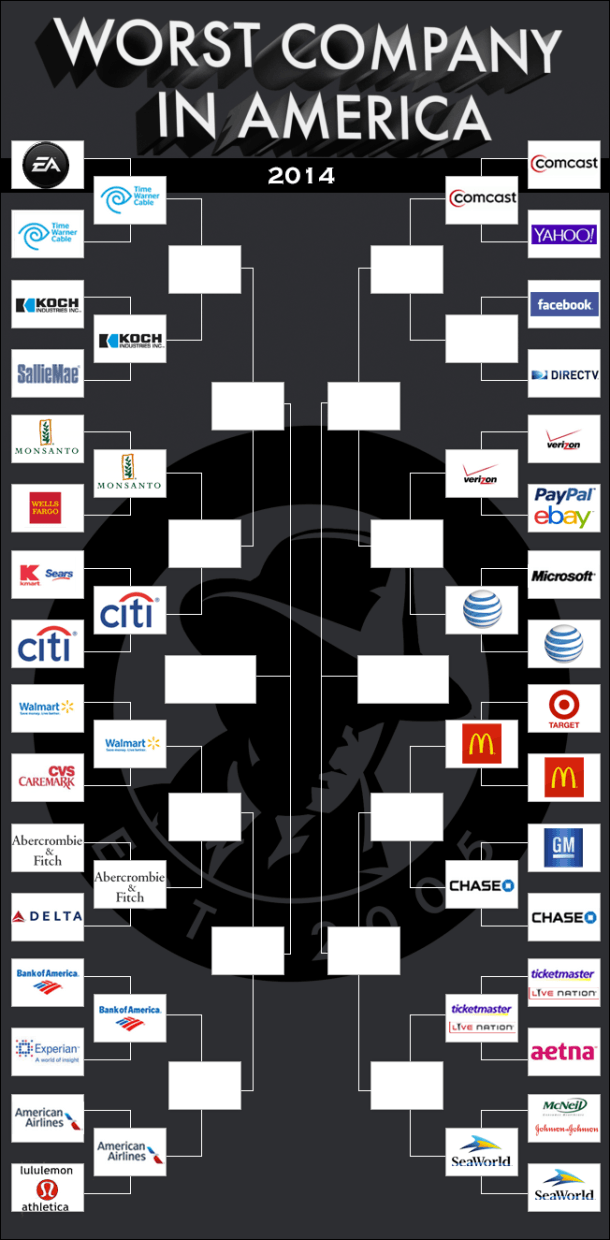
2014wciabracketdayfive

Our friends at The Consumerist invite you to participate in the 2014 Worst Company in America contest. Readers are invited to cast a series of votes — one each day — to help narrow the field to the truly abysmal, the god-awful, and the despised. The ultimate winner receives the Golden Poo award.

Not surprisingly, the nation’s biggest telecom companies are among the regular finalists. The big ones are all there — Comcast, Time Warner Cable, Verizon, and AT&T.

Hated cable companies frequently beat down big banks like the vipers at Chase, where settlements in the hundreds of millions with the government for wrongdoing are almost a monthly occurrence. Voters would rather fly the Unfriendly Skies with Divided Airlines, Last Frontier Air — even US Scare — than deal with Comcast’s offshore customer service. The bad boys at Electronic Arts and Koch Industries bring knives to AT&T’s gunfight on good customer relations.

Over the last eight years, Comcast turned up as the big winner of the Golden Poo award in 2010 and either runner-up or third place in 2008, 2009, 2011, and 2013. AT&T achieved third place in 2012. Time Warner Cable and Verizon are usually eliminated in the finals, but their regular appearance on the nominations list is not something they can be proud of. Time Warner Cable has already managed to beat back EA, big winner in 2012 and 2013. So this year they might go all the way to the top… or is it bottom?

Year Winner Runner-up Third place
2006 Halliburton Choicepoint Wal-Mart and US Government
2007 RIAA Halliburton Wal-Mart and Exxon
2008 Countrywide Financial Comcast Diebold and Wal-Mart
2009 AIG Comcast Bank of America and Ticketmaster
2010 Comcast Cash4Gold Bank of America and Ticketmaster
2011 BP Bank of America Comcast and Ticketmaster
2012 Electronic Arts Bank of America AT&T and Wal-Mart
2013 Electronic Arts Bank of America Comcast

Search This Site:

Contributions:

Recent Comments:

Your Account:

Stop the Cap!