

Home » Competition » Recent Articles:

FCC Chairman Thomas Wheeler Explains His Net Neutrality Policies… at the Cable Industry Convention

Wheeler

Wheeler

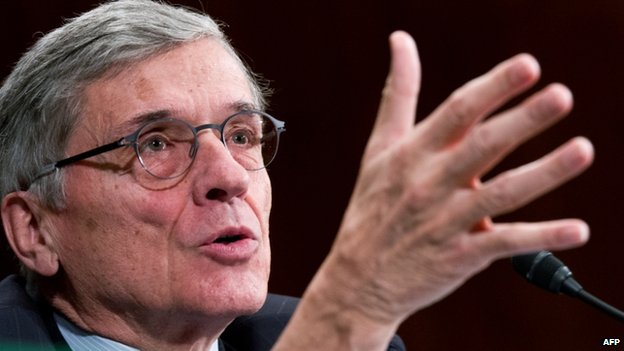
Federal Communications Commission chairman Thomas Wheeler this morning defended his forthcoming Net Neutrality policies in front of an audience of cable executives attending the Cable Show in Los Angeles.

“If you read some of the press accounts about what we propose to do, those of you who oppose Net Neutrality might feel like a celebration was in order,” Wheeler told the cable industry audience. “Reports that we are gutting the Open Internet rules are incorrect. I am here to say wait a minute. Put away the party hats. The Open Internet rules will be tough, enforceable and, with the concurrence of my colleagues, in place with dispatch.”

“Let me be clear,” Wheeler continued. “If someone acts to divide the Internet between ‘haves’ and ‘have-nots,’ we will use every power at our disposal to stop it. I consider that to include Title II. Just because it is my strong belief that following the court’s roadmap will produce similar protections more quickly, does not mean I will hesitate to use Title II if warranted. And, in our Notice, we are asking for input as to whether this approach should be used.”

Wheeler also used the forum to acknowledge that cable companies are now the “principal provider of broadband” in the United States, a slap at telephone company DSL service that continues to lose market share.

Wheeler’s comments primarily addressed intentional interference with Internet traffic and remained silent about whether the FCC would allow providers to delay network upgrades that gradually allow service to degrade while selling improved “Quality of Service” contracts to content providers like Netflix.

“Prioritizing some traffic by forcing the rest of the traffic into a congested lane won’t be permitted under any proposed Open Internet rule,” Wheeler insisted. “We will not allow some companies to force Internet users into a slow lane so that others with special privileges can have superior service.”

[flv]http://www.phillipdampier.com/video/FCC Chairman Tom Wheeler’s Speech and Chat with Michael Powell 4-30-14.mp4[/flv]

FCC chairman Thomas Wheeler spoke before the 2014 NCTA Cable Show this morning to speak about Net Neutrality and chat with NCTA president Michael Powell. (39:15)

Wheeler’s remarks in full can be found below the jump:

… Continue Reading

Flippity Floppity: Cox Promises Gigabit Speeds to Meet Customer Demand It Dismissed Last Year

Phillip Dampier April 30, 2014 Broadband Speed, Competition, Cox, Online Video, Video 1 Comment

coxCox Communications Inc., the third-largest U.S. cable company, will offer gigabit broadband to residential customers later this year when it begins deploying DOCSIS 3.1 technology across its footprint.

“We’re working on our road map now to bring gigabit speeds to customers this year,” Pat Esser, the president and chief executive officer of Cox, said yesterday in an interview with Bloomberg Television’s Betty Liu at the Cable Show in Los Angeles. Cox customers have asked for faster speeds, he said.

The gigabit speed upgrade is a significant flip-flop for Cox Communications, which last year dismissed the demand for super-fast Internet speeds, suggested they were unnecessary for residential customers and too expensive to offer.

“It would cost multiple billions” to upgrade Cox’s network to offer gigabit speeds to all its customers, Esser said in January 2013. Now Esser tells Bloomberg the estimated cost is closer to “hundreds of millions of dollars to build.”

gigabitThe leveling off of video subscriptions has made broadband a critical part of Cox’s ongoing business plan. Esser claims Cox will adapt its business network infrastructure to introduce gigabit service to residential customers in some cities.

Last November, Cox’s chief technology officer Kevin Hart told FierceCable’s Steve Donohue that DOCSIS 3.1 upgrades will be able to handle gigabit speeds without difficulty after analog television channels are switched to digital service.

“We have a five-year roadmap in terms of our video architecture–what we’re doing from an analog-to-digital conversion to free up spectrum on the network for broadband growth,” Hart said. “We’re freeing up spectrum, building out node-splits and then aligning with the [DOCSIS] 3.1 roadmap for 1-gigabit speeds.”

Cable operators are increasingly changing their tune about offering faster speed Internet since Google Fiber arrived on the scene. Recent announcements that Google was planning a major expansion of fiber to the home service in multiple cities around the country has brought a flurry of often vague commitments for expanded fiber networks, particularly from AT&T.

Privately held Cox has maintained a low profile about speed hikes and network upgrades until now. Cox has about six million residential and business customers, with most choosing speeds up to 25Mbps. Esser offered no details about pricing or availability and Hart told an audience at the Los Angeles Cable Show this week Cox was still concentrating on expanding availability of 150-200Mbps service across its footprint. With that in mind, it is unlikely Cox will introduce gigabit service on a widely available basis this year.

[flv]http://www.phillipdampier.com/video/Bloomberg Cox Plans Faster Internet to Challenge Google Video 4-30-14.flv[/flv]

Bloomberg’s Betty Liu talks with Cox CEO Pat Esser about the cable company’s plans for gigabit broadband speeds coming later this year. (2:30)

Mediacom Boosts Speeds Up to 305Mbps; Upgrades Begin in June

Phillip Dampier April 29, 2014 Broadband Speed, Competition, Consumer News, Mediacom 2 Comments

logo_mediacom_mainMediacom sent Stop the Cap! a press release today indicating it is boosting broadband speeds at no charge for customers starting this June and continuing through the summer months.
  • Prime Plus ($59.95), originally 30/2Mbps will be upgraded to 50/5Mbps in early June;
  • Ultra ($79.95), originally 50/5Mbps will be increased to 100/10Mbps in early June;
  • Ultra Plus ($99.95), formerly 105/10Mbps, increases to 150/20Mbps and will be rolled out to most Mediacom systems over the summer. Upload speeds may initially stay at 10Mbps until the upgrades are complete.

Mediacom is testing 305/10Mbps service in Cedar Rapids, Ia. to compete with CenturyLink. It costs $199.95 a month. Standard Internet service ($49.95) remains unchanged at 15/1Mbps.

“Today, we’re either pulling down data or sending something up,” Mediacom spokeswoman Phyllis Peters said. “People want faster speeds coming down because a lot of people maybe are tapping into things coming down. They want more speed in both directions because they’re sharing video files and higher-bandwidth applications.”

The company said it will be the eighth time in the last 10 years it will have increased Internet speeds, in each case without raising prices.

“We’re doubling our network capacity every 18 months,” Peters said.


Cable Industry Mulls Its Options: Usage-Based Billing or Content Provider-Pays Pricing Models

Phillip Dampier April 29, 2014 Competition, Consumer News, Data Caps, Net Neutrality, Online Video, Public Policy & Gov't Comments Off on Cable Industry Mulls Its Options: Usage-Based Billing or Content Provider-Pays Pricing Models

cable showCable industry executives on hand at this year’s Cable Show in Los Angeles are debating whether Netflix has taught the cable industry some important lessons about how to treat its online video competition.

Phil Lind, executive vice president of regulatory affairs at Rogers Communications called Comcast’s peering deal with Netflix a groundbreaking breakthrough on how the Internet will be treated in the future.

Netflix has been forced to compensate the cable and telephone companies for its reliance on their broadband pipes to reach customers.

Mike Fries, president and CEO of Liberty Global said the issue of Net Neutrality relates primarily to online video and the discussion will inevitably come down to choosing between providing a broadband fast lane for content producers willing to pay or adopting usage-based billing that compensates the industry for the growth of streaming video.

Several on the panel disagreed with the contention that Netflix has outmaneuvered the cable industry with a superior on-screen interface and better on-demand content. But Fries said Netflix has achieved more success than the industry’s own TV Everywhere initiative, which unlocks online content for authenticated, paying cable TV subscribers. In addition to unwieldy authentication systems that pester subscribers with frequent log-in demands, content rights issues still dramatically limit the amount of streamed video available from TV Everywhere platforms.

Protection Money: Verizon Next to Collect Tribute from Netflix for Trouble-Free Streaming

Phillip Dampier April 29, 2014 Broadband Speed, Competition, Consumer News, Data Caps, Net Neutrality, Online Video, Public Policy & Gov't, Verizon Comments Off on Protection Money: Verizon Next to Collect Tribute from Netflix for Trouble-Free Streaming

netflixpaywallNetflix has reached an agreement with Verizon Communications for a paid-peering interconnection between the two that will help assure Verizon’s broadband customers can watch Netflix content without repeated buffering slowdowns.

It is the second major deal for Netflix where money has changed hands to assure a more error-free experience for customers, coming two months after a similar deal with Comcast.

Both Verizon and AT&T have told their respective shareholders they anticipate new revenue streams from interconnection agreements with Netflix, which now constitutes a large percentage of evening Internet traffic in the United States.

By establishing a more direct connection between Netflix and Verizon, customers should experience fewer streaming problems. Netflix traditionally pays third parties to handle its traffic and some of those shared connections have grown increasingly overcongested. ISPs are becoming increasingly reluctant to upgrade them without financial compensation.

The FCC does not consider peering arrangements part of the Net Neutrality controversy, but for customers the result is the same — without a financial arrangement with a provider, content from certain websites may not be dependably accessible. Earlier this year, Netflix viewing was increasingly disrupted for many Verizon, AT&T, and Comcast customers.

Netflix CEO Reed Hastings has repeatedly complained Netflix is being subjected to an “arbitrary tax” to assure dependable service to its paying customers. Hastings now wants the FCC to treat the issue as an “end run” around Net Neutrality and include peering agreements and financial compensation issues in the new Net Neutrality rules expected to be introduced in May.

Most analysts do not expect FCC chairman Thomas Wheeler to oppose or regulate the financial arrangements between ISPs and content producers.

Search This Site:

Contributions:

Recent Comments:

Your Account:

Stop the Cap!