

Home » Competition » Recent Articles:

Wall Street: Telecom Mergers Are Supercalifragilisticexpialidocious! Consumers: More Pocket-Picking

Phillip Dampier May 14, 2014 Competition, Consumer News, Data Caps, Editorial & Site News, Online Video, Public Policy & Gov't, Rural Broadband Comments Off on Wall Street: Telecom Mergers Are Supercalifragilisticexpialidocious! Consumers: More Pocket-Picking

price-gouging-cake“Comcast Corp.’s bid to buy Time Warner Cable Inc. may be the opening act for a yearlong festival of telecommunications deals that would alter Internet, phone and TV service for tens of millions of Americans.” — Bloomberg News, May 14, 2014

Wall Street analysts remain certain Comcast and Time Warner Cable won’t be the only merger on the table this year as the $45 billion dollar deal is expected to spark a new wave of consolidation, further reducing competitive choice in telecom services for most Americans.

While the industry continues to insist that the current foundation of deregulation is key to investment and competition, the reality on the ground is less certain.

Let’s review history:

For several decades, the cable industry has avoided head-on competition with other cable operators. They argue the costs of “overbuilding” cable systems into territories already serviced by another company is financially impractical and reckless. But that did not stop telephone companies like AT&T and Verizon from overhauling portions of their networks to compete, and in at least some communities another provider has emerged to offer some competition. Some wonder if AT&T was willing to spend billions to upgrade their urban landline network to provide U-verse, why won’t cable companies spend some money and compete directly with one another?

The answer is simple: They can earn a lot more by limiting competition.

When only a few firms account for most of the sales of a product, those firms can sometimes exercise market power by either explicitly or implicitly coordinating their actions. Coordinated interaction is especially suspect where all firms seem to charge very similar prices and few, if any, are willing to challenge the status quo.

Since the 1980s, the telecommunications industry has been deregulated off and on to a degree not seen since the pioneer days of telephone service. That was the era when waves of mergers created near-monopolies in the oil, railroad, energy, tobacco, steel and sugar industries. By the late 1890s, evidence piled up that proved reducing the number of providers in a market leads to higher prices and poor service. The abuses eventually led to the passage of the Sherman Antitrust Act of 1890 and later the Clayton Antitrust Act of 1914.
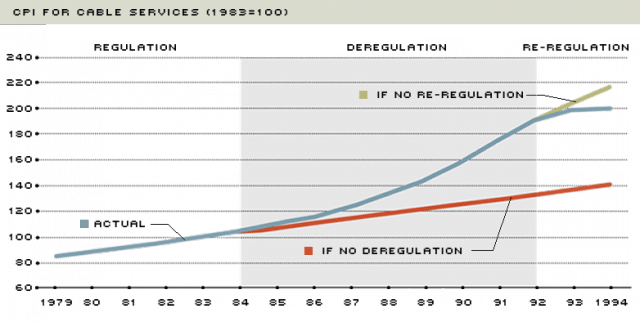
Here is what happened when the cable industry was reined in during the early 1990s, only to be deregulated again.

Here is what happened when the cable industry was reined in during the early 1990s, only to be deregulated again.

The generation of political leaders that dominated Washington during the 1980s developed selective amnesia about economic history and dismantled many of the regulatory protections established to protect consumers, arguing competition would keep markets in check. In the broadband and cable business, that has not proved as successful as the industry represents.

At the heart of the problem is the 1996 Telecommunications Act, signed into law by President Bill Clinton. The sweeping law is littered with lobbyist landmines for consumers and their interests. Under the guise of increasing competition, the 1996 law actually helped reduce competition by removing regulatory oversight and, perhaps unintentionally, sparking an enormous rampage of industry consolidation followed by price increases. The Bush Administration kept the war on consumers going with the appointment of Michael Powell (now the CEO of the cable industry’s lobbying group) to chair the Federal Communications Commission. Under Powell, non-discriminatory access to networks by competitors was curtailed, and Powell’s FCC gave carte blanche to the cable industry’s plan to cluster its territories into large regional monopolies and a tight national oligopoly. The FCC’s own researchers quietly admitted in the early 2000s “clustering raised prices.”
Cable prices

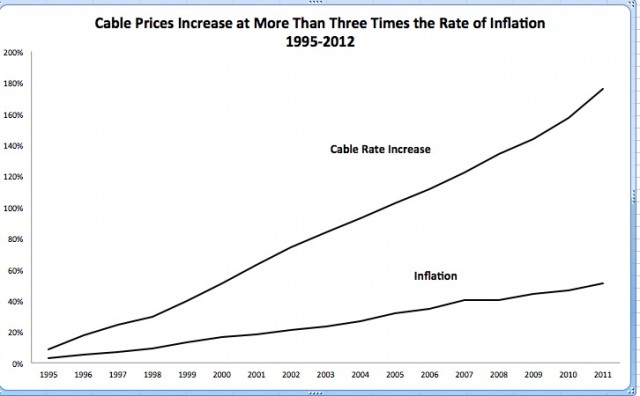
By January 2001, cable operators had settled on rate increases that averaged three times the rate of inflation. While the national inflation rate hovered around 1%, cable companies routinely raised basic cable rates an average of 7% annually. Powell declared rising cable rates were not a consumer problem and adopted the industry’s classic talking point that rate increases reflect the “value of the programming” found on cable. In fact, even as cable customers grew increasingly angry about rate increases, Powell told three different reporters he wanted to further relax the FCC’s involvement in cable pricing. (McClintock, Pamela, “Powell: No Cable Coin Crisis” Variety, April 30, 2001; Hearn, Ted. “Powell: Value Matters in Cable Rates,” Multichannel News, March 13, 2002; Powell Press Conference, February 8, 2001; Dreazen, Yochi. “FCC Chairman Signals Change, Plans to Limit Intervention,” Wall Street Journal, February 7, 2001.)
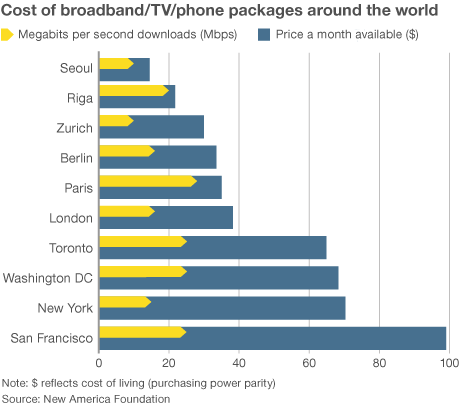
cost_broadband_around_the_world_v2Economists reviewing data found in publicly available corporate balance sheets soon found evidence that the “increased programming costs”-excuse for rate increases did not hold water. The less competition or number of choices available to consumers in the market unambiguously lead to higher prices. It has remained true since Consumers’ Union revealed the financial trickery in 2003:

The cable industry will claim that programming costs are driving prices up. While programming costs have certainly risen, a close look at the numbers shows that rising program costs account for only a small part of the rising rates.

If costs were really the cause of rising prices, then the cable industries’ operating margins – the difference between its revenues and costs — would not be rising. The facts are just the opposite. Operating margins have been increasing dramatically since 1997. The operating margin for the industry as a whole will reach $18.8 billion per year in 2002, $7 billion more than it was in 1997. Operating revenues per subscriber have increased dramatically over that period, from $208 per year to $273. That is, after taking out all the operating costs, including programming costs, cable operators have increased their take per subscriber by over 30 percent.

[…] The ability of cable operators to raise rates and increase revenues, even with rising programming costs, stems from the market power they have at the point of sale. They would not be able to raise prices and pass program price increases through if they did not have monopoly power.

Consumers’ Union also foreshadows what will happen if another wave of industry consolidation takes hold the way it did over a decade earlier:

While the cable industry has certainly increased capital expenditures to upgrade its plants, it has actually sunk a lot more capital into another activity – mergers and acquisitions.

It is the outrageous prices that have been paid to buy each other out and consolidate the industry that is helping to drive the rate increases. Between 1998, when the first mega merger between cable operators was announced, and 2001, when the last big merger was announced, cable companies spent over a quarter of a trillion dollars buying each other out. In those four years, they spent almost six times as much on mergers and acquisitions as they did on capital expenditures to upgrade their systems. At the same time, the average price paid per subscriber more than doubled.

countries_with_high_speed_broadbandWhen a cable operator pays such an outrageous price, the previous owner is reaping the financial rewards of his monopoly power. The acquiring company can only pay such a high price by assuming that his monopoly power will allow him to continue to increase prices. Monopoly power is being bought and sold and borrowed against. The new cable operator, who has paid for market power, may insist that the debt he has incurred to obtain it is a real cost on his books. That may be correct in the literal sense (he owes someone that money) but that does not make it right, or the abuse of market power legal.

Fast-forwarding to 2014, economist and Temple professor Joel Maxcy said the same basic economic truths still exist today with Comcast’s merger with Time Warner Cable.

“My concern is the merger and the consolidation of the cable and internet delivery system for consumers and what will happen to internet and cable rates and choices,” Maxcy said, voicing his hesitancy about a deal that merges the nation’s two largest cable providers. “As that industry has gotten more consolidated over time, we have seen rates go up. The answer from them is that we’ve got more choices. Are we better off or not better off? I don’t know, but certainly rates have gone up at a much faster rate than the inflation rate. The result of more monopoly power is always higher prices and less choices and it seems that this merger moves in that direction.”

“The threat from non-network content providers is a concern for the cable industry,” Maxcy added.

“We’re moving to a situation where we don’t need cable, but we still need the internet and the cable companies are the ones that have control of that,” he said. “Consolidating them together makes them more competitive against the outside forces, but the other argument makes the whole thing less competitive so they’ll have more ability to control the access to Netflix, YouTube and the like. People that may develop other similar sorts of services will have a hard time getting the access they would like to purchase those.”

Chris Stigall spoke with economist and Temple professor Joel Maxcy on Talk Radio 1210 WPHT in Philadelphia about Comcast’s attempt to purchase Time Warner Cable and what that means for consumers. Feb. 18, 2014 (12:10)
You must remain on this page to hear the clip, or you can download the clip and listen later.

A Merger Watch Has Been Issued for Your Internet Service, Cable-TV Provider

Phillip Dampier May 14, 2014 AT&T, Comcast/Xfinity, Competition, Consumer News, DirecTV, Dish Network, T-Mobile, Wireless Broadband Comments Off on A Merger Watch Has Been Issued for Your Internet Service, Cable-TV Provider

moneywedThe announced merger of Comcast and Time Warner Cable is expected to have far-reaching implications for other companies in the video and broadband business, with expectations 2014 could be one of the busiest years in a decade for telecom industry mergers and buyouts.
AT&T + DirecTV = Less Video Competition

Bloomberg News reports an announcement from AT&T that it intends to acquire DirecTV for as much as $50 billion could be forthcoming before Memorial Day. Such a merger would drop one satellite television competitor in AT&T landline service areas and promote nationwide bundling of AT&T wireless service with satellite television.

Historically low-interest rates would help AT&T finance such a deal and would turn DirecTV into a division of AT&T, easing concerns the satellite company has been at a disadvantage because it lacks a broadband and phone package.

“While the Comcast/TWC deal was the trigger, the backdrop of a slow macro economy, new competitors, shifts in technology and consumer habits all come together and force the need for more scale,” Todd Lowenstein, a fund manager at Highmark Capital Management Inc. in Los Angeles told Bloomberg.

Satellite television companies remain technologically disadvantaged to withstand the growing influence of online video and their subscriber numbers have peaked.

If AT&T buys DirecTV, the wireless giant could theoretically bundle its service with DirecTV’s video product, and in some areas of the country its U-verse high-speed broadband to the home, to compete with cable, said Amy Yong, an analyst at Macquarie Group in New York, in a note to clients.

Sprint + T-Mobile = Less Wireless Competition

Dish + T-Mobile = A Draw

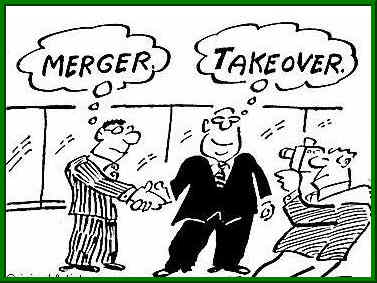
mergerIn a less likely deal Sprint is still trying to pursue T-Mobile USA for a potential merger and if regulators reject that idea, Charles Ergen’s Dish Network is said to be interested.
To prepare Washington for another telecommunications deal, SoftBank founder Masayoshi Son’s lobbying firm, Carmen Group, has again been meeting with elected officials and regulators to argue the merits of a merger with T-Mobile, according to a person familiar with the matter.

Dish, which failed to buy Sprint last year, would be interested in acquiring T-Mobile if regulators block Sprint’s efforts, Ergen said. That hinges on whether SoftBank Corp. fails to win regulatory approval for its plan to buy T-Mobile, which is controlled by Deutsche Telekom AG, Ergen said last week. The Japanese wireless company owns 80 percent of Sprint.

All three deals carry a combined value of $170 billion in equity and debt and would impact 80 million Americans.

Suitors hope regulators will be in the mood to approve merger deals as they contemplate enlarging Comcast through its purchase of Time Warner Cable.

Even if all the deals don’t pass muster, Wall Street banks will still rake in millions in fees advising players on how to structure the deals. Goldman Sachs and J.P. Morgan would join executives winning considerable sums for reducing the number of competitors providing telecommunications services in the U.S.

Whether customers would benefit is a question open to much debate.

Comcast: Usage-Based Billing for All Customers Within 5 Years; ‘We’re Also Allowed to Do Fast Lanes’

Phillip Dampier May 14, 2014 Broadband "Shortage", Broadband Speed, Comcast/Xfinity, Competition, Consumer News, Data Caps, Net Neutrality, Online Video, Public Policy & Gov't Comments Off on Comcast: Usage-Based Billing for All Customers Within 5 Years; ‘We’re Also Allowed to Do Fast Lanes’

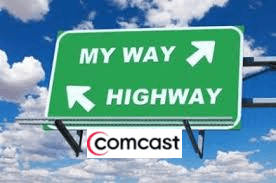
comcast highwayComcast will introduce usage-based billing on all of its broadband customers nationwide within five years, whether they like it or not.
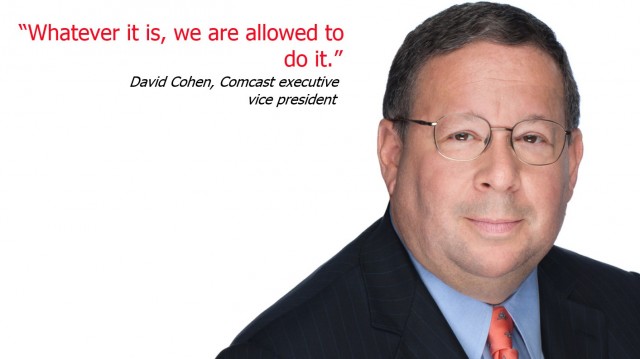
Comcast’s executive vice president David Cohen told Variety he predicts the new usage limit will likely be 350GB a month but could increase to 500GB in 2019. Cohen claims consumers in usage-capped test markets prefer a preset usage limit and an overlimit fee of $10 for each additional 50GB of usage.

But Stop the Cap! has learned at no time has Comcast surveyed customers about whether they want their Internet usage metered or capped. That question is evidently not an option.

If Time Warner Cable territories are merged under the Comcast brand, usage billing would likely immediately follow.

Usage caps will go a long way to protect Comcast’s cable television package from online video, which if viewed in significant amounts could put customers over their monthly usage limit and subject them to higher fees.

“We’re trying to go slowly, not out of a regulatory concern (but because) we have no desire to blow up our high-speed data business,” he said.

cohenIf the merger is approved, Comcast will face significantly less competition in many Verizon service areas also served by Time Warner Cable. Verizon FiOS expansion has ended and the company continues to de-emphasize its DSL service, which is the only broadband competition Time Warner Cable faces in many upstate New York and western Massachusetts communities.
An unrepentant Cohen also doubled down on paid prioritization — Internet fast lanes — declaring regardless of what the FCC decides on Net Neutrality, Comcast still has the right to offer paid prioritization to customers.

“Whatever it is, we are allowed to do it,” said Cohen, speaking at the MoffettNathanson Media & Communications Summit in New York. “We are not sure we know what paid prioritization, or what a fast lane, is. Fast lane sounds bad… (but) I believe that whatever it is, it has been completely legal for 15 or 20 years.”

The way Comcast’s lawyers read “Title II,” even if the FCC declares broadband ISPs to be common carriers, Cohen says Comcast will go right on selling prioritized access, claiming Title II doesn’t prohibit paid prioritization — indeed, he said, “the whole history” of Title II is that carriers are allowed to provide different levels of service at different prices, reports Variety.

Cohen said he expects Washington regulators will promptly approve the company’s buyout of Time Warner Cable with no delays, insisting the deal is “not that difficult” in terms of antitrust implications.


Public Service Commission to N.Y. Towns: You Have No Negotiating Leverage Over Time Warner Cable

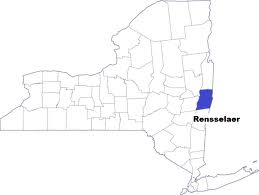
rensselaer countyRensselaer County is just a short drive to the east of New York’s capital city Albany, but for residents in the southern half of the county, it might as be in the middle of nowhere.
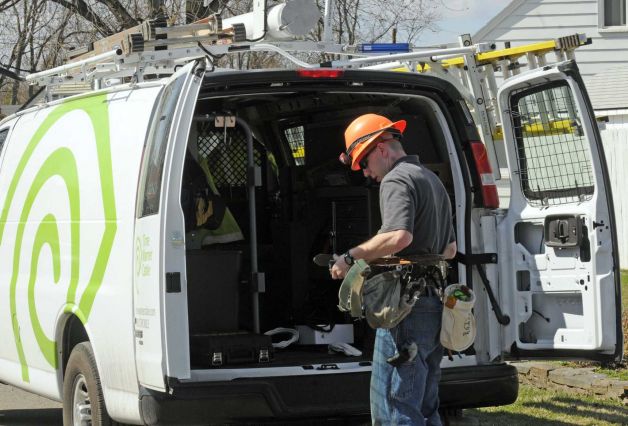

Welcome to the world of broadband have’s and have-nots. If you live in the county seat — Troy, Internet access is widely available. But if you live in a community like Nassau, in the southern part of the county, getting Internet access is strictly a hit or miss affair, and in practical terms, the only entity that will decide if you have reasonable access to broadband is Time Warner Cable.

Verizon has decided that the days of expanding DSL in rural areas are over. There is no possibility those without access to DSL now will ever see Verizon’s fiber network FiOS coming their way either. That has left many residents with an unfortunate choice between heavily usage-capped and slow satellite Internet access or heavily usage-capped and expensive wireless Internet from a cell phone company.

Nassau does have a franchise agreement with Time Warner Cable, the only cable operator willing to offer service in this part of upstate New York. The contract specifies Time Warner will bring service to any neighborhood where there are at least 20 residences within a one-mile radius.

The Record News covered negotiations for a franchise renewal for the cable company last year, and found Time Warner Cable held all the cards and the town had almost no leverage in the negotiations:

A rare sight in southern Renssalear County.

A rare sight in southern Rensselaer County.

“We really have no negotiating leverage or power and the Public Service Commission (PSC) was helpful in looking at the contract, but told us we were basically out of luck with any efforts to require anything,” said town Supervisor David Fleming, who said he was told by Time Warner Cable that specific areas in Nassau are “not currently serviceable.”

The town had marked out all the areas that were not served and met with Time Warner to try to gain extensions of service.

“This only succeeded in a couple of areas,” he said. “This is because PSC told us we have no bargaining power. The only big concession we were able to get was to reduce the number of houses per mile needed for service, but this was a pretty standard fall back for Time Warner.”

The town succeeded in negotiating standards down to 20 dwellings per cable mile from 30. “We continue to explore this matter, but frankly, there has been a great deal of unwillingness to expand service in our community,” Fleming said. “The state has been of no help in expanding services.”

As a result, Time Warner has been generally adamant about not expanding service to residents like Alan Austin, who lives on a street where 11 houses are built within a half-mile, technically the same ratio required by Time Warner Cable.

Rensselaer sign“We’ve asked them to bring the service and they won’t,” Austin told the newspaper.

Actually, Time Warner is willing to expand into Austin’s neighborhood — for the right price.

Time Warner agreed it would install cable service if the 11 homes collectively paid a $12,000 installation fee.

“We’re out of luck because we’re never going to get another nine houses in this mile,” Austin said. “We can’t get anybody to bring service here, unless we’re willing to pay an exorbitant amount.”

As for alternatives, don’t call Verizon, they’ll call you. The phone company has suggested rural residents consider their wireless broadband and phone service, assuming a cell tower can reach them with a reasonable signal. But the cost is very high — at least $50 for only 4GB of usage per month and another $20 for telephone service.

Austin is lucky enough to receive some reception from Sprint, which is slightly more reasonably priced. But to get a reliable signal, he has to place his mobile Wi-Fi hotspot in his non-climate-controlled attic. When temperatures fall or soar, the hotspot stops working. Austin has rigged a remote-powered fan in the attic to blow cool air on the hotspot this summer to keep it up and running.

“It’s ridiculous,” he admitted. “People don’t believe me when I tell them these things, but that’s what we deal with.”

The newspaper also pondered the impact of being an Internet have-not with respect to education. In more than a few communities in the county, teachers avoid giving assignments that require students to do research over the Internet, putting them at a potentially serious disadvantage when they attend college.

Businesses also avoid areas where broadband poses a significant challenge, which affects jobs. Selling a home in a broadband blackout zone can also be difficult as savvy buyers increasingly now insist on Internet accessibility.

Without the benefit of bundling discounts, rural Americans pay substantially higher prices for telecommunications services. A promotional bundle from Time Warner Cable can provide phone, Internet, and television service for less than $100 a month. Austin says his package costs more than twice that — more than $220 monthly between paying bills for Verizon phone service, DirectTV television and Sprint for broadband Internet.

These kinds of challenges are ready-made to be addressed on the local government level, but cable and phone companies lobbied successfully for near-total deregulation, making it impossible for town officials to provoke change. In fact, had the community successfully revoked Time Warner Cable’s franchise, no other commercial provider would be willing to step in. That remains common in every community considering its future relationship with the area’s cable company. An informal understanding between cable operators keep them from competing outside of their defined territories.

That leaves Nassau officials with no options, except whether to renew Time Warner’s franchise on the company’s terms for five or ten years. Time Warner wouldn’t hear of a five-year contract so the town capitulated and agreed to a 10-year franchise renewal that will continue to leave residents like Austin without much hope for cable broadband service indefinitely.

And the Winner Is… United Arab Emirates Now the World Leader in Fiber to the Home Broadband

fiberThe United Arab Emirates leads the world with the highest penetration of fiber-to-the-home broadband service.

At least 85 percent of all homes in the UAE today rely on fiber broadband, according to research by the Fiber to the Home Council.

The UAE’s love for fiber broadband comes from the country’s aggressive government-directed infrastructure and services modernization plan as part of the Emirates’ transformation into the 21st century knowledge economy.

In the UAE, e-commerce, e-government, e-education, and e-health are pervasive, allowing residents instant access to government, commercial, health and educational services. Only fiber broadband had the capacity to handle both the broadband traffic today and sustain the rapid expansion of bandwidth required tomorrow.

The country relies on fiber networks to power smart electricity service, cell towers, wireless data, and various electronic payment systems, which allow consumers to use a single smart card to pass through immigration at airports with biometric authentication, as well as pay for everything from food to traffic fines, utility bills, or even zakat (charitable giving by Muslims).

The two national broadband providers — du and Etisalat, both invested heavily in fiber infrastructure with a goal of connecting every home and business to their competing fiber networks.

uaeSubscription rates in the next-biggest markets — South Korea, Hong Kong, Japan, Singapore, and Taiwan — range from 63 percent to 37 percent, the council notes. In comparison, the United States trails dismally with just 7.62% of Americans signed up for fiber to the home service and Canada’s fiber numbers still too negligible to rate, with only Atlantic Canada seeing widespread fiber deployments.

This leaves North America rapidly falling behind in the race to build next generation fiber broadband networks.

Speaking at the ITU’s recent World Telecommunication Development Conference, the council’s chairman, Dr. Suleiman Al Hedaithy noted that “fiber connections are available to more than 200 million homes globally — a tenth of all the households in the world,” adding that of these homes, “an estimated 107 million households subscribe to fiber-based services.”

Across the Middle East and North Africa, “more than 1.5 million households are using FTTH service,” Al Hedaithy added, with the UAE “ranked number one in FTTH penetration rate globally, for the past two consecutive years.”

In comparison, only 8.7 million Americans subscribe to fiber service.

Etisalat has invested $5.17 billion in fiber upgrades inside the UAE.

Living the eLife with fiber to the home service in the UAE.

Living the eLife with fiber to the home service in the UAE.

Last year, the total length of the UAE’s fiber network was equal to “five times the distance between the Earth and the moon, consisting of a total of 2.8 million kilometers of cable being deployed all over the country,” Etisalat CEO Saleh Al Abdooli said.

Elsewhere across the region:

  • Saudi Arabia’s ambitious fiber to the home projects reached 38% of households by the end of 2013;
  • Qatar will approach 100% fiber coverage by the end of 2015;
  • The next growth areas in regional fiber network construction will be in Egypt, Algeria, and Kuwait;
  • The fastest speed fiber networks offering 100+Mbps are in Bahrain, Jordan, Qatar, Saudi Arabia, and the UAE;
  • There is no relevant development of fiber networks in Libya, Sudan, Syria, Yemen or the Palestinian territories.

“The future,” according to Christine Beylouni, director general at the FTTH Council Middle East & North Africa, “is definitely fiber to the home.”

Search This Site:

Contributions:

Recent Comments:

Your Account:

Stop the Cap!
